The position is this:
Facilities in services (eg changing rooms in leisure centres, public toilets) can be provided on a single-sex basis under Sch 3 §§26-27 of the Equality Act 2010. There are various conditions in Sch 3 that have to be met, including that the service is.../1
a proportionate means of achieving a legitimate aim. The EA doesn’t say that services have to provide single-sex facilities, but it might be direct or indirect discrimination against women to fail to provide them, depending on the facts.../2
The relevant parts of the revised Code of Practice are essentially about how Sch 3 EA works. But Sch 3 EA doesn’t cover workplaces. They are subject to the Workplace (Health, Safety & Welfare) Regulations 1992, which require workers to be provided with toilets and, where.../3
appropriate, washing and changing facilities on either a single-sex basis or in separate lockable single user rooms. Alongside that, the ordinary rules of sex discrimination and gender reassignment discrimination apply to workplaces.../4
There are numerous possible discrimination claims that can be brought about an employer’s failure to make appropriate provision for women, men and trans people.
It would be a serious mistake to try to apply Sch 3 EA to a workplace situation. You would get the law wrong.
/end
• • •
Missing some Tweet in this thread? You can try to
force a refresh

I expect the misleading headline and first para of this article to be urgently corrected. Trans people's rights haven't been reduced and I didn't at any time say that they had. I said that trans people have been lied to about what their rights are.
@GreenJennyJones @soniasodha @ForWomenScot @MForstater @carla_denyer 🧵It’s an inevitable consequence of the judgment.
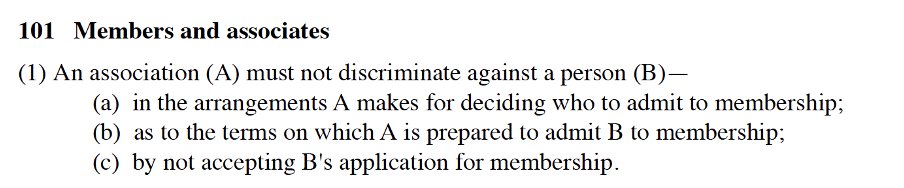
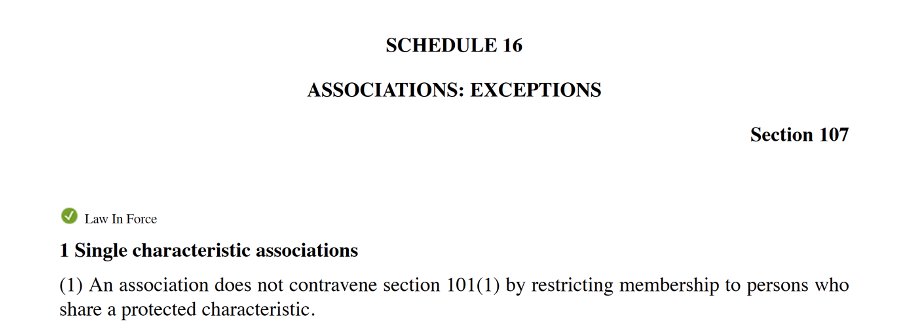
In general an association mustn’t discriminate against a person by depriving them of membership because of a protected characteristic: s.101(1). So eg a reading group can’t say “no disabled people” /1
@GreenJennyJones @soniasodha @ForWomenScot @MForstater @carla_denyer But there’s an exception which says that an association can be limited to people who share a protected characteristic: Sch 16 para 1. Thus an association can be limited to women, disabled people, older people, black people etc /2
@GreenJennyJones @soniasodha @ForWomenScot @MForstater @carla_denyer An association can combine protected characteristics as long as it’s for people who all have the same two (or more) PCs: lesbian women, black men, young Asian disabled people etc. This way, everybody in the club falls within both/all the PCs /3
There are several concerning legal inaccuracies in this piece by barrister Sam Fowles about yesterday’s landmark #SupremeCourt decision in For Women Scotland v The Scottish Ministers 🧵⬇️ theguardian.com/commentisfree/…
1. The decision does not leave the legal rights of women untouched and nor does it make the legal landscape more complex. Quite the reverse on both counts.
2. This was not “simple”. Before yesterday the classes of woman in the EA were understood to be (1) women and girls (2) transmen without GRCs (3) transwomen with GRCs (4) for the purposes of the maternity discrimination provisions, transmen with GRCs
This report is an interesting contribution to the debate on free speech in higher education. There’s quite a lot I disagree with – a few initial thoughts in 🧵⬇️. For more lively debate on this subject don’t forget to sign up for the @officestudents#OfSInsight event next week!
My thoughts on the report (first reading): 1. The report has a lot of useful and important information about the rights of protestors to freedom of expression. This is certainly an area that higher education institutions must pay attention to. However…