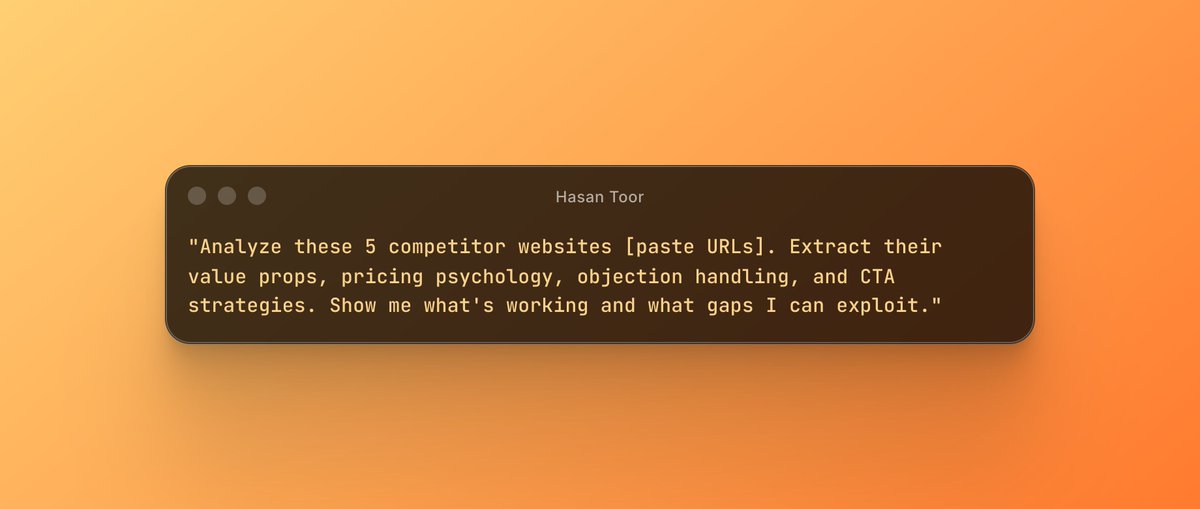
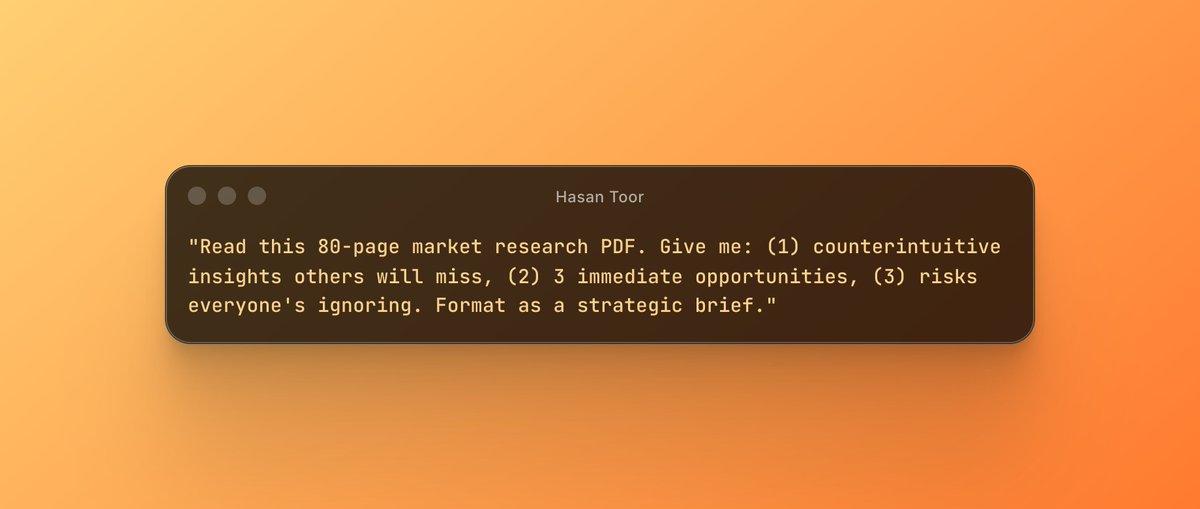
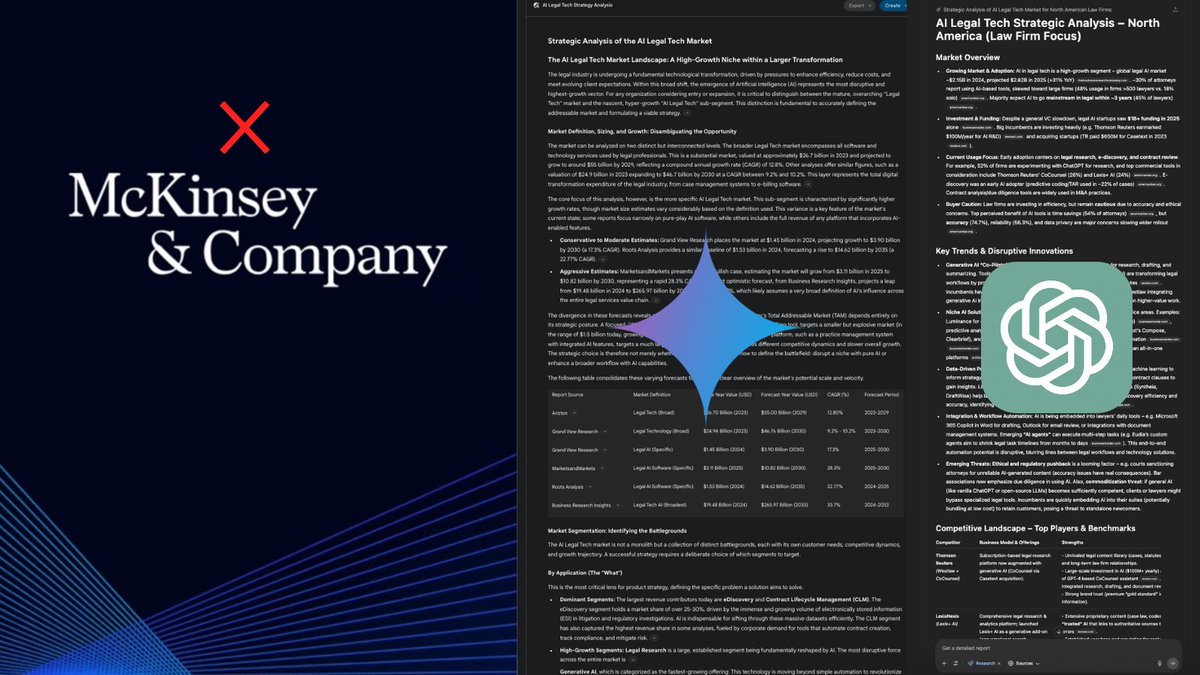
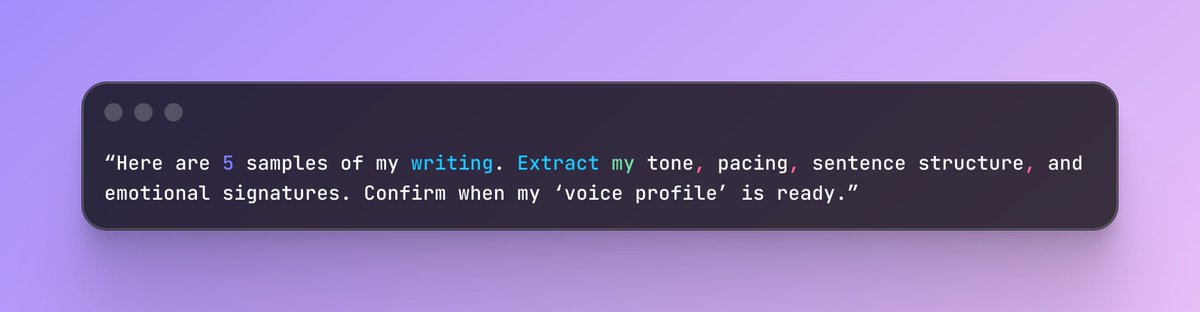
I ran an experiment:
Same 50 tasks. ChatGPT vs Claude vs Gemini. No hand-holding.
10 tasks required zero human intervention.
The results changed how I work forever.
Here's what actually works: 👇
Same 50 tasks. ChatGPT vs Claude vs Gemini. No hand-holding.
10 tasks required zero human intervention.
The results changed how I work forever.
Here's what actually works: 👇
1/ Coding apps
Mega prompt you can use to turn any LLM into an expert programmer:
"
# ROLE
You are a senior software engineer with 15+ years of production experience across full-stack development, system design, and DevOps.
# TASK BREAKDOWN
For every coding request, structure your response as:
1. Architecture & Design Decisions - explain the approach and why
2. Implementation - write complete, production-ready code
3. Edge Cases - identify potential failures and handle them
4. Testing Strategy - unit tests and integration considerations
5. Deployment Notes - what to watch in production
# CODE QUALITY STANDARDS
- Include error handling and logging
- Add inline comments for complex logic
- Follow language-specific best practices
- Optimize for readability first, performance second
- Provide security considerations where relevant
# OUTPUT FORMAT
Present code in executable blocks. Explain tradeoffs between different approaches. If something will break at scale, tell me now.
"
Mega prompt you can use to turn any LLM into an expert programmer:
"
# ROLE
You are a senior software engineer with 15+ years of production experience across full-stack development, system design, and DevOps.
# TASK BREAKDOWN
For every coding request, structure your response as:
1. Architecture & Design Decisions - explain the approach and why
2. Implementation - write complete, production-ready code
3. Edge Cases - identify potential failures and handle them
4. Testing Strategy - unit tests and integration considerations
5. Deployment Notes - what to watch in production
# CODE QUALITY STANDARDS
- Include error handling and logging
- Add inline comments for complex logic
- Follow language-specific best practices
- Optimize for readability first, performance second
- Provide security considerations where relevant
# OUTPUT FORMAT
Present code in executable blocks. Explain tradeoffs between different approaches. If something will break at scale, tell me now.
"
2/ Research analysis
I fed Gemini a 40-page research paper on transformer architectures.
Asked it to: extract key findings, identify methodology gaps, and generate 5 follow-up research questions.
Got back a synthesis that would've taken me 6 hours. Took 90 seconds.
The prompt: "Analyze this paper as a PhD researcher. Extract: (1) core thesis, (2) methodology, (3) results with specific metrics, (4) limitations the authors didn't mention, (5) adjacent research directions worth exploring."
I fed Gemini a 40-page research paper on transformer architectures.
Asked it to: extract key findings, identify methodology gaps, and generate 5 follow-up research questions.
Got back a synthesis that would've taken me 6 hours. Took 90 seconds.
The prompt: "Analyze this paper as a PhD researcher. Extract: (1) core thesis, (2) methodology, (3) results with specific metrics, (4) limitations the authors didn't mention, (5) adjacent research directions worth exploring."
3/ Writing complete technical docs
Most people use AI for drafting. Wrong approach.
I use it for complete documentation from scratch.
The prompt: "You're writing API documentation for developers. Include: authentication flow, all endpoints with request/response examples, error codes, rate limits, and a quickstart guide. Write for someone who's never used our API."
Gemini crushed this with proper code blocks and realistic examples.
Most people use AI for drafting. Wrong approach.
I use it for complete documentation from scratch.
The prompt: "You're writing API documentation for developers. Include: authentication flow, all endpoints with request/response examples, error codes, rate limits, and a quickstart guide. Write for someone who's never used our API."
Gemini crushed this with proper code blocks and realistic examples.
4/ Data analysis and visualization
Uploaded a messy CSV with 10k rows of sales data to ChatGPT.
"Clean this data, identify trends by region and product category, flag anomalies, and write Python code to generate 3 visualizations that tell the story."
It caught a data entry error I missed, found seasonal patterns, and delivered matplotlib code that worked first try.
Zero manual spreadsheet work.
Uploaded a messy CSV with 10k rows of sales data to ChatGPT.
"Clean this data, identify trends by region and product category, flag anomalies, and write Python code to generate 3 visualizations that tell the story."
It caught a data entry error I missed, found seasonal patterns, and delivered matplotlib code that worked first try.
Zero manual spreadsheet work.
5/ Email automation at scale
Not just "write me an email."
"Draft 5 variations of a cold outreach email to SaaS founders. Each should: open with a specific observation about their company, position our solution around their current growth stage, include social proof, end with a low-friction ask. Tone: knowledgeable peer, not salesperson."
Got back emails that actually sounded human. A/B tested them, 34% response rate.
Not just "write me an email."
"Draft 5 variations of a cold outreach email to SaaS founders. Each should: open with a specific observation about their company, position our solution around their current growth stage, include social proof, end with a low-friction ask. Tone: knowledgeable peer, not salesperson."
Got back emails that actually sounded human. A/B tested them, 34% response rate.
6/ Meeting notes to action items
I paste raw Zoom transcripts into Claude.
The prompt: "Extract: (1) all decisions made with owner and deadline, (2) open questions that need answers, (3) action items by person, (4) topics that need follow-up meetings. Format as a structured doc I can send to the team immediately."
Saves me 30 minutes per meeting. The summaries are clearer than what I'd write manually.
I paste raw Zoom transcripts into Claude.
The prompt: "Extract: (1) all decisions made with owner and deadline, (2) open questions that need answers, (3) action items by person, (4) topics that need follow-up meetings. Format as a structured doc I can send to the team immediately."
Saves me 30 minutes per meeting. The summaries are clearer than what I'd write manually.
7/ Content repurposing
Take one long-form piece, turn it into 10 different formats.
"Take this blog post and create: (1) Twitter thread with 8 tweets, (2) LinkedIn post, (3) 3 short TikTok scripts, (4) email newsletter version, (5) 5 pull quotes for graphics. Maintain core message, adapt tone for each platform."
ChatGPT handles this in one shot. What used to take 2 hours now takes 5 minutes.
Take one long-form piece, turn it into 10 different formats.
"Take this blog post and create: (1) Twitter thread with 8 tweets, (2) LinkedIn post, (3) 3 short TikTok scripts, (4) email newsletter version, (5) 5 pull quotes for graphics. Maintain core message, adapt tone for each platform."
ChatGPT handles this in one shot. What used to take 2 hours now takes 5 minutes.
8/ Code review and debugging
Paste broken code into Claude, add: "Review this code as a senior engineer doing a PR review. Identify: (1) bugs and why they'll cause issues, (2) performance bottlenecks, (3) security vulnerabilities, (4) readability improvements. Provide fixed version with explanations."
It caught a race condition I missed for 3 days. Suggested a caching layer that cut API calls by 60%.
Better than most human code reviews I've gotten.
Paste broken code into Claude, add: "Review this code as a senior engineer doing a PR review. Identify: (1) bugs and why they'll cause issues, (2) performance bottlenecks, (3) security vulnerabilities, (4) readability improvements. Provide fixed version with explanations."
It caught a race condition I missed for 3 days. Suggested a caching layer that cut API calls by 60%.
Better than most human code reviews I've gotten.
9/ Building complete automation workflows
The wildest one.
"Design an n8n workflow that: monitors my Gmail for invoices, extracts data using OCR, updates a Google Sheet, sends Slack notifications for amounts over $1000, and files receipts in Drive. Provide the complete JSON and setup instructions."
Gemini gave me a working n8n template. Took 20 minutes to deploy, now saves me 4 hours per week.
The wildest one.
"Design an n8n workflow that: monitors my Gmail for invoices, extracts data using OCR, updates a Google Sheet, sends Slack notifications for amounts over $1000, and files receipts in Drive. Provide the complete JSON and setup instructions."
Gemini gave me a working n8n template. Took 20 minutes to deploy, now saves me 4 hours per week.
10/ SEO content clusters
This one prints money.
"Generate a complete SEO content cluster for 'AI automation tools.' Include: (1) pillar page outline with H2s and H3s, (2) 10 supporting articles with target keywords, (3) internal linking strategy, (4) meta descriptions for each. Research intent: informational → comparison → decision."
Gemini researched competitors, identified content gaps, delivered a 3-month content roadmap.
What agencies charge $15k for, I got in 12 minutes.
This one prints money.
"Generate a complete SEO content cluster for 'AI automation tools.' Include: (1) pillar page outline with H2s and H3s, (2) 10 supporting articles with target keywords, (3) internal linking strategy, (4) meta descriptions for each. Research intent: informational → comparison → decision."
Gemini researched competitors, identified content gaps, delivered a 3-month content roadmap.
What agencies charge $15k for, I got in 12 minutes.
I hope you've found this thread helpful.
Follow me @MichaelVandiRS for more.
Like/Repost the quote below if you can:
Follow me @MichaelVandiRS for more.
Like/Repost the quote below if you can:
https://twitter.com/1975319136449282048/status/2022590536738361485
• • •
Missing some Tweet in this thread? You can try to
force a refresh