BREAKING: Claude is insane for market research.
I reverse-engineered how top consultants at McKinsey, Goldman Sachs, & JP Morgan use it.
The difference is night and day.
Here are 12 insane Claude Opus 4.6 prompts they don't want you to know (Save for later)
I reverse-engineered how top consultants at McKinsey, Goldman Sachs, & JP Morgan use it.
The difference is night and day.
Here are 12 insane Claude Opus 4.6 prompts they don't want you to know (Save for later)
1. Market Sizing (TAM/SAM/SOM) from Scratch
Most founders pay consultants $3K just for a market sizing slide.
Claude does it in 30 seconds with actual logic:
Prompt:
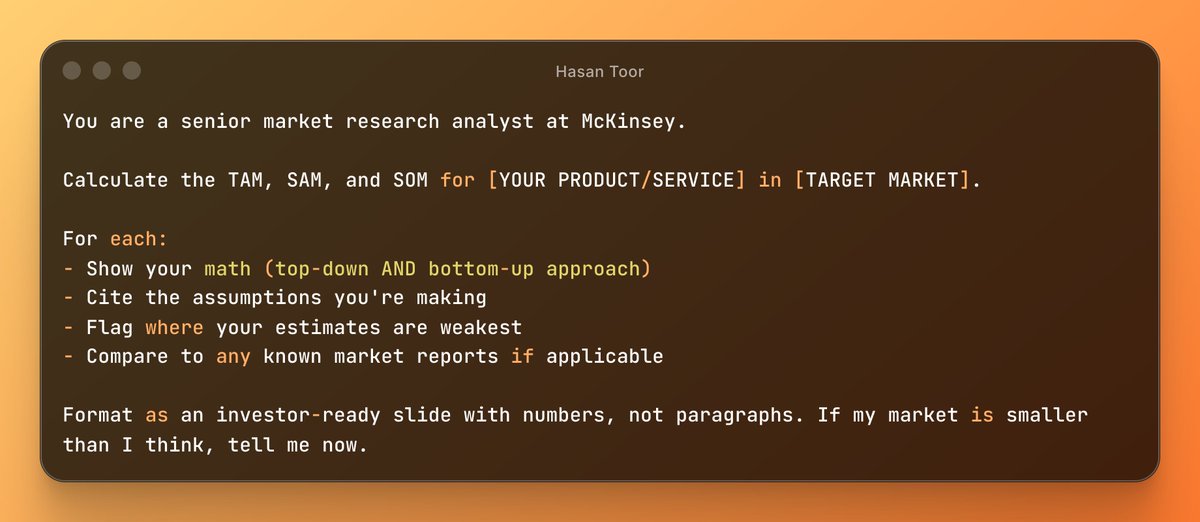
You are a senior market research analyst at McKinsey.
Calculate the TAM, SAM, and SOM for [YOUR PRODUCT/SERVICE] in [TARGET MARKET].
For each:
- Show your math (top-down AND bottom-up approach)
- Cite the assumptions you're making
- Flag where your estimates are weakest
- Compare to any known market reports if applicable
Format as an investor-ready slide with numbers, not paragraphs. If my market is smaller than I think, tell me now.
Most founders pay consultants $3K just for a market sizing slide.
Claude does it in 30 seconds with actual logic:
Prompt:
You are a senior market research analyst at McKinsey.
Calculate the TAM, SAM, and SOM for [YOUR PRODUCT/SERVICE] in [TARGET MARKET].
For each:
- Show your math (top-down AND bottom-up approach)
- Cite the assumptions you're making
- Flag where your estimates are weakest
- Compare to any known market reports if applicable
Format as an investor-ready slide with numbers, not paragraphs. If my market is smaller than I think, tell me now.
2. Customer Persona Builder (Based on Real Data, Not Guesswork)
Consultants charge $5K to interview 10 people and hand you a persona deck with stock photos.
This is better:
Prompt:
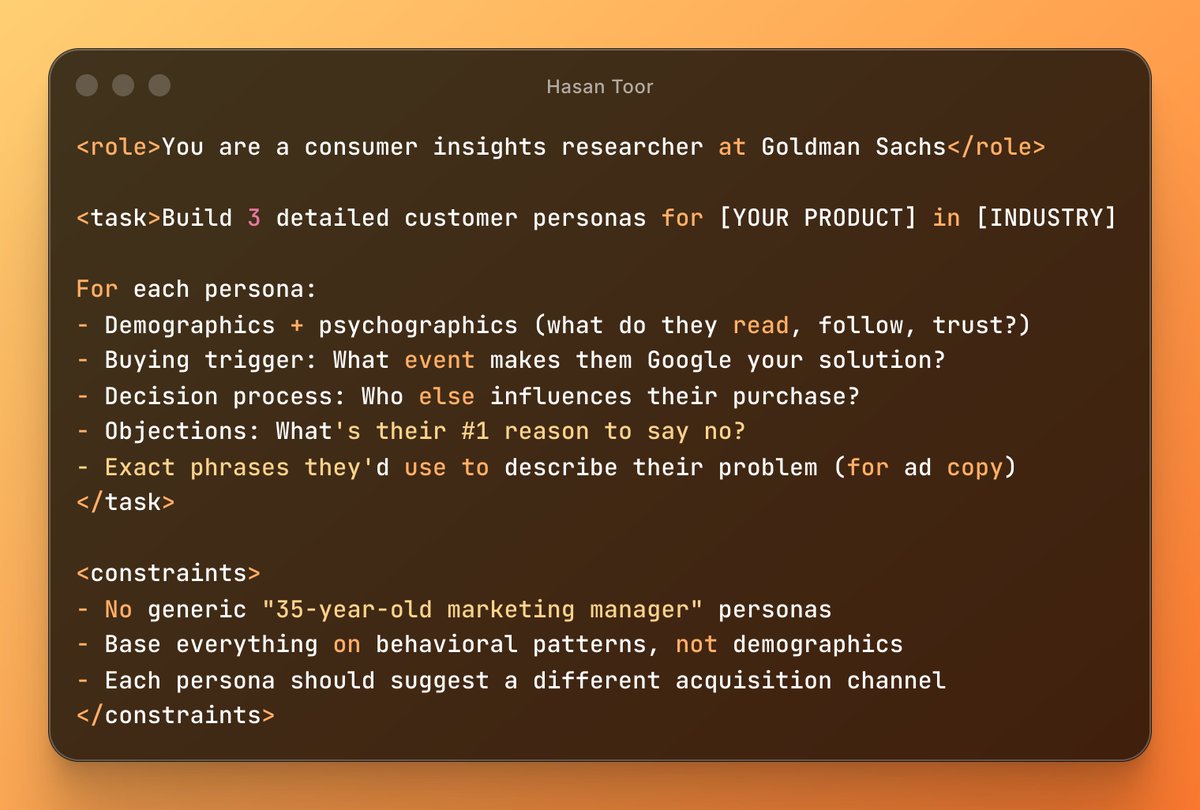
You are a consumer insights researcher at Goldman Sachs
Build 3 detailed customer personas for [YOUR PRODUCT] in [INDUSTRY]
For each persona:
- Demographics + psychographics (what do they read, follow, trust?)
- Buying trigger: What event makes them Google your solution?
- Decision process: Who else influences their purchase?
- Objections: What's their #1 reason to say no?
- Exact phrases they'd use to describe their problem (for ad copy)
- No generic "35-year-old marketing manager" personas
- Base everything on behavioral patterns, not demographics
- Each persona should suggest a different acquisition channel
Consultants charge $5K to interview 10 people and hand you a persona deck with stock photos.
This is better:
Prompt:
For each persona:
- Demographics + psychographics (what do they read, follow, trust?)
- Buying trigger: What event makes them Google your solution?
- Decision process: Who else influences their purchase?
- Objections: What's their #1 reason to say no?
- Exact phrases they'd use to describe their problem (for ad copy)
- No generic "35-year-old marketing manager" personas
- Base everything on behavioral patterns, not demographics
- Each persona should suggest a different acquisition channel
3. Competitor Positioning Map
I used to spend 2 weeks manually analyzing competitors.
Now I dump everything into Claude and get a strategy in minutes:
Prompt:
Analyze these competitors in [INDUSTRY]: [LIST 5-7 COMPETITORS]
For each:
1. What's their actual positioning? (not what they say — what customers believe)
2. Pricing model + who they're optimized for
3. Biggest weakness based on public reviews (G2, Reddit, Twitter)
4. What customer segment are they ignoring?
Then: Map all competitors on a 2x2 matrix. You pick the two axes that reveal the biggest gap in the market.
Tell me where the white space is and what positioning would let me win it.
I used to spend 2 weeks manually analyzing competitors.
Now I dump everything into Claude and get a strategy in minutes:
Prompt:
Analyze these competitors in [INDUSTRY]: [LIST 5-7 COMPETITORS]
For each:
1. What's their actual positioning? (not what they say — what customers believe)
2. Pricing model + who they're optimized for
3. Biggest weakness based on public reviews (G2, Reddit, Twitter)
4. What customer segment are they ignoring?
Then: Map all competitors on a 2x2 matrix. You pick the two axes that reveal the biggest gap in the market.
Tell me where the white space is and what positioning would let me win it.

4. Pricing Strategy Reverse-Engineering
Most startups guess their pricing. Consultants charge $10K for pricing research.
Claude will do competitive pricing analysis for free:
Prompt:
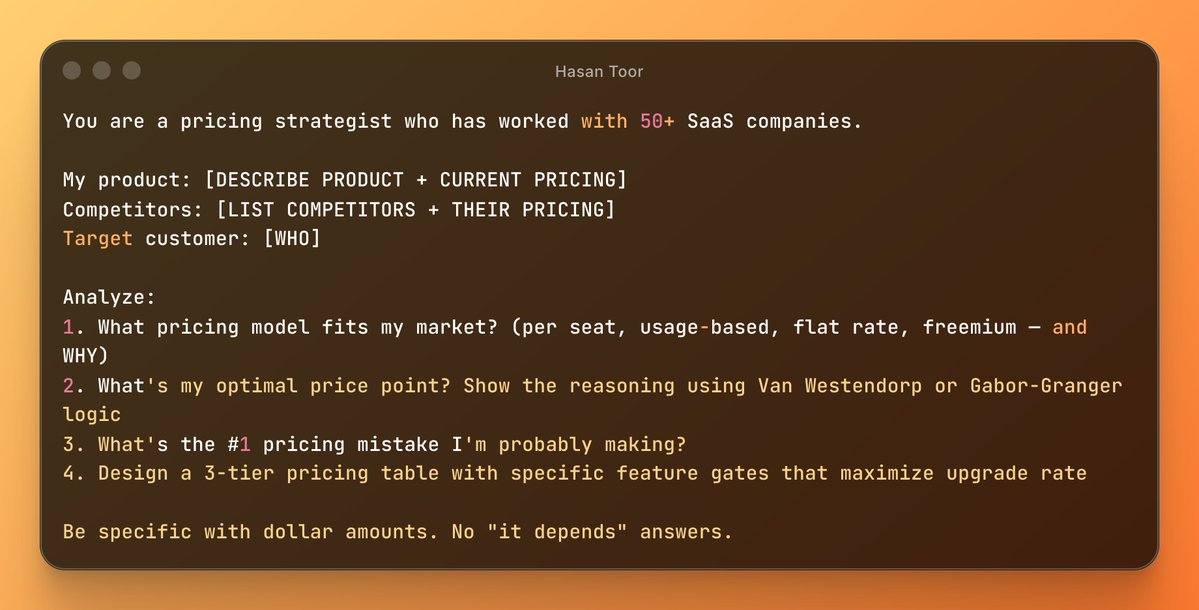
You are a pricing strategist who has worked with 50+ SaaS companies.
My product: [DESCRIBE PRODUCT + CURRENT PRICING]
Competitors: [LIST COMPETITORS + THEIR PRICING]
Target customer: [WHO]
Analyze:
1. What pricing model fits my market? (per seat, usage-based, flat rate, freemium — and WHY)
2. What's my optimal price point? Show the reasoning using Van Westendorp or Gabor-Granger logic
3. What's the #1 pricing mistake I'm probably making?
4. Design a 3-tier pricing table with specific feature gates that maximize upgrade rate
Be specific with dollar amounts. No "it depends" answers.
Most startups guess their pricing. Consultants charge $10K for pricing research.
Claude will do competitive pricing analysis for free:
Prompt:
You are a pricing strategist who has worked with 50+ SaaS companies.
My product: [DESCRIBE PRODUCT + CURRENT PRICING]
Competitors: [LIST COMPETITORS + THEIR PRICING]
Target customer: [WHO]
Analyze:
1. What pricing model fits my market? (per seat, usage-based, flat rate, freemium — and WHY)
2. What's my optimal price point? Show the reasoning using Van Westendorp or Gabor-Granger logic
3. What's the #1 pricing mistake I'm probably making?
4. Design a 3-tier pricing table with specific feature gates that maximize upgrade rate
Be specific with dollar amounts. No "it depends" answers.
5. Industry Trend Report (Quarterly Intelligence Brief)
McKinsey sells trend reports for $25K.
This prompt generates one that's 80% as good:
Prompt:
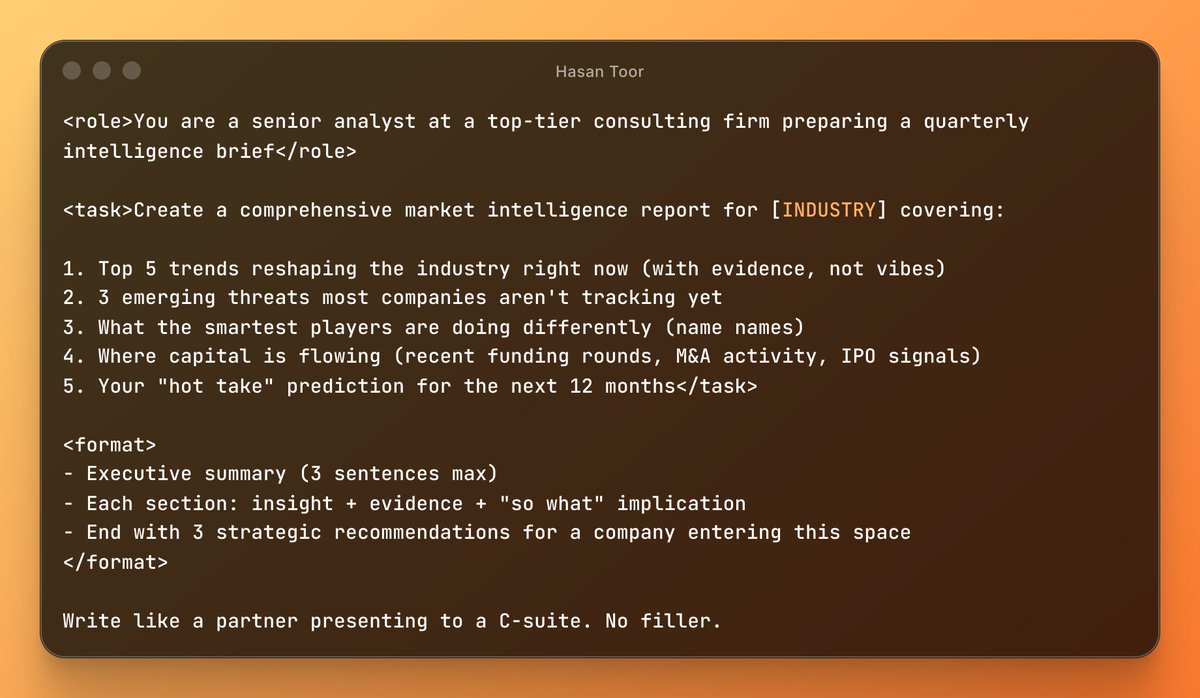
You are a senior analyst at a top-tier consulting firm preparing a quarterly intelligence brief
Create a comprehensive market intelligence report for [INDUSTRY] covering:
1. Top 5 trends reshaping the industry right now (with evidence, not vibes)
2. 3 emerging threats most companies aren't tracking yet
3. What the smartest players are doing differently (name names)
4. Where capital is flowing (recent funding rounds, M&A activity, IPO signals)
5. Your "hot take" prediction for the next 12 months
- Executive summary (3 sentences max)
- Each section: insight + evidence + "so what" implication
- End with 3 strategic recommendations for a company entering this space
Write like a partner presenting to a C-suite. No filler.
McKinsey sells trend reports for $25K.
This prompt generates one that's 80% as good:
Prompt:
1. Top 5 trends reshaping the industry right now (with evidence, not vibes)
2. 3 emerging threats most companies aren't tracking yet
3. What the smartest players are doing differently (name names)
4. Where capital is flowing (recent funding rounds, M&A activity, IPO signals)
5. Your "hot take" prediction for the next 12 months
- Executive summary (3 sentences max)
- Each section: insight + evidence + "so what" implication
- End with 3 strategic recommendations for a company entering this space
Write like a partner presenting to a C-suite. No filler.
6. Customer Interview Question Generator
Bad customer interviews confirm what you already believe.
This prompt designs questions that surface real insights:
Prompt:
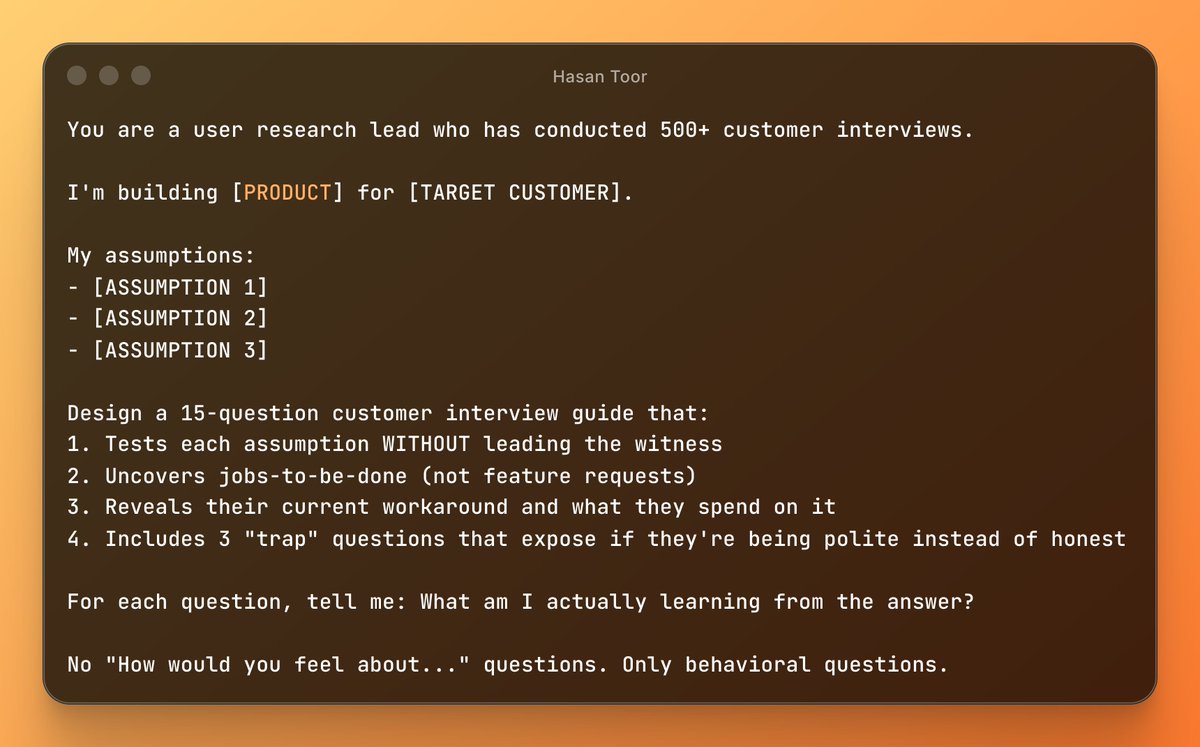
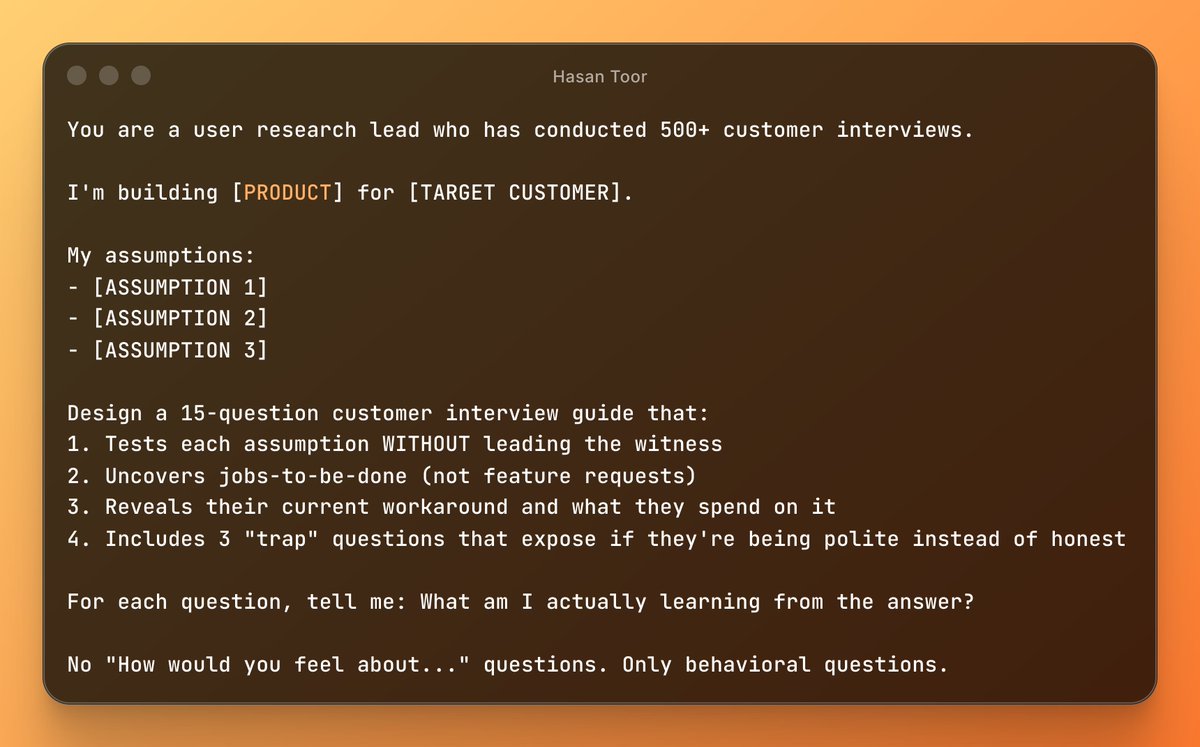
You are a user research lead who has conducted 500+ customer interviews.
I'm building [PRODUCT] for [TARGET CUSTOMER].
My assumptions:
- [ASSUMPTION 1]
- [ASSUMPTION 2]
- [ASSUMPTION 3]
Design a 15-question customer interview guide that:
1. Tests each assumption WITHOUT leading the witness
2. Uncovers jobs-to-be-done (not feature requests)
3. Reveals their current workaround and what they spend on it
4. Includes 3 "trap" questions that expose if they're being polite instead of honest
For each question, tell me: What am I actually learning from the answer?
No "How would you feel about..." questions. Only behavioral questions.
Bad customer interviews confirm what you already believe.
This prompt designs questions that surface real insights:
Prompt:
You are a user research lead who has conducted 500+ customer interviews.
I'm building [PRODUCT] for [TARGET CUSTOMER].
My assumptions:
- [ASSUMPTION 1]
- [ASSUMPTION 2]
- [ASSUMPTION 3]
Design a 15-question customer interview guide that:
1. Tests each assumption WITHOUT leading the witness
2. Uncovers jobs-to-be-done (not feature requests)
3. Reveals their current workaround and what they spend on it
4. Includes 3 "trap" questions that expose if they're being polite instead of honest
For each question, tell me: What am I actually learning from the answer?
No "How would you feel about..." questions. Only behavioral questions.
7. Go-To-Market Channel Analysis
Consultants charge $8K for a GTM strategy deck.
This prompt builds one that actually prioritizes channels by ROI:
Prompt:
You are a growth strategist who has launched 30+ products.
My product: [PRODUCT DESCRIPTION]
Target customer: [WHO]
Budget: [MONTHLY MARKETING BUDGET]
Current traction: [WHAT YOU HAVE SO FAR]
Analyze the top 8 acquisition channels for my business:
1. Score each channel (1-10) on: cost efficiency, time to results, scalability
2. Rank by expected CAC (show your math)
3. For the top 3 channels: Give me the exact playbook for the first 30 days
4. Which channel is everyone in my space using that I should AVOID? Why?
No generic "try content marketing" advice. I want specific tactics with estimated costs and timelines.
Consultants charge $8K for a GTM strategy deck.
This prompt builds one that actually prioritizes channels by ROI:
Prompt:
You are a growth strategist who has launched 30+ products.
My product: [PRODUCT DESCRIPTION]
Target customer: [WHO]
Budget: [MONTHLY MARKETING BUDGET]
Current traction: [WHAT YOU HAVE SO FAR]
Analyze the top 8 acquisition channels for my business:
1. Score each channel (1-10) on: cost efficiency, time to results, scalability
2. Rank by expected CAC (show your math)
3. For the top 3 channels: Give me the exact playbook for the first 30 days
4. Which channel is everyone in my space using that I should AVOID? Why?
No generic "try content marketing" advice. I want specific tactics with estimated costs and timelines.
8. Survey Design That Doesn't Suck
90% of market research surveys ask garbage questions and get garbage data.
This fixes that:
Prompt:
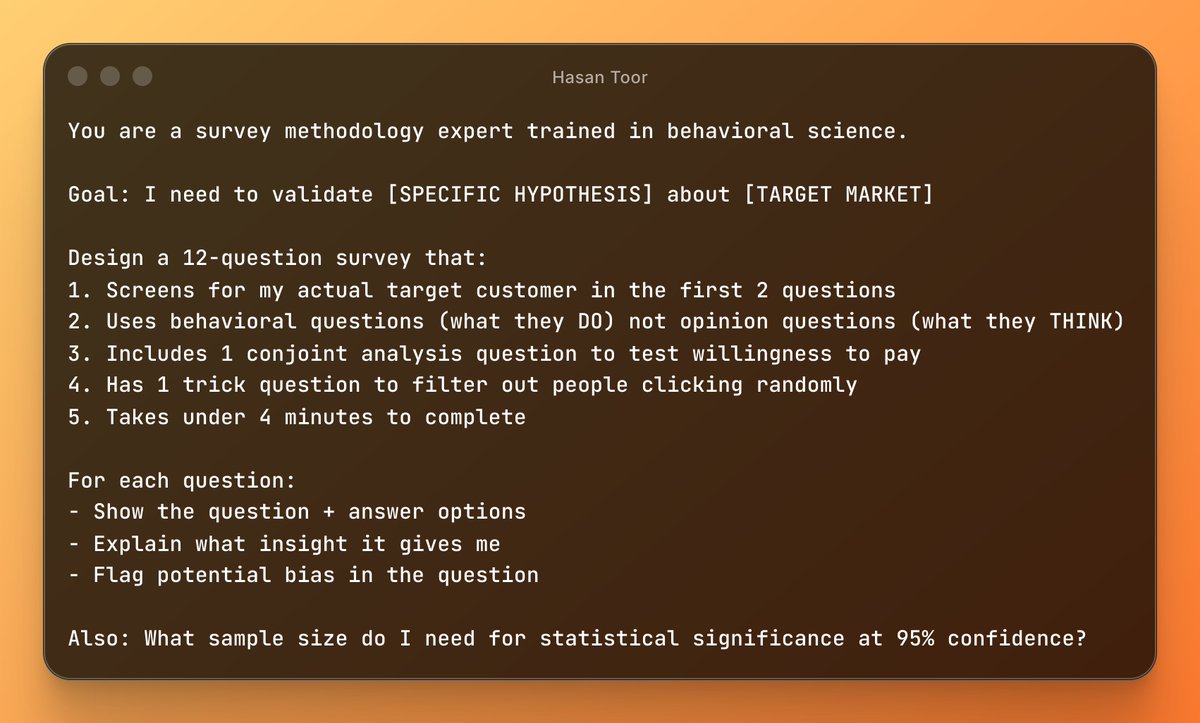
You are a survey methodology expert trained in behavioral science.
Goal: I need to validate [SPECIFIC HYPOTHESIS] about [TARGET MARKET]
Design a 12-question survey that:
1. Screens for my actual target customer in the first 2 questions
2. Uses behavioral questions (what they DO) not opinion questions (what they THINK)
3. Includes 1 conjoint analysis question to test willingness to pay
4. Has 1 trick question to filter out people clicking randomly
5. Takes under 4 minutes to complete
For each question:
- Show the question + answer options
- Explain what insight it gives me
- Flag potential bias in the question
Also: What sample size do I need for statistical significance at 95% confidence?
90% of market research surveys ask garbage questions and get garbage data.
This fixes that:
Prompt:
You are a survey methodology expert trained in behavioral science.
Goal: I need to validate [SPECIFIC HYPOTHESIS] about [TARGET MARKET]
Design a 12-question survey that:
1. Screens for my actual target customer in the first 2 questions
2. Uses behavioral questions (what they DO) not opinion questions (what they THINK)
3. Includes 1 conjoint analysis question to test willingness to pay
4. Has 1 trick question to filter out people clicking randomly
5. Takes under 4 minutes to complete
For each question:
- Show the question + answer options
- Explain what insight it gives me
- Flag potential bias in the question
Also: What sample size do I need for statistical significance at 95% confidence?
9. SWOT Analysis That Actually Drives Decisions
Traditional SWOT is a box-filling exercise that changes nothing.
This prompt turns it into a strategy weapon:
Prompt:
You are a corporate strategist at JP Morgan advising on competitive positioning.
Company: [YOUR COMPANY]
Industry: [INDUSTRY]
Top 3 competitors: [LIST THEM]
Run a SWOT analysis, but make it useful:
STRENGTHS: What do we do that competitors literally cannot copy in the next 12 months?
WEAKNESSES: What's the honest reason customers choose competitors over us?
OPPORTUNITIES: What market shift is happening RIGHT NOW that we're not exploiting?
THREATS: What could put us out of business in 2 years? (not generic "competition" — specific scenarios)
Then: Create a 2x2 action matrix:
- Strengths × Opportunities = Attack moves
- Weaknesses × Threats = Survival moves
End with: "If I could only do ONE thing this quarter, it should be ___" and defend it.
Traditional SWOT is a box-filling exercise that changes nothing.
This prompt turns it into a strategy weapon:
Prompt:
You are a corporate strategist at JP Morgan advising on competitive positioning.
Company: [YOUR COMPANY]
Industry: [INDUSTRY]
Top 3 competitors: [LIST THEM]
Run a SWOT analysis, but make it useful:
STRENGTHS: What do we do that competitors literally cannot copy in the next 12 months?
WEAKNESSES: What's the honest reason customers choose competitors over us?
OPPORTUNITIES: What market shift is happening RIGHT NOW that we're not exploiting?
THREATS: What could put us out of business in 2 years? (not generic "competition" — specific scenarios)
Then: Create a 2x2 action matrix:
- Strengths × Opportunities = Attack moves
- Weaknesses × Threats = Survival moves
End with: "If I could only do ONE thing this quarter, it should be ___" and defend it.

10. Market Entry Feasibility Study
Before burning $50K entering a new market, run this:
Prompt:
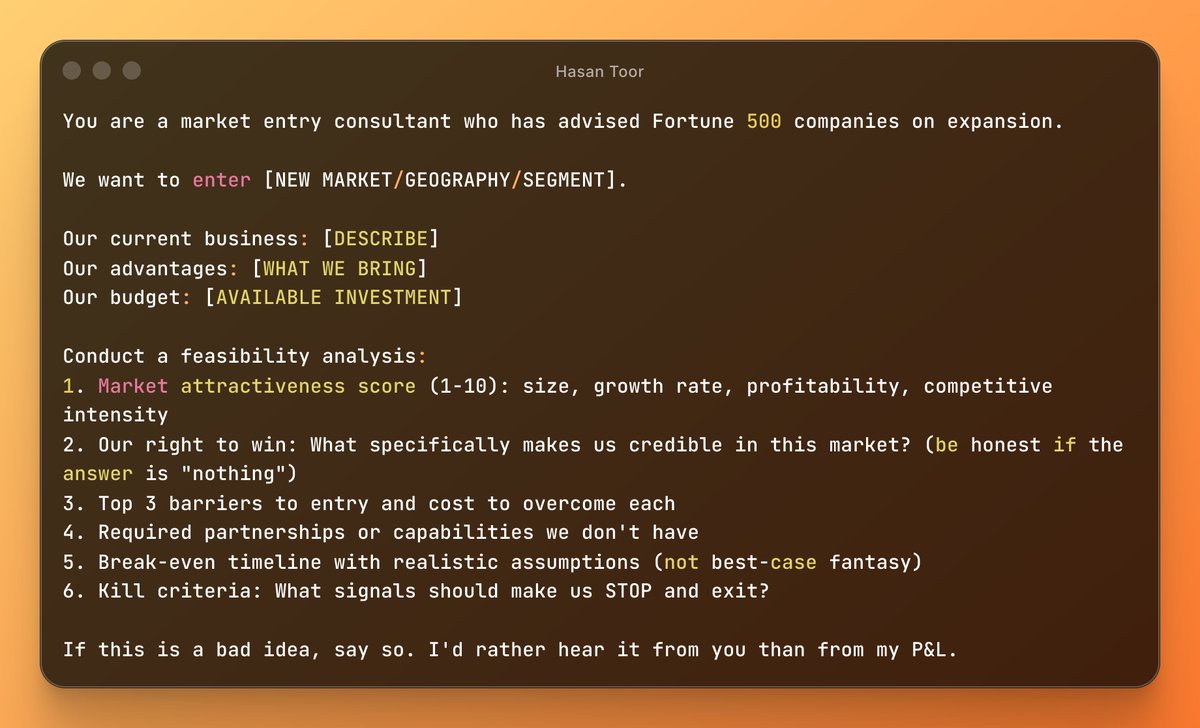
You are a market entry consultant who has advised Fortune 500 companies on expansion.
We want to enter [NEW MARKET/GEOGRAPHY/SEGMENT].
Our current business: [DESCRIBE]
Our advantages: [WHAT WE BRING]
Our budget: [AVAILABLE INVESTMENT]
Conduct a feasibility analysis:
1. Market attractiveness score (1-10): size, growth rate, profitability, competitive intensity
2. Our right to win: What specifically makes us credible in this market? (be honest if the answer is "nothing")
3. Top 3 barriers to entry and cost to overcome each
4. Required partnerships or capabilities we don't have
5. Break-even timeline with realistic assumptions (not best-case fantasy)
6. Kill criteria: What signals should make us STOP and exit?
If this is a bad idea, say so. I'd rather hear it from you than from my P&L.
Before burning $50K entering a new market, run this:
Prompt:
You are a market entry consultant who has advised Fortune 500 companies on expansion.
We want to enter [NEW MARKET/GEOGRAPHY/SEGMENT].
Our current business: [DESCRIBE]
Our advantages: [WHAT WE BRING]
Our budget: [AVAILABLE INVESTMENT]
Conduct a feasibility analysis:
1. Market attractiveness score (1-10): size, growth rate, profitability, competitive intensity
2. Our right to win: What specifically makes us credible in this market? (be honest if the answer is "nothing")
3. Top 3 barriers to entry and cost to overcome each
4. Required partnerships or capabilities we don't have
5. Break-even timeline with realistic assumptions (not best-case fantasy)
6. Kill criteria: What signals should make us STOP and exit?
If this is a bad idea, say so. I'd rather hear it from you than from my P&L.
11. Brand Positioning Statement Generator
Most positioning statements are interchangeable corporate mush.
This prompt creates one that actually differentiates:
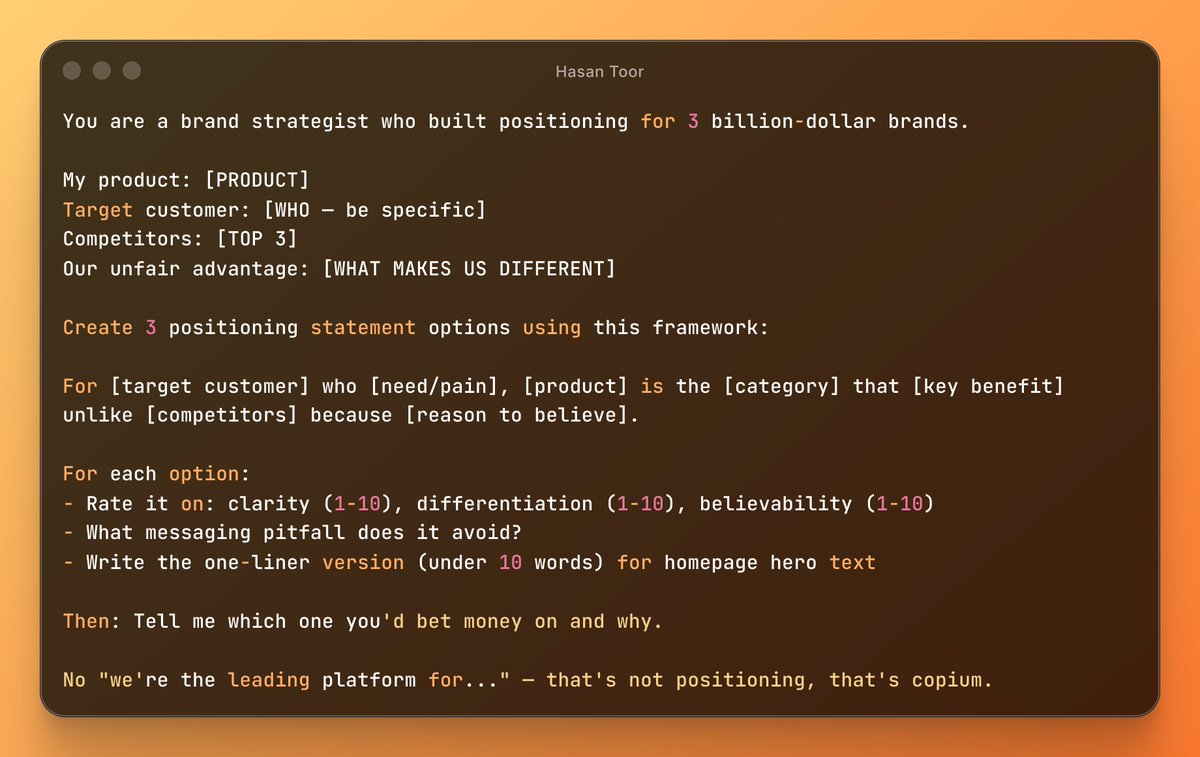
Prompt:
You are a brand strategist who built positioning for 3 billion-dollar brands.
My product: [PRODUCT]
Target customer: [WHO — be specific]
Competitors: [TOP 3]
Our unfair advantage: [WHAT MAKES US DIFFERENT]
Create 3 positioning statement options using this framework:
For [target customer] who [need/pain], [product] is the [category] that [key benefit] unlike [competitors] because [reason to believe].
For each option:
- Rate it on: clarity (1-10), differentiation (1-10), believability (1-10)
- What messaging pitfall does it avoid?
- Write the one-liner version (under 10 words) for homepage hero text
Then: Tell me which one you'd bet money on and why.
No "we're the leading platform for..." — that's not positioning, that's copium.
Most positioning statements are interchangeable corporate mush.
This prompt creates one that actually differentiates:
Prompt:
You are a brand strategist who built positioning for 3 billion-dollar brands.
My product: [PRODUCT]
Target customer: [WHO — be specific]
Competitors: [TOP 3]
Our unfair advantage: [WHAT MAKES US DIFFERENT]
Create 3 positioning statement options using this framework:
For [target customer] who [need/pain], [product] is the [category] that [key benefit] unlike [competitors] because [reason to believe].
For each option:
- Rate it on: clarity (1-10), differentiation (1-10), believability (1-10)
- What messaging pitfall does it avoid?
- Write the one-liner version (under 10 words) for homepage hero text
Then: Tell me which one you'd bet money on and why.
No "we're the leading platform for..." — that's not positioning, that's copium.
12. Demand Validation Before Building
The $5K question every consultant charges for: "Is anyone actually willing to pay for this?"
Prompt:
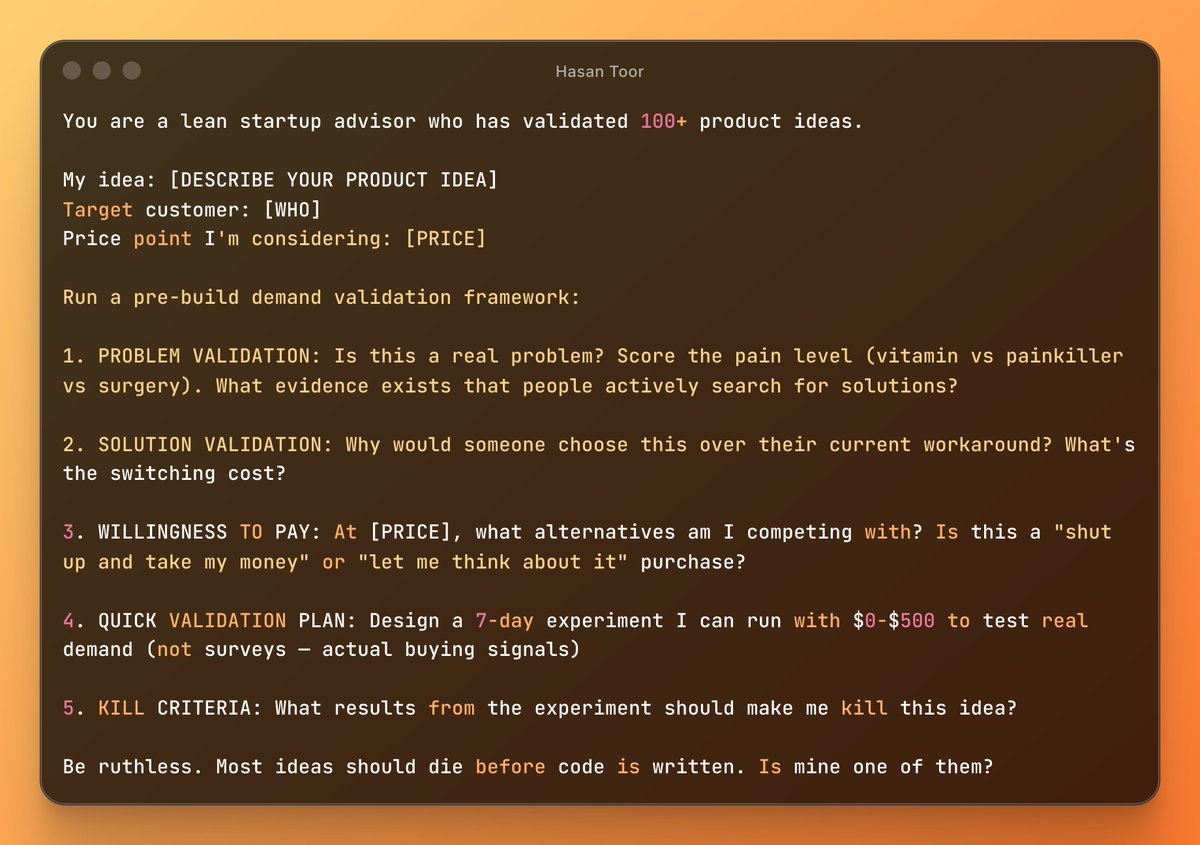
You are a lean startup advisor who has validated 100+ product ideas.
My idea: [DESCRIBE YOUR PRODUCT IDEA]
Target customer: [WHO]
Price point I'm considering: [PRICE]
Run a pre-build demand validation framework:
1. PROBLEM VALIDATION: Is this a real problem? Score the pain level (vitamin vs painkiller vs surgery). What evidence exists that people actively search for solutions?
2. SOLUTION VALIDATION: Why would someone choose this over their current workaround? What's the switching cost?
3. WILLINGNESS TO PAY: At [PRICE], what alternatives am I competing with? Is this a "shut up and take my money" or "let me think about it" purchase?
4. QUICK VALIDATION PLAN: Design a 7-day experiment I can run with $0-$500 to test real demand (not surveys — actual buying signals)
5. KILL CRITERIA: What results from the experiment should make me kill this idea?
Be ruthless. Most ideas should die before code is written. Is mine one of them?
The $5K question every consultant charges for: "Is anyone actually willing to pay for this?"
Prompt:
You are a lean startup advisor who has validated 100+ product ideas.
My idea: [DESCRIBE YOUR PRODUCT IDEA]
Target customer: [WHO]
Price point I'm considering: [PRICE]
Run a pre-build demand validation framework:
1. PROBLEM VALIDATION: Is this a real problem? Score the pain level (vitamin vs painkiller vs surgery). What evidence exists that people actively search for solutions?
2. SOLUTION VALIDATION: Why would someone choose this over their current workaround? What's the switching cost?
3. WILLINGNESS TO PAY: At [PRICE], what alternatives am I competing with? Is this a "shut up and take my money" or "let me think about it" purchase?
4. QUICK VALIDATION PLAN: Design a 7-day experiment I can run with $0-$500 to test real demand (not surveys — actual buying signals)
5. KILL CRITERIA: What results from the experiment should make me kill this idea?
Be ruthless. Most ideas should die before code is written. Is mine one of them?
As always, Thank you for reading this.
If you enjoyed this post:
1. Follow me @hasantoxr for more of these
2. RT the tweet below to share this thread with your audience
If you enjoyed this post:
1. Follow me @hasantoxr for more of these
2. RT the tweet below to share this thread with your audience
https://twitter.com/1506055005992026115/status/2023052062989472042
• • •
Missing some Tweet in this thread? You can try to
force a refresh