Mayank Vora Profile picture
Feb 18 12 tweets 4 min read Read on X
OpenAI and Anthropic engineers don't prompt like everyone else.

I reverse-engineered 7 techniques from talking to 8 insiders directly.

The difference is insane.

Here are the edge-case prompts they don't want you to know:
First thing I noticed: every one of them writes prompts that assume the model will fail.

Not optimistic prompts.

Adversarial ones.

They're not trying to get a good answer. They're trying to catch where the model breaks.

That changes everything about how you write prompts.
1. The Chain-of-Doubt

"Walk me through your reasoning step by step. After each step, ask yourself: could this be wrong? If yes, say why."

Kills hallucination confidence.

The model second-guesses itself mid-answer instead of committing to a wrong path.

Two Meta engineers independently named this their most-used debug prompt.
2. The Failure Audit

"Complete this task, then list every assumption you made that could be wrong. Rate each assumption 1–10 on confidence."

Forces the model to surface its own blind spots.

These engineers use it before shipping any AI-generated output to production.
3. The Anti-Expert

"Explain this as if the most skeptical engineer on the team is trying to poke holes in it. What would they say?"

Gets the model to argue against itself.

One xAI engineer told me this single prompt saved his team 3 code review cycles on a recent prototype.
4. The Edge Case Stress Test

"Give me 10 inputs that would break this function. For each one, show exactly how and why it fails."

Not "write test cases."

Force it to hunt for failure modes.

It finds edge cases in 40 seconds that take junior devs 2 hours to spot manually.
5. The Constraint Flip

"Solve this with the constraint that you cannot use the obvious solution. What's the second-best approach?"

Forces the model off its first-instinct pattern.

Especially powerful for architecture decisions where the "easy" answer is usually the one that breaks at scale.
6. The Role Collision

"Answer this as a senior systems engineer AND a skeptical product manager at the same time. Show where they'd disagree."

Gets two opposing mental models in one response.

Every time I've run this, the disagreement section contains the actual insight.
7. The Silent Assumption Extractor

"Before answering, list every implicit assumption baked into my question. Then answer."

The engineers at xAI use this before any architecture review prompt.

What comes out in the assumption list is almost always more useful than the answer itself.
Here's what all 7 have in common:

They treat the model as an adversary to outsource thinking to not a tool to get quick answers from.

The top engineers aren't writing better prompts.

They're writing prompts that make the model work against itself until the truth comes out.

Save this thread. You'll use at least 3 of these this week.
AI is not going to take job..

Our newsletter, The Shift, delivers breakthroughs, tools, and strategies to help you become value creator and build in this new era easily.

Subscribe:

Plus: Get access to 3k+ AI Tools and free AI courses when you join.theshiftai.beehiiv.com/subscribe
I hope you've found this thread helpful.

Follow me @aiwithmayank for more.

Like/Repost the quote below if you can:

• • •

Missing some Tweet in this thread? You can try to force a refresh

 

Keep Current with Mayank Vora

Mayank Vora Profile picture

Stay in touch and get notified when new unrolls are available from this author!

Read all threads

This Thread may be Removed Anytime!

PDF

Twitter may remove this content at anytime! Save it as PDF for later use!

Try unrolling a thread yourself!

how to unroll video
  1. Follow @ThreadReaderApp to mention us!

  2. From a Twitter thread mention us with a keyword "unroll"
@threadreaderapp unroll

Practice here first or read more on our help page!

More from @aiwithmayank

May 15
Writing from scratch is a waste of time.

Claude can turn raw ideas into polished content in minutes.

Here are 10 Claude prompts to think, draft, and publish like a content machine: Image
1. Turn messy thoughts into clear ideas

Most people don’t have a writing problem.

They have a thinking problem.

Use this:

---

I’m going to dump messy thoughts below.

Your job:

- Extract the core idea
- Identify the strongest angle
- Remove weak points
- Turn it into a clear content thesis

Here are my thoughts:

[paste messy notes]

---
2. Find the strongest hook

Your post lives or dies in the first 2 seconds.

Use Claude to generate scroll-stoppers:

---

Act as a viral X content strategist.

Take this idea:

[insert idea]

Generate 20 hooks.

Rules:

- First line must create curiosity
- Use contrast, specificity, or tension
- No generic advice
- No corporate language
- Make it sound native to X

---
Read 13 tweets
May 14
McKinsey is cool and powerful.

But Claude can do what they do for free.

Here are 8 prompts that turn any rough idea into market research, customer pain analysis, competitor maps, pricing tests, and an MVP plan in minutes 👇 Image
1/ Market Sizing

Prompt: "You are a senior strategy consultant who has sized markets for Goldman Sachs, McKinsey, and Sequoia portfolio companies. My business idea is [describe idea in 2-3 sentences].

I need a rigorous bottom-up market sizing, not a top-down guess. Start by defining who exactly buys this, how many of them exist, how frequently they would buy, and what they would reasonably pay. Build TAM from that. Then narrow to SAM by filtering for the geography, segment, and channel I can actually reach in year one.

Then give me SOM based on realistic capture rate given my stage, team, and resources. Show every assumption explicitly and tell me if any assumption is the one that breaks the whole model if it's wrong. End with a single verdict: is this market large enough to build a venture-scale business, a profitable small business, or neither?"

This one prompt saves you from building a real product inside a fake market.
2/ Customer Pain Analysis

Prompt: "You are a senior UX researcher who just completed 60 in-depth customer interviews for a new product in the [industry] space. The product concept is [describe it]. Synthesize the findings the way a McKinsey analyst would present them to a founding team.

Give me the 5 most acute pain points this customer segment experiences, ranked by severity and frequency. For each pain point tell me: how disruptive is this to their daily work or life on a scale of 1 to 10 and why, is this a hair-on-fire emergency or a chronic low-grade frustration, are they currently spending money or time to manage this pain and if so what are they using, why is the current solution still failing them, and what emotional language did customers use when describing this problem.

End with a paragraph on which single pain point represents the sharpest entry wedge and why."

If no pain point scores above a 7, the idea needs to change before anything else does.
Read 12 tweets
May 11
Google quietly built the closest thing to a private tutor.

It’s called NotebookLM.

Upload your textbook, lecture slides, and class notes.

It turns them into a tutor that only answers from your material.

Here are 10 prompts to turn any class into a study system: Image
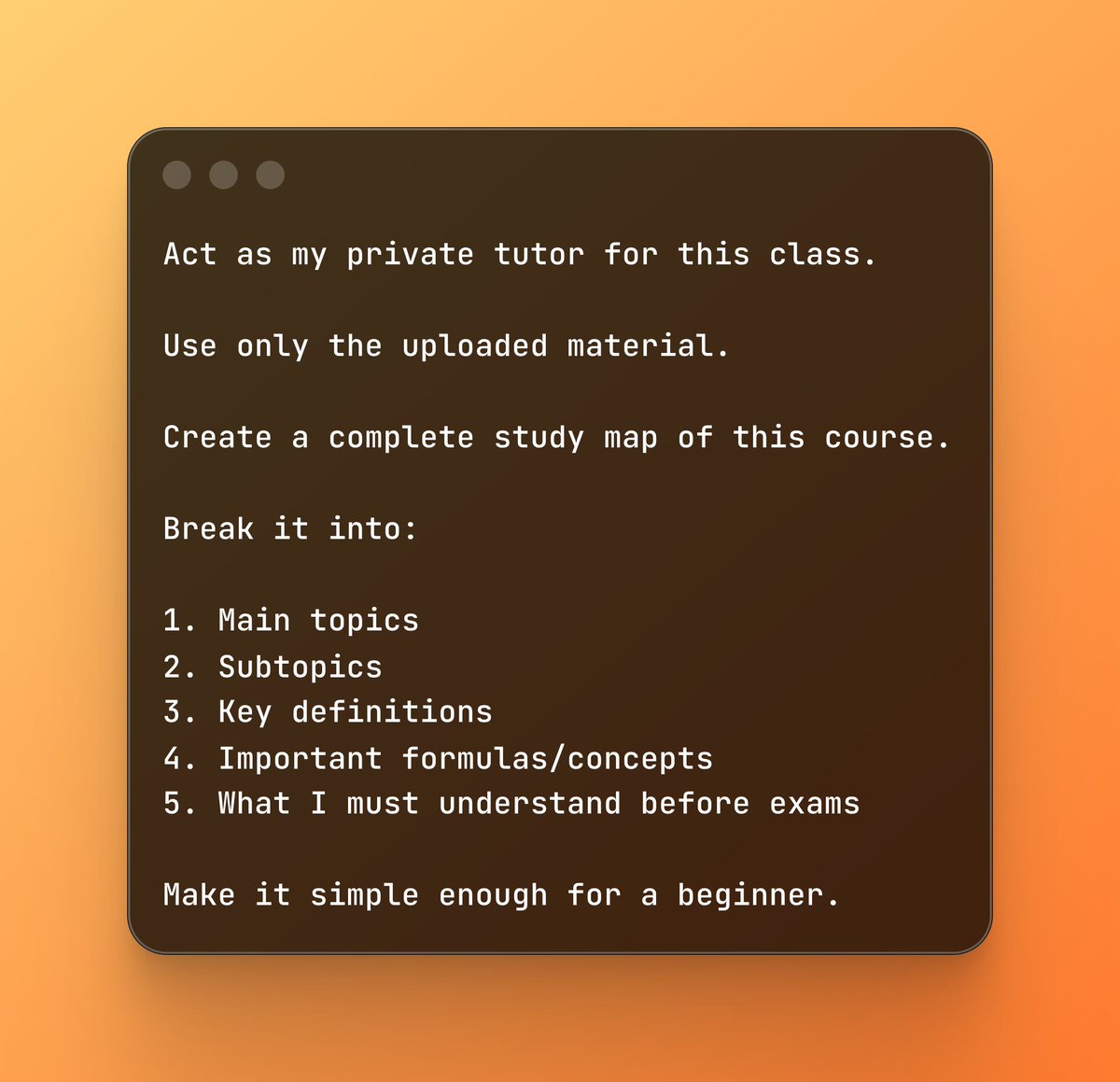
Prompt 1: Build the study map

“Act as my private tutor for this class.

Use only the uploaded material.

Create a complete study map of this course.

Break it into:

1. Main topics
2. Subtopics
3. Key definitions
4. Important formulas/concepts
5. What I must understand before exams

Make it simple enough for a beginner.”Image
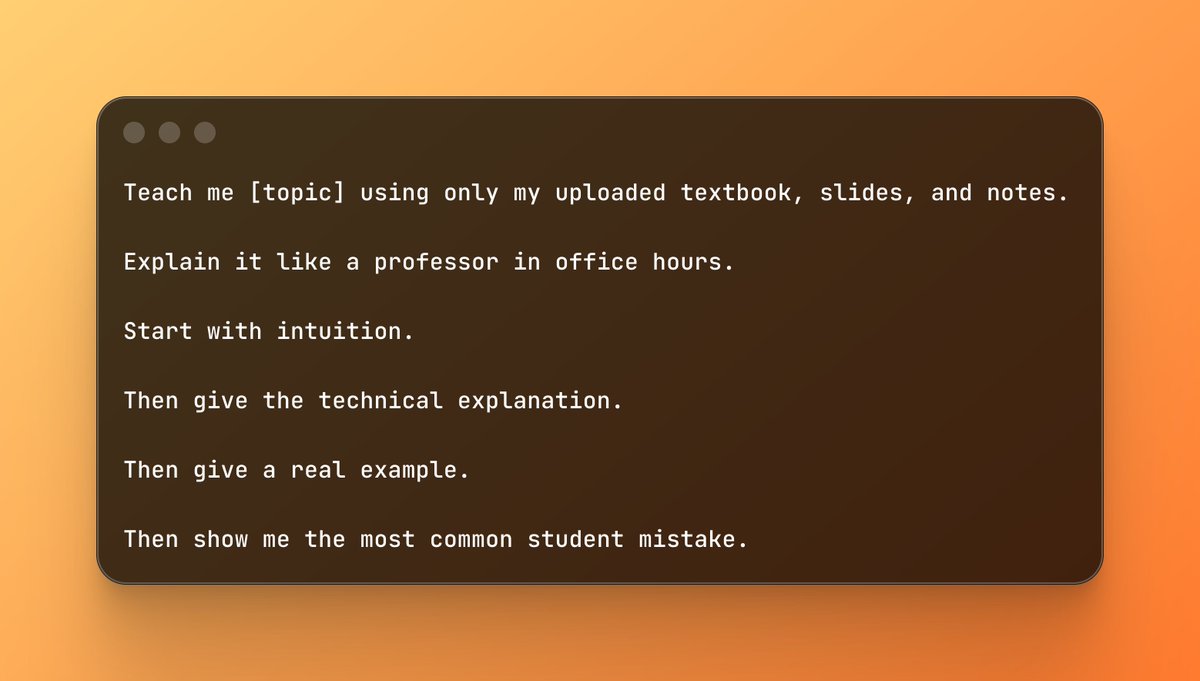
Prompt 2: Explain like a professor

“Teach me [topic] using only my uploaded textbook, slides, and notes.

Explain it like a professor in office hours.

Start with intuition.

Then give the technical explanation.

Then give a real example.

Then show me the most common student mistake.”Image
Read 12 tweets
May 8
Perplexity can now research like a Wall Street analyst for free.

Here are 10 insane Perplexity prompts that turn earnings calls, SEC filings, news, and market data into investment briefs in minutes:

(Bookmark this for later) Image
1/ The Company Deep-Dive Prompt

Prompt:

"Act like a Wall Street equity research analyst.

Research [COMPANY NAME / TICKER] using the latest earnings calls, annual reports, SEC filings, investor presentations, and credible news sources.

Give me a complete investment brief covering:
- What the company does
- How it makes money
- Main business segments
- Revenue growth
- Profitability
- Competitive position
- Key risks
- Management commentary
- Bull case
- Bear case
- Final analyst-style summary

Cite sources for every major claim."

This turns Perplexity into a research desk.

Instead of opening 27 tabs, you get the whole company explained in one clean brief.Image
2/ The Earnings Call Breakdown

Prompt:

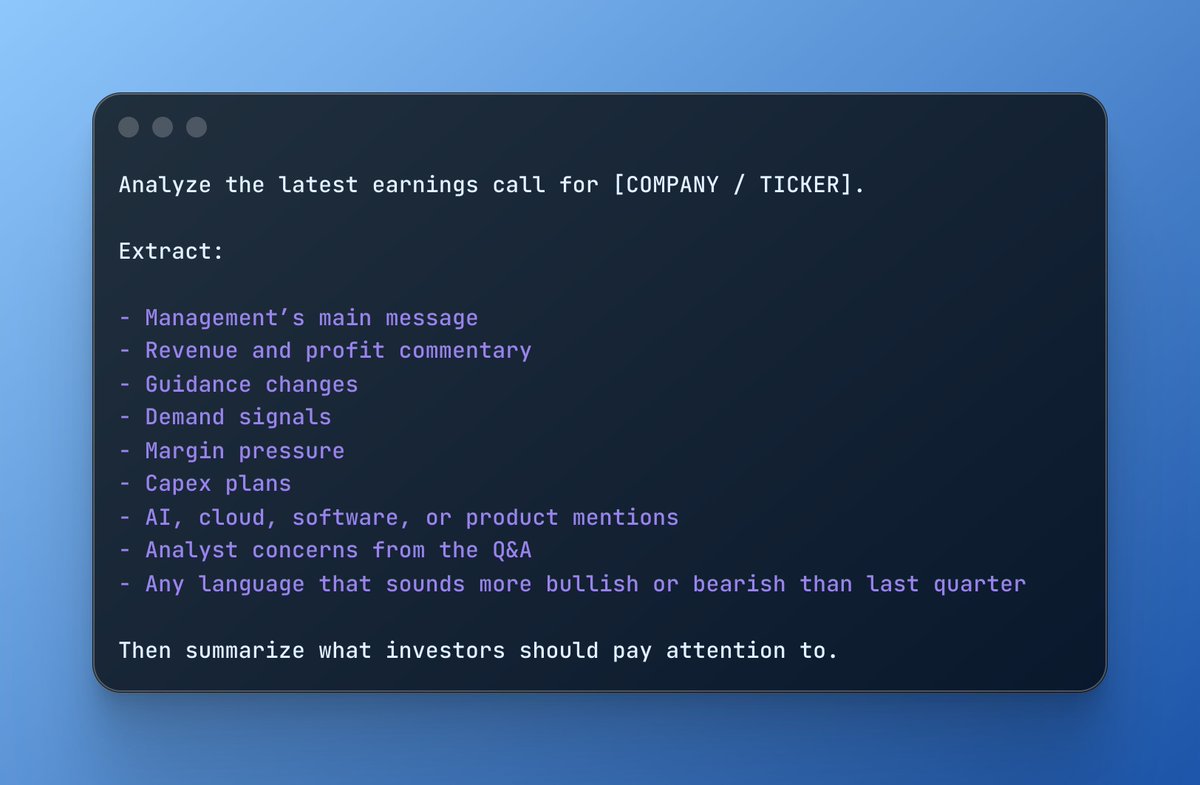
"Analyze the latest earnings call for [COMPANY / TICKER].

Extract:
- Management’s main message
- Revenue and profit commentary
- Guidance changes
- Demand signals
- Margin pressure
- Capex plans
- AI, cloud, software, or product mentions
- Analyst concerns from the Q&A
- Any language that sounds more bullish or bearish than last quarter

Then summarize what investors should pay attention to."

Earnings calls are where companies reveal what they want the market to believe.

This prompt helps you separate the actual signal from the corporate script.Image
Read 13 tweets
May 2
Top 1% students don't rewatch lectures.

They import every lecture transcript into NotebookLM, ask it to predict exam questions, then build a study guide around those exact questions.

Here is the full workflow 👇 Image
Step 1: Grab the transcript of every lecture. Most universities auto-generate them. YouTube has them too. Paste them all into one NotebookLM notebook.

Step 2: Run this prompt first:

"You are a professor who has taught this subject for 20 years. Based on everything in these lectures, predict the 10 most likely exam questions. Rank them by how frequently the concepts appeared across lectures."

Do not ask for a summary. Ask for predictions. That single word changes everything the output gives you.
Step 3: Run this immediately after:

"Now build a one-page study guide structured entirely around those 10 questions. For each question, give me the core concept, the most common mistake students make, and a one-sentence answer I could write under pressure."

You now have a study guide built around what will actually be tested. Not what feels important. Not what the professor spent the most time on. What the exam will ask.
Read 7 tweets
Apr 23
🚨 Top Stanford students have a secret Claude study workflow.

They don’t “read textbooks” the normal way anymore.

They upload chapters into Claude, run 5 prompts, and understand more in 30 minutes than most students get from 4 hours of highlighting.

I thought this was exaggerated.

Then I tested it on a brutal economics textbook.

It was real.

Here’s the exact system:Image
1. The Core Idea Decoder

Most textbooks bury the real concept under pages of examples, side notes, and filler explanations.

Students finish chapters and still can’t explain what mattered.

Paste this first:

“Read this chapter and identify the 3 most important ideas a top student must deeply understand. Ignore trivia. Ignore low-value details. For each idea: explain it simply, explain why it matters, and explain how it connects to the rest of the chapter.”

This instantly separates signal from noise.

You stop memorizing pages.

You start seeing structure.
2. The Professor Test Predictor

Good students study content.

Great students study how content gets tested.

Paste:

“If you were a Stanford professor writing an exam on this chapter, what 10 difficult questions would you ask to reveal whether a student truly understands it? Include conceptual traps, application questions, and common mistakes.”

This changes everything.

Because the brain remembers differently when it expects to be tested.

You stop passively reading.

You start preparing for pressure.
Read 8 tweets

Did Thread Reader help you today?

Support us! We are indie developers!


This site is made by just two indie developers on a laptop doing marketing, support and development! Read more about the story.

Become a Premium Member ($3/month or $30/year) and get exclusive features!

Become Premium

Don't want to be a Premium member but still want to support us?

Make a small donation by buying us coffee ($5) or help with server cost ($10)

Donate via Paypal

Or Donate anonymously using crypto!

Ethereum

0xfe58350B80634f60Fa6Dc149a72b4DFbc17D341E copy

Bitcoin

3ATGMxNzCUFzxpMCHL5sWSt4DVtS8UqXpi copy

Thank you for your support!

Follow Us!

:(