There is an enormous scandal brewing at @IRB_Canada. Canadians are being screwed by massive fraudulent asylum claims, and it all relates to terrible incentive structures.
The thread below is email correspondence from a whistle-blower employee.
1/
The thread below is email correspondence from a whistle-blower employee.
1/
First, some context.
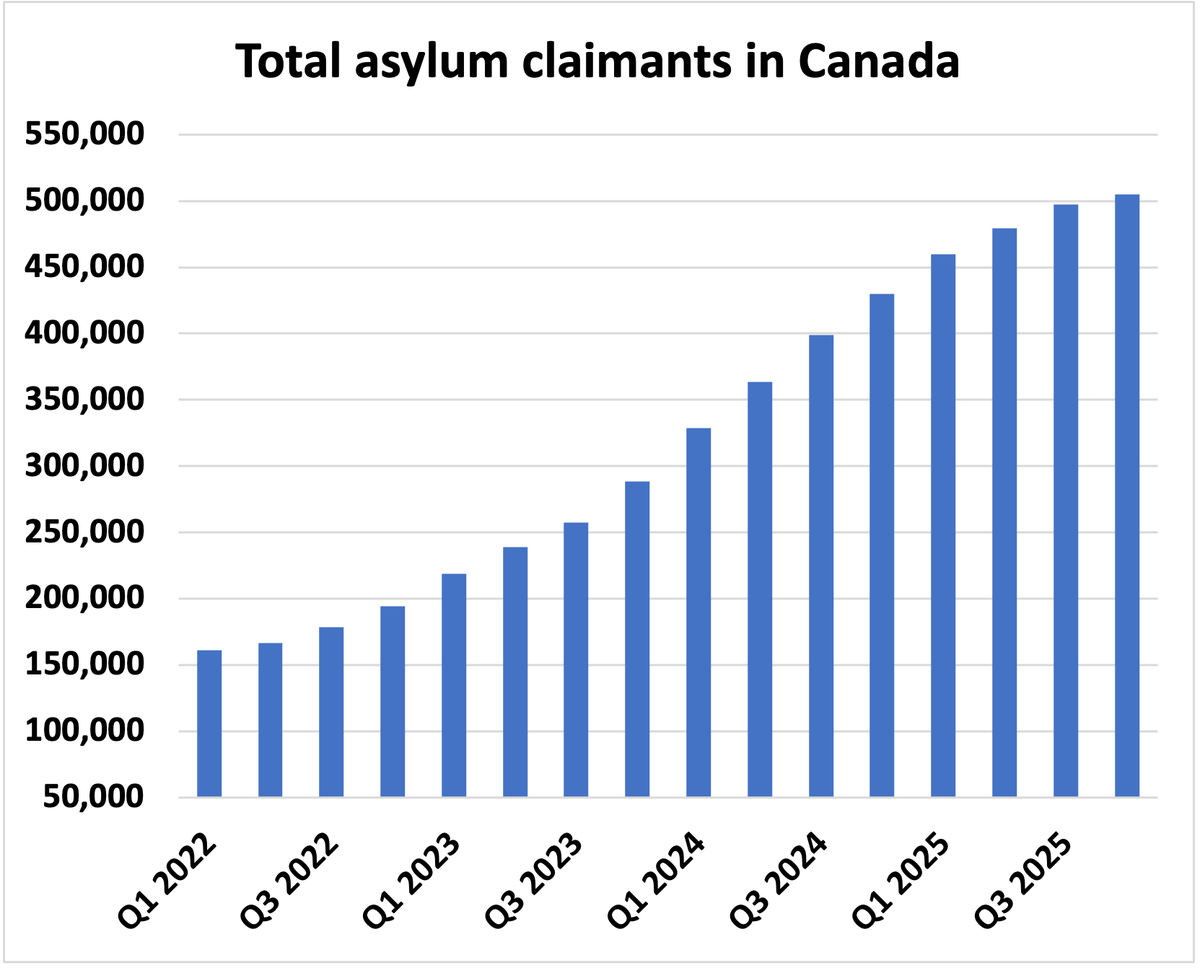
We have half a million asylum claimants in Canada currently...triple from 2022 levels and now accounting for 1 in every 84 people in the country.
2/
We have half a million asylum claimants in Canada currently...triple from 2022 levels and now accounting for 1 in every 84 people in the country.
2/
Now from the whistle-blower employee at @IRB_Canada:
"I worked as a decision maker in immigration. The amount of fraud and mismanagement is a massive scandal worthy of a national public inquiry waiting to happen." 3/
"I worked as a decision maker in immigration. The amount of fraud and mismanagement is a massive scandal worthy of a national public inquiry waiting to happen." 3/
"The positive decision rate for refugee claims is sky high (it's probably going to exceed 85% this year) because it's impossible to say "no" in the time constraints given. The law makes saying "no" and calling out fraud very difficult and time-consuming." 4/
"The decision maker needs to spend a lot of time preparing, a lot of time holding the hearing, and the decision will be difficult to write to comply with all the requirements under the law as interpreted by the courts. There is no time." 5/
"The IRB is supposed to function in a way similar to a "court". In reality, it's a high turnover minimum-wage, entry level positive decision mill where tribunal members are treated like disposable labor and forced to say "yes" majority of the time given the time constraints." 6/
"The IRB as an institution has been emboldened by years of not facing consequences and they keep adding more work, to the point where there is barely enough time to say perfunctory yeses to nearly everyone. The result is that refugee fraud is rampant but unnoticed." 7/
"People don't know because when they look at the data, it says most claimants are refugees (some lawyers and law professors say that the rare use of the fraud provisions in the law is evidence that there is little or no fraud, that is because they don't know that it is simply not possible to issue a decision applying that provision within the time constraints given, and that to do so means working late without getting paid for long hours or facing threats of termination for not being efficient)." 8/
"It's impossible to know how prevalent it is because the people supposed to say where there is fraud are not "allowed" to (what has been going on is justified by the volume of claims according to IRB leadership). The pressure keeps going up, the positive rate keeps going up.
The word is out that it's easy to game (and that even if you lose, there are lots of recourses and little consequences)." 9/
The word is out that it's easy to game (and that even if you lose, there are lots of recourses and little consequences)." 9/
"It is not possible to deal with the number of claims assigned given the time allowed. This means that to only work 40-50 hours a week (you're paid 37.5) and to keep your job, you have to say yes to fraud because saying no means spending a lot of time preparing, doing the hearing, and writing the decision you don't have time to write." 10/
"Overtime is all unpaid because the IRB gets away with saying all claims can be decided within the same time allotment.
Basically, they know it and make people keep their head down or quit or face dismissal/non-renewal. And even if you do a lot of free overtime (and I don't mean only a few hours), it's probably not enough if you're going to try to reject fraud because of how much there is." /11
Basically, they know it and make people keep their head down or quit or face dismissal/non-renewal. And even if you do a lot of free overtime (and I don't mean only a few hours), it's probably not enough if you're going to try to reject fraud because of how much there is." /11
"That was my attempt at giving you some context. What I'm trying to say is that people deciding refugee claims (to cite only one example of a really big mismanagement problem in immigration) are forced to say yes to most claims.
No one needs to take my word for it: There is a lot of data reported online, and one easy and probably persuasive way to demonstrate this would be to illustrate already available on refugeelab.ca/projects/refug…." /12
No one needs to take my word for it: There is a lot of data reported online, and one easy and probably persuasive way to demonstrate this would be to illustrate already available on refugeelab.ca/projects/refug…." /12
"I did an analysis of the RLL's Excel spreadsheets for yearly data to test the hypothesis that the number of negative decisions predicts turnover/time.
From the RLL files spanning 2019–2024, recognition rates rose from around 69% to over 80%, with a clear pattern where members with lower rates (more negatives) had average tenures of 1.4 years, compared to 4.2 years for high-grant members." /13
From the RLL files spanning 2019–2024, recognition rates rose from around 69% to over 80%, with a clear pattern where members with lower rates (more negatives) had average tenures of 1.4 years, compared to 4.2 years for high-grant members." /13
"Turnover is high, with 60–70% of members active less than 2 years.
- Trends show adjudicators adapting upward in rates post-2019
- In 2024, ~52% of adjudicator (with 30+ decisions) had positive rates >90%, with many at 95–100%
-Earlier years: ~28–35% >90% (2019–2022), rising to 48% in 2023"
/14
- Trends show adjudicators adapting upward in rates post-2019
- In 2024, ~52% of adjudicator (with 30+ decisions) had positive rates >90%, with many at 95–100%
-Earlier years: ~28–35% >90% (2019–2022), rising to 48% in 2023"
/14
"The public service survey (the most recent one issued last summer) also has some interesting data about the IRB. Of all public servants across the entire government, IRB tribunal members at the ID and RPD combined report the lowest confidence in senior leadership"
/15
/15
This is a huge scandal that highlights the magnitude of the fraud in the asylum system and the inability of adjudicators to effectively weed it out.
This is consistent with concerns raised by the @CDHoweInstitute in an study just this week:
/16cdhowe.org/wp-content/upl…
This is consistent with concerns raised by the @CDHoweInstitute in an study just this week:
/16cdhowe.org/wp-content/upl…
This requires immediate attention and a massive overhaul at @IRB_Canada
@LenaMetlegeDiab @MichelleRempel @PierrePoilievre
/17
@LenaMetlegeDiab @MichelleRempel @PierrePoilievre
/17
• • •
Missing some Tweet in this thread? You can try to
force a refresh