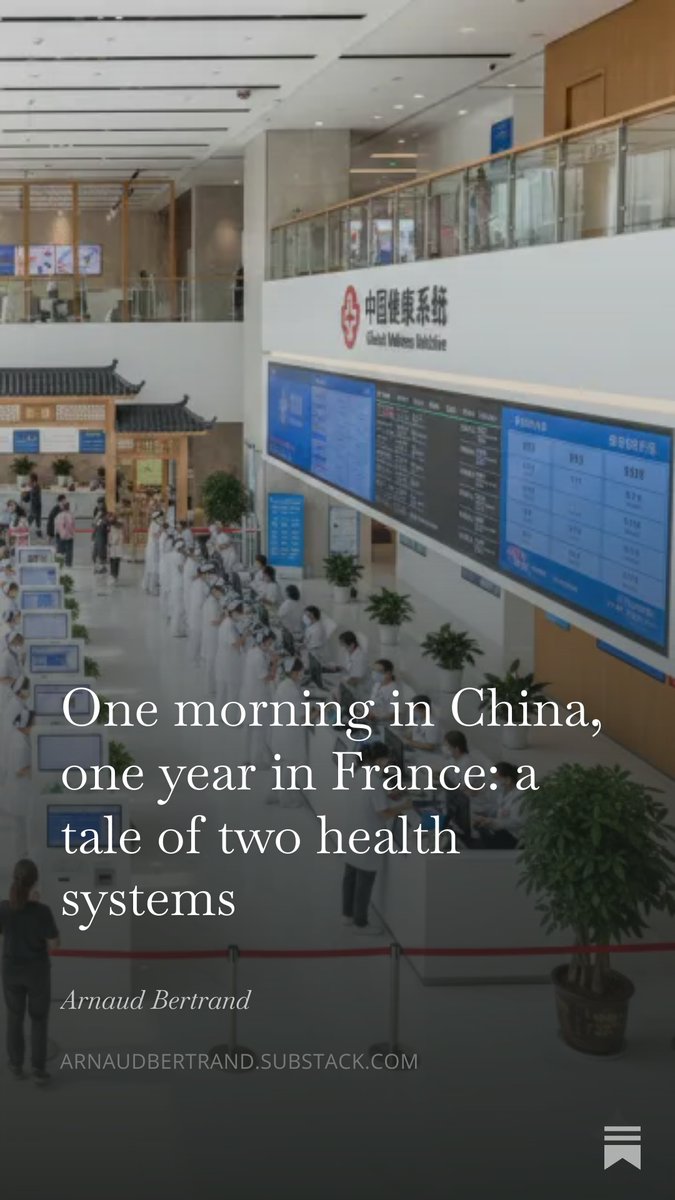
I've been wanting to write this for a while: an article on the key characteristics of the Chinese health system, as a patient.
It's something that I - perhaps unfortunately - have come to have a lot of experience with in my eight years in China.
I've been to the doctor as a patient dozens of times. My wife delivered our first daughter in a Chinese hospital, and had cancer surgery in Shanghai. My younger daughter - who once completely severed her thumb in an unfortunate accident in rural Gansu - had emergency surgery in a small clinic there (her thumb is fine now!). We spent the entire covid episode in China. And, to this day, I still go back to China every year to do my routine health tests or the occasional procedure (like a thyroid biopsy in Harbin last year).
In other words, when it comes to the Chinese health system, I've seen a lot.
What's fascinating about the Chinese health system, and that's true in general about many things in China, is that it never inherited Western dogma about how things were supposed to work, it's completely unconstrained by what everyone else has decided is "normal".
And, as a result, you end up with things that would simply sound impossible to any Western patient: a consultation with the head cardiologist of one of Shanghai's best hospitals for less than $10, blood test results in under 30 minutes, and a system where you can walk in, see three specialists and walk out with a diagnosis and your medicine - all before noon.
As I argue in the article that's all enabled by 3 characteristics that sound super unorthodox: 1) extremely short consultation times, less than 5 minutes 2) no GP gatekeepers (you go straight to see specialists) 3) systematic testing for every patient, even if you just have a cold
Each one sounds wrong. And in fact when I describe them to doctor friends in the West they immediately explain to me why that can't possibly work, and how their own system is far superior.
Except that it does work, I checked the numbers (on top of my personal experience): the Chinese system handles close to 10 billion total outpatient visits a year (nhc.gov.cn/cms-search/dow…), or about 7 visits per person per year on average, and the average wait time is only about 18 minutes (gov.cn/yaowen/shipin/…).
Contrast this with France, my country, where people already go to the doctor A LOT, but still less than in China: only 5.5 visits per person per year (evaluation.securite-sociale.fr/home/maladie/M…). And the French system can't even handle this lower volume: when you can see a specialist straight away in China - you don't even need to make an appointment in advance - you need to wait months to see one in France (50 days on average for a cardiologist, for instance: drees.solidarites-sante.gouv.fr/sites/default/…).
I've personally managed to see 3 specialists AND do all related tests AND get the test results AND get diagnoses AND buy the medicine to cure me - all in the space of a morning at a hospital in Shanghai. That would have undoubtedly taken me a whole year in the French system.
My purpose here is not to argue that the West should replicate the Chinese health system wholesale, but to ask an honest question: what if some of the things we take for granted about healthcare aren't nearly as inevitable as we think? Is it completely unthinkable that we've developed some dogmas that are costing us - in money, in time, and occasionally in lives?
That's the whole point of my article: describing a health system built from first principles by people who never assumed we in the West knew better - up to you to decide if they have a point.
I don't know if people understand just how insanely egregious this is.
First of all, 1) not only are NATO spending targets NOT legally binding (nothing in any NATO-related legal text mandates a specific GDP-based threshold for defense spending), but on top of this 2) Spain requested AND RECEIVED an exemption from the 5% target at the 2025 Hague Summit - NATO changed the declaration's language specifically to allow Spain to sign while publicly declaring it would not comply (jurist.org/news/2025/06/n…)
This means that, legally speaking and according to NATO's own rules, Spain is doubly within its rights: there is no binding obligation to begin with, and Spain was excused from even this non-binding obligation.
That's the first point: Germany's chancellor just endorsed - from the Oval Office - the U.S. punishing a fellow EU nation for refusing to comply with an obligation that doesn't exist in law, under a political pledge Spain was excused from at a NATO summit.
The second point is that this 5% target has nothing to do with "defense", quite the contrary in fact: it is pretty explicitly an imperial tribute to the U.S. that will actually **weaken** European defense.
That was Spain's main argument for refusing to comply: Prime Minister Pedro Sánchez said that "committing to 5% would not make us any safer" because it "would only reinforce our dependence" on the U.S. (tiempoar.com.ar/ta_article/ped…)
That's the insane thing about EU defense spending: in recent years, the more it has spent on defense, the more that spending has flowed to American contractors as opposed to European ones, making the EU defense industry weaker (x.com/adam_tooze/sta…). Increasing spending to 5% doesn't strengthen European defense: it accelerates exactly this transfer.
All the more insane given the well-documented production backlogs in the U.S. defense industry and its inability to produce at scale: US defense analysts - including from Trump-adjacent think tanks like AEI (aei.org/research-produ…) - openly acknowledge that European customers would be deprioritized behind U.S. ones in any real conflict.
AND, critically, a defense industry from a country that's increasingly hostile to Europe - explicitly so in its National Security Strategy - and whose weaponry has "kill switches" that allows for remote disabling.
I mean, the sheer madness of it: anyone with an ounce of common sense can see that DOUBLING your defense spending to enrich a foreign arms industry that has kill switches on your weapons, can't meet its own military's needs, and increasingly treats you as an adversary, is not even remotely a defense strategy - it's suicide.
That's why having Merz - in the oval office, sitting next to Trump - endorse economic coercion against the one EU country that's still sane enough to see through this madness is so egregious, and frankly straight-up traitorous.
For those who know Asterix and Obelix, Spain is the "one small village still holding out against the invaders" and Merz is Cassius Ceramix, the self-described "gallo-roman" Gaul village chief who's the incarnation of all sycophants after his tribe were conquered by the Romans.
I'm with Asterix, and all Europeans should be too.
The "one small village still holding out against the invaders"
This strange square 👇 is undoubtedly the most extraordinary work of literature in human history. Yet, unfortunately, barely anyone in the West has ever heard of it.
There was this woman poet in 4th century China called Su Hui (蘇蕙), a child genius who had reportedly mastered Chinese characters by age 3.
At 21 years old, heartbroken by her husband who left her for another woman, she decided to encode her feelings in a structure so intricate, so beautiful, so intellectually staggering that it still baffles scholars to this day.
Came to be known as the Xuanji Tu (璇璣圖) - the "Star Gauge" or "Map of the Armillary Sphere" - it's a 29 by 29 grid of 841 characters that can produce over 4,000 different poems.
Read it forward. Read it backward. Read it horizontally, vertically, diagonally. Read it spiraling outward from the center. Read it in circles around the outer edge. Each path through the grid produces a different poem - all of them coherent, all of them beautiful, all of them rhyming, all of them expressing variations on the same themes of longing, betrayal, regret, and undying love.
The outer ring of 112 characters forms a single circular poem - believed to be both the first and longest of its kind ever written. The interior grid produces 2,848 different four-line poems of seven characters each. In addition, there are hundreds of other smaller and longer poems, depending on the reading method.
At the center a single character she left implied but unwritten: 心 (xin) - "heart." Later copyists would add it explicitly, but in Su Hui's original the meaning was even more beautiful: 4,000 poems, all orbiting the space where her heart used to be.
Take for instance the outer red grid of the Star Gauge. Starting from the top right corner and reading down, you get this seven-character quatrain:
仁智懷德聖虞唐,
貞志篤終誓穹蒼,
欽所感想妄淫荒,
心憂增慕懷慘傷。
In pinyin, it is:
Rén zhì huái dé shèng yú táng,
zhēnzhì dǔ zhōng shì qióng cāng,
qīn suǒ gǎnxiǎng wàng yín huāng,
xīn yōu zēng mù huái cǎn shāng.
Notice how it rhymes? táng / cāng / huāng / shāng
The rough translation in English is: "The benevolent and wise cherish virtue, like the sage-kings Yao and Shun, With steadfast will I swear to the heavens above, What I revere and feel - how could it be wanton or dissolute? My heart's sorrow grows, longing brings only grief."
Now read it from the bottom to the top and you get this entirely different seven-character quatrain:
傷慘懷慕增憂心,
荒淫妄想感所欽,
蒼穹誓終篤志貞,
唐虞聖德懷智仁。
And the meaning is just as beautiful and coherent: "Grief and sorrow, longing fills my worried heart, Wanton and dissolute fantasies - is that what you revere? I swear to the heavens my constancy is true, May we embody the sage-kings' virtue, wisdom, and benevolence."
That's just 2 poems out of the over 4,000 you can construct from the Xuanji Tu!
At the very center of the grid, the 8 red characters wrapped around the central heart, she "signed" her poem with a hidden message:
詩圖璇玑,始平蘇氏。 "The poem-picture of the Armillary Sphere, by Su of Shiping."
Or reversed:
蘇氏詩圖,璇玑始平。 "Su's poem-picture - the Armillary Sphere begins in peace."
Many scholars, and even emperors, throughout Chinese history have been completely obsessed by Su Hui's puzzle.
For instance, in the Ming dynasty, a scholar named Kang Wanmin (康萬民) devoted his entire life to the poems (kangshiw.com/contents/461/2…), ending up documenting twelve different reading methods - forward, backward, diagonal, radiating, corner-to-corner, spiraling - and extracting 4,206 poems. His book on the subject ("Reading Methods for the Xuanji Tu Poems", 璇璣圖詩讀法) runs to hundreds of pages.
Empress Wu Zetian herself, the legendary woman emperor of the Tang dynasty, wrote a preface to the Xuanji Tu around 692 CE (baike.baidu.com/item/%E7%BB%87…).
Incredibly, there's even far more complexity to the Xuanji Tu than just the poems:
- The name 璇玑 (Xuanji) - Armillary Sphere - is astronomical in meaning and the way the poems can be read mirrors the way celestial bodies orbit around a fixed center. It's a model of the heavens.
- Her original work, with the characters woven on silk brocade, was in five colors (red, black, blue/green, purple, and yellow) which correspond to the Five Elements (五行) - the foundational Chinese philosophical system that explains how the universe operates. So it's also a model of the entire cosmic order according to ancient Chinese philosophy.
- It's also of course deeply mathematical with this 29 x 29 perfect square grid, with sub-squares, lines and rectangles, and a structure which allows for symmetrical reading patterns in all directions
- Last but not least, the content of the poems themselves contain multiple registers. On top of expressing her personal grief and longing for her husband, it's also filled with accusations against the concubine (Zhao Yangtai) he left her for, reflections on politics (with many references to sage-kings) and philosophical reflections.
So the Star Gauge is simultaneously:
- A love letter (expressing personal longing)
- A legal brief (arguing her case against her rival)
- A cosmological model (structured like the heavens)
- A Five Element diagram (encoding the fundamental structure of the world according to ancient Chinese philosophy)
- A mathematical construction with perfect symmetry and precision
And yet, for all this complexity, we should not forget this was all ultimately in service of the simplest human message imaginable: a 21-year-old woman asking the love of her life "come back to me".
Her husband did, eventually. According to what empress Wu Zetian herself wrote in her preface to the Xuanji Tu, when he received Su's brocade he was so "moved by its supreme beauty" that he sent away his concubine and returned to his wife. As the story goes, they lived together until old age.
This is big. The final U.S. National Security Strategy was just published and the refocus on the Western Hemisphere (i.e. the Americas) is confirmed.
The document clearly establishes this as the U.S.'s number 1 priority, saying that the U.S. will now "assert and enforce a 'Trump Corollary' to the Monroe Doctrine."
In terms of military presence, they write that this means "a readjustment of our global military presence to address urgent threats in our Hemisphere, and away from theaters whose relative import to American national security has declined in recent decades or years."
On China, a couple of points.
The most striking aspect to me is that China is NOT anymore defined as "the" primary threat, "most consequential challenge," "pacing threat," or similar formulations used in previous such documents.
It's clearly downgraded as a priority. Based on the document's structure and emphasis, the top U.S. priorities could be characterized as: 1) Homeland security and borders (migration, cartels, etc.) 2) Western Hemisphere (Monroe Doctrine restoration) 3) Economic security (reindustrialization, supply chains) 4) China and Indo-Pacific
To be clear they don't define China as an ally or a partner in any shape or form but primarily as 1) an economic competitor, 2) a source of supply chain vulnerabilities (but also a trading partner) and 3) a player who regional dominance should be "ideally" denied because it "has major implications for the U.S. economy."
Interestingly, I believe for the first time ever, they mention the possibility of being overmatched militarily by China:
- They write that "deterring a conflict over Taiwan, ideally by preserving military overmatch, is a priority": "ideally" clearly means that it's ideal, but not necessarily a given. The fact that they call deterring conflict over Taiwan merely "a priority" also suggests, by definition, that it's no more a top strategic priority, or a vital interest.
- On Taiwan they also clearly imply that if the U.S.'s "First Island Chain allies" don't "step up and spend - and more importantly do - much more for collective defense", then there might be "a balance of forces so unfavorable to us as to make defending that island impossible."
They still maintain that "the United States does not support any unilateral change to the status quo in the Taiwan Strait" but, clearly, there's a widening gap between what the US says it opposes and what it's actually willing to do about it.
Interestingly as well, contrary to previous such document, there is zero ideological dimension in the document when it comes to China. No "democracy vs. autocracy" framing, no "rules-based international order" to defend, no values-based crusade. China is treated as a practical issue to be managed, not an ideological adversary to be defeated.
In fact the document explicitly mentions, I think for the first time ever as well, that US policy is now:
- "not grounded in traditional, political ideology"
- that they "seek good relations and peaceful commercial relations with the nations of the world without imposing on them democratic or other social change that differs widely from their traditions and histories"
- and that they seek "good relations with nations whose governing systems differ from ours."
Which is quite a stunning departure from the rhetoric of the past few decades. We all knew this but it's now amply clear that the era of missionary liberal internationalism in US foreign policy is dead and buried.
The competition with China is primarily described in economic terms, explicitly so: they write the competition is about "winning the economic future" and that economics are "the ultimate stakes."
Notably, they admit that the tariffs approach "that began in 2017" when it comes to China essentially failed because "China adapted" and has "strengthened its hold on supply chains."
The new strategy, as described in the document, is to build an economic coalition against China that can exert more leverage than the US economy alone - a tacit admission that America just isn't powerful enough on its own anymore.
The contradiction is however obvious: unclear how you build an economic coalition against China while simultaneously waging trade wars against your coalition partners, demanding they shoulder more of their own defense, and treating every allied relationship as a deal to be renegotiated in America's favor.
At some point these "allies" will be asking a very obvious question: why sacrifice our economic interests to prop up an America that can no longer compete on its own - and that offers us less and less in return?
In a normal world, this should be an immense scandal in Europe.
Le Monde has a long article (lemonde.fr/international/…) describing the hellish life of Nicolas Guillou, a French judge at the ICC in The Hague, due to U.S. sanctions punishing him for authorizing arrest warrants against Netanyahu and Gallant for war crimes in Gaza.
Guillou's daily existence has been transformed into a Kafkaesque nightmare. He cannot: open or maintain accounts with Google, Amazon, Apple, or any US company; make hotel reservations (Expedia canceled his booking in France hours after he made it); conduct online commerce, since he can't know if the packaging is American; use any major credit card (Visa, Mastercard, Amex are all American); access normal banking services, even with non-American banks, as banks worldwide close sanctioned accounts; conduct virtually any financial transaction.
He describes it as being "economically banned across most of the planet," including in his own country, France, and where he works, the Netherlands.
That's the real shocking aspect of this: the Americans are:
- punishing a European citizen
- for doing his job in Europe
- applying laws Europe officially supports
- at an institution based in Europe
- that Europe helped create and fund
and Europe is not only doing essentially nothing to protect him, they're actively enforcing America's sanctions against their own citizen - European banks closing his accounts, European companies refusing him service, European institutions standing by while Washington destroys a European judge's life on European soil.
Again, in a normal world, European leaders and citizens should be absolutely outraged about this. But we've so normalized the hollowing out of European sovereignty that the sight of a European citizen being economically executed on European soil for upholding European law is treated, at best, as an unfortunate technical complication in transatlantic relations.
I already wrote about this when I visited the ICC this summer 👇
We're on the edge of Europe's most humiliating moment in history.
The White House is apparently about to achieve a comprehensive peace deal with Russia which Kirill Dmitriev, the Russian negotiator, say is "a much broader framework [than just a ceasefire agreement], basically saying, 'How do we really bring, finally, lasting security to Europe, not just Ukraine.'"
So in effect it looks like this is an agreement which redraws the entire European security architecture.
The thing, however, is that Europeans are NOT part of the discussions and, when asked about them, the White House replied: “We don't really care about the Europeans.”
This would make it probably the first time EVER in history that Europe's security is decided completely by outside forces, as a proxy with zero say in its own fate (indeed with explicit contempt for its input).
I actually looked into this for my August article "Not at the table: Europe's colonial moment" (arnaudbertrand.substack.com/p/not-at-the-t…). The only comparable parallel I could find is the fall of Constantinople in 1453. But even this was a somewhat “classic” military defeat where the victor simply dictated terms. At the time, there wasn't another external power negotiating with the Ottomans about how to carve up Byzantine territory - it was at least a straightforward conquest.
Don't misunderstand me. I'll be the first to applaud if the Ukraine war comes to an end. It was, as I have argued since day 1 (x.com/RnaudBertrand/…), one of the most predictable and therefore one of the most avoidable wars in history.
BUT, and this is a huge "but", having your continent's security architecture redesigned without you sets a catastrophic precedent: it defines Europe as nothing more than geography to be bargained over by others.
This is the natural consequence of decades of appalling strategic choices by Europeans, starting with the fundamental decision to outsource their security to NATO - effectively to Washington - rather than building genuine strategic autonomy. This shaped how Europe dealt with both Russia and Ukraine: following hawkish US policy, dictated by its own interests to keep Eurasia divided ("divide and conquer"), as opposed to Europe's own interests which clearly lay in continental integration and stability.
Now we see the wages of these choices: a continent whose opinion literally doesn't matter when its security is being negotiated.
Caveat: Tass (Russia's official news agency) says "Russia has no OFFICIAL information from US about some 'agreements'" 👇 x.com/imetatronink/s…
The emphasis on "official" is mine because this means there is *unofficial* information, which is indeed the case here given that the talks between Steve Witkoff (Trump envoy) and Kirill Dmitriev (who runs Russia's sovereign wealth fund) are backchannel negotiations.
My point still stands of course: the White House - backchannel or not - is negotiating with Russia without Europe at the table and they did say they "don't really care about the Europeans." Europe wasn't at the table either during Trump's *official* discussion with Putin in Alaska this summer.
Which means that even if this particular deal falls through or the timeline is premature, the pattern is clear: Europe's security is something the U.S. and Russia discuss between themselves and Europe isn't a participant in these conversations - it's the subject matter.
This is hilarious:
Witkoff posted as a public tweet which he undoubtedly meant as PM (and that he since deleted) that the story must have been leaked by "K", which could refer to the Russian negotiator Kirill Dmitriev or Keith Kellogg, Trump's special envoy for Ukraine.
This is a genuinely incredible story: China found in U.S. archives an energy source that could power its entire future for 20,000 years - and they just made it work.
I'm not exaggerating. In the 1960s the U.S. - specifically Oak Ridge National Laboratory in Tennessee - invented a revolutionary type of nuclear reactor that could run on thorium instead of uranium (much more abundant and cheaper), with no meltdown risk, generating 50x less waste, and requiring no water. Then, due to messy politics, they killed the program in 1969 and fired the visionary behind it.
Afterwards the declassified blueprints for the project sat forgotten in archives for decades. That is until Chinese scientists found them and decided in 2011 to run an experimental project in the Gansu desert to see if they could make it work.
A few days ago, after 14 years of work, they finally did.
I spent many days researching this and wrote the full story - how the technology works, the bureaucratic politics that killed it in America, and why this could genuinely be game-changing.