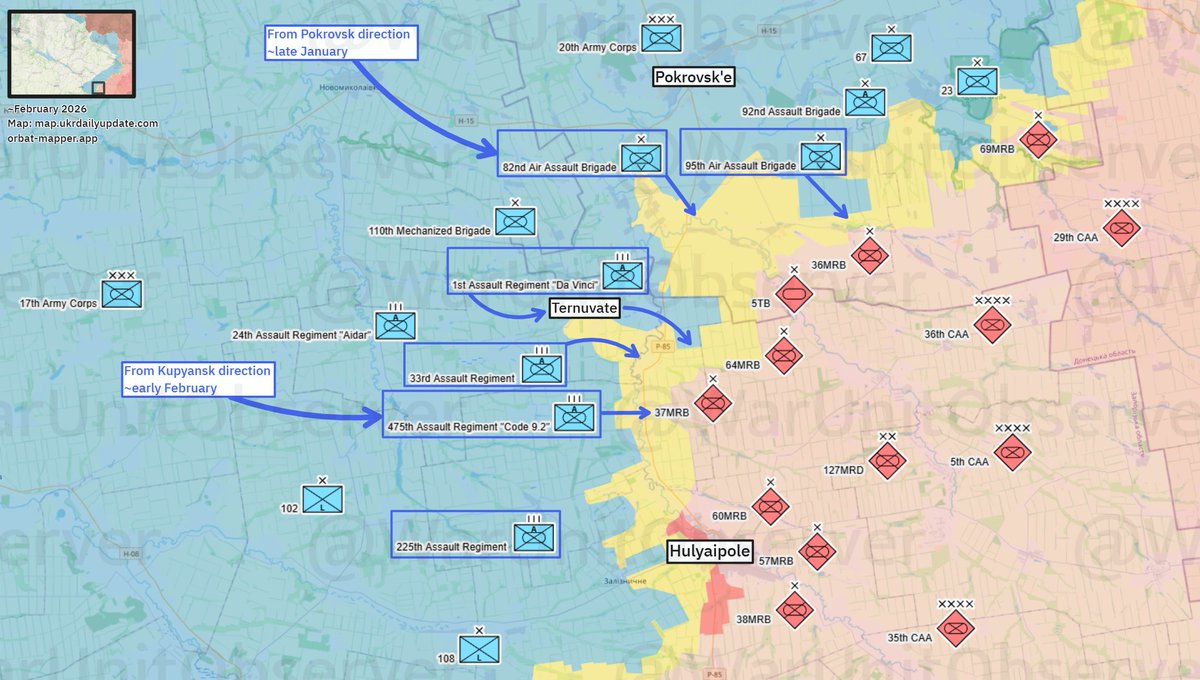
🇺🇦Ukrainian counterattacks on the southern front - the wider perspective
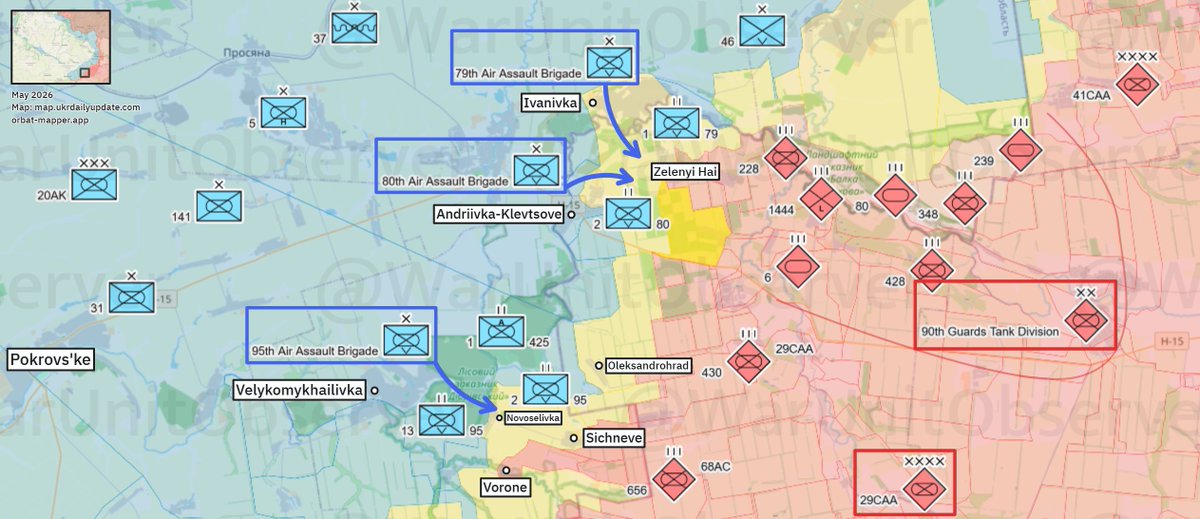
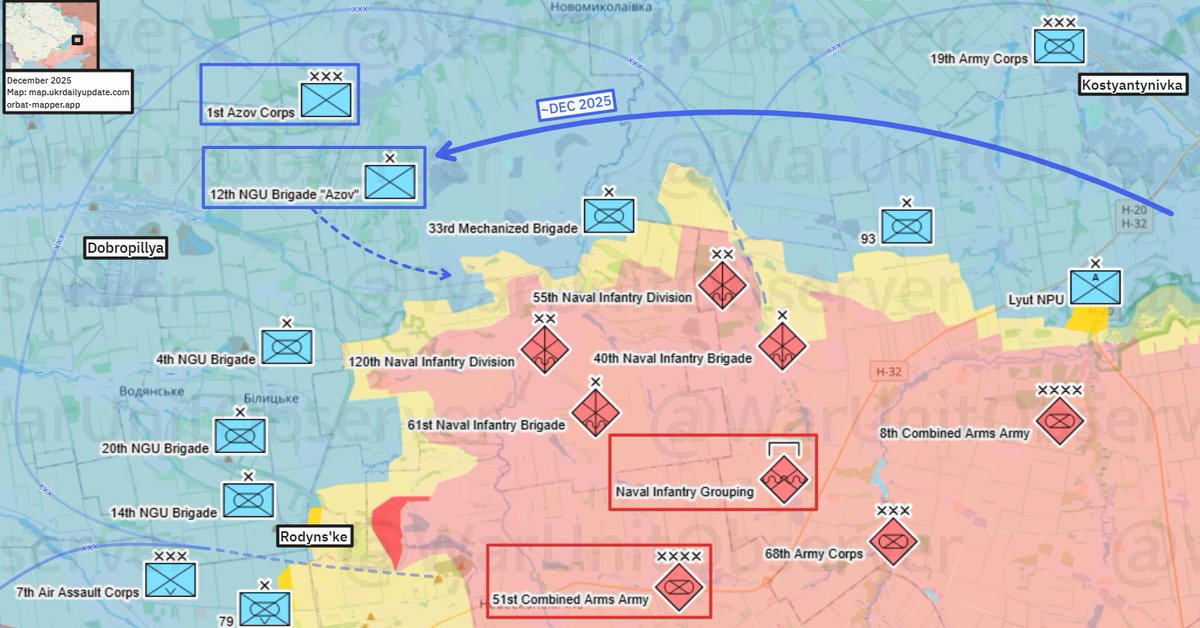
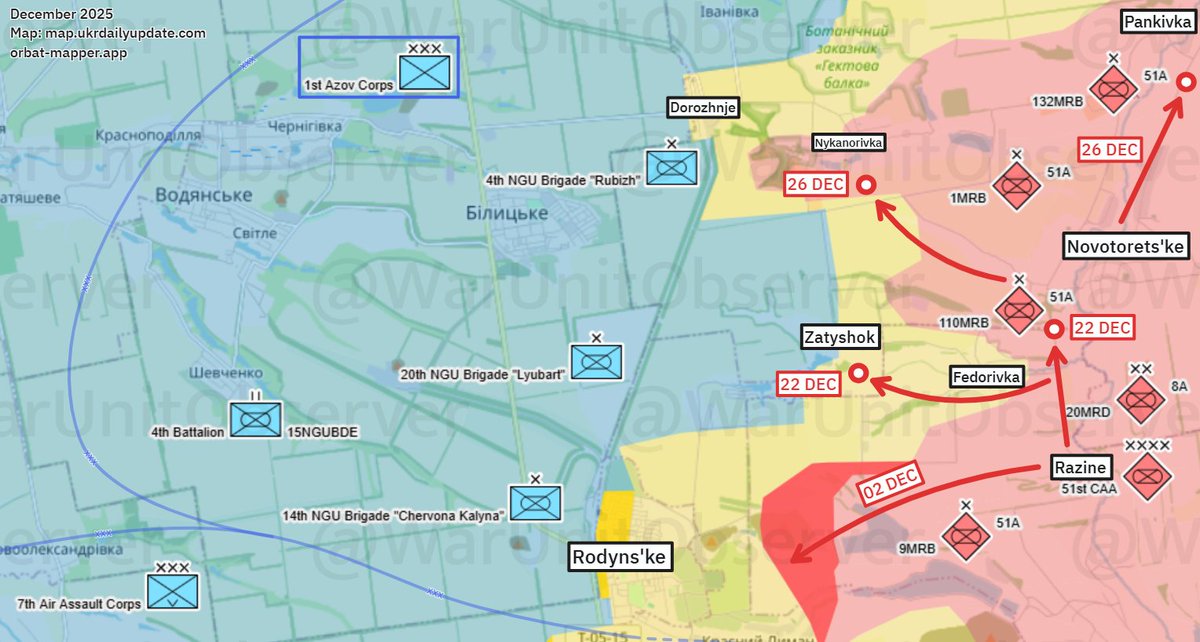
Between the end of January and the beginning of February, Ukrainian forces began a series of counterattacks aimed at the south-eastern corner of the frontline - split between the Zaporizhzhia and Dnipro oblasts.
This area recorded the deepest 🇷🇺Russian advances in late 2025, but the low force density generated by the infiltration tactics used seems to be an exploitable weakness.
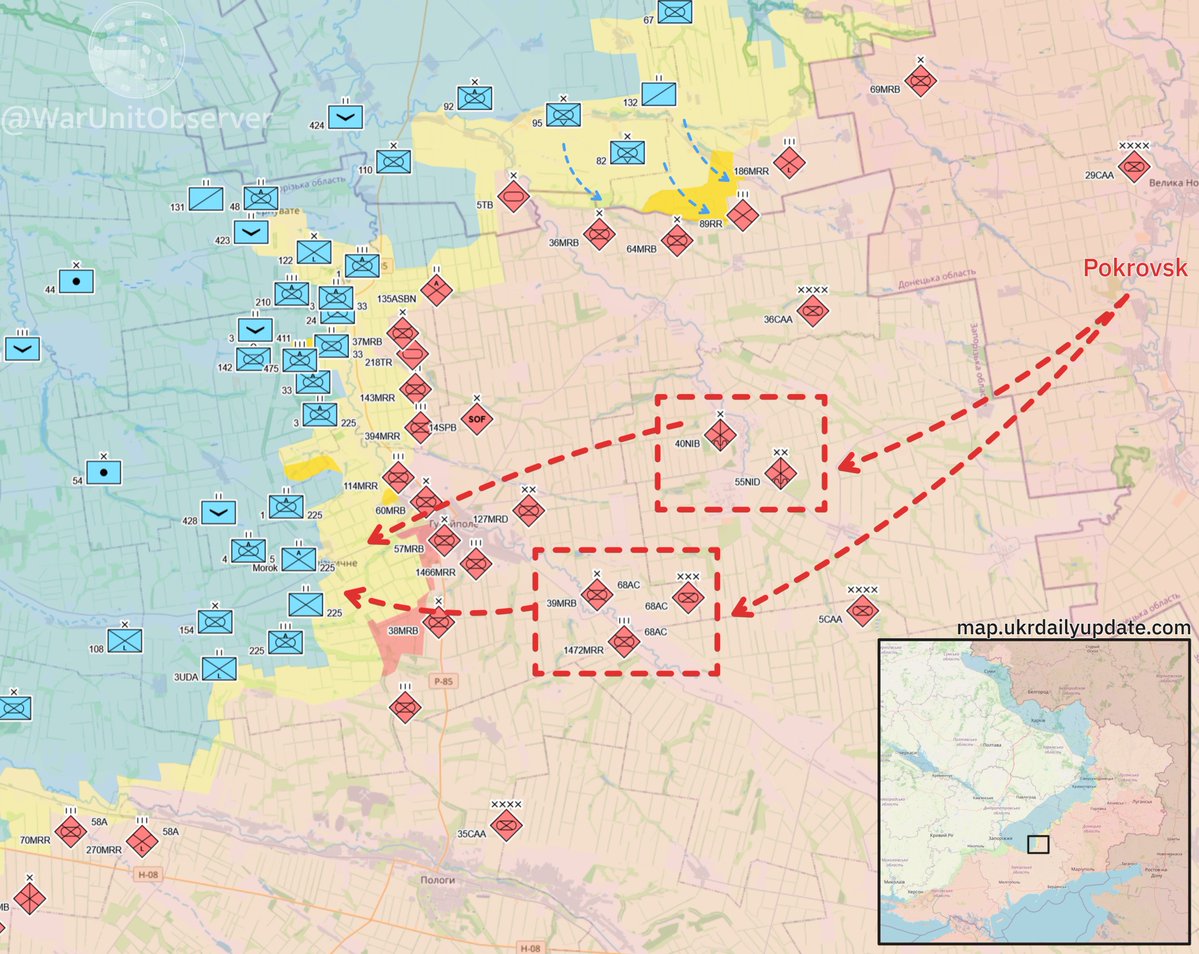
The Russian 🇷🇺“Vostok” Grouping faces several 🇺🇦Ukrainian assault regiments along with the 🇺🇦82nd and 95th Air Assault brigades, redeployed from Pokrovsk in late January for the occasion.
Given most of this information has been published by various other sources, we set out to provide a longer perspective on the often neglected and forgotten south-eastern corner of the frontline.
[1/9]
Between the end of January and the beginning of February, Ukrainian forces began a series of counterattacks aimed at the south-eastern corner of the frontline - split between the Zaporizhzhia and Dnipro oblasts.
This area recorded the deepest 🇷🇺Russian advances in late 2025, but the low force density generated by the infiltration tactics used seems to be an exploitable weakness.
The Russian 🇷🇺“Vostok” Grouping faces several 🇺🇦Ukrainian assault regiments along with the 🇺🇦82nd and 95th Air Assault brigades, redeployed from Pokrovsk in late January for the occasion.
Given most of this information has been published by various other sources, we set out to provide a longer perspective on the often neglected and forgotten south-eastern corner of the frontline.
[1/9]
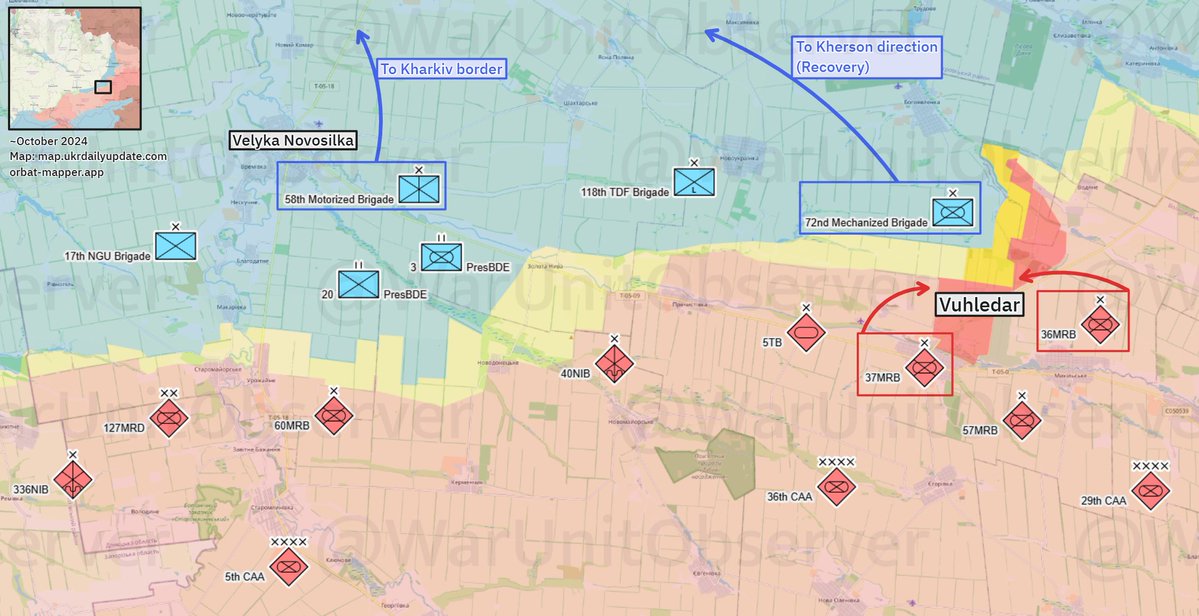
On October 1st, 2024 the ruins of Vuhledar were fully occupied by 🇷🇺Russian forces.
The famous lynchpin of Ukraine’s southeastern front that had withstood the attacks of hundreds of Russian vehicles in the first two years of the war - charred husks of BMPs, BTRs and T-series tanks still populate the fields south of Vuhledar to this day - had given in.
The Ukrainian unit that led the defence of Vuhledar, the 🇺🇦72nd Mechanized Brigade, was rotated out of the area soon after the city fell for rest and recovery, after two straight years spent on the frontline.
In the same days, some 30 kilometers west, the 🇺🇦58th Motorized Brigade would leave the Velyka Novosilka front for the northern border of Kharkiv oblast.
Another “leading” Ukrainian unit, acting as headquarters for attached units in a ~20km wide sector, had now left the southern edge of Donetsk oblast.
These two rotations would spell the end of frontline stability in southern Donetsk.
The famous lynchpin of Ukraine’s southeastern front that had withstood the attacks of hundreds of Russian vehicles in the first two years of the war - charred husks of BMPs, BTRs and T-series tanks still populate the fields south of Vuhledar to this day - had given in.
The Ukrainian unit that led the defence of Vuhledar, the 🇺🇦72nd Mechanized Brigade, was rotated out of the area soon after the city fell for rest and recovery, after two straight years spent on the frontline.
In the same days, some 30 kilometers west, the 🇺🇦58th Motorized Brigade would leave the Velyka Novosilka front for the northern border of Kharkiv oblast.
Another “leading” Ukrainian unit, acting as headquarters for attached units in a ~20km wide sector, had now left the southern edge of Donetsk oblast.
These two rotations would spell the end of frontline stability in southern Donetsk.
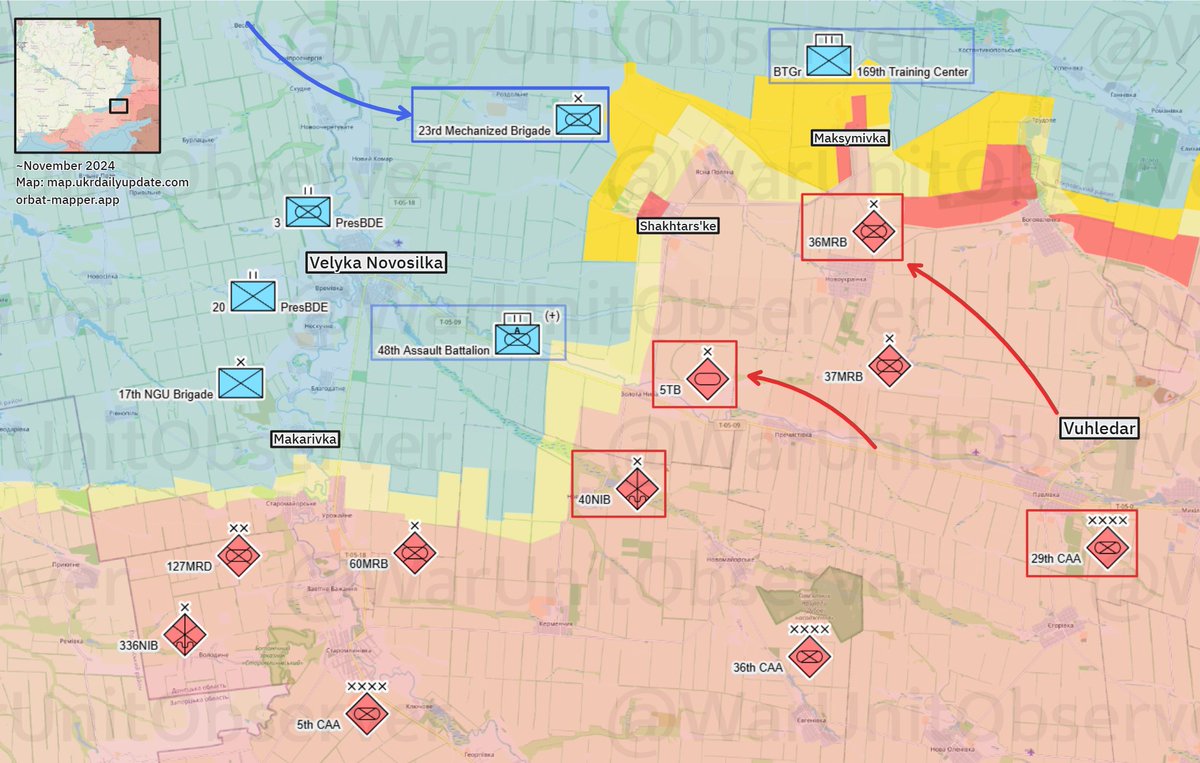
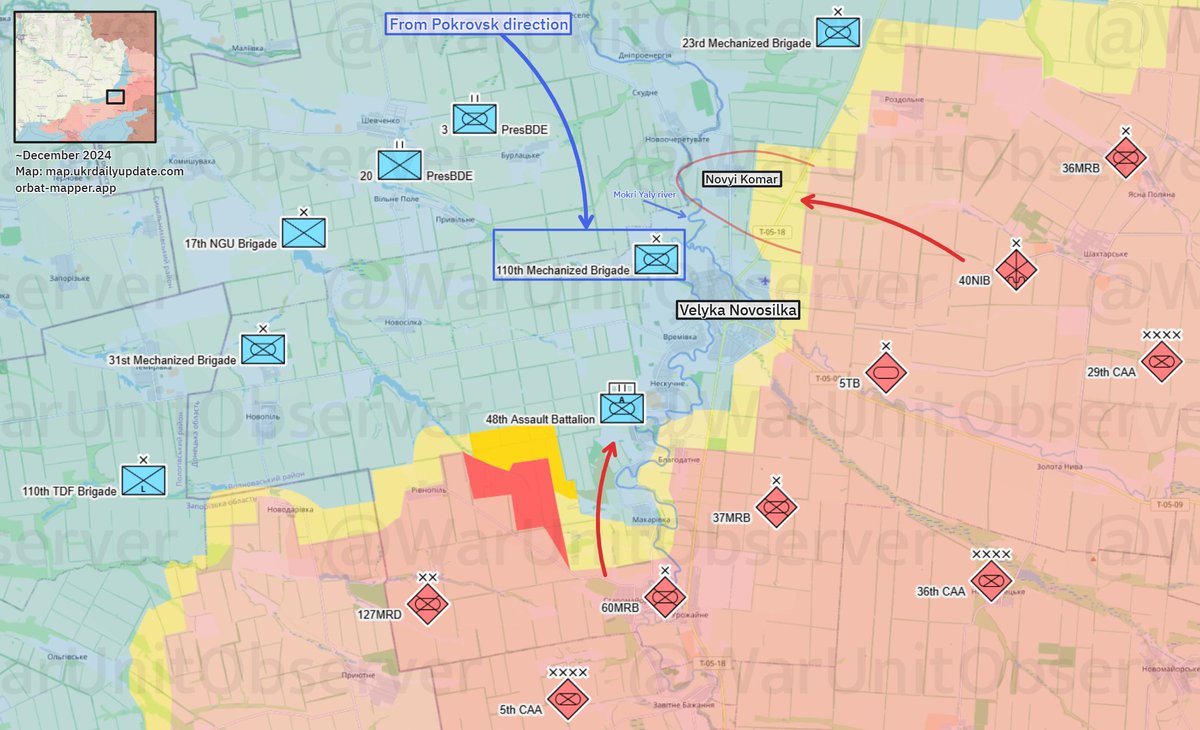
During the last months of 2024, 🇷🇺Russian forces continued their advance and drove a deep wedge between Vuhledar and Velyka Novosilka.
Units of the 🇷🇺29th Combined Arms Army, the 36th Motor Rifle Brigade in particular, managed to achieve 10-kilometer advances in a single day - relatively impressive figures in the “post-2022” positional conflict.
The 🇷🇺40th Naval Infantry and 5th Tank brigades advanced on the 36th’s left flank.
The 🇺🇦23rd Mechanized Brigade was rushed to the area, attempting to support two battlegroups based on the 48th Assault Battalion and 169th Training Center, but the eastern flank of Velyka Novosilka had essentially collapsed.
Battles would develop similarly north of Vuhledar despite higher force density on the Ukrainian side, culminating in the fall of Kurakhove by the first week of 2025.
Units of the 🇷🇺29th Combined Arms Army, the 36th Motor Rifle Brigade in particular, managed to achieve 10-kilometer advances in a single day - relatively impressive figures in the “post-2022” positional conflict.
The 🇷🇺40th Naval Infantry and 5th Tank brigades advanced on the 36th’s left flank.
The 🇺🇦23rd Mechanized Brigade was rushed to the area, attempting to support two battlegroups based on the 48th Assault Battalion and 169th Training Center, but the eastern flank of Velyka Novosilka had essentially collapsed.
Battles would develop similarly north of Vuhledar despite higher force density on the Ukrainian side, culminating in the fall of Kurakhove by the first week of 2025.
Velyka Novosilka, considered a key hub in southern Donetsk, was reinforced by the battle-hardened 🇺🇦110th Mechanized Brigade from the Pokrovsk sector in December - with additional elements attached to compensate for previous attrition, it was expected to hold the town.
However, 🇷🇺Russian elements had already reached the Mokri Yaly river on the northern and south-western sides of Velyka Novosilka, turning the entire urban area into a bridgehead over a water obstacle. Moving both resources and personnel in and out of the city became nearly impossible.
Ukrainian forces retreated across the Mokri Yaly, not without substantial losses, and Velyka Novosilka was lost by the end of January 2025.
However, 🇷🇺Russian elements had already reached the Mokri Yaly river on the northern and south-western sides of Velyka Novosilka, turning the entire urban area into a bridgehead over a water obstacle. Moving both resources and personnel in and out of the city became nearly impossible.
Ukrainian forces retreated across the Mokri Yaly, not without substantial losses, and Velyka Novosilka was lost by the end of January 2025.
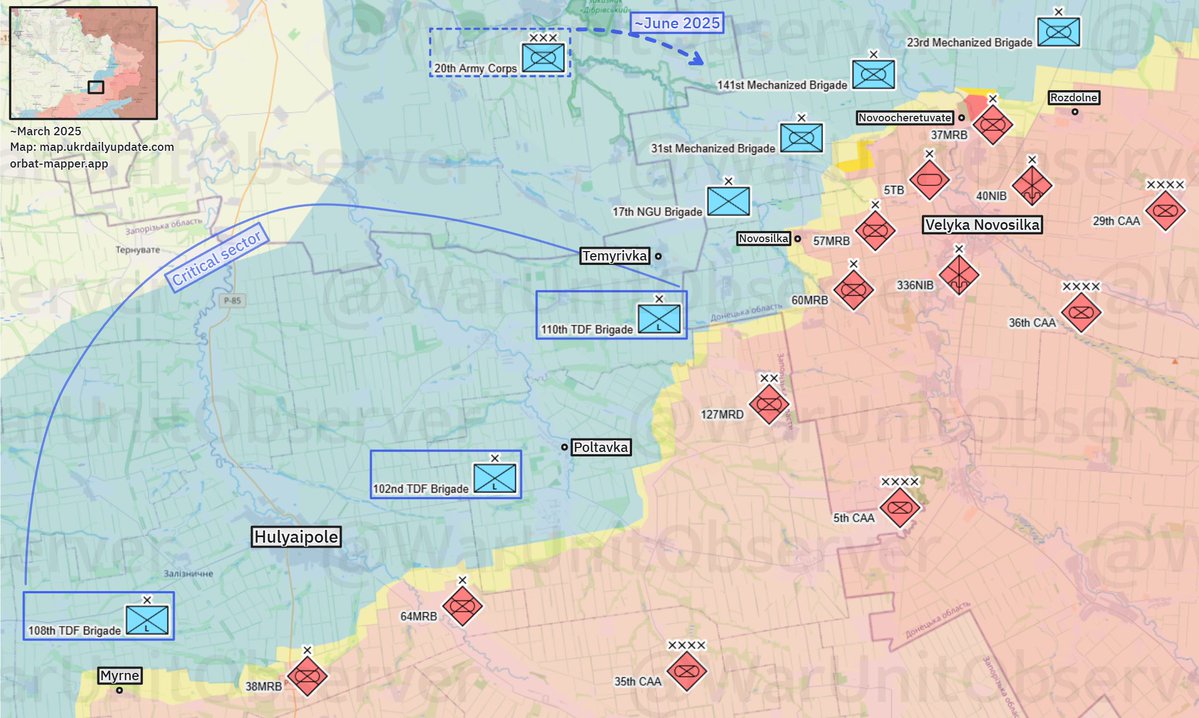
By the end of winter, several 🇺🇦ground forces brigades had fully taken charge of sectors in the area. East to west, these were the 23rd, 141st (replacing most of 110th) and 31st Mechanized Brigades.
Directly west of Velyka Novosilka stood the National Guard’s 🇺🇦17th Brigade, previously south of the town and now in charge of the area near Novosilka.
This sector would eventually come under the command of the newly created 🇺🇦20th Army Corps in early summer.
Further west, however, lay the critical area of the southern front: a section of the line entirely under the control of three 🇺🇦Territorial Defence (TDF) brigades, deployed here since 2023 and with a mixed combination of separate TDF battalions assigned to them.
While 🇷🇺Russian pressure between Myrne and Temyrivka had been virtually non-existent until 2024, this would change in 2025.
Directly west of Velyka Novosilka stood the National Guard’s 🇺🇦17th Brigade, previously south of the town and now in charge of the area near Novosilka.
This sector would eventually come under the command of the newly created 🇺🇦20th Army Corps in early summer.
Further west, however, lay the critical area of the southern front: a section of the line entirely under the control of three 🇺🇦Territorial Defence (TDF) brigades, deployed here since 2023 and with a mixed combination of separate TDF battalions assigned to them.
While 🇷🇺Russian pressure between Myrne and Temyrivka had been virtually non-existent until 2024, this would change in 2025.
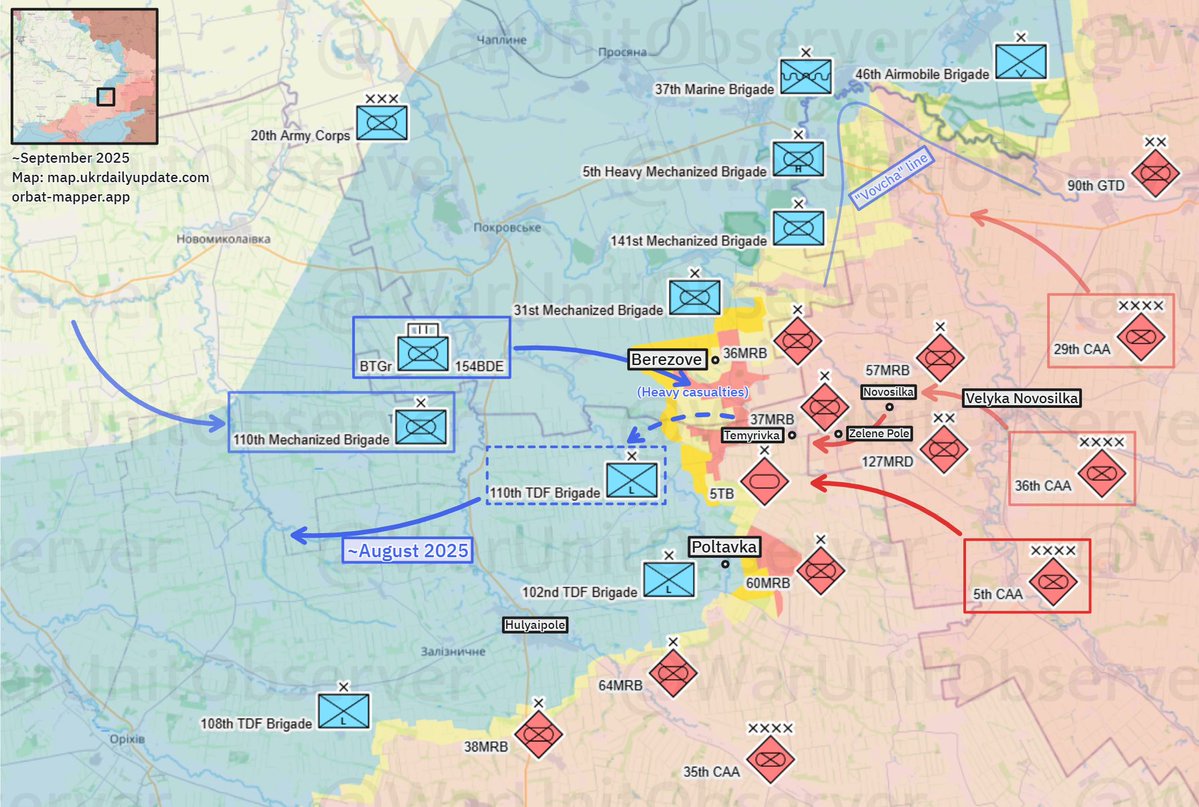
The Russian 🇷🇺“Vostok” group initially focused its resources on its northern flank - the 29th and 36th CAAs slowly advanced north of Velyka Novosilka during the spring, eventually establishing themselves on the Vovcha river in the summer.
However, the 🇺🇦Ukrainian mechanized brigades (along with Marine and Air Assault units) opposing them prevented any real breakthrough. The Russian offensive pace remained relatively slow.
Around mid-July, it seems the 🇷🇺“Vostok” group shifted its main effort towards the western flank.
Attacks began out of Zelene Pole and Novosilka. By mid-August, Temyrivka was mostly under 🇷🇺Russian control.
The 🇺🇦110th Territorial Defense Brigade’s sector, with its various attached TDF battalions, slowly gave way to the 🇷🇺5th CAA (127th Division, 57th and 60th brigades) and 🇷🇺36th CAA units (5th and 37th brigades).
As had happened in Velyka Novosilka, the 🇺🇦110th Mechanized Brigade was rushed in at the end of August, attempting to stabilize the Berezove-Poltavka line.
In yet another example of poorly organized defensive structure, a battalion tactical group of the 🇺🇦154th Mechanized Brigade was hastily deployed here and its personnel attached to other units, including the 6th Battalion of the 108th TDF Brigade - itself detached from its parent brigade and operating under the 110th TDF Brigade. These battalions suffered heavy casualties.
This patchwork of separate companies and battalions cobbled together under entirely unrelated commands has been a distinctive trademark of the southern front since 2024, and likely one of the main causes of its repeated failures.
However, the 🇺🇦Ukrainian mechanized brigades (along with Marine and Air Assault units) opposing them prevented any real breakthrough. The Russian offensive pace remained relatively slow.
Around mid-July, it seems the 🇷🇺“Vostok” group shifted its main effort towards the western flank.
Attacks began out of Zelene Pole and Novosilka. By mid-August, Temyrivka was mostly under 🇷🇺Russian control.
The 🇺🇦110th Territorial Defense Brigade’s sector, with its various attached TDF battalions, slowly gave way to the 🇷🇺5th CAA (127th Division, 57th and 60th brigades) and 🇷🇺36th CAA units (5th and 37th brigades).
As had happened in Velyka Novosilka, the 🇺🇦110th Mechanized Brigade was rushed in at the end of August, attempting to stabilize the Berezove-Poltavka line.
In yet another example of poorly organized defensive structure, a battalion tactical group of the 🇺🇦154th Mechanized Brigade was hastily deployed here and its personnel attached to other units, including the 6th Battalion of the 108th TDF Brigade - itself detached from its parent brigade and operating under the 110th TDF Brigade. These battalions suffered heavy casualties.
This patchwork of separate companies and battalions cobbled together under entirely unrelated commands has been a distinctive trademark of the southern front since 2024, and likely one of the main causes of its repeated failures.
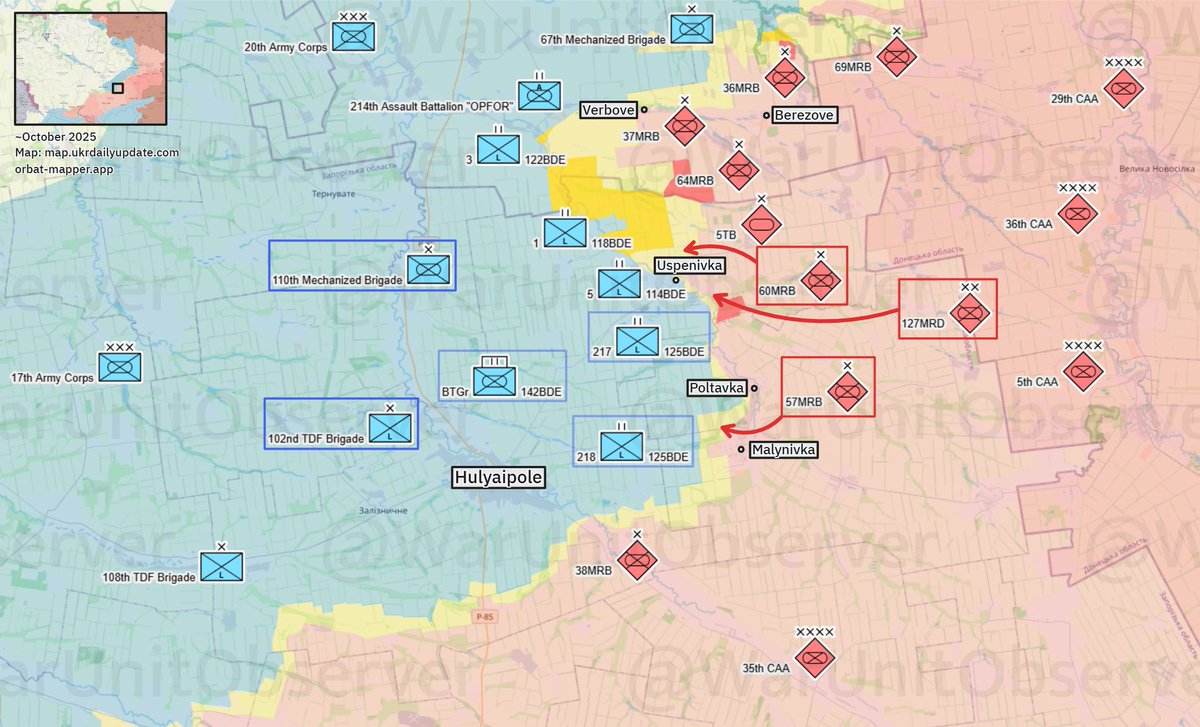
“Repeated” indeed, as 🇷🇺Russian forces had now taken Berezove and put their eyes on the southern lynchpin of the defensive line: Malynivka and Poltavka, 15 kilometers directly east of Hulyaipole.
The 🇺🇦102nd TDF Brigade had been here since 2022, defending the frontline south and east of Hulyaipole.
However, the brigade on its left flank had now collapsed.
In addition to this, the entire leadership of the 102nd was changed at some point in October. According to sources, this led to the dissolution of most procedures in the unit, which had been developed over 3 years operating in the area.
More battalions were attached, including from the 🇺🇦125th (ex-TDF) Heavy Mechanized Brigade, 142nd Mechanized Brigade and 114th TDF Brigade.
Both Poltavka and Malynivka fell to the 🇷🇺57th Motor Rifle Brigade by the end of October, with the 🇺🇦217th and 218th battalions of the 125th Brigade and a 🇺🇦battalion tactical group from the 142nd Brigade all taking heavy casualties.
Uspenivka fell to the 🇷🇺127th Motor Rifle Division and 60th Motor Rifle Brigade in the first week of November.
This paved 🇷🇺Russia’s way to Hulyaipole’s eastern approaches.
The 🇺🇦102nd TDF Brigade had been here since 2022, defending the frontline south and east of Hulyaipole.
However, the brigade on its left flank had now collapsed.
In addition to this, the entire leadership of the 102nd was changed at some point in October. According to sources, this led to the dissolution of most procedures in the unit, which had been developed over 3 years operating in the area.
More battalions were attached, including from the 🇺🇦125th (ex-TDF) Heavy Mechanized Brigade, 142nd Mechanized Brigade and 114th TDF Brigade.
Both Poltavka and Malynivka fell to the 🇷🇺57th Motor Rifle Brigade by the end of October, with the 🇺🇦217th and 218th battalions of the 125th Brigade and a 🇺🇦battalion tactical group from the 142nd Brigade all taking heavy casualties.
Uspenivka fell to the 🇷🇺127th Motor Rifle Division and 60th Motor Rifle Brigade in the first week of November.
This paved 🇷🇺Russia’s way to Hulyaipole’s eastern approaches.
🇷🇺Russian forces thus continued advancing from Uspenivka and Poltavka, reaching the Hulyaipole-Pokrovske highway at the end of November.
Various villages in the open fields between these two larger towns were infiltrated and taken by invading forces.
Hulyaipole was, at this point, in a semi-encirclement with Russians on three sides.
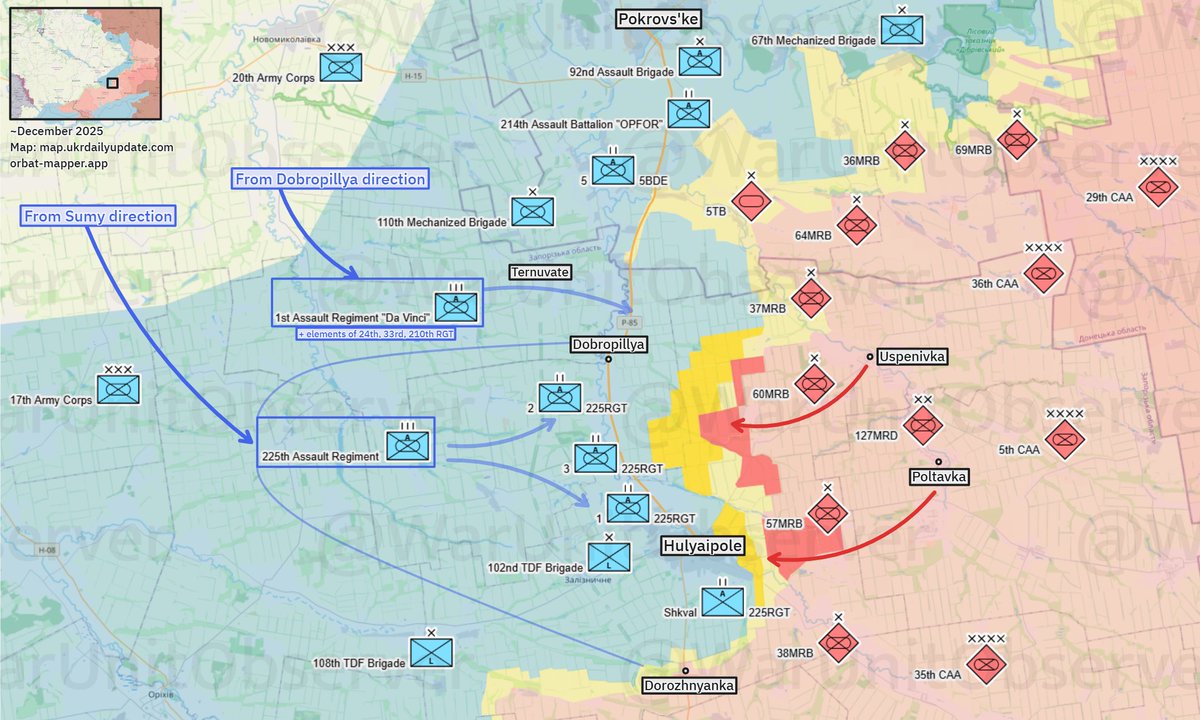
The 🇺🇦225th Assault Regiment in its entire strength was thus redeployed from Sumy in late November.
It took control of the entire Hulyaipole sector, approximately from Dorozhnyanka to Dobropillya, and re-organized the (mainly TDF) forces now under it.
While the city still fell to the Russians, the 🇺🇦225th’s intervention managed to slow down their momentum and consolidate the line on the Hulyaipole-Pokrovske highway by January. While enemy infiltrations continued, they were not allowed to consolidate after moving kilometers deep behind the Ukrainian lines, as had happened during the autumn.
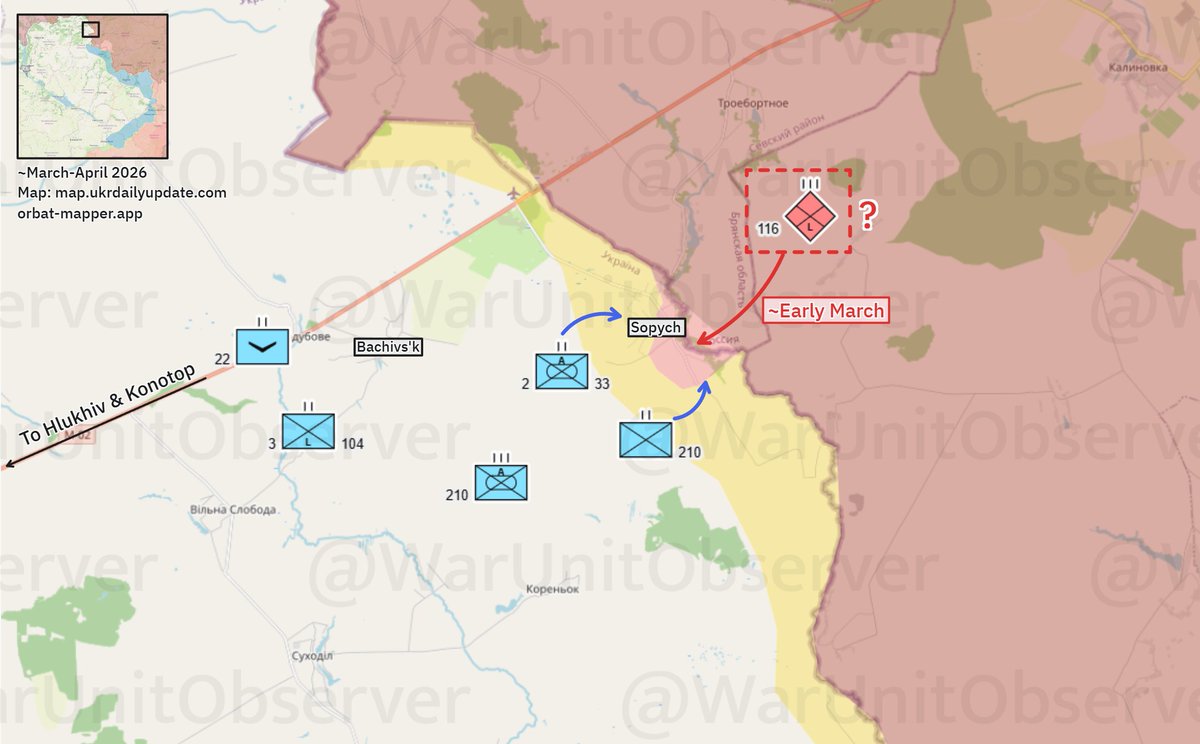
Despite this, Ukrainian higher command also deployed most of the 🇺🇦1st Assault Regiment north of the 225th, along with various elements of the 🇺🇦33rd, 24th and 210th Regiments.
In hindsight, this decision could have been a hint for 🇷🇺Russian command that the 🇺🇦Ukrainian objective was not simply slowing their advances, but retaking the initiative in the area.
Various villages in the open fields between these two larger towns were infiltrated and taken by invading forces.
Hulyaipole was, at this point, in a semi-encirclement with Russians on three sides.
The 🇺🇦225th Assault Regiment in its entire strength was thus redeployed from Sumy in late November.
It took control of the entire Hulyaipole sector, approximately from Dorozhnyanka to Dobropillya, and re-organized the (mainly TDF) forces now under it.
While the city still fell to the Russians, the 🇺🇦225th’s intervention managed to slow down their momentum and consolidate the line on the Hulyaipole-Pokrovske highway by January. While enemy infiltrations continued, they were not allowed to consolidate after moving kilometers deep behind the Ukrainian lines, as had happened during the autumn.
Despite this, Ukrainian higher command also deployed most of the 🇺🇦1st Assault Regiment north of the 225th, along with various elements of the 🇺🇦33rd, 24th and 210th Regiments.
In hindsight, this decision could have been a hint for 🇷🇺Russian command that the 🇺🇦Ukrainian objective was not simply slowing their advances, but retaking the initiative in the area.
Closing remarks: while the extent of 🇺🇦Ukrainian success since the beginning of this recent operation is still unclear, it seems the attacking units have managed to halt 🇷🇺Russian momentum and clear several villages previously considered in the "gray zone" or under light Russian control.
Given the last time 🇺🇦Ukraine held the initiative in this area was during the 2023 counteroffensive's push south of Velyka Novosilka, this is an important result.
It also demonstrates 🇺🇦Ukrainian forces retain the ability to conduct localized offensive operations, as was the case in Dobropillya (August-September 2025) and Kupyansk (September-November 2025).
We will provide more detailed information on these ongoing events as it becomes available.
Given the last time 🇺🇦Ukraine held the initiative in this area was during the 2023 counteroffensive's push south of Velyka Novosilka, this is an important result.
It also demonstrates 🇺🇦Ukrainian forces retain the ability to conduct localized offensive operations, as was the case in Dobropillya (August-September 2025) and Kupyansk (September-November 2025).
We will provide more detailed information on these ongoing events as it becomes available.
• • •
Missing some Tweet in this thread? You can try to
force a refresh