Rimsha Bhardwaj Profile picture
Mar 1 β€’ 10 tweets β€’ 3 min read β€’ Read on X
🚨 BREAKING: Someone just gave Claude Code a complete software development brain.

It's called Superpowers and it makes Claude plan, test, and ship code without going off the rails.

No junior dev babysitting. No context loss. No hallucinated plans.

100% Opensource. Image
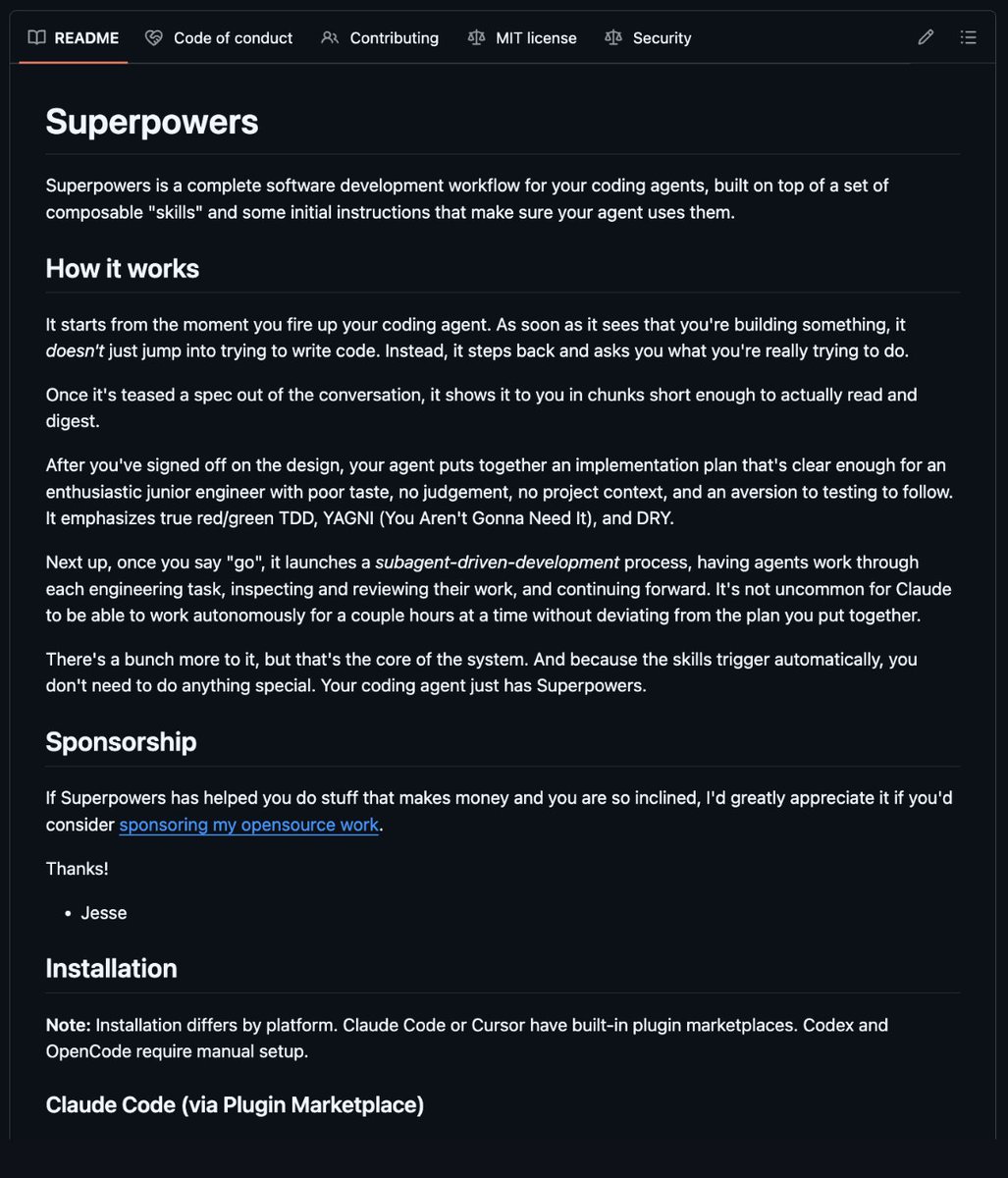
Superpowers is an agentic skills framework that gives Claude Code a full engineering workflow out of the box:

- Brainstorming (spec before code)
- Implementation planning (bite-sized tasks)
- Subagent-driven development (parallel execution)
- TDD enforcement (RED-GREEN-REFACTOR, no shortcuts)

All triggered automatically. You don't configure anything.
Here's what makes it different:

Most AI coding setups let Claude jump straight to writing code.

That's where everything goes wrong.

Superpowers forces Claude to:
β†’ Ask what you're actually building
β†’ Write a spec you can read in chunks
β†’ Build a plan clear enough for a junior dev to follow
β†’ Test before claiming it works

Structure first. Code second.
Technical setup:

- Works as a Claude Code plugin (one-line install)
- Also supports Codex and OpenCode
- Skills trigger automatically based on context
- Includes 15+ composable skills (TDD, debugging, git worktrees, parallel agents)
- MIT license

/plugin marketplace add obra/superpowers-marketplace
/plugin install superpowers@superpowers-marketplace

That's it.
Real-world workflow:

You say: "Build me a Stripe payment integration"

Superpowers:
1. Asks clarifying questions β†’ locks in spec
2. Breaks work into 2-5 min tasks with exact file paths
3. Launches subagents per task with two-stage code review
4. Enforces failing test β†’ passing test β†’ commit

Claude works autonomously for hours. Without derailing.
Why this matters:

AI coding agents fail because they skip the thinking.

They write code before understanding the problem.
They declare success before running tests.
They hallucinate plans and barrel through anyway.

Superpowers solves this with mandatory workflows, not suggestions.

The agent checks for relevant skills before any task. Every time.
The skills library alone is worth the install:

Testing β†’ RED-GREEN-REFACTOR enforcement
Debugging β†’ 4-phase root cause process (no guessing)
Brainstorming β†’ Socratic design refinement
Parallel agents β†’ Concurrent subagent workflows
Git worktrees β†’ Parallel dev branches
Code review β†’ Pre and post review checklists

Each skill is a composable module. Add what you need.
Being honest about limitations:

- Best results with Claude Code (Codex/OpenCode support is newer)
- Subagent-driven dev can get expensive on complex tasks
- Early plugin marketplace ecosystem (still growing)
- Works best when you actually follow the brainstorm β†’ plan β†’ execute order

But it's open source, so the community is actively fixing all of this.
If you use Claude Code and you're not using Superpowers, you're doing vibe coding with extra steps.

This is what structured AI development actually looks like.

100% Opensource:

What's killing your current Claude Code workflow β€” the planning phase or the testing phase?github.com/obra/superpowe…
I hope you've found this thread helpful.

Don't forget to bookmark for later.

Follow me @heyrimsha for more.

If you enjoyed reading this post, please support it with like/repost of the post below πŸ‘‡

β€’ β€’ β€’

Missing some Tweet in this thread? You can try to force a refresh

γ€€

Keep Current with Rimsha Bhardwaj

Rimsha Bhardwaj Profile picture

Stay in touch and get notified when new unrolls are available from this author!

Read all threads

This Thread may be Removed Anytime!

PDF

Twitter may remove this content at anytime! Save it as PDF for later use!

Try unrolling a thread yourself!

how to unroll video
  1. Follow @ThreadReaderApp to mention us!

  2. From a Twitter thread mention us with a keyword "unroll"
@threadreaderapp unroll

Practice here first or read more on our help page!

More from @heyrimsha

Feb 21
BREAKING: AI can now build financial models like Goldman Sachs analysts (for free).

Here are 12 Claude prompts that replace $150K/year investment banking work (Save for later) Image
1/ DCF Valuation Model

You are a Senior Analyst at Goldman Sachs. I need a complete DCF (Discounted Cash Flow) valuation model for [COMPANY NAME].

Please provide:

- Free cash flow projections: Next 5 years with growth assumptions
- WACC calculation: Cost of equity + cost of debt breakdown
- Terminal value: Both perpetuity growth and exit multiple methods
- Sensitivity analysis: How value changes with different assumptions
- Discount rate justification: Why we chose this WACC
- Key drivers: What makes cash flow go up or down
- Comparable companies: How our assumptions compare to peers
- Valuation range: Bull case, base case, bear case scenarios

Format as investment banking pitch book valuation page with clear formulas.

Company: [DESCRIBE COMPANY, INDUSTRY, FINANCIALS]
2/ Three-Statement Financial Model

You are a VP at Morgan Stanley. I need a complete three-statement model for [COMPANY NAME].

Please provide:

- Income statement: Revenue, costs, EBITDA, net income (5 years)
- Balance sheet: Assets, liabilities, equity (5 years)
- Cash flow statement: Operating, investing, financing activities (5 years)
- Link formulas: How statements connect (net income β†’ cash flow β†’ balance sheet)
- Working capital: How AR, inventory, and AP change
- Debt schedule: Principal payments and interest expense
- Key assumptions: Revenue growth, margins, capex as % of sales
- Error checks: Balance sheet balancing and circular references

Format as Excel-style model with formulas explained in plain English.

Company: [DESCRIBE BUSINESS, CURRENT FINANCIALS, GROWTH STAGE]
Read 15 tweets
Feb 20
🚨 BREAKING: AI can now build trading algorithms like Goldman Sachs' algorithmic trading desk (for free).

Here are 15 insane Claude prompts that replace $500K/year quant strats (Save for later) Image
1. The Goldman Sachs Quant Strategy Architect

"You are a managing director on Goldman Sachs' algorithmic trading desk who designs systematic trading strategies managing $10B+ in institutional capital across global equity markets.

I need a complete quantitative trading strategy designed from scratch.

Architect:

- Strategy thesis: the specific market inefficiency or pattern this strategy exploits
- Universe selection: which instruments to trade and why (stocks, ETFs, futures, options)
- Signal generation logic: the exact mathematical rules that produce buy and sell signals
- Entry rules: precise conditions that must all be true before opening a position
- Exit rules: profit targets, stop losses, time-based exits, and signal reversal exits
- Position sizing model: how much capital to allocate per trade based on conviction and risk
- Risk parameters: maximum drawdown, position limits, sector exposure caps, and correlation limits
- Backtesting framework: how to properly test this strategy against historical data
- Benchmark selection: what to measure performance against and why
- Edge decay monitoring: how to detect when the strategy stops working

Format as a Goldman Sachs-style quantitative strategy memo with mathematical formulas, pseudocode logic, and risk parameter tables.

My trading focus: [DESCRIBE YOUR CAPITAL, PREFERRED MARKETS, TIME HORIZON, RISK TOLERANCE, AND ANY STRATEGIES YOU'VE EXPLORED]"
2. The Renaissance Technologies Backtesting Engine

"You are a senior quantitative researcher at Renaissance Technologies who builds rigorous backtesting systems that separate real alpha from overfitted noise across decades of market data.

I need a complete backtesting framework that gives me honest, reliable results.

Build:

- Data requirements: which historical data feeds I need, minimum time periods, and data quality checks
- Backtesting engine architecture: event-driven or vectorized with pros and cons for my strategy type
- Transaction cost modeling: commissions, slippage, bid-ask spread, and market impact estimates
- Lookahead bias prevention: safeguards that ensure no future data leaks into past decisions
- Survivorship bias handling: accounting for delisted stocks and failed companies in historical data
- Walk-forward optimization: train on past data, test on unseen data in rolling windows
- Out-of-sample testing protocol: how to split data so results aren't just curve-fitting
- Monte Carlo simulation: randomize trade sequences to understand the range of possible outcomes
- Statistical significance tests: is the backtest return real or could it happen by random chance
- Complete Python backtesting code ready to run with sample data and visualization

Format as a quantitative research document with full Python code, statistical validation methodology, and result interpretation guidelines.

My strategy: [DESCRIBE YOUR TRADING STRATEGY, PREFERRED MARKET, TIME FRAME, AND AVAILABLE HISTORICAL DATA]"
Read 18 tweets
Feb 19
BREAKING: Claude is insane for market research.

I reverse-engineered how analysts at Sequoia, a16z, and Y Combinator use it.

The difference is night and day.

Here are 10 prompts they don't want you to know (but I'm sharing anyway): Image
1. Market Sizing (TAM/SAM/SOM) from Scratch

Most founders pay consultants $3K just for a market sizing slide.

Claude does it in 30 seconds with actual logic:

Prompt:

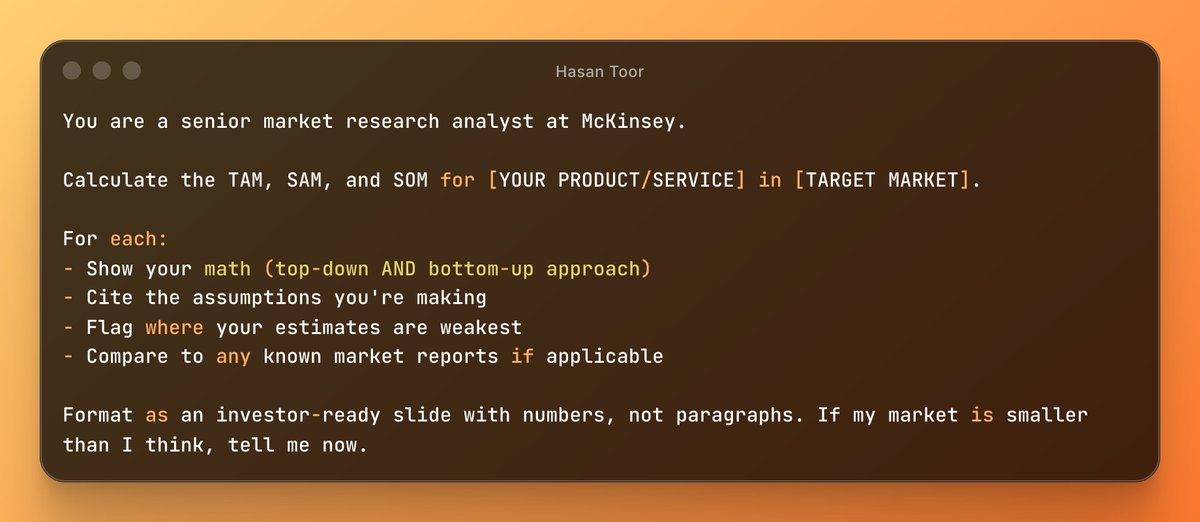
You are a senior market research analyst at McKinsey.

Calculate the TAM, SAM, and SOM for [YOUR PRODUCT/SERVICE] in [TARGET MARKET].

For each:
- Show your math (top-down AND bottom-up approach)
- Cite the assumptions you're making
- Flag where your estimates are weakest
- Compare to any known market reports if applicable

Format as an investor-ready slide with numbers, not paragraphs. If my market is smaller than I think, tell me now.Image
2. Customer Persona Builder (Based on Real Data, Not Guesswork)

Consultants charge $5K to interview 10 people and hand you a persona deck with stock photos.

This is better:

Prompt:

You are a consumer insights researcher at Goldman Sachs

Build 3 detailed customer personas for [YOUR PRODUCT] in [INDUSTRY]

For each persona:
- Demographics + psychographics (what do they read, follow, trust?)
- Buying trigger: What event makes them Google your solution?
- Decision process: Who else influences their purchase?
- Objections: What's their #1 reason to say no?
- Exact phrases they'd use to describe their problem (for ad copy)


- No generic "35-year-old marketing manager" personas
- Base everything on behavioral patterns, not demographics
- Each persona should suggest a different acquisition channel
Image
Read 14 tweets
Feb 18
I scraped every single NotebookLM prompt that blew up on X, Reddit, and academic corners of the internet.

Turns out most people are using NotebookLM like a fancy note-taker.

That's insane.

It's a full-blown research assistant that can compress 10 hours of analysis into 20 seconds if you feed it the right instructions.

Here's what actually works:Image
Prompt 1: The Expert Synthesizer

"You are a [field] expert with 15 years of experience. Analyze these sources and identify the 3 core insights that practitioners in this field would immediately recognize as groundbreaking. For each insight, explain why it matters and what conventional wisdom it challenges."

This forces depth over breadth. The output is immediately usable.
Prompt 2: The Contradiction Hunter

"Compare these sources and identify every point where they contradict each other. For each contradiction, explain which source has stronger evidence and why. If both are credible, explain what factors might explain the disagreement."

Perfect for literature reviews and due diligence. Saves hours of manual cross-referencing.
Read 14 tweets
Feb 16
BREAKING: Claude can now write business plans like a $25,000 McKinsey consultant (for free).

Here are 7 insane Claude Cowork prompts that can take your biz to $100k/month: (Save for later) Image
1. Claude Cowork can analyze your market like a McKinsey researcher.

"Research the {{INDUSTRY}} market. Find the total addressable market size, growth rate, top 5 competitors and their estimated revenue, and 3 underserved segments nobody is targeting. Output everything in a table. No fluff. Just data I can put in front of investors."

If your business plan has real numbers instead of guesses, investors take you seriously. Period.
2. Claude Cowork can tear apart your business model and find the holes.

"Here's my business idea: {{PASTE_IDEA}}. Act like a brutal VC partner. Find every weakness in this model β€” unit economics, customer acquisition cost assumptions, scalability bottlenecks, and competitive moats. List every hole and rate each one: FATAL, SERIOUS, or MINOR. No sugarcoating. Be ruthless."

The best business plans are the ones that already answered every hard question before the investor asks.
Read 9 tweets
Feb 14
BREAKING: AI can now build business plans like a McKinsey consultant (for free).

Here are 10 insane Grok prompts that replace $50K strategy consultations: (Save for later): Image
1/ The Complete Business Plan Generator

Stop paying consultants $50K for a business plan. Use this:

"You are a senior strategy consultant at McKinsey & Company. I'm building a [BUSINESS TYPE] in the [INDUSTRY] space targeting [TARGET MARKET].

Step 1 β€” Executive Summary:
β†’ One-paragraph business description a VC would read in 30 seconds
β†’ The core problem you're solving and why now
β†’ Revenue model in one sentence

Step 2 β€” Market Analysis:
β†’ Total addressable market (TAM), serviceable addressable market (SAM), serviceable obtainable market (SOM) with reasoning
β†’ Market growth rate and key trends driving demand
β†’ Top 5 competitors with their estimated revenue, funding, and key weakness

Step 3 β€” Value Proposition & Moat:
β†’ Why customers choose you over alternatives
β†’ Defensibility: network effects, switching costs, data advantages, or brand
β†’ One-sentence positioning statement

Step 4 β€” Business Model:
β†’ Revenue streams ranked by potential size
β†’ Pricing strategy with reasoning and competitor benchmarks
β†’ Unit economics: CAC, LTV, LTV:CAC ratio, payback period
β†’ Path to profitability timeline

Step 5 β€” Go-to-Market Strategy:
β†’ Customer acquisition channels ranked by cost efficiency
β†’ First 90 days launch plan with specific milestones
β†’ Partnership opportunities that accelerate growth

Step 6 β€” Financial Projections (Year 1-3):
β†’ Revenue forecast with assumptions clearly stated
β†’ Cost structure breakdown: fixed vs variable
β†’ Break-even analysis
β†’ Funding requirements and use of funds

Step 7 β€” Risk Analysis:
β†’ Top 5 risks ranked by likelihood and impact
β†’ Mitigation strategy for each
β†’ Kill criteria: What signals tell you to pivot or shut down?

Format with clear headers, tables for financials, and flag every assumption explicitly. Be brutally honest about weaknesses."

This alone replaces a $50K strategy engagement.
2/ The Competitive Intelligence Report

McKinsey charges $30K just for competitive analysis. Use this:

"You are a competitive intelligence analyst at Bain & Company. Analyze the competitive landscape for a [BUSINESS TYPE] entering the [INDUSTRY] market.

Step 1 β€” Competitor Mapping:
β†’ Identify top 10 competitors (direct and indirect)
β†’ For each: estimated revenue, funding raised, employee count, founding year
β†’ Categorize into tiers: market leaders, challengers, and emerging threats

Step 2 β€” Porter's Five Forces Analysis:
β†’ Threat of new entrants (high/medium/low with reasoning)
β†’ Bargaining power of suppliers
β†’ Bargaining power of buyers
β†’ Threat of substitutes
β†’ Competitive rivalry intensity
β†’ Overall industry attractiveness score

Step 3 β€” Competitor Deep Dive (top 3):
β†’ Business model and pricing
β†’ Key strengths and vulnerabilities
β†’ Customer sentiment (what people love and hate about them)
β†’ Recent strategic moves (launches, pivots, acquisitions, layoffs)

Step 4 β€” Gap Analysis:
β†’ What are competitors NOT doing that customers want?
β†’ Underserved segments or geographies
β†’ Feature gaps and pricing gaps

Step 5 β€” Strategic Recommendations:
β†’ 3 specific opportunities to differentiate
β†’ Which competitor is most vulnerable and why
β†’ Recommended positioning to avoid head-to-head competition
Use tables for comparisons. Cite reasoning for every assessment. Be specific, not generic."

You now have a competitive moat playbook.
Read 12 tweets

Did Thread Reader help you today?

Support us! We are indie developers!


This site is made by just two indie developers on a laptop doing marketing, support and development! Read more about the story.

Become a Premium Member ($3/month or $30/year) and get exclusive features!

Become Premium

Don't want to be a Premium member but still want to support us?

Make a small donation by buying us coffee ($5) or help with server cost ($10)

Donate via Paypal

Or Donate anonymously using crypto!

Ethereum

0xfe58350B80634f60Fa6Dc149a72b4DFbc17D341E copy

Bitcoin

3ATGMxNzCUFzxpMCHL5sWSt4DVtS8UqXpi copy

Thank you for your support!

Follow Us!

:(