
Multiple lines of evidence are converging on the idea that viruses you picked up decades ago might quietly be driving age-related diseases.
We've known for a few years that EBV raises MS risk 32-fold, and that molecular mimicry between an EBV protein and nerve insulation likely triggers brain autoimmunity. What remained unclear was why some people persistently carry EBV and others don't.
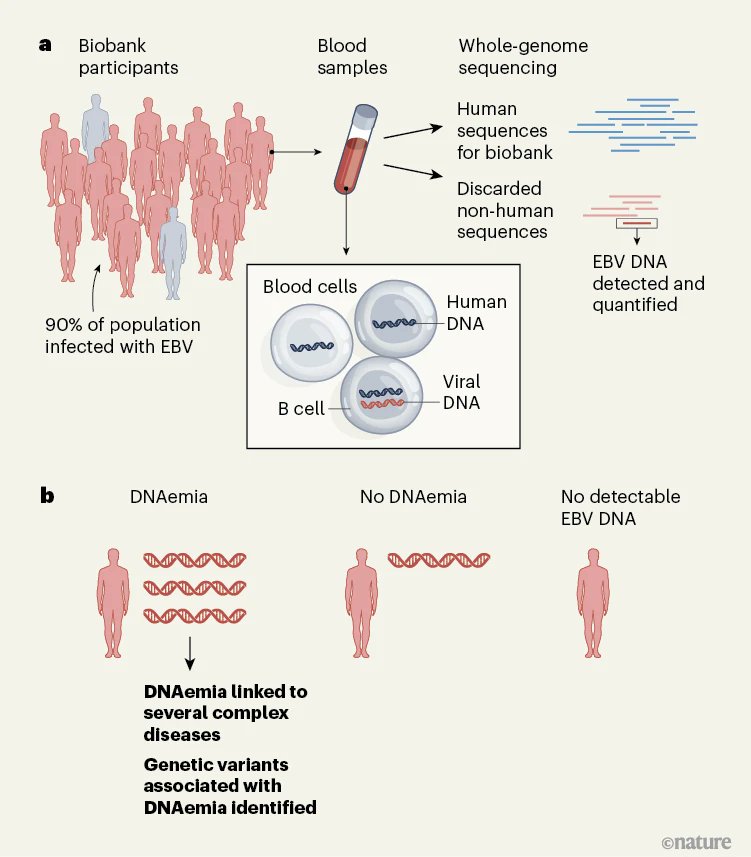
A new paper in @Nature from the @RyanDhindsa (whose lab has been supported by @impetusgrants) and @CalebLareau labs answers that at population scale. They mined ~735,000 human genomes for traces of Epstein-Barr virus, using reads of viral genomes that existing pipelines were throwing out as junk, and found that ~10% of people carry detectable EBV DNA in blood.
Carrying persistent EBV is associated with variable antigen processing, and the broader genetic architecture of viral persistence shares a component with lupus, rheumatoid arthritis, and type 1 diabetes.
Meanwhile, a separate line of very recent evidence is also pointing in that direction. The shingles vaccine, targeting another persistent herpesvirus, is showing ~20% dementia risk reduction in quasi-randomized studies which has been replicated across multiple countries.
There seems to be more at the intersection of immunity and age-related disease than we initially thought.
We've known for a few years that EBV raises MS risk 32-fold, and that molecular mimicry between an EBV protein and nerve insulation likely triggers brain autoimmunity. What remained unclear was why some people persistently carry EBV and others don't.
A new paper in @Nature from the @RyanDhindsa (whose lab has been supported by @impetusgrants) and @CalebLareau labs answers that at population scale. They mined ~735,000 human genomes for traces of Epstein-Barr virus, using reads of viral genomes that existing pipelines were throwing out as junk, and found that ~10% of people carry detectable EBV DNA in blood.
Carrying persistent EBV is associated with variable antigen processing, and the broader genetic architecture of viral persistence shares a component with lupus, rheumatoid arthritis, and type 1 diabetes.
Meanwhile, a separate line of very recent evidence is also pointing in that direction. The shingles vaccine, targeting another persistent herpesvirus, is showing ~20% dementia risk reduction in quasi-randomized studies which has been replicated across multiple countries.
There seems to be more at the intersection of immunity and age-related disease than we initially thought.
Read the Nature paper here: nature.com/articles/s4158…
The EBV papers mentioned:
- science.org/doi/10.1126/sc…
- nature.com/articles/s4158…
The shingles + dementia papers mentioned:
- cell.com/cell/fulltext/…
- nature.com/articles/s4158…
The EBV papers mentioned:
- science.org/doi/10.1126/sc…
- nature.com/articles/s4158…
The shingles + dementia papers mentioned:
- cell.com/cell/fulltext/…
- nature.com/articles/s4158…
Infectious disease and aging research tend to be funded separately, which means work like this often falls between categories. This is part of why the next round of @impetusgrants includes a focused call on infectious disease and aging.
Details: norn.group/impetus-grants
Details: norn.group/impetus-grants
If you want to keep learning about aging and how we'll make progress in fighting it, check out our substack: norngroup.substack.com
• • •
Missing some Tweet in this thread? You can try to
force a refresh




