Izabella Kaminska Profile picture
Mar 13 23 tweets 4 min read Read on X
THREAD: Why the private credit crisis is just the West’s version of “involution”

1/ In my latest piece for TBS I argue that the West's growing private credit crisis represents its own version of China's economic "involution" — a liquidity-driven form of economic growth that produces enormous activity and capital deployment but progressively weaker underlying returns.
2/ In China the mechanism was domestic financial repression. Cheap household savings were channeled into low-return industrial investment, producing massive overcapacity and exports sold abroad at razor-thin or even negative margins.
3/ In the West the mechanism looked different but produced a similar outcome. Extremely cheap capital and abundant liquidity fueled a private-equity, venture, and later private-credit ecosystem that allowed large numbers of structurally unprofitable firms to keep expanding.
4/ Many of these companies pursued scale at almost any cost. The idea was simple: give the product away, subsidize adoption, dominate market share, eliminate competitors, and worry about profitability later.
5/ The Silicon Valley / unicorn playbook therefore ended up mirroring Chinese industrial policy in an unexpected way: success depended less on near-term profits than on outlasting competitors through subsidized growth.
6/ But that dynamic rarely stopped once a winner emerged. New waves of venture-funded challengers constantly arrove trying to undercut incumbents, producing the same hyper-competitive environment seen in Chinese manufacturing sectors.
7/ In both cases the system starts to look less like normal price discovery and more like a quota-driven process where activity and expansion matter more than sustainable returns.
8/ Western markets reinforced this logic. For more than a decade investors overwhelmingly rewarded companies for growth rather than profits, allowing deeply unprofitable businesses to survive as long as revenues and market share kept expanding.
9/ That expansion was financed by private equity and venture capital backed largely by long-term investors like pension funds and endowments. Fund managers were rewarded primarily through valuation marks and paper gains, not realized cash returns.
10/ Over time private credit emerged as the refinancing layer that helped keep the system going — providing loans to companies traditional banks increasingly avoided while helping private equity preserve valuations and delay losses.
11/ The entire structure worked because liquidity was abundant and investors didn’t need immediate distributions. As long as capital kept flowing and valuations kept rising, the system could keep extending itself.
12/ If my analysis is correct then today's private credit turmoil isn’t really the cause of the problem.
Rather, it's a moment when a decade-plus of liquidity-driven involution collides with the need to produce real cash returns.
13/ Demographics are forcing that shift. Pension funds and other long-term investors are increasingly being drawn down to meet obligations, which means they now need actual cash flows, not just rising NAV marks.
14/ Once investors start demanding realizations, the illusion breaks. Companies that could survive indefinitely under abundant liquidity suddenly have to prove they can generate real profits and service real debt.
15/ The end result is classic involution: each additional unit of credit extended simply sustains or expands a loss-making business model, making the next round of growth even more expensive and less viable to finance.
16/ The circularity also begins to resemble China’s system in another way. In China, banks fund projects that sustain struggling firms; In the U.S., private credit funds refinance companies that sustain valuations and fund economics across the private-equity chain.
17/ The only difference lies in the funding source. Chinese repression draws on household deposits trapped in the banking system, while Western private credit draws on pooled institutional capital attracted by promises of stable, high returns.
18/ If that system unwinds, it doesn’t mean American growth was entirely illusory. But it likely means some portion of measured growth reflected subsidized expansion and capital recycling rather than durable productivity gains. On that front, since a relatively good wedge of the American economy is still propped up by actually viable dividend-producing companies, the U.S. is probably better positioned to deal with its involution crisis than China.
19/ Nonetheless, it still suggests the celebrated strength of deep Western capital markets may have a shadow side: instead of state-directed investment like China, the West has engineered planning by proxy — liquidity-driven capital allocation guided by incentives, narratives, and growth metrics rather than sustainable profitability.
20/ In that sense the private credit shake-out isn’t purely a crisis. It’s the painful but necessary process of defunding zombies and redirecting capital toward sectors where genuine productivity and durable returns exist.
21/ Don't get me wrong. The last decade’s repression-like conditions did produce real breakthroughs (just as the cold war space race did) — AI and other frontier technologies benefited enormously from that capital surge. But once the key infrastructure and platforms emerge, the system eventually has to transition from subsidized scale to productive investment.
22/ One final difference from 2008: unlike the GFC, the risk in the West also sits largely outside the core banking system and payments infrastructure. That means losses are more likely to show up as weaker investor returns and slower growth than as a systemic financial collapse. That's not the case in China.
23/ I should add that the above analysis applies more to the growth-driven tech / software / SaaS phase of the private-credit story than the conventional one.

But that doesn’t mean the earlier form wasn’t also susceptible to involution. The private-equity model by definition works by layering additional financial claims over largely unchanged cash flows through leverage and concentrated ownership.

Taking companies private replaces market-based scrutiny with sponsor-based scrutiny — the premise being that a smaller group of professional investors can restructure and grow a business more effectively than dispersed public shareholders.

In practice, however, much of the return comes from concentrating control and increasing leverage, which allows those investors to capture a larger share of the same underlying cash flows. Incentives are not always aligned.

• • •

Missing some Tweet in this thread? You can try to force a refresh

 

Keep Current with Izabella Kaminska

Izabella Kaminska Profile picture

Stay in touch and get notified when new unrolls are available from this author!

Read all threads

This Thread may be Removed Anytime!

PDF

Twitter may remove this content at anytime! Save it as PDF for later use!

Try unrolling a thread yourself!

how to unroll video
  1. Follow @ThreadReaderApp to mention us!

  2. From a Twitter thread mention us with a keyword "unroll"
@threadreaderapp unroll

Practice here first or read more on our help page!

More from @izakaminska

Mar 11
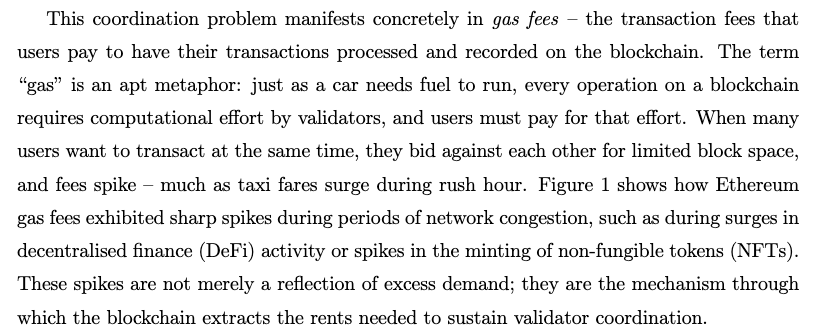
Nice to see that @HyunSongShin has officially recognized that stablecoins open the door to an "Uber Surge Pricing" type liquidity market. [Actual gas markets also clear in a similar way, notably the NBP balancing point system.]

The below screenshot is from his latest BIS paper "Tokenomics and blockchain fragmentation".

This is something I've been pointing to for years, though I've seen it as eventually leading to dynamic pricing and markets for intraday funds in general.

The paper is more concerned about the fragility and fragmentation risk introduced in systems that rely on many different networks using surge pricing mechanisms to ration entry and exit across systems.

And of course turkeys don't vote for xmas, so the central bank perspective is that all this "congestion" and cost uncertainty can be avoided if programmable money just shifts to cbank ledgers where the cbank balance sheet can absorb congestion shocks in a way that can regulate transaction costs.

The BIS concludes: "These [programmable money] innovations do not require decentralised consensus among anonymous validators. They can be implemented on unified ledgers anchored by central banks, which benefit from the institutional trust of the
traditional monetary system."

bis.org/publ/work1335.…Image
Here's some historic context from :

the-blindspot.com/important-the-…
Also relevant, my long read regarding how perpetuals came to be:

thepeg.co/p/long-read-th…
Read 4 tweets
Feb 20
THREAD 🧵I know everyone is very excited about aliens this morning, but I ask you, is it really as exciting as super wonky insights on dollar liquidity plumbing, Federal Reserve balance sheet policy, and stablecoin statecraft?

I think not. I interviewed Fed governor Stephen Miran this week and those were just some of the topics we discussed. For those who can't be bothered to wade through the transcript, I thought it might be useful to highlight the wonkiest bits.

thepeg.co/p/transcript-f…
1) Top wonky insight for me is that Miran is as perplexed as me about the ongoing role of the Fed Funds Market. "I’m not quite sure why we hold on to the Fed funds rate, but we do. Maybe someday someone will explain it to me," he said.
2) I asked him if the current environment calls for greater awareness of how debt management policy is interacting with monetary policy.

He said that while the two don’t require explicit coordination, because the Fed should be pursuing monetary policy for monetary purposes, and Treasury should be pursuing fiscal policy for fiscal policy purposes, they do require awareness, because what "the one does can depend on what the other does, because the choices from the one can affect conditions that matter for the choices of the other."

And "In theory, you could run up against a time in which there are constraints."
Read 8 tweets
Jun 30, 2025
🧵1/ I wonder how many people realise that what's really going on with stablecoins is a massive US statecraft play to re-dollarize the world on its own terms. You could even call it a "re-stablization op" (yep - there's a gag in there).
2/ My analysis is that the reason why many countries are panicking about the upcoming dollar onslaught is because it's a backchannel way to rebase the system, and force 2008-era capital holes to be finally written down.
3/The intent is also to re-establish the supremacy of the dollar in markets where people can't trust their own governments, via a freely floated currency that can actually offer proper price discovery against domestic currencies.
Read 21 tweets
Apr 10, 2025
1/ Just a short recap of why it pays to watch your blind spots.

On Feb 23 we argued that the Mar-a-Lago Accord was gearing up to be more of a Bretton Woods 2.0 affair than a Plaza Accord. But also that the real challenge was how to get everyone to the table.

the-blindspot.com/in-the-blind-s…
2/ March 1 we explained the real struggle was between two systems, both of which independently believe are liberating the other from oppression. We called it mutual liberation syndrome.

the-blindspot.com/in-the-blind-s…
3/ On March 8, we explained that to get everyone to the table a controlled demolition of the stock market was necessary using Xi’s own strategy of shaking down the system to highlight its vulnerabilities and keep wealth imbalances in check.

the-blindspot.com/in-the-blind-s…
Read 4 tweets
Apr 9, 2025
1/ Amid the endless and breathless commentary today, worth remembering this is a giant game of high stakes Liar’s Poker.

It’s also an exercise in mutual assured economic destruction. MAED.

This means it’s not about markets or valuations, it’s almost exclusively about game theory and who can withstand the pressure longer.

The idea this hasn’t been war gamed is naive though.

A few things to remember: Officially China doesn’t own much long dated paper so it can claim plausible deniability re the long-end sell off. But in reality we have no idea what China really owns, because of its use of offshore proxies.
2/ As I set out in the Great Simplification podcast in March, for “MAED” theory to work you need to present the perception you really are MAD enough to do the unthinkable.

I also argued that there is a paradoxical stability in the game theory equation from having a consistently reliable Liar at the table.

3/ If the objective is creating a steady and stable state or drawing multiple players to a negotiation where trust is the missing variable there is a paradoxical stability associated with the presence of what I would call a “known liar”.

The introduction of a predictably deceptive agent can paradoxically create a common knowledge dynamic. The liar becomes a fixed variable — a strategic constant — whose motivations are well-understood. This transforms higher-order uncertainty into first-order predictability, enabling the formation of a new, more stable Nash equilibrium.

In other words, if there are two negotiations about to take place about how to structure the new financial system and trust is lacking, the preference should be to gather at the table of the known liar.

And who has the world been saying is greatest liar of them all?Image
Read 5 tweets
Mar 15, 2025
I’m starting to think that the great stock market rotation from ESG/FANG to MAGA stocks could be one of the most obvious stock market opportunities in the post 2008-era.

I also think people are confusing Trump family grift with very tactical signalling about how to position to take advantage of the pump, and magnify it. And yes they will make money out of it, but that’s kind of the point. It’s an alignment of their political vision for America with VC-style carried interest. If their vision fails so will their portfolios.

That is arguably a healthier way to handle the conflicts related to insider-influenced political stock picks (based on regulatory arb) - usually removed from any comprehensive vision for the country - than having politicians run Nancy Pelosi-style stock portfolios, or take advisory positions after their terms end.

There’s an argument the Trump clan are just making the Pelosi thing explicit, and timely enough to ensure as many normal people can come on the ride as possible.

More at the below link 👇
It’s all about using hype rather than explicit financial repression to drive irrational exuberance that can drive private capital into strategic autonomy plays that can boost domestic productivity and growth.

I think soon enough Europe and Britain will copy this somehow.

If not, they will just be forced to do it with actual financial repression instead of the cult inspiring magic of a state-sponsored version of The Apprentice, where absolutely everyone has a chance at being a contestant.
Read 4 tweets

Did Thread Reader help you today?

Support us! We are indie developers!


This site is made by just two indie developers on a laptop doing marketing, support and development! Read more about the story.

Become a Premium Member ($3/month or $30/year) and get exclusive features!

Become Premium

Don't want to be a Premium member but still want to support us?

Make a small donation by buying us coffee ($5) or help with server cost ($10)

Donate via Paypal

Or Donate anonymously using crypto!

Ethereum

0xfe58350B80634f60Fa6Dc149a72b4DFbc17D341E copy

Bitcoin

3ATGMxNzCUFzxpMCHL5sWSt4DVtS8UqXpi copy

Thank you for your support!

Follow Us!

:(