
Jürgen Habermas died today at 96.
Few political theorists shaped how we think about democratic legitimacy in modern societies as profoundly. His lifelong question was straightforward but demanding:
How can political authority be justified under conditions of pluralism?
🧵
Few political theorists shaped how we think about democratic legitimacy in modern societies as profoundly. His lifelong question was straightforward but demanding:
How can political authority be justified under conditions of pluralism?
🧵
Habermas’s early breakthrough was The Structural Transformation of the Public Sphere (1962).
Here, he reconstructs the emergence of the public sphere: spaces where private citizens debate matters of common concern and subject political authority to rational-critical scrutiny.
Here, he reconstructs the emergence of the public sphere: spaces where private citizens debate matters of common concern and subject political authority to rational-critical scrutiny.
The argument is historical but normative.
Democratic legitimacy depends on public reasoning. When the public sphere is colonised by state bureaucracy, media power, or economic interests, the conditions for public reasoning deteriorate.
Democratic legitimacy depends on public reasoning. When the public sphere is colonised by state bureaucracy, media power, or economic interests, the conditions for public reasoning deteriorate.
The normative core of Habermas’s theory is captured in the famous formulation:
“der zwanglose Zwang des besseren Arguments”
the unforced force of the better argument.
Legitimacy emerges when positions prevail because others accept the reasons, not because of authority or coercion
“der zwanglose Zwang des besseren Arguments”
the unforced force of the better argument.
Legitimacy emerges when positions prevail because others accept the reasons, not because of authority or coercion
This idea is elaborated systematically in The Theory of Communicative Action (1981).
Habermas distinguishes between:
strategic action (oriented toward success)
communicative action (oriented toward understanding).
Democratic politics ultimately relies on the latter.
Habermas distinguishes between:
strategic action (oriented toward success)
communicative action (oriented toward understanding).
Democratic politics ultimately relies on the latter.
Language itself carries normative expectations.
In The Theory of Communicative Action, Habermas argues that every speech act raises validity claims:
truth
normative rightness
sincerity
These claims can be challenged and justified through argument.
In The Theory of Communicative Action, Habermas argues that every speech act raises validity claims:
truth
normative rightness
sincerity
These claims can be challenged and justified through argument.
The same work introduces Habermas’s influential distinction between lifeworld and system:
The lifeworld reproduces shared meanings through communication.
The system coordinates action through money and administrative power.
Modern societies require both.
The lifeworld reproduces shared meanings through communication.
The system coordinates action through money and administrative power.
Modern societies require both.
The danger arises when market and bureaucratic logics intrude into areas that should remain governed by communicative norms. Habermas calls this the “colonisation of the lifeworld”.
Beyond his social theory, Habermas diagnosed the problem politically.
In Legitimation Crisis (1975), he argues that advanced capitalist states face crises when administrative systems can no longer generate sufficient normative justification for political authority.
In Legitimation Crisis (1975), he argues that advanced capitalist states face crises when administrative systems can no longer generate sufficient normative justification for political authority.
He identifies four interlinked crises: economic (a cyclical feature of capitalism), rationality (the state unable to manage economic contradictions), legitimation (citizens questioning political authority), and motivation (loss of motivation to adhere to social norms).
The key insight: modern states must justify their authority, not just exercise it.
Between Facts and Norms (1992) presents a model of deliberative democracy in which legitimacy arises from the interaction among civil society, public sphere, and democratic institutions
Between Facts and Norms (1992) presents a model of deliberative democracy in which legitimacy arises from the interaction among civil society, public sphere, and democratic institutions
Habermas argued that democratic legitimacy depends on political decisions being justifiable through public reasoning and open to contestation. Democracy is an ongoing process of justification.
One place where I disagreed with Habermas was his stance on Ukraine.
From Starnberg, the emphasis on restraint and escalation management reflects a deeply rooted sense of responsibility in a nuclear age and Germany’s historical (post 1945) caution about war.
From Starnberg, the emphasis on restraint and escalation management reflects a deeply rooted sense of responsibility in a nuclear age and Germany’s historical (post 1945) caution about war.
But from Prague or Kyiv the question looks different.
When a democracy faces imperial aggression, the problem is not only managing risks but defending the very conditions under which democratic self-government can exist at all.
When a democracy faces imperial aggression, the problem is not only managing risks but defending the very conditions under which democratic self-government can exist at all.
Disagreement is not a departure from Habermas’s project; it is its condition.
He never asked us to agree, only to justify our positions in ways others can question and contest.
In that sense, even my sharp disagreement above remains part of the democratic practice & his legacy.
He never asked us to agree, only to justify our positions in ways others can question and contest.
In that sense, even my sharp disagreement above remains part of the democratic practice & his legacy.
In a shared process of reasoning, the only authority should be the unforced force of the better argument.
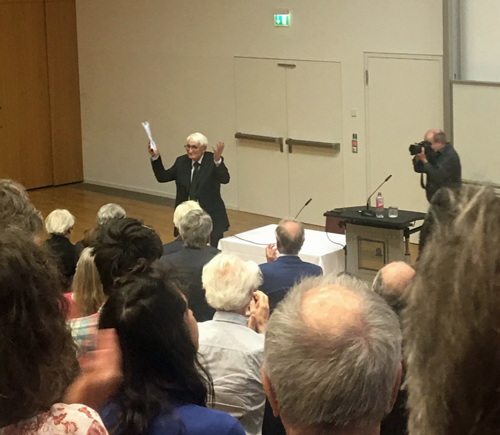
P.S.: Photo from the 2019 lecture in Frankfurt. The lecture was famously interrupted by a fire alarm, and we got all evacuated - I never got to finish my Habermas bingo ... 
• • •
Missing some Tweet in this thread? You can try to
force a refresh




