One of the helpful things that comes from reading blow-by-blow, day-by-day military histories is that you see how wildly assessments of past wars whose outcomes are now known changed as the wars progressed.
There are so many unknowns in this war. The fog of war is real. The war itself is just a few weeks old. Much can happen in another three weeks—or another six months.
• • •
Missing some Tweet in this thread? You can try to
force a refresh

The obvious answer is something like “the top 5 poets of each era” because 21st century writers do not consume much poetry.
But there are other options. Most 19th century authors would have read Carlyle, and you can make the case that a lot of 19th century prose is downstream his influence (see Moby Dick).
The idea that the Iran operation was mostly about China, that it fundamentally changes Chinese perceptions of American strength, or that it has already altered the balance of power between China and America in any real way, is bizarre to me.
We know what metrics the Chinese judge their competition with the US by. We know the military measures they care about and we know the non-military elements of national power that they think are most important.
Very honestly: the upcoming war powers resolutions vote on Iran will likely matter more to Chinese perceptions of American capacity (if the admin fails to get the vote) than the actual military attacks on Iran. Not hard to predict the sort of analysis the Xie Tao types will write up.
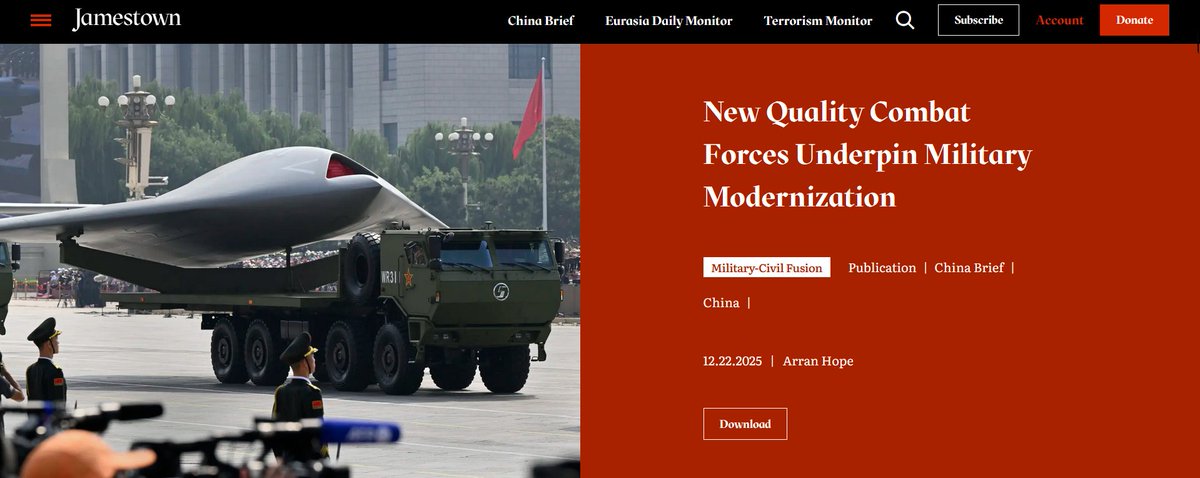
Important brief from @Arranjnh for @ChinaBriefJT on the relationship between military power and the "new quality productive forces" that Xi Jinping has staked the future of the Chinese economy on.
If you have followed anything said by Chinese leaders since about 2020, you know that China has embarked on a grand quest to dominate 21st century science and technology. I wrote about that here: scholars-stage.org/saving-china-t…
The key idea here: a China that pioneers new technological frontiers and dominates high-industry manufacturing will grow itself out of its current economic problems and place itself at the center of the global economy for decades.
I do not think China hawkery vs dovery is that well correlated with having lived in China.
I do think it is correlated with career inside China. Journalists who have lived in China are generally far more hawkish than academics who did, for example. It is not an accident that both Pottinger and Garnaut worked as China correspondents before they went into government.
If you have never been to China but your area of policy expertise is climate, you are probably pretty dovish on China. If you have never been to China but your area of policy expertise is military affairs, you are probably hawkish on China.
This makes sense in a way. If you have spent your career closely tracking the PLA's naval advances by looking at satellite photography and financial statements of Chinese naval firms, and have served as a sailor yourself, it would be very hard to not be a hawk, frankly.
The other problem with Angelica’s post is that she has the causality reversed: thr Taiwanese nationalist movement did not form because foreigners created a historical narrative to justify it—foreigners took cues from TW nationalists not the other way around!
(This is also true for many bearish takes on China’s economy and politics: many ideas start with *Chinese* critics of the existing situation, get parlayed to their western friends in journalism/finance/think tank world, and then come to dominate the western debate about China).
There is this strange disbelief in Taiwanese agency in Angelica’s post: as if guys like Michael, who started as a blogger, could be responsible for the ideology of Taiwan’s largest political party!