Alexandra Prokopenko Profile picture
Mar 19 10 tweets 3 min read Read on X
The Iran war coverage focuses on oil. The slower, more consequential story is fertilizers. A near-shutdown of the Strait of Hormuz is triggering a supply shock that will show up in food prices 6-9 months from now. Putin's gains here may be more long-term than simply lining his pockets with petrodollars
According to Lloyd's List Intelligence, Post-March 1 commercial traffic: 105 transits, 8.7m dwt. Same period in 2025: 1,870 transits, 167.9m dwt. That's a 94% collapse - not "disruption." The Gulf produces ~49% of global urea exports and ~30% of ammonia. Nearly all of it is stuck.
Consequences already material. Urea up 25-30% since Feb 28. Gulf producers have declared force majeure on contracts to South America and Asia. ~1 million metric tons of fertilizer physically stranded in the Gulf. Force majeure means contracts are legally severed -not delayed. Buyers must find alternatives now.
agweb.com/news/policy/po…
This is where Russia enters. Russia is a key supplier of ammonia and nitrogen fertilizers worldwide and, along with Belarus, covers about 40% of the global potash market. Russia, along with Qatar, is the prime exporter of urea to the US, and Russia exports the bulk of its fertilizer — more than 45 million tons a year — to the Global South. Nigerian and Ghanaian importers are already placing Q3 pre-orders with Russian suppliers
The timeline runs in three waves. Wave 1 (now): fertilizer price spike, contract disruption. Wave 2 (Q3-Q4 2026): reduced planting, lower yields — worst in Africa and South Asia where pre-purchasing is impossible. Wave 3 (2027): food price inflation hitting retail in import-dependent economies carnegieendowment.org/emissary/2026/…
The 2022 comparison matters, but has a critical asymmetry. Then: Russia was sanctioned, the Gulf was fine, and grain prices spiked simultaneously so farmers could offset input costs with revenue. Now: Russia is fully operational, the Gulf has stopped, and grain prices are not surging like in 2022. Higher costs, flat revenue.
Kremlin hawk Patrushev frames the war as destroying "the system of global trade-economic relations," signalling that Moscow sees this not as a crisis but as an opportunity for realignment. He does not mention Ukraine, but suggests that merchant ships may be escorted by Russian Navy vessels. It should be noted that Patrushev’s son is a deputy prime minister of the Russian government responsible for agriculture and fertilisers. kommersant.ru/doc/8514927?fr…
Russia's Position in Each Wave
Wave 1: Revenue. Higher prices and higher volumes sold simultaneously.
Wave 2: Market share. Supply contracts being rewritten now will direct purchasing toward non-Gulf, non-Hormuz sources. Russia is the largest available alternative for nitrogen and potash globally.
Wave 3: Geopolitical leverage. Countries dependent on Russian fertilizer for their food supply do not vote against Russia in multilateral forums, do not join sanctions coalitions, and provide the political constituency for the "Global South neutrality" narrative Moscow has been cultivating since 2022.
the Iran war will probably be over before most people connect it to the food prices they're paying in 2027. Russia will be positioned as the indispensable supplier that kept the lights on. That positioning wasn't planned. But it would be actively harvested.

• • •

Missing some Tweet in this thread? You can try to force a refresh

 

Keep Current with Alexandra Prokopenko

Alexandra Prokopenko Profile picture

Stay in touch and get notified when new unrolls are available from this author!

Read all threads

This Thread may be Removed Anytime!

PDF

Twitter may remove this content at anytime! Save it as PDF for later use!

Try unrolling a thread yourself!

how to unroll video
  1. Follow @ThreadReaderApp to mention us!

  2. From a Twitter thread mention us with a keyword "unroll"
@threadreaderapp unroll

Practice here first or read more on our help page!

More from @amenka

Jan 12
"The economy is not very important because it adapts to everything, said Putin at his year-end meeting with business.
Putin is wrong.
Beyond inflation and spending dynamics, here are 10 triggers I'll be monitoring in Russia's economy in 2026 — to assess when the system transitions from managed stagnation to searching for a new equilibrium through crisis. 🧵
thebell.io/ekonomika-ko-v…
2/Budget interest payments
Rose to 8.8% of total budget in 2026 (vs 4.4% in 2021). Will exceed combined education + healthcare spending.
Even as the key rate falls from 21% to 16%, total debt service grows because debt stock expands faster. Off-budget industry lending compounds the problem.
3/ Russia revised its 2025 budget deficit twice.
Final figure: 5.7trn rubles (2.6% GDP) vs. planned 1.17trn (0.5%). In fact it's probably higher, we'll learn it soon.
Largest absolute deficit in modern Russian history. And it's plugged with:

Tax increases (4th consecutive year)
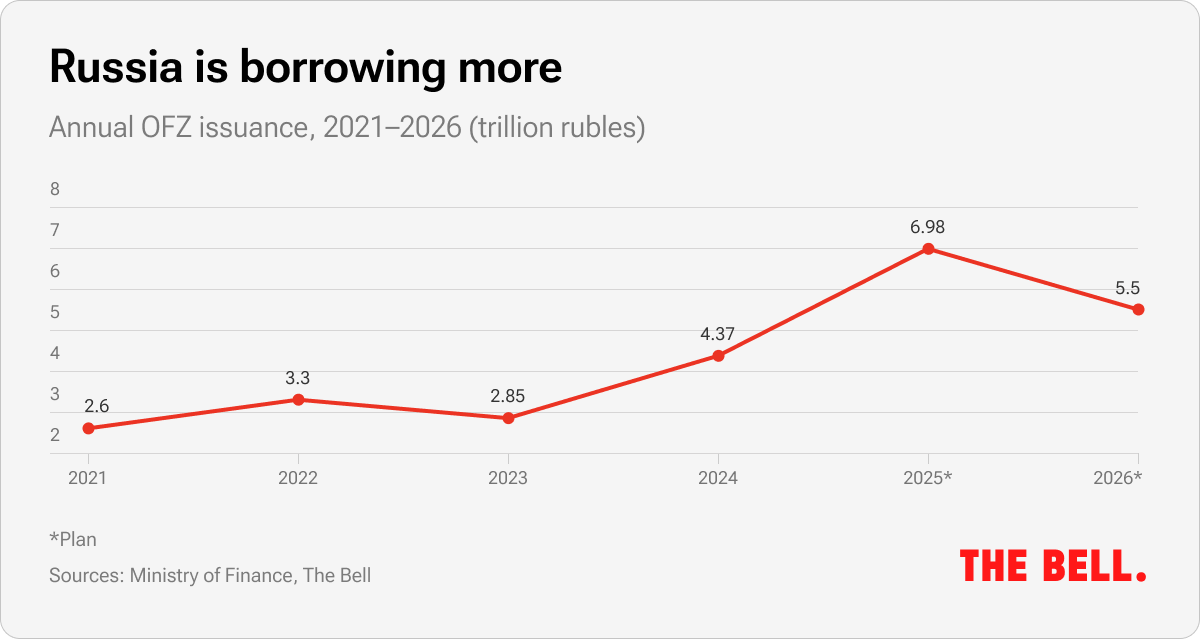
Debt accumulation (most inflationary path). In November, Banks bought 84.3% of the record 1.8trn ruble placement.Image
Read 12 tweets
Dec 26, 2024
Some funny (actually not) pics about the Rus economy w @kolyandr. Russia’s economy performed like a marathon runner on steroids in 2024. But the effect of the drugs is already beginning to wear off. GDP growth is currently slowing, while inflation is rising Image
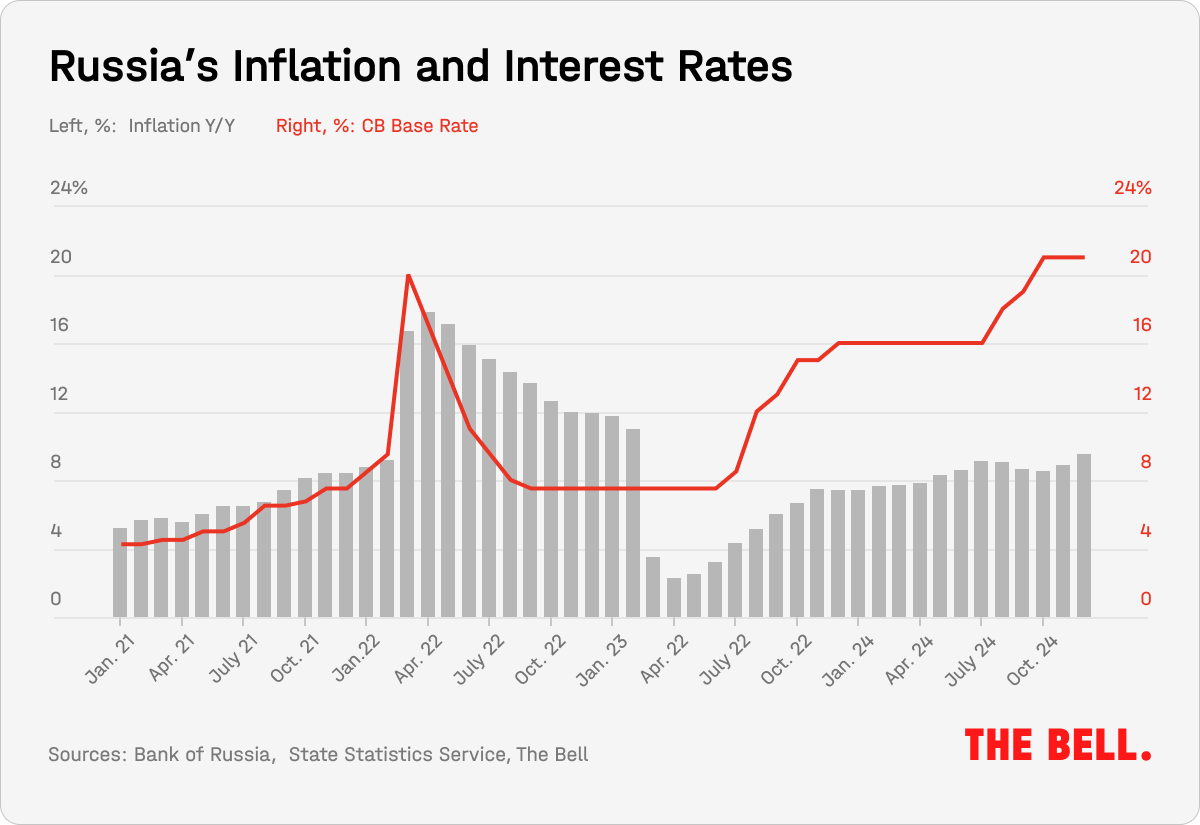
By the third week of December, annual inflation had hit 9.5%, which was significantly higher than the Central Bank’s most recent forecast of a maximum of 8.5%. Even record-high interest rates (21%) have not tamed inflation Image
The war continues to suck resources out of the Russian economy. As in previous wartime years, the biggest single item of state spending in 2025 will be the armed forces. And all the increase in nO&G revenues will go to the military Image
Read 10 tweets
Sep 23, 2024
As mentioned, Russia's military spending will remain elevated in 2025. Our forecasts are once again confirmed. Defense spending in 2025 is projected to reach 13.2 trillion rubles (~$142 billion) or 6,2% of GDP (10.4 trillion rubles planned for this year) Image
40% of the budget will be allocated to national defense and domestic security. This highlights how Russia is seriously adapting its economy to long-term elevated military spending. The economic price of this doesn't seem a concern for Putin. The real costs will come due not now
Putin has the funds to cover these expenses for the next 12 months. Where does the money come from?
- hydrocarbon export revenues
- tax increases and excise duties; improved tax collection on turnover taxes
- A delay in fulfilling the promises made in the presidential address
Read 6 tweets
Jun 17, 2024
Putin has appointed Anna Tsivileva, Leonid Gornin, Pavel Fradkov as new deputies at MoD.What does it tell us:
- Tsivileva is called Putin's great-niece
- Fradkov is the son of former PM and Foreign intelligence service head Mikhail Fradkov
- None of them are from Belousov's team
1/ the division of labour is following:
1st Deputy Minister Gornin will oversee the financial support of the Army. This was part of his duties in the Ministry of Finance, which meant that the control of military expenditure stayed in the hands of the financiers
2/Pavel Fradkov will be responsible for property management and construction of facilities for the MoD. Same responsibilities as had recently imprisoned Shoigu's deputy Ivanov. Noteworthy Fradkov's brother is CEO of Promsvyazbank - a 2key bank for the military-industrial complex
Read 5 tweets
Apr 29, 2024
Following the release of the US aid package to Ukraine, the best-case scenario for Kyiv in '24 seems to be that 🇷🇺's gains are limited to incremental progress at the height of its defense spending. But what if 🇷🇺's military spending has not yet peaked?
🧵
carnegieendowment.org/politika/92326
1/ From the Kremlin’s standpoint, U.S. aid may not directly challenge Russian military superiority in Ukraine, but it could increase the costs associated with maintaining superiority and thus delay Russia’s victory. Putin may view this aid package as potentially the last one
2/ If Ukraine, with Western support, does its homework regarding mobilization, fortification, and defense on the front, the Kremlin will be forced to react. And the increase in defense spending in 2025 from 5% of GDP to more can be such a reaction
Read 7 tweets
Apr 10, 2024
Russia's economy, fueled by the ongoing war with Ukraine, shows surprising stability amidst sanctions. However, this stability is precarious and not everlasting. In my newest paper for @CarnegieEndow, I explore the resilience and risks of Russia's economy
carnegieendowment.org/2024/04/10/is-…
1/ While sanctions restrict Russia's economic growth, they've paradoxically shielded it from certain external shocks. Key pillars of resilience include:
- Market nature of the economy
- Commodities-based exports
- Strategies to bypass sanctions
- Significant fiscal impulse
2/ Since 2014, Russia has adapted its financial system to mounting U.S./EU sanctions, ensuring that foreign-currency debt levels pose no threat to financial stability. The Central Bank of Russia holds sufficient foreign-exchange reserves to finance this debt Image
Read 21 tweets

Did Thread Reader help you today?

Support us! We are indie developers!


This site is made by just two indie developers on a laptop doing marketing, support and development! Read more about the story.

Become a Premium Member ($3/month or $30/year) and get exclusive features!

Become Premium

Don't want to be a Premium member but still want to support us?

Make a small donation by buying us coffee ($5) or help with server cost ($10)

Donate via Paypal

Or Donate anonymously using crypto!

Ethereum

0xfe58350B80634f60Fa6Dc149a72b4DFbc17D341E copy

Bitcoin

3ATGMxNzCUFzxpMCHL5sWSt4DVtS8UqXpi copy

Thank you for your support!

Follow Us!

:(