Nicholas Decker Profile picture
Mar 19 15 tweets 4 min read Read on X
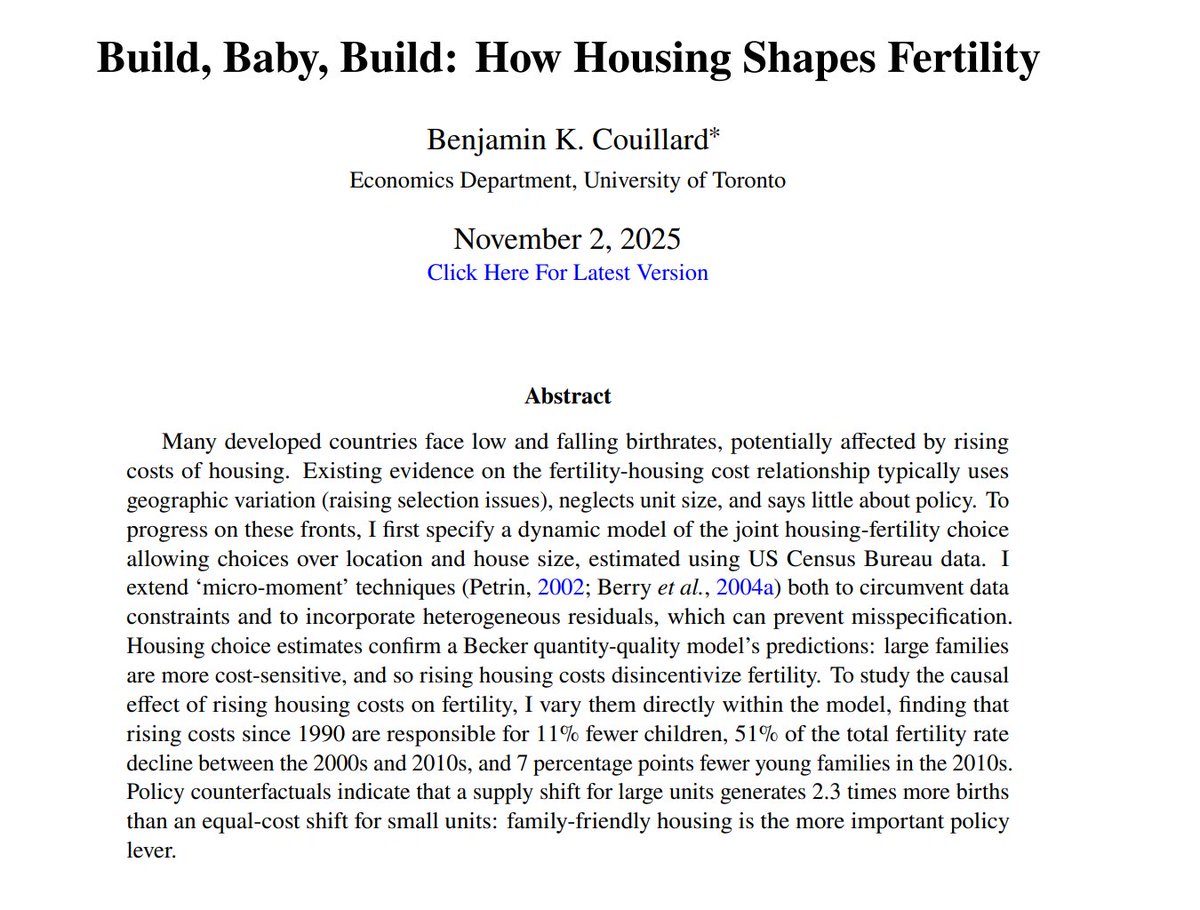
Fertility has fallen in the United States. At the same time, housing has gotten substantially more expensive. Are these related? How so? Benjamin Couillard attributes fully half of the fertility decline of the 2000s and 2010s to housing prices, a loss of 13 million children! 1/ Image
The paper is a substantial improvement over the reduced form approach to estimating the effect of housing prices on fertility. Using local variation is not ideal, because housing supply changes somewhere affect prices everywhere. We're not really sure what we're measuring.
Instead, we're going to estimate demand for housing using BLP (1995) with micromoments, with some interesting modifications to deal with logs with zero, and adding a model of fertility choice. The next few tweets will explain what exactly this all means.
The fertility side is relatively straightforward. Parents maximize their utility over time, have preferences over both quantity and quality of children, and housing enters as a cost of kids. In each year, some percentage of people have kids as a function of characteristics below. Image
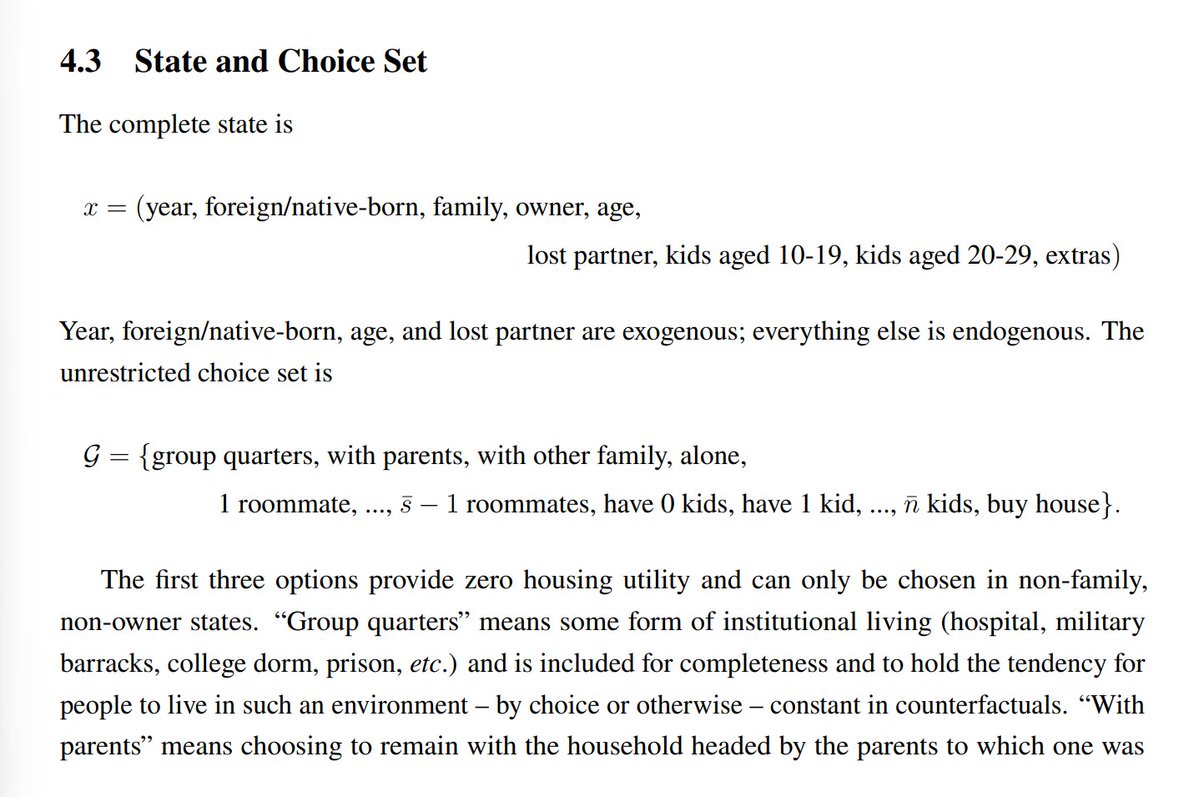
On the demand side, the starting point is Berry Levinsohn Pakes (1995). People have preferences over observed characteristics, price, and unobserved characteristics. These preferences are drawn from a distribution. We take a guess at the parameters for the variance
and then solve for the mean utility -- the sum of price and observed and unobserved characteristics -- which justify the market shares. (We then take more guesses at the variance, using instruments for the endogenous price -- characteristics are generally assumed exogenous).
Bayer, Ferreira, and McMillan (2007) skip over the distribution element, because they can directly observe detailed data on who lives in what place. Couillard does not have that data, but what he can do is use the partial and overlapping Census data to infer what he needs.
If he observes the joint distribution of tract, family status, and size (but not age or tenure), and tract and tenure and size (but not age or status), and so on, you can infer what is the most likely way to fill in the underlying details
Couillard also has some very interesting stuff in dealing with logs of zero. If you take ln(0), you get negative infinity. It breaks. You can rewrite things as a Poisson regression, which can handle such things, at the cost of your variances not being quite right.
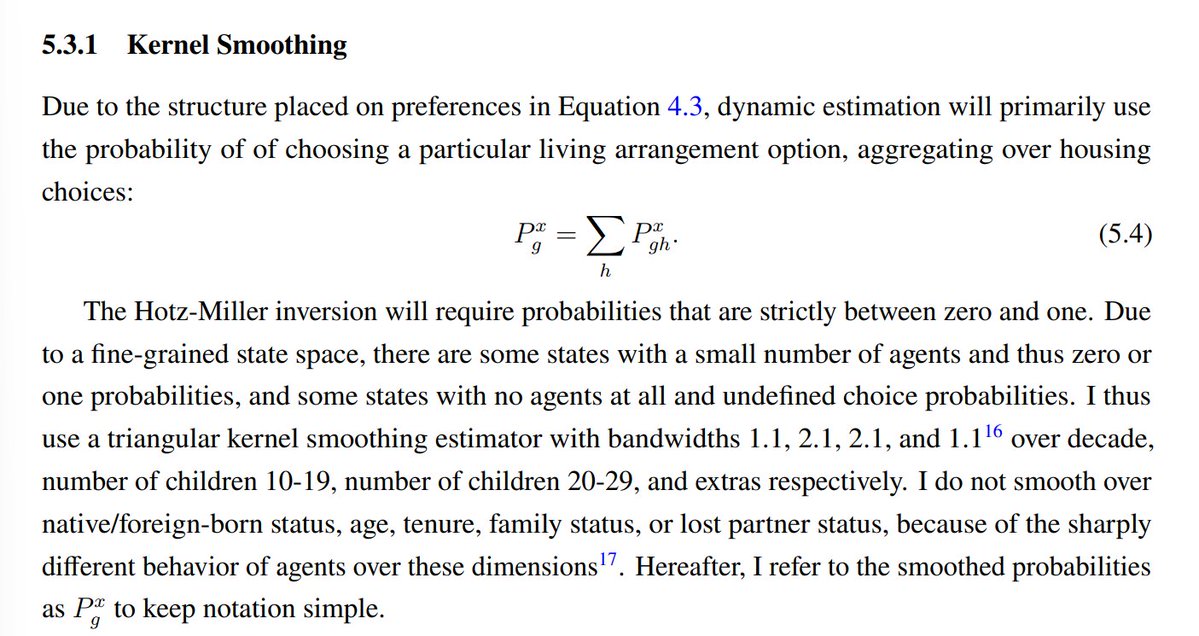
Further, when we're simulating people's choices, Hotz-Miller requires using observed choices conditional upon some state to infer what people value. If there's noise and many states, sometimes zero people choose a thing. To get around this, he smooths things like number of childrenImage
For instruments for price, the basic logic is that places that are somewhat distant but not far away no longer offer amenities people go to, but they do offer things people could *move* to. Changes in those amenities affect rent cleanly.
When we do alter policy, it's a complicated general equilibrium system. We iterate until we get convergence. Image
So that's the model! But what of the results? They're both optimistic and pessimistic -- bad policy has had a terrible cost on fertility, but good policy can fix it. Returning rents to where they were in the 90s would put us back near replacement fertility rate. Image
We can also meaningfully increase fertility by pushing housing supply towards larger units -- people respond tremendously to having more space. Image
Benjamin Couillard, "Build, Baby, Build: How Housing Shapes Fertility" (2026)
ti.org/pdfs/BuildBaby…

• • •

Missing some Tweet in this thread? You can try to force a refresh

 

Keep Current with Nicholas Decker

Nicholas Decker Profile picture

Stay in touch and get notified when new unrolls are available from this author!

Read all threads

This Thread may be Removed Anytime!

PDF

Twitter may remove this content at anytime! Save it as PDF for later use!

Try unrolling a thread yourself!

how to unroll video
  1. Follow @ThreadReaderApp to mention us!

  2. From a Twitter thread mention us with a keyword "unroll"
@threadreaderapp unroll

Practice here first or read more on our help page!

More from @captgouda24

Feb 18
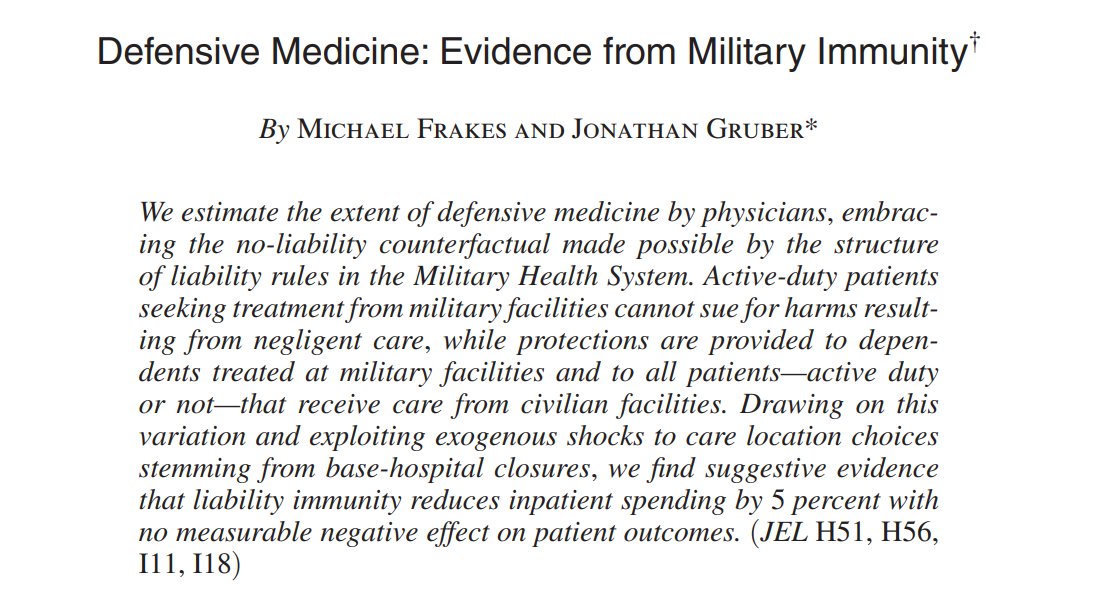
Being able to sue your doctor for negligence increases costs by 5% while having no effect whatsoever on patients outcomes. All liability laws cause is ass-covering. 1/ Image
"Defensive medicine" is ordering extra tests and procedures so that nobody can accuse you, after the fact, of not doing enough. This may look like a doctor ordering a cancer test needlessly, or perhaps an unnecessary biopsy.
The key variation comes from the U.S. military -- active-duty members treated by military doctors cannot for negligence. By contrast, their dependents treated by the same doctor can. If either are treated by civilian doctors, they may also sue.
Read 17 tweets
Feb 13
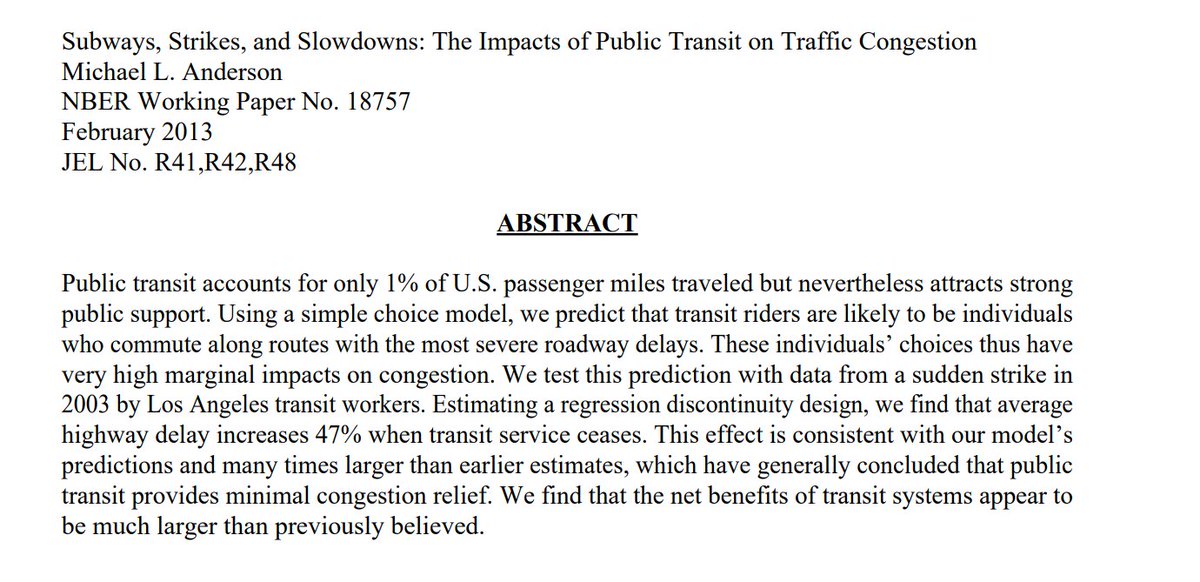
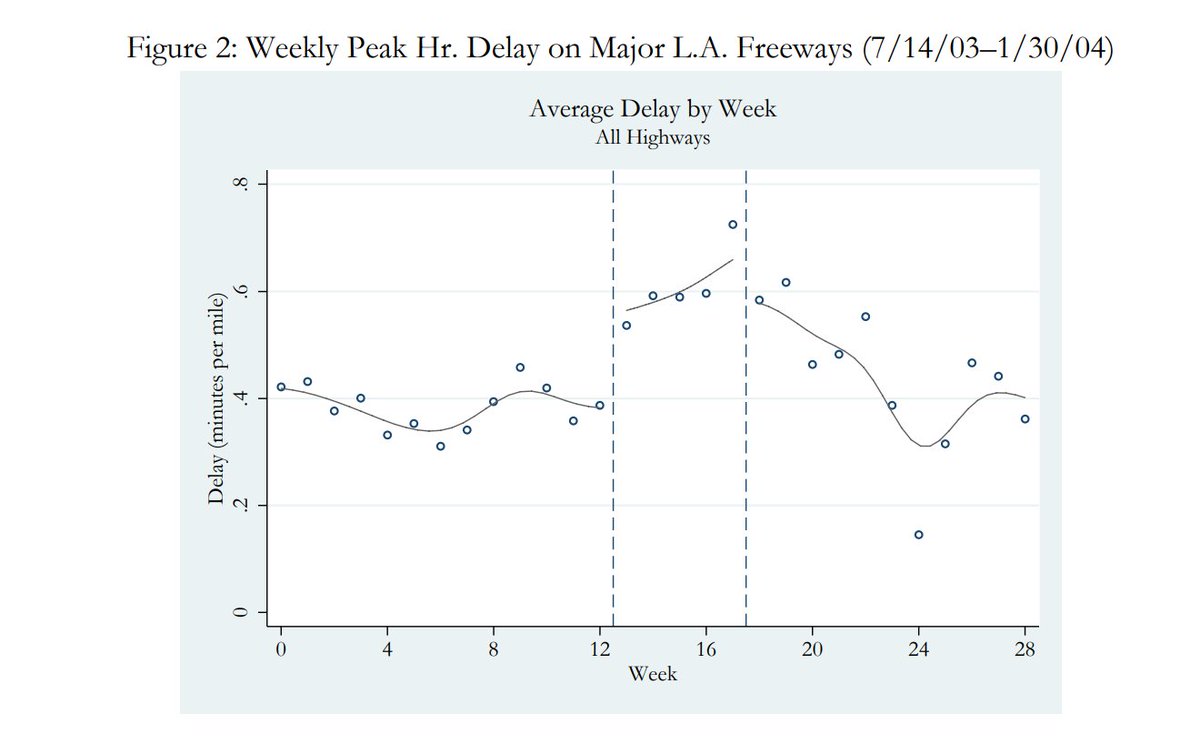
It turns out that public transit is extremely important for reducing traffic. Because the relationship of traffic and congestion is extremely non-linear, a shutdown of transit can cause massive increases in congestion -- justifying substantial subsidies for trains and buses. 1/ Image
tThis is a methodologically simple paper, but very clean. In October 2003, the LA public transit workers went on strike for 35 days. We can consider the change in congestion, after sanity testing it, to be the effect of the MTA.
During peak hours, the average delay increased by about 50% relative to what free-flowing traffic would be. That's (roughly) going from 1:24 per mile to 1:36, or the equivalent of making a 28 minute commute last 32 minutes instead. Image
Read 6 tweets
Dec 30, 2025
What killed the local newspaper? Craigslist. The actual reporting function of the newspaper was never what made it profitable -- it was simply a way to get people to look at the classified advertisements. With that gone, the work with positive externalities died. 1/ Image
This is a classic staggered roll-out paper -- if you are willing to buy the assumption that Craigslist expanded to different markets in a way that is unrelated to future trends, conditional on basic demographic controls, then you buy the paper. Image
This is certainly supported by the evidentiary record -- I must point out, it is *extremely hard* to win lawsuits that a company controller is not maximizing company profits. Image
Read 12 tweets
Dec 28, 2025
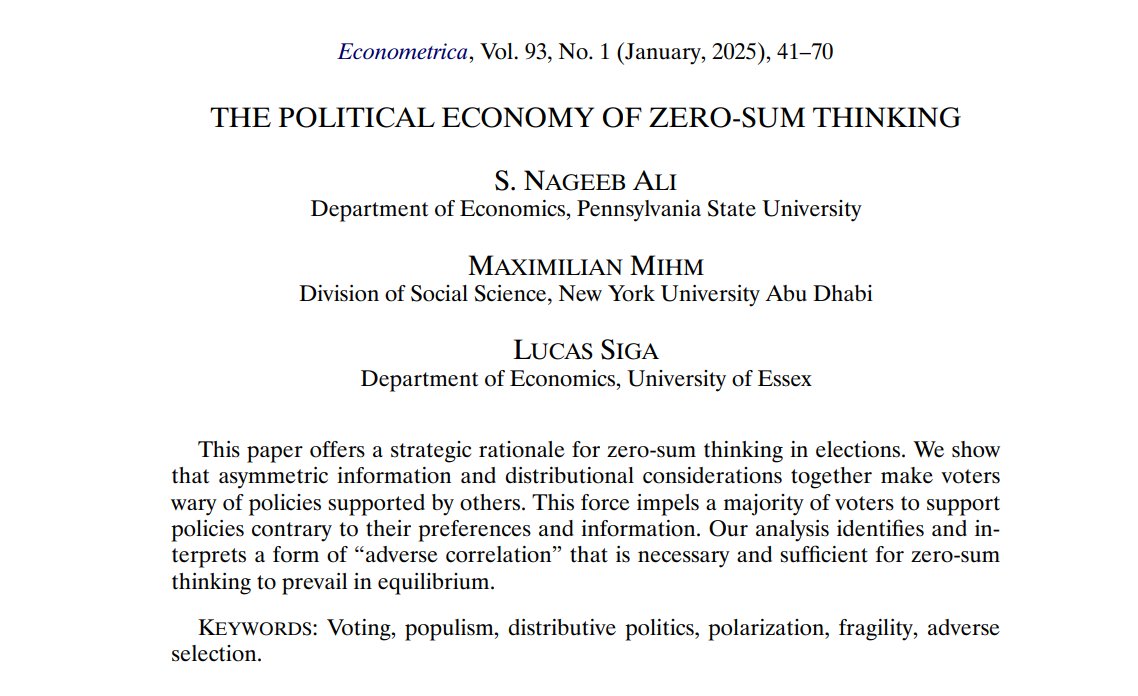
Why we so often behave as though the world is zero-sum when it isn't? This paper shows that even the slightest bit of asymmetric information is sufficient to cause us to go away from the optimal outcome, and lead to people to vote for things they don't want in expectation! 1/ Image
Consider three voters, Alice, Bob and Carol. They are deciding whether to enact policy P, and policy P*. P is a payoff of zero to all people. Policy P* gives two voters a pay off of 2, and one voter a payoff of -3. Which voter loses depends on the state of the world.
In expectation, the loser is random. With no information, all three vote for P* -- it's what maximizes their payoffs, on average. If everyone knows the state of the world, it passes 2-1. And if all three have the same amount of info, it will pass most of the time.
Read 7 tweets
Dec 20, 2025
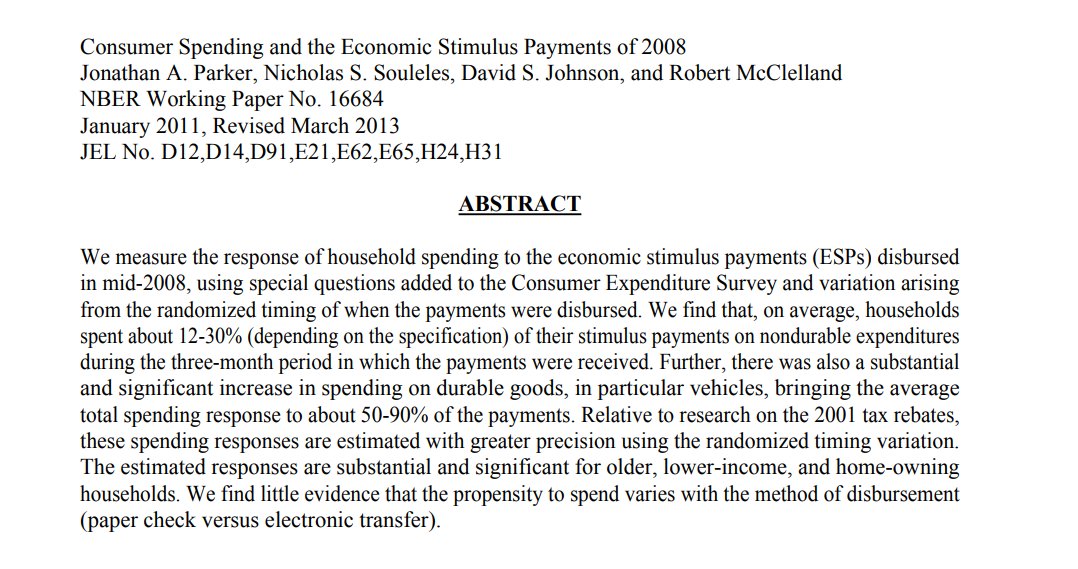
The marginal propensity to consume (or MPC) is one of the most important parameters to know if we want to estimate the effect of fiscal stimulus. Yet, we may not be able to know the real effect -- even from perfectly identified studies! Stimulus is less effective than we think.1/ Image
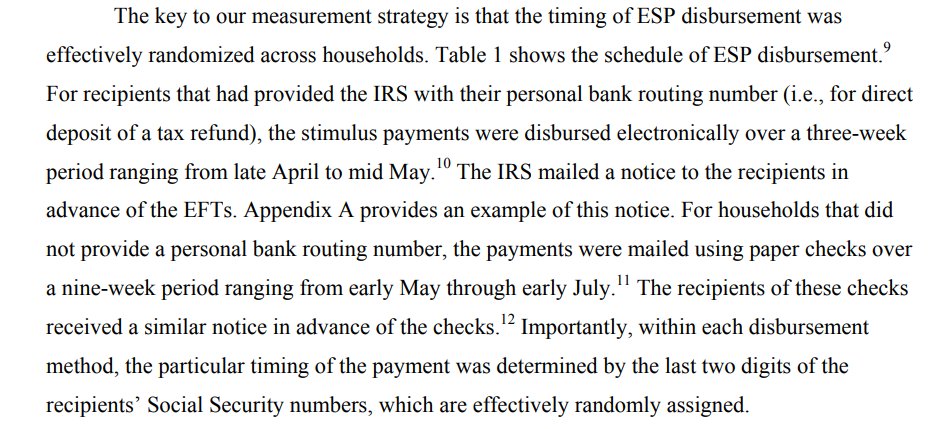
Previous micro work on the MPCs take two basic paths. With Parker et al (2013), the identifying variation is coming from random variation in which people actually received their checks. Image
Image
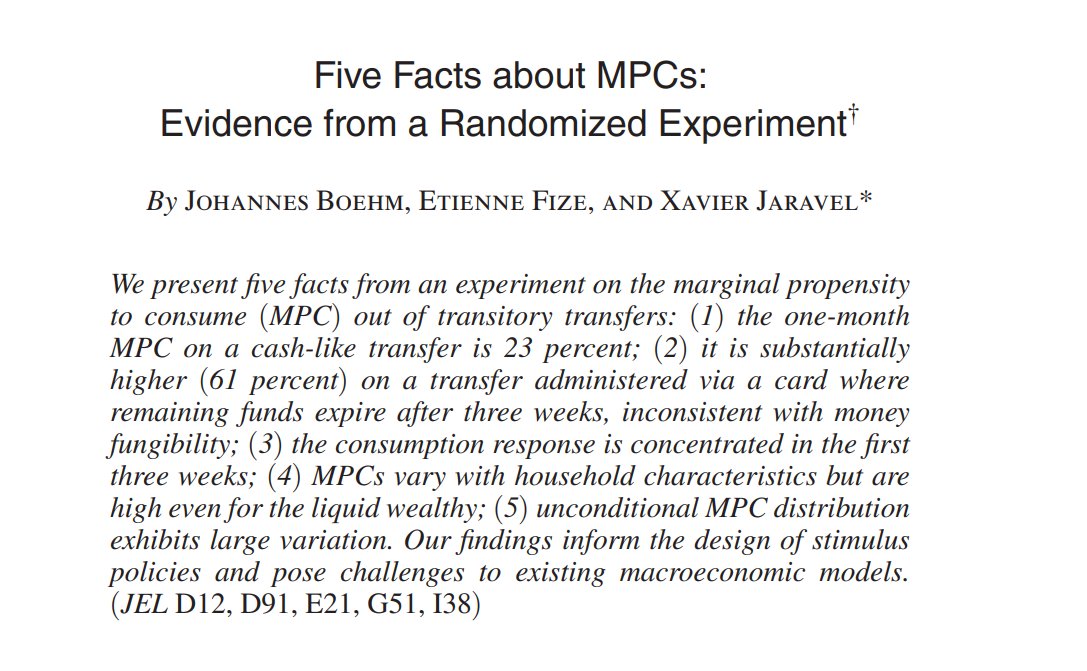
Alternatively, you can have a randomized experiment, as in "Five Facts about MPCs". In both cases, they find very large propensities to consume immediately, rather than save. Image
Read 13 tweets
Dec 16, 2025
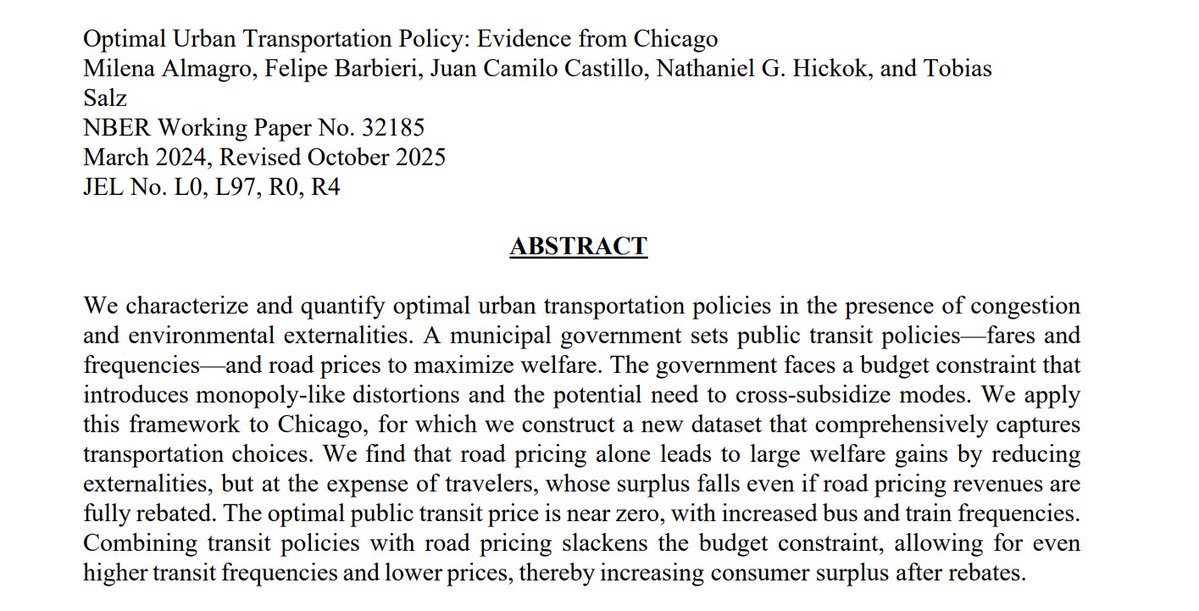
This paper is an absolutely monumental piece of work. Given incredibly detailed data on how people travel in Chicago, can one calculate the optimal prices of vehicles, roads, and public transport? It turns out -- free buses are correct! And we need massive taxes on vehicles. 1/ Image
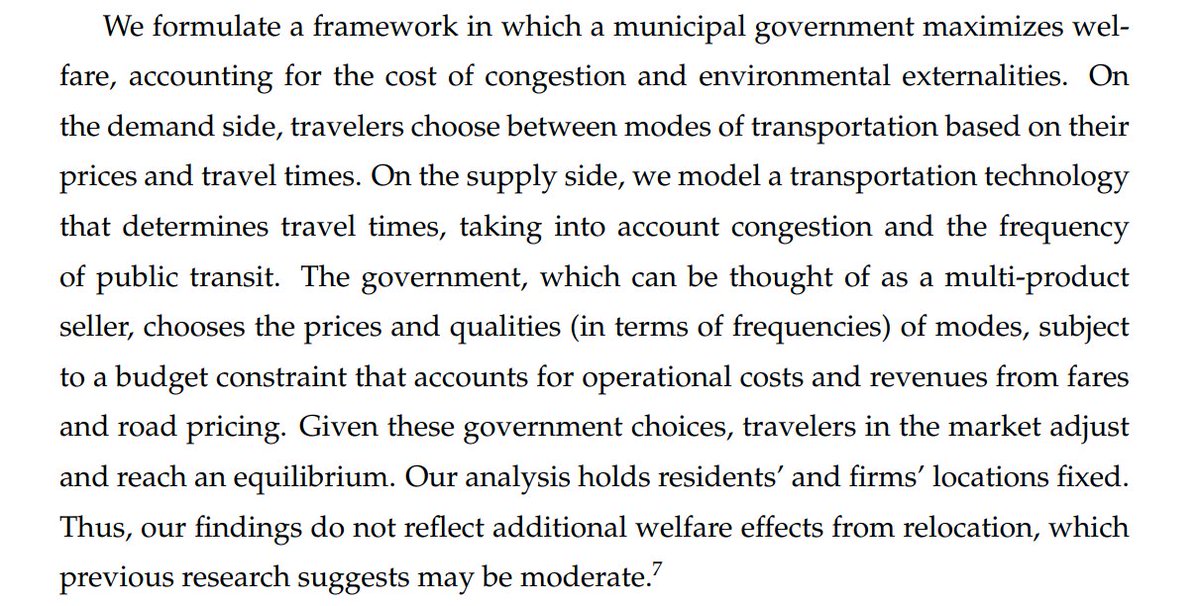
To simplify the analysis, we will skip over endogenous reallocation of people, and we are only dealing with pricing the modes which we have now. People are taken to flow between each of the 77 Chicago neighborhoods -- we are not getting more granular than this. Image
To preview the results -- since the government is budget constrained, we will not get optimal results without cross-subsidization. Image
Read 16 tweets

Did Thread Reader help you today?

Support us! We are indie developers!


This site is made by just two indie developers on a laptop doing marketing, support and development! Read more about the story.

Become a Premium Member ($3/month or $30/year) and get exclusive features!

Become Premium

Don't want to be a Premium member but still want to support us?

Make a small donation by buying us coffee ($5) or help with server cost ($10)

Donate via Paypal

Or Donate anonymously using crypto!

Ethereum

0xfe58350B80634f60Fa6Dc149a72b4DFbc17D341E copy

Bitcoin

3ATGMxNzCUFzxpMCHL5sWSt4DVtS8UqXpi copy

Thank you for your support!

Follow Us!

:(