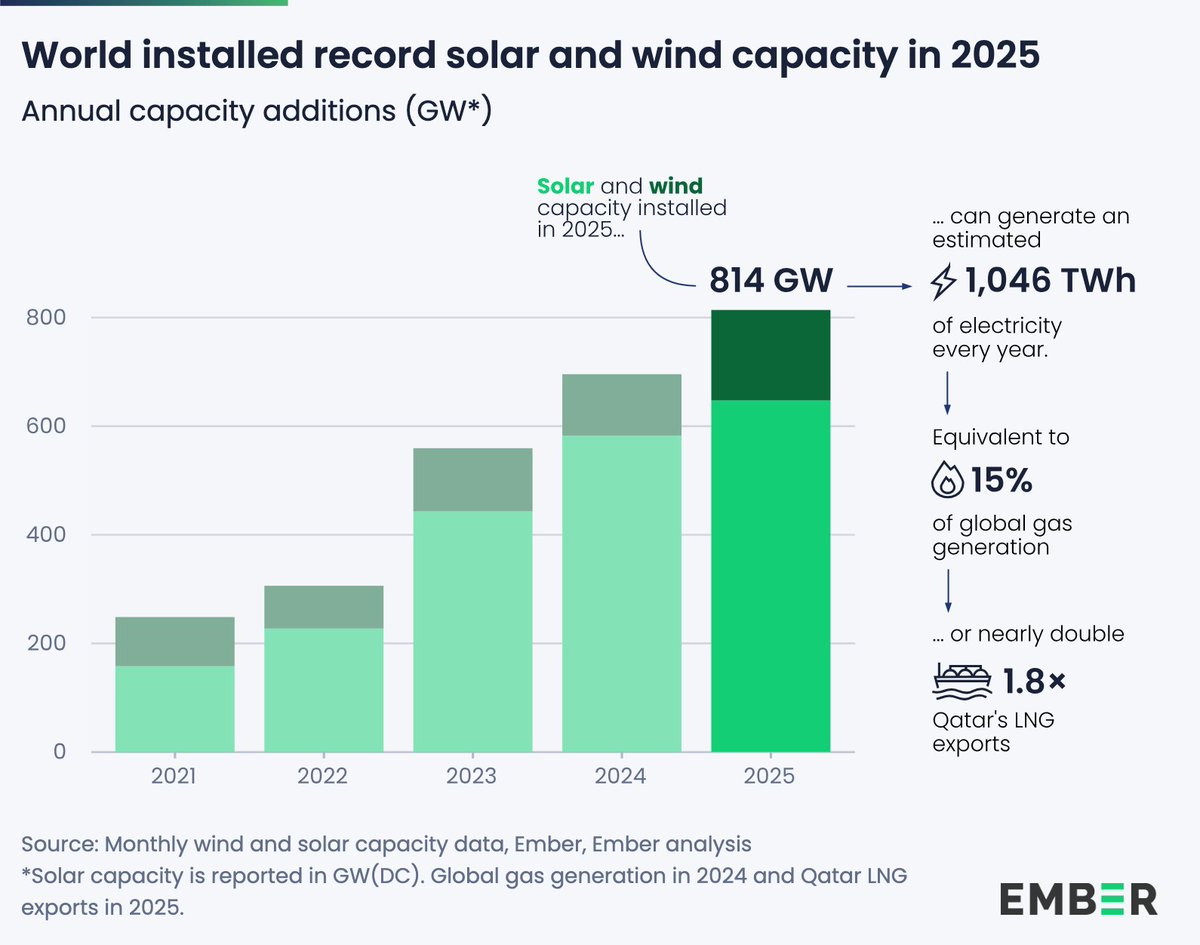
NEW | World adds record 814 GW of solar and wind in 2025, cushioning impact of the gas price crunch ☀️🌪️
The new capacity can generate enough power every year to displace a SEVENTH of global gas generation —or almost DOUBLE Qatar’s annual LNG export volume—saving ~$138 bn 💰
The new capacity can generate enough power every year to displace a SEVENTH of global gas generation —or almost DOUBLE Qatar’s annual LNG export volume—saving ~$138 bn 💰
Since the start of the US-Israeli war with #Iran, global #solar and #wind capacity has avoided the equivalent of ~330 TWh of gas generation, at a cost of $40 BILLION at current market prices
🗣️ “As they scale up, they will strengthen energy independence and insulate consumers”
🗣️ “As they scale up, they will strengthen energy independence and insulate consumers”

Dive into this data with Ember’s newly launched Monthly Capacity Data tool! 📊
It's an interactive tool for tracking monthly wind and solar capacity deployment across 25 countries that make up 93% of global solar and 92% of global wind capacity 🌍🌎🌏👇
ember-energy.org/data/wind-and-…
It's an interactive tool for tracking monthly wind and solar capacity deployment across 25 countries that make up 93% of global solar and 92% of global wind capacity 🌍🌎🌏👇
ember-energy.org/data/wind-and-…
• • •
Missing some Tweet in this thread? You can try to
force a refresh