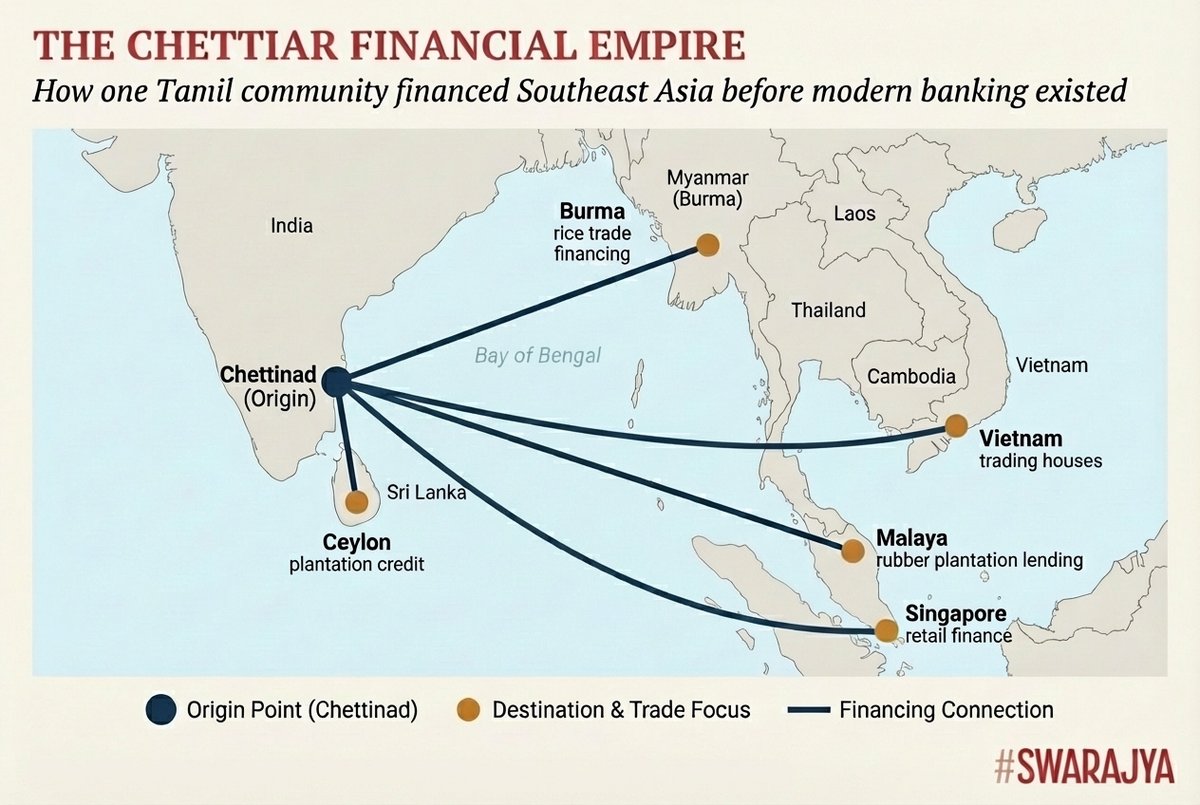
Before modern multinational banks reached Southeast Asia, merchants from 75 villages in Tamil Nadu had already built a transnational financial system.
They financed rice in Burma, rubber in Malaya, retail in Singapore, plantations in Ceylon — connected not by contracts but by kinship and reputation.
This is the story of the Chettiars.🧵
They financed rice in Burma, rubber in Malaya, retail in Singapore, plantations in Ceylon — connected not by contracts but by kinship and reputation.
This is the story of the Chettiars.🧵
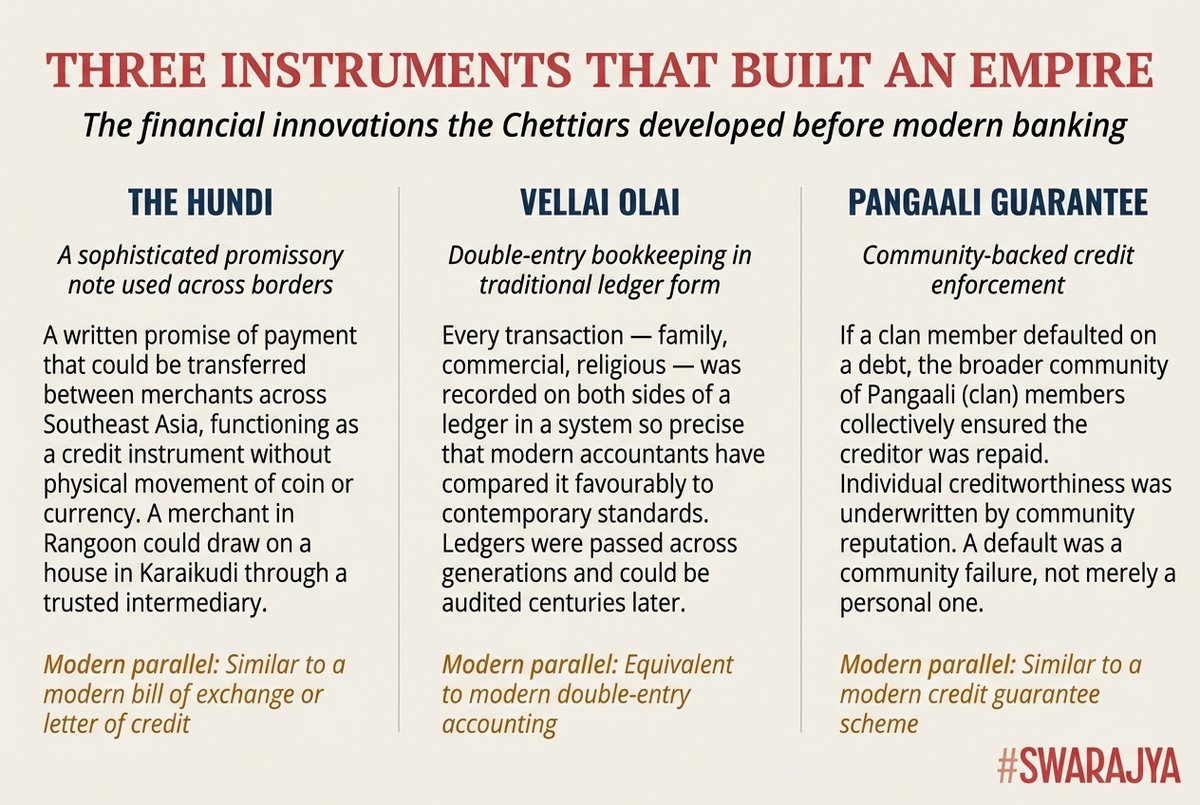
Their financial instruments were not primitive arrangements. They were sophisticated.
--The Hundi moved money across borders without physical currency.
--The Vellai Olai tracked every transaction — commercial, familial, religious — with double-entry precision.
--The Pangaali guarantee meant the community underwrote an individual's credit.
--The Hundi moved money across borders without physical currency.
--The Vellai Olai tracked every transaction — commercial, familial, religious — with double-entry precision.
--The Pangaali guarantee meant the community underwrote an individual's credit.
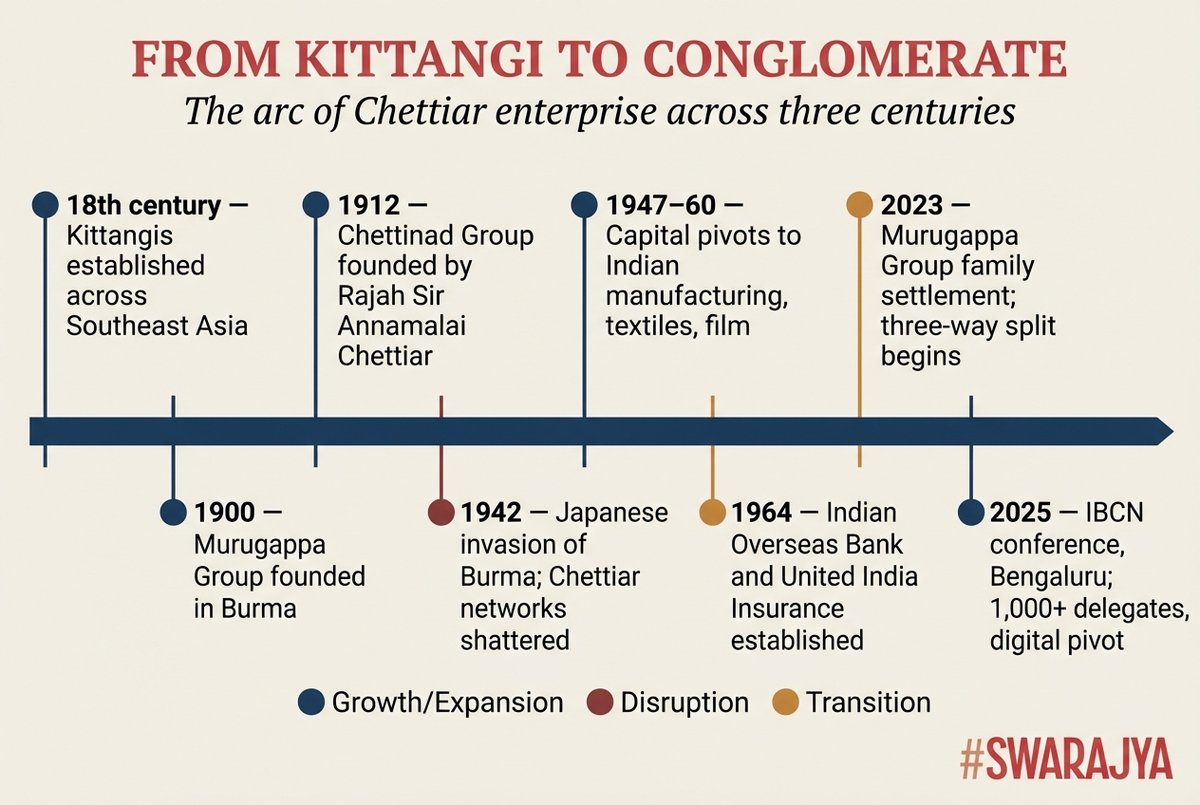
Things were going smoothly—until 1942. The Japanese invasion of Burma shattered the economic order in which Chettiar finance thrived.
Many merchants fled, leaving behind properties and loans. Newly independent nations restructured their financial systems. The old network lost ground.
But the Chettiars did what good entrepreneurs always do. They adapted.
Many merchants fled, leaving behind properties and loans. Newly independent nations restructured their financial systems. The old network lost ground.
But the Chettiars did what good entrepreneurs always do. They adapted.
Capital pivoted to Indian manufacturing, engineering, textiles and cinema:
Six business groups. One cultural origin. A bank with India's first major international presence. The studio that shaped South Indian cinema. A petrochemical giant. A university built on a gifted 443-acre estate.
Six business groups. One cultural origin. A bank with India's first major international presence. The studio that shaped South Indian cinema. A petrochemical giant. A university built on a gifted 443-acre estate.

The structure that produced this success was built on a simple principle: the habits of one generation become the instincts of the next.
Young men apprenticed from age 13, rising from podiyan (office boy) to mudalaali (owner) over decades. Every transaction — family, commercial, religious — was recorded. Capital flowed through kinship. Risk was shared.
Young men apprenticed from age 13, rising from podiyan (office boy) to mudalaali (owner) over decades. Every transaction — family, commercial, religious — was recorded. Capital flowed through kinship. Risk was shared.
But a strain is showing now.
A single Chettinad mansion may have 40 to 50 legal heirs — spread across Chennai, Singapore, London, New York.
One branch wants a heritage hotel. Another holds the veto.
The mansions that once hosted weddings lasting days now stand in majestic silence.
A single Chettinad mansion may have 40 to 50 legal heirs — spread across Chennai, Singapore, London, New York.
One branch wants a heritage hotel. Another holds the veto.
The mansions that once hosted weddings lasting days now stand in majestic silence.
The most public rupture: the Murugappa Group — once the poster child for Indian family business — began a three-way split in 2024-25 after a landmark family settlement.
AVM Productions, the studio that built South Indian cinema, is locked in property disputes reaching the Madras High Court.
The joint-family model is under strain everywhere.
AVM Productions, the studio that built South Indian cinema, is locked in property disputes reaching the Madras High Court.
The joint-family model is under strain everywhere.
But the Chettiars haven't disappeared.
At the IBCN conference in Bengaluru in 2025, over 1,000 delegates gathered — a modern assembly that mirrored the temple-city gatherings of the 19th century.
Capital is now pooled through angel networks. The community's legendary trust serves as social encryption for global trade.
The mansions may be thinning. The ledger is still in the black.
@kbalakumar
swarajyamag.com/business/the-c…
At the IBCN conference in Bengaluru in 2025, over 1,000 delegates gathered — a modern assembly that mirrored the temple-city gatherings of the 19th century.
Capital is now pooled through angel networks. The community's legendary trust serves as social encryption for global trade.
The mansions may be thinning. The ledger is still in the black.
@kbalakumar
swarajyamag.com/business/the-c…
• • •
Missing some Tweet in this thread? You can try to
force a refresh