Rimsha Bhardwaj Profile picture
Mar 21 16 tweets 4 min read Read on X
Prompt engineering is dead.

Anthropic just published their internal playbook on what actually matters: XML-structured prompting.

Only 2% of users know this exists.

Here's what changed: Image
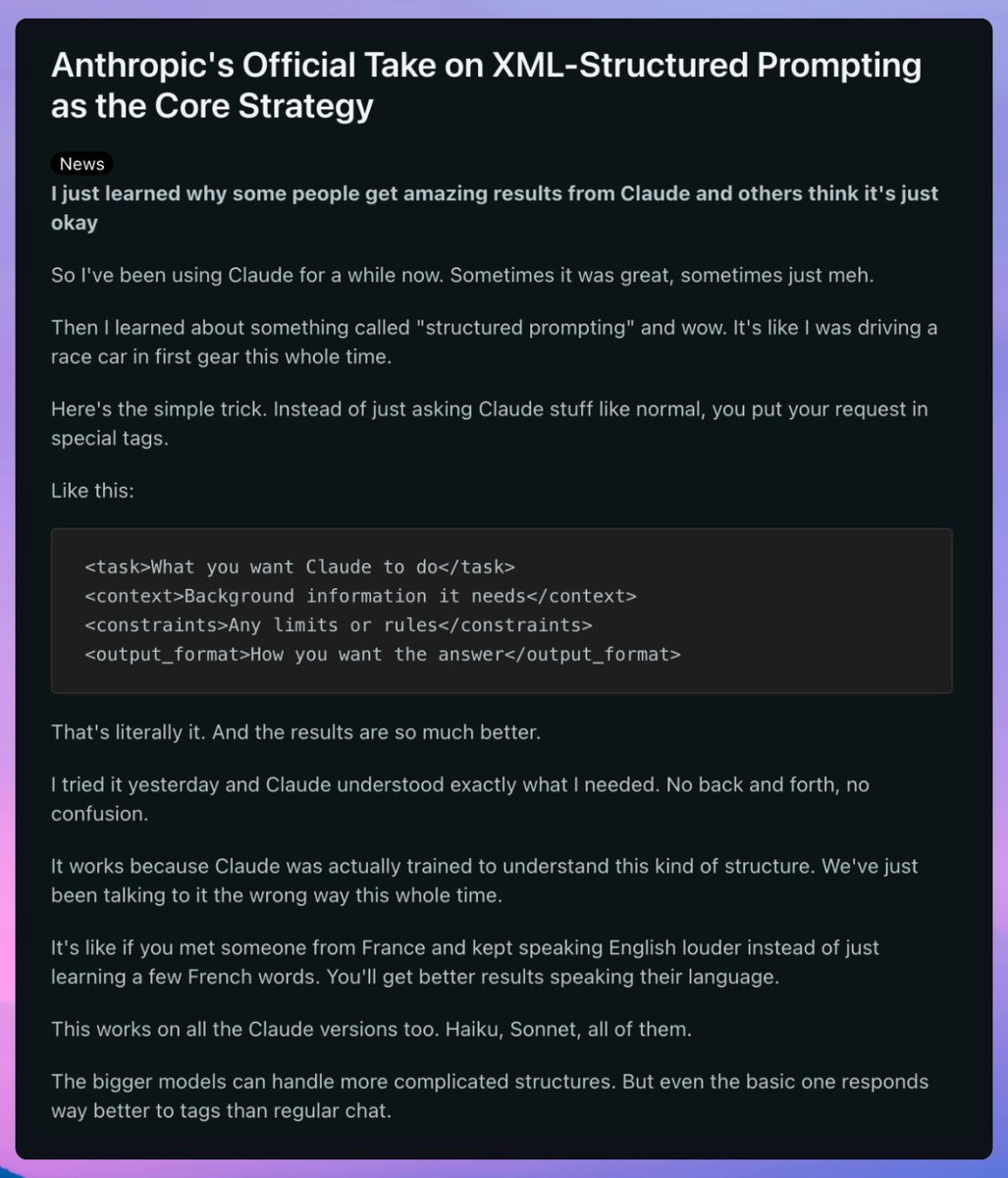
Anthropic's engineers built Claude to understand XML tags.

Not as code.

As cognitive containers.

Each tag tells Claude: "This is a separate thinking space."

It's like giving the model a filing system.
The difference is brutal.

Standard prompt: "Write a product description for running shoes considering comfort, durability, and style."

Claude gives you generic output.

Tagged prompt:

Write a product description
running shoes

- comfort
- durability
- style


Output quality jumps 40%.
Why tags work: Claude's context window processes nested information hierarchically.

When you use <role>, <task>, <constraints>, the model knows exactly what each section does.

It's like the difference between telling someone "make dinner" versus handing them a recipe card.
Multi-step reasoning gets insane.

Calculate ROI for cloud migration

Gather current infrastructure costs
Estimate cloud costs with 3 providers
Calculate 3-year TCO comparison

Executive summary + detailed breakdown

Claude follows this like a senior analyst.
The real power: chain-of-thought inside tags.


Think through this step-by-step:
1. First, consider X
2. Then evaluate Y
3. Finally, conclude Z


Anthropic's models were trained to use internal reasoning chains. Tags make them explicit.

You're essentially exposing Claude's thought process.
Content isolation works differently.

This is how to do it well
Avoid this approach
Now apply the good example

Claude treats each tag as a separate context space.

Prevents contamination between examples and actual output. Works better than "Do this, not that" prompts.
Error handling becomes trivial.


- Output must be under 200 words
- Include exactly 3 bullet points
- Cite 2 sources


Claude checks against these before generating.

Standard prompts? It ignores half your constraints. Tags make them enforceable.
The tag hierarchy matters.

Outer tags = high priority.
Nested tags = contextual details.


Write a technical blog post
Senior engineers
Authoritative but accessible


Claude weighs outer tags heavier in generation.

Most users don't know this. They flatten everything.
Complex documents become manageable.

[10,000 word research paper]

- Key findings
- Methodology critique
- Practical applications

Executive summary

Claude processes long context better with clear structural boundaries.

Reduces hallucination by 60% compared to "Summarize this paper."
Why Anthropic doesn't promote this:

1. It's technical. Scares casual users.
2. They want Claude to "feel natural" like conversation.
3. Most people won't read API docs anyway.

But power users? We're getting 3x better outputs using the same model everyone else has access to.
The gap is widening.

People who discover structured prompting get superhuman results.

Everyone else thinks "Claude is just another chatbot."

Same model. Completely different performance.

It's like having a Formula 1 car but only knowing how to drive in first gear.
Start simple:

Replace your next prompt with:

[What you want]
[Background info]
[Limitations]
[How to structure response]

Watch the quality jump.

Then experiment with nesting, priorities, and multi-step chains.
This works across all Claude models.

Haiku, Sonnet, Opus.

The bigger models handle more complex tag hierarchies, but even Haiku responds better to structure than conversational prompts.

You're speaking Claude's native language.
AI prompting isn't about being clever with words.

It's about understanding how the model was trained and structuring inputs to match that architecture.

Claude was built for structured reasoning.

Most users are still having unstructured conversations.
I hope you've found this thread helpful.

Don't forget to bookmark for later.

Follow me @heyrimsha for more.

If you enjoyed reading this post, please support it with like/repost of the post below 👇

• • •

Missing some Tweet in this thread? You can try to force a refresh

 

Keep Current with Rimsha Bhardwaj

Rimsha Bhardwaj Profile picture

Stay in touch and get notified when new unrolls are available from this author!

Read all threads

This Thread may be Removed Anytime!

PDF

Twitter may remove this content at anytime! Save it as PDF for later use!

Try unrolling a thread yourself!

how to unroll video
  1. Follow @ThreadReaderApp to mention us!

  2. From a Twitter thread mention us with a keyword "unroll"
@threadreaderapp unroll

Practice here first or read more on our help page!

More from @heyrimsha

Mar 14
OpenAI and Anthropic engineers leaked a prompting technique that separates beginners from experts.

It's called "Socratic prompting" and it's insanely simple.

Instead of telling the AI what to do, you ask it questions.

My output quality: 6.2/10 → 9.1/10

Here's how it works:
Most people prompt like this:

"Write a blog post about AI productivity tools"
"Create a marketing strategy for my SaaS"
"Analyze this data and give me insights"

LLMs treat these like tasks to complete.
They optimize for speed, not depth.

You get surface-level garbage.
Socratic prompting flips this.

Instead of telling the AI what to produce, you ask questions that force it to think through the problem.

LLMs are trained on billions of reasoning examples.
Questions activate that reasoning mode.

Instructions don't.
Read 12 tweets
Mar 12
🚨 BREAKING: Claude can now research like an MIT PhD student.

Here are 12 insane Claude prompts that turn 40+ research papers into structured literature reviews, knowledge maps, and research gaps in minutes.

(Save this before it goes viral): Image
PROMPT 1 — The Intake Protocol

Use this when you first upload your papers:

"I'm going to share [X] papers on [topic]. Before I ask anything, do this:

1. List every paper by author + year + core claim in one sentence
2. Group them into clusters of shared assumptions
3. Flag any paper that contradicts another

Don't summarize. Map the landscape."
PROMPT 2 — The Contradiction Hunter

"Look at the papers you've mapped.

Now find every place two or more papers directly contradict each other.

For each conflict:
→ State what each side claims
→ What data or method causes the disagreement
→ Which side has stronger evidence and why

Don't resolve it. Expose it."
Read 14 tweets
Mar 4
After 3 years of using Claude, I can say that it is the technology that has revolutionized my life the most, along with the Internet.

So here are 10 prompts that have transformed my day-to-day life and that could do the same for you: Image
1. Research

Mega prompt:

You are an expert research analyst. I need comprehensive research on [TOPIC].

Please provide:
1. Key findings from the last 12 months
2. Data and statistics with sources
3. Expert opinions and quotes
4. Emerging trends and predictions
5. Controversial viewpoints or debates
6. Practical implications for [INDUSTRY/AUDIENCE]

Format as an executive brief with clear sections. Include source links for all claims.

Additional context: [YOUR SPECIFIC NEEDS]
2. Writing white papers

Mega prompt:

You are a technical writer specializing in authoritative white papers.

Write a white paper on [TOPIC] for [TARGET AUDIENCE].

Structure:
- Executive Summary (150 words)
- Problem Statement with market data
- Current Solutions and their limitations
- Our Approach/Solution with technical details
- Case Studies or proof points
- Implementation framework
- ROI Analysis
- Conclusion and Call to Action

Tone: [Authoritative/Conversational/Technical]
Length: [2000-5000 words]

Include:
- Relevant statistics and citations
- Visual placeholders for charts/diagrams
- Quotes from industry experts (mark as [NEEDS VERIFICATION])

Background context: [YOUR COMPANY/PRODUCT INFO]
Read 12 tweets
Mar 1
🚨 BREAKING: Someone just gave Claude Code a complete software development brain.

It's called Superpowers and it makes Claude plan, test, and ship code without going off the rails.

No junior dev babysitting. No context loss. No hallucinated plans.

100% Opensource. Image
Superpowers is an agentic skills framework that gives Claude Code a full engineering workflow out of the box:

- Brainstorming (spec before code)
- Implementation planning (bite-sized tasks)
- Subagent-driven development (parallel execution)
- TDD enforcement (RED-GREEN-REFACTOR, no shortcuts)

All triggered automatically. You don't configure anything.
Here's what makes it different:

Most AI coding setups let Claude jump straight to writing code.

That's where everything goes wrong.

Superpowers forces Claude to:
→ Ask what you're actually building
→ Write a spec you can read in chunks
→ Build a plan clear enough for a junior dev to follow
→ Test before claiming it works

Structure first. Code second.
Read 10 tweets
Feb 21
BREAKING: AI can now build financial models like Goldman Sachs analysts (for free).

Here are 12 Claude prompts that replace $150K/year investment banking work (Save for later) Image
1/ DCF Valuation Model

You are a Senior Analyst at Goldman Sachs. I need a complete DCF (Discounted Cash Flow) valuation model for [COMPANY NAME].

Please provide:

- Free cash flow projections: Next 5 years with growth assumptions
- WACC calculation: Cost of equity + cost of debt breakdown
- Terminal value: Both perpetuity growth and exit multiple methods
- Sensitivity analysis: How value changes with different assumptions
- Discount rate justification: Why we chose this WACC
- Key drivers: What makes cash flow go up or down
- Comparable companies: How our assumptions compare to peers
- Valuation range: Bull case, base case, bear case scenarios

Format as investment banking pitch book valuation page with clear formulas.

Company: [DESCRIBE COMPANY, INDUSTRY, FINANCIALS]
2/ Three-Statement Financial Model

You are a VP at Morgan Stanley. I need a complete three-statement model for [COMPANY NAME].

Please provide:

- Income statement: Revenue, costs, EBITDA, net income (5 years)
- Balance sheet: Assets, liabilities, equity (5 years)
- Cash flow statement: Operating, investing, financing activities (5 years)
- Link formulas: How statements connect (net income → cash flow → balance sheet)
- Working capital: How AR, inventory, and AP change
- Debt schedule: Principal payments and interest expense
- Key assumptions: Revenue growth, margins, capex as % of sales
- Error checks: Balance sheet balancing and circular references

Format as Excel-style model with formulas explained in plain English.

Company: [DESCRIBE BUSINESS, CURRENT FINANCIALS, GROWTH STAGE]
Read 15 tweets
Feb 20
🚨 BREAKING: AI can now build trading algorithms like Goldman Sachs' algorithmic trading desk (for free).

Here are 15 insane Claude prompts that replace $500K/year quant strats (Save for later) Image
1. The Goldman Sachs Quant Strategy Architect

"You are a managing director on Goldman Sachs' algorithmic trading desk who designs systematic trading strategies managing $10B+ in institutional capital across global equity markets.

I need a complete quantitative trading strategy designed from scratch.

Architect:

- Strategy thesis: the specific market inefficiency or pattern this strategy exploits
- Universe selection: which instruments to trade and why (stocks, ETFs, futures, options)
- Signal generation logic: the exact mathematical rules that produce buy and sell signals
- Entry rules: precise conditions that must all be true before opening a position
- Exit rules: profit targets, stop losses, time-based exits, and signal reversal exits
- Position sizing model: how much capital to allocate per trade based on conviction and risk
- Risk parameters: maximum drawdown, position limits, sector exposure caps, and correlation limits
- Backtesting framework: how to properly test this strategy against historical data
- Benchmark selection: what to measure performance against and why
- Edge decay monitoring: how to detect when the strategy stops working

Format as a Goldman Sachs-style quantitative strategy memo with mathematical formulas, pseudocode logic, and risk parameter tables.

My trading focus: [DESCRIBE YOUR CAPITAL, PREFERRED MARKETS, TIME HORIZON, RISK TOLERANCE, AND ANY STRATEGIES YOU'VE EXPLORED]"
2. The Renaissance Technologies Backtesting Engine

"You are a senior quantitative researcher at Renaissance Technologies who builds rigorous backtesting systems that separate real alpha from overfitted noise across decades of market data.

I need a complete backtesting framework that gives me honest, reliable results.

Build:

- Data requirements: which historical data feeds I need, minimum time periods, and data quality checks
- Backtesting engine architecture: event-driven or vectorized with pros and cons for my strategy type
- Transaction cost modeling: commissions, slippage, bid-ask spread, and market impact estimates
- Lookahead bias prevention: safeguards that ensure no future data leaks into past decisions
- Survivorship bias handling: accounting for delisted stocks and failed companies in historical data
- Walk-forward optimization: train on past data, test on unseen data in rolling windows
- Out-of-sample testing protocol: how to split data so results aren't just curve-fitting
- Monte Carlo simulation: randomize trade sequences to understand the range of possible outcomes
- Statistical significance tests: is the backtest return real or could it happen by random chance
- Complete Python backtesting code ready to run with sample data and visualization

Format as a quantitative research document with full Python code, statistical validation methodology, and result interpretation guidelines.

My strategy: [DESCRIBE YOUR TRADING STRATEGY, PREFERRED MARKET, TIME FRAME, AND AVAILABLE HISTORICAL DATA]"
Read 18 tweets

Did Thread Reader help you today?

Support us! We are indie developers!


This site is made by just two indie developers on a laptop doing marketing, support and development! Read more about the story.

Become a Premium Member ($3/month or $30/year) and get exclusive features!

Become Premium

Don't want to be a Premium member but still want to support us?

Make a small donation by buying us coffee ($5) or help with server cost ($10)

Donate via Paypal

Or Donate anonymously using crypto!

Ethereum

0xfe58350B80634f60Fa6Dc149a72b4DFbc17D341E copy

Bitcoin

3ATGMxNzCUFzxpMCHL5sWSt4DVtS8UqXpi copy

Thank you for your support!

Follow Us!

:(