
➥ Why I think Agentic Wallets is the next decade of wallets
I noticed they are replacing the idea of what a wallet is
For the last cycle, I interacted with wallets like everyone else:
> open app → check txn → click confirm & hope I didn’t miss anything
That flow worked because I was the executor
But the moment I imagine running even a simple trading agent 24/7, I already see the problem:
- If I have to approve every action → the agent is useless
- If I give it full key access → I’m one bug away from losing everything
There is no middle ground in current wallets
After digging into solutions from @coinbase, @safe , @privy_io, @0xPolygon... I don’t think the competition is about UX anymore
Each of them is optimizing a different layer:
> @coinbase
- I see them going heavy on infra reliability
- TEE + MPC, compliance layers, session controls… this feels like they are building a safe execution environment first
- Good for institutions, but still quite rigid for agents that need dynamic behavior
> @safe
- Modular smart accounts, multisig logic, onchain policies like allowance, delay, recovery
- Strong for human coordination, but agents don’t naturally fit into multisig-style decision flows
> @privy_io
- API-first approach stands out
- Instead of wallets as products, they treat wallets like embedded infra with programmable policy engines
> @0xPolygon
- They are pushing identity + execution together
- Dual wallet design (EOA + smart account)
- session-based execution, things like ERC-4337 / ERC-8004
But none of them fully solve how do I let an agent move money without trusting it completely
So I tried to simplify it into my own framework, @stripe classified agent commerce into 5 levels with @mpp
They’re still hovering between Level 1 and Level 2
That means agents are barely assisting, they are not really trusted with money yet
So when people talk about fully autonomous agents managing capital… I think that narrative is ahead of reality by a lot
Where things get interesting is when you look at how these systems are being designed
The architecture is quietly shifting into 4 layers:
- Accounts → where funds live
- Permissions → what agents are allowed to do
- Execution → how they act
- Governance → how humans step in
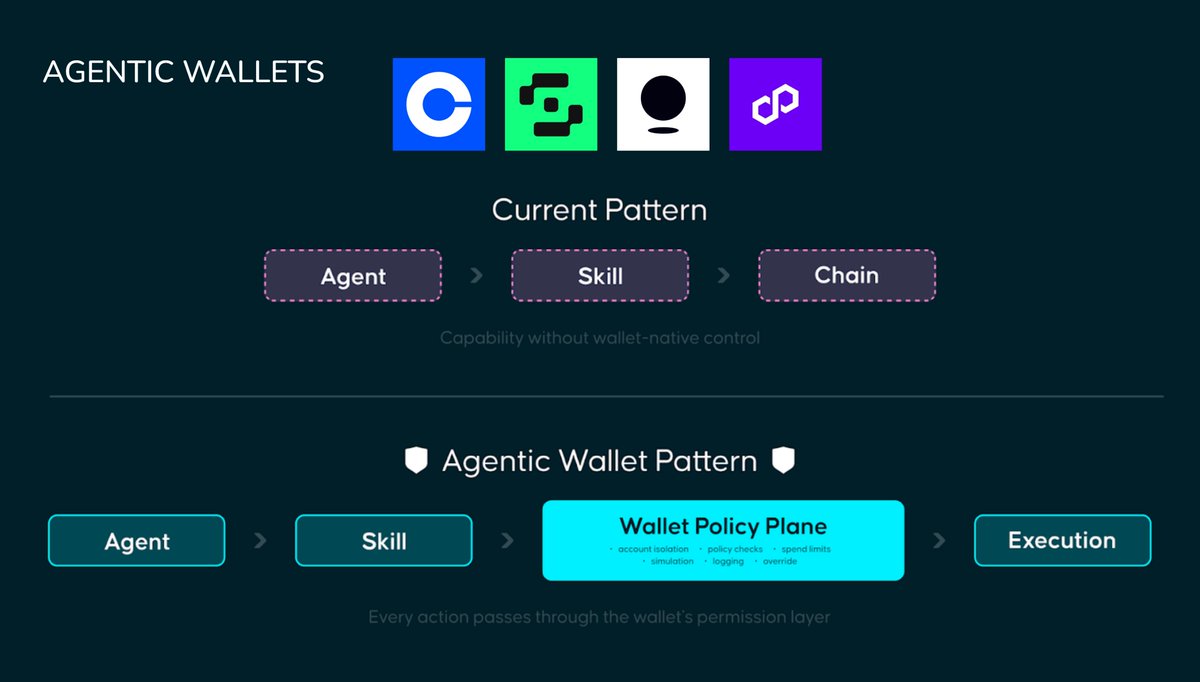
But if I’m being honest, only one layer actually matters that’s the permission layer is the new wallet
Because that’s where spend limits exist, asset restrictions exist, counterparty controls exist, kill-switch logic exists
It’s basically a layer that sits between agent decisions and execution:
> agent wants to act → policy checks → only then funds move
If this layer is weak, nothing else matters
I’m convinced the first wallet I trust will be the one that proves even if the agent is wrong, my money is still safe
I noticed they are replacing the idea of what a wallet is
For the last cycle, I interacted with wallets like everyone else:
> open app → check txn → click confirm & hope I didn’t miss anything
That flow worked because I was the executor
But the moment I imagine running even a simple trading agent 24/7, I already see the problem:
- If I have to approve every action → the agent is useless
- If I give it full key access → I’m one bug away from losing everything
There is no middle ground in current wallets
After digging into solutions from @coinbase, @safe , @privy_io, @0xPolygon... I don’t think the competition is about UX anymore
Each of them is optimizing a different layer:
> @coinbase
- I see them going heavy on infra reliability
- TEE + MPC, compliance layers, session controls… this feels like they are building a safe execution environment first
- Good for institutions, but still quite rigid for agents that need dynamic behavior
> @safe
- Modular smart accounts, multisig logic, onchain policies like allowance, delay, recovery
- Strong for human coordination, but agents don’t naturally fit into multisig-style decision flows
> @privy_io
- API-first approach stands out
- Instead of wallets as products, they treat wallets like embedded infra with programmable policy engines
> @0xPolygon
- They are pushing identity + execution together
- Dual wallet design (EOA + smart account)
- session-based execution, things like ERC-4337 / ERC-8004
But none of them fully solve how do I let an agent move money without trusting it completely
So I tried to simplify it into my own framework, @stripe classified agent commerce into 5 levels with @mpp
They’re still hovering between Level 1 and Level 2
That means agents are barely assisting, they are not really trusted with money yet
So when people talk about fully autonomous agents managing capital… I think that narrative is ahead of reality by a lot
Where things get interesting is when you look at how these systems are being designed
The architecture is quietly shifting into 4 layers:
- Accounts → where funds live
- Permissions → what agents are allowed to do
- Execution → how they act
- Governance → how humans step in
But if I’m being honest, only one layer actually matters that’s the permission layer is the new wallet
Because that’s where spend limits exist, asset restrictions exist, counterparty controls exist, kill-switch logic exists
It’s basically a layer that sits between agent decisions and execution:
> agent wants to act → policy checks → only then funds move
If this layer is weak, nothing else matters
I’m convinced the first wallet I trust will be the one that proves even if the agent is wrong, my money is still safe
• • •
Missing some Tweet in this thread? You can try to
force a refresh






