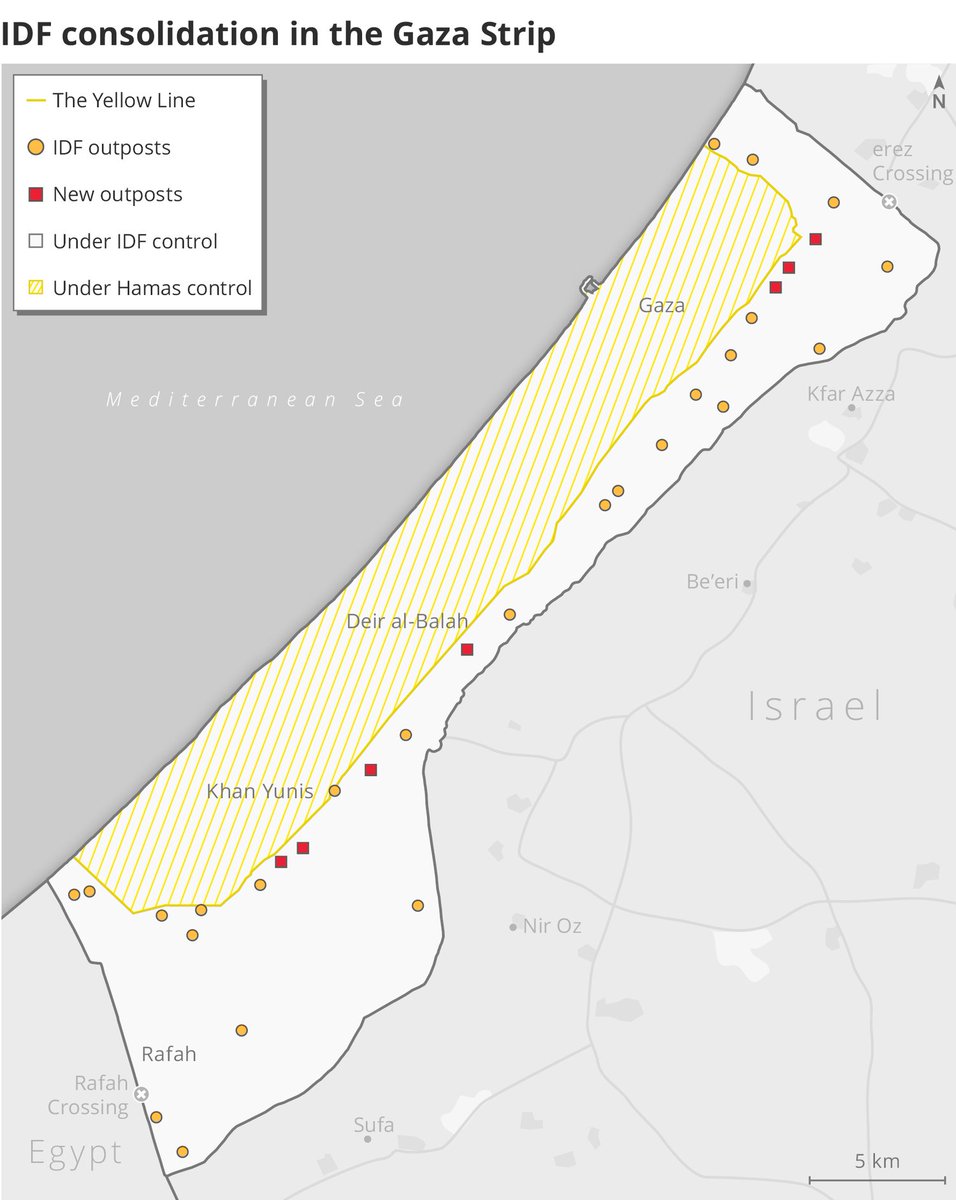
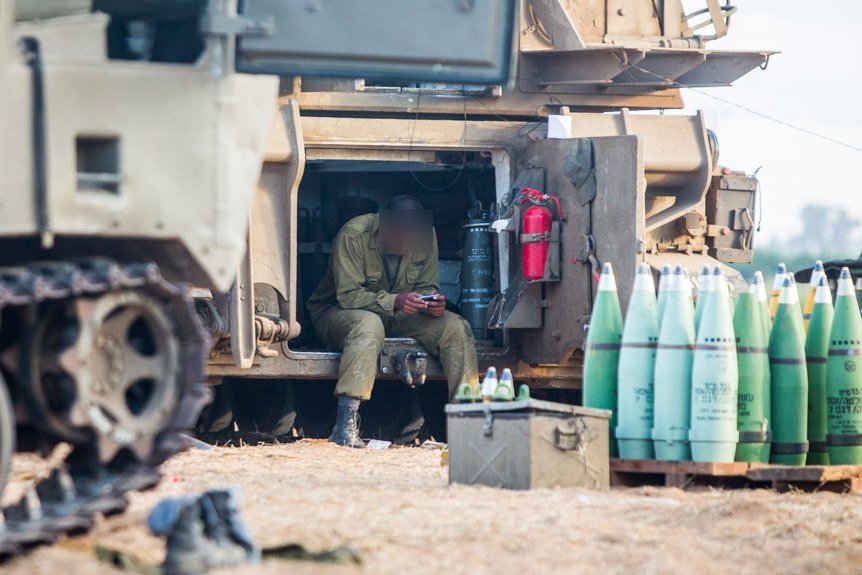
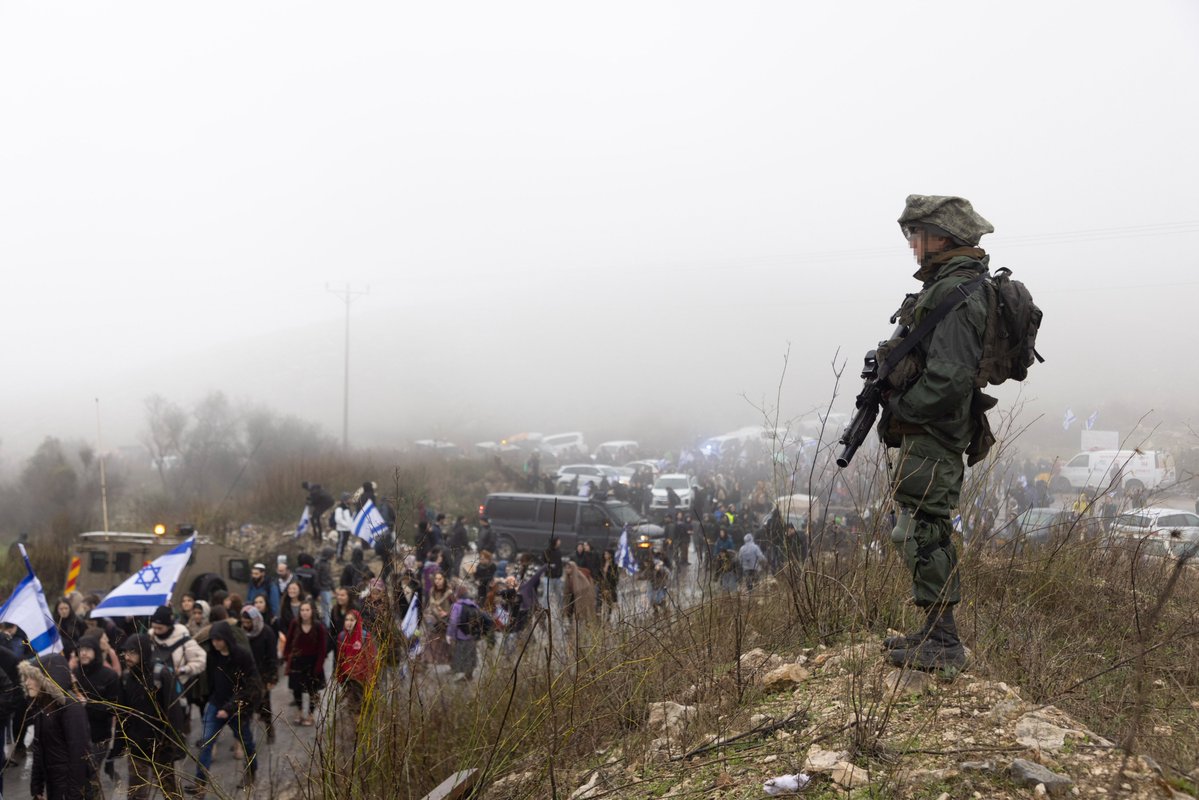
“The army is implementing a large-scale engineering project: constructing a ground barrier stretching for many kilometres along the line.” An in-depth Haaretz investigation into what’s becoming the new border in Gaza: the Yellow Line and its deadly impact on Palestinians🧵
“The area around the line is an active firing zone, with ongoing Israeli airstrikes, artillery shelling and small-arms fire. According to the UN, more than 200 Palestinians, many of them civilians, have been killed in its vicinity.”
Will Edmond, the head of Doctors Without Borders' mission in Gaza: "Over the past months we have treated many patients who were injured by gunshots and explosives around the Yellow Line while carrying out daily tasks. People don't know exactly where it is
And are injured [...] while going to their homes, getting water or collecting firewood. Another problem is that as the line steadily moves west, essential services such as water points and healthcare sites are being swallowed into the Yellow Line…"
“The separation line leaves more than half of the Strip in IDF hands, and there is currently no detailed mechanism regulating a withdrawal from it [...] Some 2.1 million Gazans are now crowded into less than half the area they lived in before the war”
“The Yellow Line was intended to be temporary, but more than five months have passed since U.S. President Donald Trump published his plan to end the war and outline stages of a phased IDF withdrawal. In practice, the army is deepening its hold on the area.”
“Analysis of satellite imagery shows that the IDF has established positions across the northern, eastern and southern Strip. It currently holds at least 32 outposts, most of them built before the cease-fire.”
“Many of the outposts are located amid the ruins of former agricultural and residential areas. Two were built on sites where mosques stood prior to the war, and another is located on a cemetery destroyed during the fighting.”
"Another manifestation of the consolidation of the separation line are earth berms erected north, east and south of the Hamas-controlled area along the Yellow Line. Their total length exceeds 17 kilometers (10.5 miles), about 40 percent of the line's full length (45 kilometers)."
Read the full investigation by @YardenMichaeli in @haaretzcom:
Israel approved the establishment of 34 settlements in the West Bank. New settlements are de facto approved by the state all the time, even if Israel only recognises them retrospectively. These are special. Their locations were selected after extensive and deliberate planning.🧵
Many of the new settlements are expected to be established in areas where, without the state’s deeper involvement, their establishment would be impossible: private Palestinian land, firing zones, and the northern West Bank, where there has not been any Israeli presence before.
At least 3 new settlements are expected to be established in “firing zones”. The IDF has used firing zones as a tool for land grabs for decades. Masafer Yatta is the most well-known example: in 1980, the lands and homes of 12 Palestinian communities there became a “firing zone”.
The border police officers who massacred the Bani Odeh family won’t be questioned, as the evidence allegedly shows they shot “out of fear for their lives.” Two parents and their two children were killed, and the two surviving children were beaten. Let’s look at the “evidence” 🧵
Nine days ago, the Bani Odeh family were returning home at night from a Ramadan shopping trip. There were four children in the car, aged 5-11, one of them blind. The border policemen, who were in the area undercover, approached the Bani Odeh family’s car.
Police claim the car had accelerated toward them. They responded by firing dozens of bullets. All four victims were shot in the head. Officers gave no warning, didn’t call on the car to stop, didn’t fire into the air, and didn’t aim at the tires. And what about witnesses?
You have no future here and must leave is what an IDF commander told five Palestinian communities in the Jordan Valley, according to multiple testimonies. The reason: the army plans to build a “security” fence there. It reminds us of something. Spoiler: it’s not about security 🧵
The IDF is building a 22-km fence through the Jordan Valley, claimed to protect settlers and stop smuggling from Jordan. As always, it’s framed as a security measure. As always, Palestinians will pay the price: more land taken, more movement restrictions, more lives disrupted.
We’ve already seen this when Israel erected the West Bank separation barrier, which cut off more than 9% of the West Bank. The barrier functions as the border between Israel and the West Bank, and its construction has had a devastating impact on tens of thousands of Palestinians.
This morning, 200 soldiers entered the Palestinian town of Ni’lin, the WB, and took over a residential building, seizing the two upper floors and forcing the families down to the ground floor. They also seized several nearby unoccupied houses. Why? It’s called “Straw Widow” 🧵
It is an IDF procedure that involves taking over a private Palestinian home to establish a military outpost. The homeowners in Ni’lin are not suspected of any wrongdoing, yet under military dictatorship, the Palestinian right to property is, like many other rights, nonexistent.
In January, Amira Hass from Haaretz exposed a particularly severe case of the same practice. The IDF entered a Palestinian home, gave the family ten minutes to leave, and then simply took over the house for weeks. Six people were made homeless and forced to rely on relatives.
Yesterday morning, we woke up to rocket alerts. Israel began bombing Iran. As often happens when the media attention shifts, Israel seized the moment to intensify its attacks against Palestinians. Here’s what happened while the world was looking the other way🧵
With the first bombings in Iran, settlers intensified their attacks on Palestinians in the West Bank. Armed with rifles, clubs, and pepper spray, settler terrorists attacked villages in Masafer Yatta, firing live fire at children who were picking akoub.
Just a few hours ago, a series of attacks took place in Duma. Armed terrorists, fully backed by the state and the IDF, attacked Palestinians and activists, injuring some of them. Arrests? Yes, six people were detained: four Palestinians, including a child, and two activists.
For 22 years we’ve led tours to Hebron, so we know for certain: the Jewish settlement there is constantly expanding. Hebron is a microcosm of the occupation, where its mechanisms are most exposed. Understand Hebron, and you’ll understand how the occupation operates as a whole 🧵
1. Increased military presence. Right before the establishment of the new settlement, the IDF conducted a raid in the same neighbourhood, arresting dozens.
And as settlers expand deeper into the large Palestinian city of Hebron, their “security perimeter” expands with them. Someone has to “protect” them, right? That means more soldiers, more raids, more arrests, more operations.