
🧵1/4
Thread of beloved passages from the mystical poem, Mantiq al-tair (Language of the Birds), written by twelfth-century Iranian, Farid al-Din 'Attar.
Paired with stunning Persian artwork.
If you're not into poetry, trust me, bookmark & read it when you've got 5, it's absolutely EPIC!
The length of the poem is about 4,500 couplets, roughly 220 pages. Here's a quick Synopsis & a few passages from "The Conference of the Birds"
All the birds of the world gather in restless assembly. They are weary of chaos and longing for a true king. The wise hoopoe, who once served King Solomon, steps forward and tells them of the legendary Simurgh—the radiant, all-knowing sovereign who lives beyond the mountain Qāf, at the edge of existence itself. The Simurgh, says the hoopoe, is the only being worthy to rule them, and the only path to happiness is to set out on the quest to find Him.
At first the birds are filled with enthusiasm, but when they learn that the Way crosses seven perilous valleys (Quest, Love, Understanding, Detachment, Unity, Bewilderment, and Annihilation of the self), terror overtakes them. One by one they offer excuses: the nightingale cannot leave his beloved rose; the peacock is obsessed with paradise; the duck clings to water and ritual purity; the owl hoards ruined treasures; the falcon refuses to abandon pride and courtly rank. Each excuse is answered by the hoopoe with a story—tales of lovers burned alive, kings who became beggars, saints who renounced everything, and ordinary souls who found God in the midst of disgrace.
The longest and most shattering of these stories is that of Sheikh Sanʿān, a renowned Muslim saint who falls hopelessly in love with a Christian girl in Georgia. For her sake he drinks wine, tends pigs, burns his prayer rug, and converts to Christianity—only to be saved at last by divine mercy and the tears of his disciples.
After countless stories and warnings, a small band of birds finally sets out. Thousands perish along the road. The survivors cross the seven valleys, each more devastating than the last. In the Valley of Love they are consumed by longing; in the Valley of Understanding their certainties dissolve; in Detachment they lose even the desire for salvation; in Unity they see that everything is One; in Bewilderment they no longer know who or where they are; and in the final valley of Self-Annihilation nothing remains of the separate “I.”
At last, exhausted and reduced to thirty birds (sī murgh), they reach the court of the Simurgh. They expect to bow before a majestic king. Instead, after a long silence, a voice speaks:
“You who have come through fire and loss, look—you are the Simurgh, and the Simurgh is you.”
A mirror is placed before them. In its surface they see not a glorious sovereign, but their own ragged, travel-worn selves. The thirty birds and the Simurgh are one and the same. The seeker, the sought, and the act of seeking dissolve into a single, radiant reality.
In that instant every question, every pain, every separate identity is annihilated in the boundless ocean of divine unity. The birds who began the journey as a noisy multitude end as a silent, eternal oneness—lost, found, and forever transformed.
ʿAṭṭār closes with a quiet prayer: may we, too, become nothing, so that we may become everything.
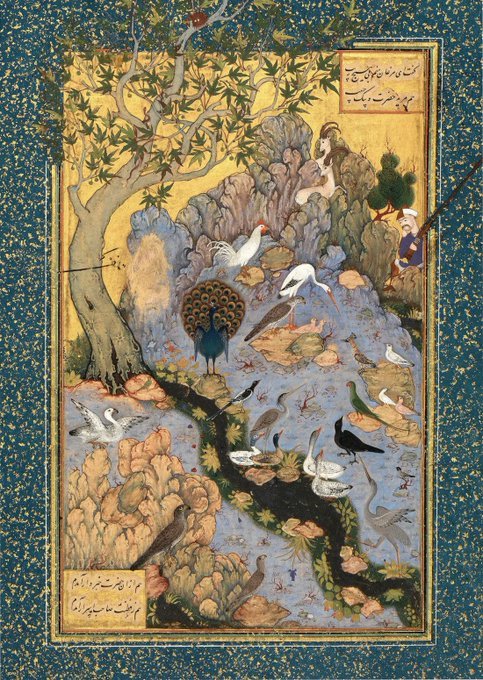
- The illustration on this folio depicts a scene from the mystical poem. The birds, which symbolize individual souls in search of the simurgh (a mystical bird representing ultimate spiritual unity), are assembled in an idyllic landscape to begin their pilgrimage under the leadership of a hoopoe.
Thread of beloved passages from the mystical poem, Mantiq al-tair (Language of the Birds), written by twelfth-century Iranian, Farid al-Din 'Attar.
Paired with stunning Persian artwork.
If you're not into poetry, trust me, bookmark & read it when you've got 5, it's absolutely EPIC!
The length of the poem is about 4,500 couplets, roughly 220 pages. Here's a quick Synopsis & a few passages from "The Conference of the Birds"
All the birds of the world gather in restless assembly. They are weary of chaos and longing for a true king. The wise hoopoe, who once served King Solomon, steps forward and tells them of the legendary Simurgh—the radiant, all-knowing sovereign who lives beyond the mountain Qāf, at the edge of existence itself. The Simurgh, says the hoopoe, is the only being worthy to rule them, and the only path to happiness is to set out on the quest to find Him.
At first the birds are filled with enthusiasm, but when they learn that the Way crosses seven perilous valleys (Quest, Love, Understanding, Detachment, Unity, Bewilderment, and Annihilation of the self), terror overtakes them. One by one they offer excuses: the nightingale cannot leave his beloved rose; the peacock is obsessed with paradise; the duck clings to water and ritual purity; the owl hoards ruined treasures; the falcon refuses to abandon pride and courtly rank. Each excuse is answered by the hoopoe with a story—tales of lovers burned alive, kings who became beggars, saints who renounced everything, and ordinary souls who found God in the midst of disgrace.
The longest and most shattering of these stories is that of Sheikh Sanʿān, a renowned Muslim saint who falls hopelessly in love with a Christian girl in Georgia. For her sake he drinks wine, tends pigs, burns his prayer rug, and converts to Christianity—only to be saved at last by divine mercy and the tears of his disciples.
After countless stories and warnings, a small band of birds finally sets out. Thousands perish along the road. The survivors cross the seven valleys, each more devastating than the last. In the Valley of Love they are consumed by longing; in the Valley of Understanding their certainties dissolve; in Detachment they lose even the desire for salvation; in Unity they see that everything is One; in Bewilderment they no longer know who or where they are; and in the final valley of Self-Annihilation nothing remains of the separate “I.”
At last, exhausted and reduced to thirty birds (sī murgh), they reach the court of the Simurgh. They expect to bow before a majestic king. Instead, after a long silence, a voice speaks:
“You who have come through fire and loss, look—you are the Simurgh, and the Simurgh is you.”
A mirror is placed before them. In its surface they see not a glorious sovereign, but their own ragged, travel-worn selves. The thirty birds and the Simurgh are one and the same. The seeker, the sought, and the act of seeking dissolve into a single, radiant reality.
In that instant every question, every pain, every separate identity is annihilated in the boundless ocean of divine unity. The birds who began the journey as a noisy multitude end as a silent, eternal oneness—lost, found, and forever transformed.
ʿAṭṭār closes with a quiet prayer: may we, too, become nothing, so that we may become everything.
- The illustration on this folio depicts a scene from the mystical poem. The birds, which symbolize individual souls in search of the simurgh (a mystical bird representing ultimate spiritual unity), are assembled in an idyllic landscape to begin their pilgrimage under the leadership of a hoopoe.
🧵2/4
The Valley of Love (the most quoted of the Seven Valleys)
The next stage is the Valley of Love’s fire;
Here reason is consumed in fierce desire.
Love has no bounds, no highway and no end;
Here heart and soul in one mad blaze descend.
The lover has no home, no creed, no goal
Except the burning that consumes the soul.
Majnun, who wandered deserts for his Layla,
Was but a child beside the true lover’s fire.
A thousand caravans may pass him by,
He sees no road, no moon, no earth, no sky.
Love’s pain is sweet; its bitterness is wine;
Its wound is joy, its death is life divine.
If you would taste this wine, then cast away
The shame of men, the hope of paradise.
Burn every veil that separates the heart
From its Beloved; let every veil depart.
Here Joseph’s beauty is a common thing,
And Zulaikha’s passion an eternal spring.
When love has grown to its consummate power
It asks no comfort and it knows no hour.
The lover lives a hundred years in one
Brief sigh, and in one sigh a thousand die.
He is the moth that circles round the flame,
candle and the burning are the same.
- Nightingale with Rose from the Qajar Album (Persia, ca. 1800–1850, vibrant Qajar-era miniature)
The Valley of Love (the most quoted of the Seven Valleys)
The next stage is the Valley of Love’s fire;
Here reason is consumed in fierce desire.
Love has no bounds, no highway and no end;
Here heart and soul in one mad blaze descend.
The lover has no home, no creed, no goal
Except the burning that consumes the soul.
Majnun, who wandered deserts for his Layla,
Was but a child beside the true lover’s fire.
A thousand caravans may pass him by,
He sees no road, no moon, no earth, no sky.
Love’s pain is sweet; its bitterness is wine;
Its wound is joy, its death is life divine.
If you would taste this wine, then cast away
The shame of men, the hope of paradise.
Burn every veil that separates the heart
From its Beloved; let every veil depart.
Here Joseph’s beauty is a common thing,
And Zulaikha’s passion an eternal spring.
When love has grown to its consummate power
It asks no comfort and it knows no hour.
The lover lives a hundred years in one
Brief sigh, and in one sigh a thousand die.
He is the moth that circles round the flame,
candle and the burning are the same.
- Nightingale with Rose from the Qajar Album (Persia, ca. 1800–1850, vibrant Qajar-era miniature)

🧵 3/4
(…and the story continues for hundreds more lines until the miraculous reversal, but this is the passage that breaks hearts every time.)
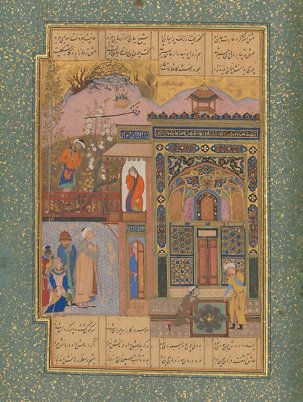
The Story of Sheikh Sanʿān – the moment of his total fall and the disciples’ despair (the emotional heart of the poem for most readers)
The sheikh, who once had led the prayer for kings,
Now wore the Christian girdle, fed the swine,
And drank the wine that every Muslim shuns.
His prayer-rug burned, his rosary was lost;
Four hundred pilgrims saw their master lost.
They wept until their tears became a flood
That carved a channel through the city’s mud. One cried: “O sheikh, have you forgotten God?”
Another tore his robe and beat his head
Against the wall until the blood ran red.
Forty days and nights they circled Mecca’s stone
In proxy for the master who had flown
From faith. At last, in dream, the Prophet came
And said: “My pity is a healing flame.
Your sheikh is saved; the girl will soon believe;
Go, bring him home, and all your hearts relieve.”
But when they reached the Christian town once more
They found the sheikh still drunk outside her door.
He cried: “Depart! I have no wish to leave
This threshold where my soul has learned to live.
I have become a Christian for her sake;
Go back, and leave me to the choice I make.”
His oldest friend fell weeping at his feet:
“Remember God, remember all we were!”
The sheikh replied: “I have no memory
Of anything except her witching eye.
If I return, my heart will break in two;
I choose this ruin — it is sweet and true.”
- Shaikh San'an beneath the Window of the Christian Maiden (Folio 18r from a 1483 Mantiq al-Ṭayr manuscript, painted ca. 1600 in Isfahan by Habiballah of Sava ca. 1600
(…and the story continues for hundreds more lines until the miraculous reversal, but this is the passage that breaks hearts every time.)
The Story of Sheikh Sanʿān – the moment of his total fall and the disciples’ despair (the emotional heart of the poem for most readers)
The sheikh, who once had led the prayer for kings,
Now wore the Christian girdle, fed the swine,
And drank the wine that every Muslim shuns.
His prayer-rug burned, his rosary was lost;
Four hundred pilgrims saw their master lost.
They wept until their tears became a flood
That carved a channel through the city’s mud. One cried: “O sheikh, have you forgotten God?”
Another tore his robe and beat his head
Against the wall until the blood ran red.
Forty days and nights they circled Mecca’s stone
In proxy for the master who had flown
From faith. At last, in dream, the Prophet came
And said: “My pity is a healing flame.
Your sheikh is saved; the girl will soon believe;
Go, bring him home, and all your hearts relieve.”
But when they reached the Christian town once more
They found the sheikh still drunk outside her door.
He cried: “Depart! I have no wish to leave
This threshold where my soul has learned to live.
I have become a Christian for her sake;
Go back, and leave me to the choice I make.”
His oldest friend fell weeping at his feet:
“Remember God, remember all we were!”
The sheikh replied: “I have no memory
Of anything except her witching eye.
If I return, my heart will break in two;
I choose this ruin — it is sweet and true.”
- Shaikh San'an beneath the Window of the Christian Maiden (Folio 18r from a 1483 Mantiq al-Ṭayr manuscript, painted ca. 1600 in Isfahan by Habiballah of Sava ca. 1600
🧵 4/4
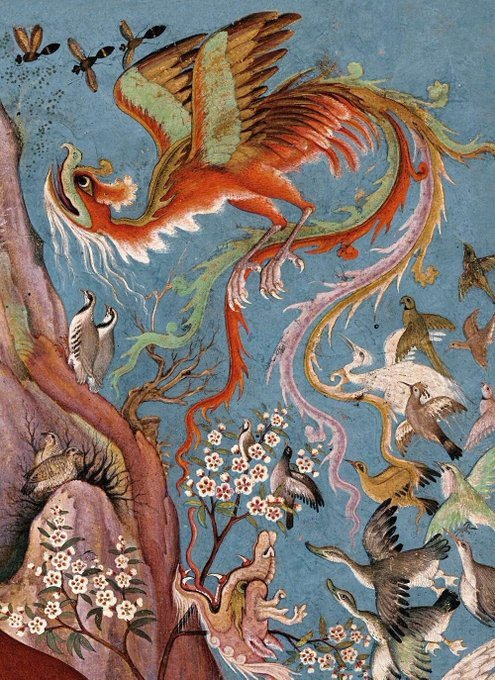
The moment when the remaining birds finally reach the end of the quest and discover the Simurgh, the great mystical goal they have been seeking.
The Final Revelation of the Simurgh (the climax of the entire poem)
They arrived at last, exhausted, at the throne of the Simurgh.
At first they were dumbfounded; then they saw
The Simurgh plain, and in that vision lost
Themselves and all they sought. A voice arose:
“You have come here in pain and weariness,
Thirty birds remain of all that multitude;
And if you look at us, you look at yourselves—
You are the Simurgh, and the Simurgh you!
This is the truth: the vision that you see
Is but the shadow cast by your own selves.
Had you not come, the shadow would not be;
You are the mirror, and the face is yours.”
A cry went up from those who understood:
“We are the Simurgh, and the Simurgh is us!”
Their separate selves were lost, annihilated
In that great oneness; every doubt and fear
Was burned away. They lived in ecstasy
Beyond the words of tongue or pen to tell.
And when the radiant Sun of that great Presence
Rose in their hearts, they saw themselves transformed
Into the very Simurgh they had sought—
The quest, the seeker, and the sought were one.
- The crow addresses the animals (Detail featuring the Simurgh) / ca. 1590-1620 / painting attributed to Miskin
The moment when the remaining birds finally reach the end of the quest and discover the Simurgh, the great mystical goal they have been seeking.
The Final Revelation of the Simurgh (the climax of the entire poem)
They arrived at last, exhausted, at the throne of the Simurgh.
At first they were dumbfounded; then they saw
The Simurgh plain, and in that vision lost
Themselves and all they sought. A voice arose:
“You have come here in pain and weariness,
Thirty birds remain of all that multitude;
And if you look at us, you look at yourselves—
You are the Simurgh, and the Simurgh you!
This is the truth: the vision that you see
Is but the shadow cast by your own selves.
Had you not come, the shadow would not be;
You are the mirror, and the face is yours.”
A cry went up from those who understood:
“We are the Simurgh, and the Simurgh is us!”
Their separate selves were lost, annihilated
In that great oneness; every doubt and fear
Was burned away. They lived in ecstasy
Beyond the words of tongue or pen to tell.
And when the radiant Sun of that great Presence
Rose in their hearts, they saw themselves transformed
Into the very Simurgh they had sought—
The quest, the seeker, and the sought were one.
- The crow addresses the animals (Detail featuring the Simurgh) / ca. 1590-1620 / painting attributed to Miskin
• • •
Missing some Tweet in this thread? You can try to
force a refresh




