Knickerbocker1664 Profile picture
Apr 2 4 tweets 3 min read Read on X
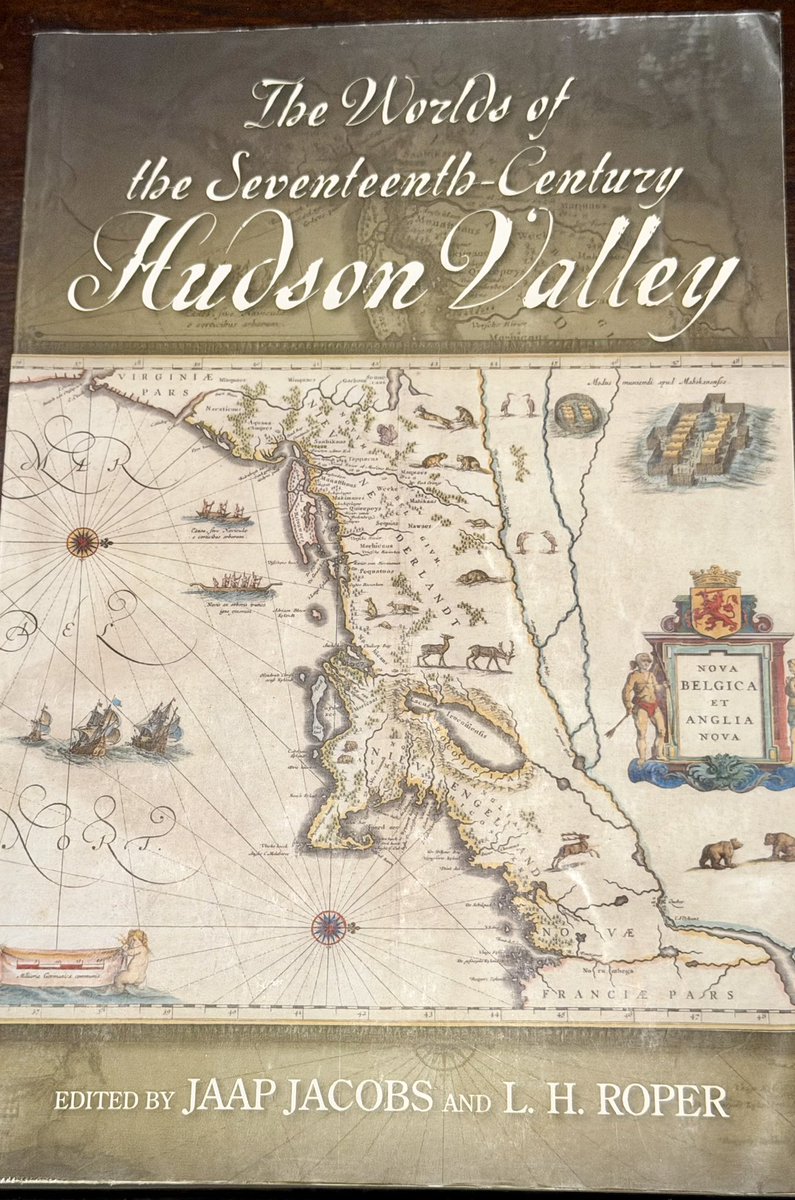
My Book recommendations on the general history of New Netherland and post-English Conquest. Image
Image
Image
Image
Image
Image
Image
Image
Image
Image
Image
Image

• • •

Missing some Tweet in this thread? You can try to force a refresh

 

Keep Current with Knickerbocker1664

Knickerbocker1664 Profile picture

Stay in touch and get notified when new unrolls are available from this author!

Read all threads

This Thread may be Removed Anytime!

PDF

Twitter may remove this content at anytime! Save it as PDF for later use!

Try unrolling a thread yourself!

how to unroll video
  1. Follow @ThreadReaderApp to mention us!

  2. From a Twitter thread mention us with a keyword "unroll"
@threadreaderapp unroll

Practice here first or read more on our help page!

More from @OldNewYork1664

Jun 30
Several hundred brave men from Maryland quite literally helped save the Revolutionary cause. They willingly laid down their lives for their comrades and for the future. There should be a national monument to their noble sacrifice. At present, all that exists is a memorial in Prospect Park, near the presumed unmarked mass grave containing their remains. It is also worth remembering that this Maryland regiment was composed of a greater number of Catholic men than perhaps any other unit in the Revolution.

Lord Stirling wrote to George Washington on August 29, 1776, providing one of the finest firsthand accounts of the pivotal rearguard action fought by approximately 400 Maryland men under William Smallwood. Their heroic last stand allowed the Continental Army to withdraw to its fortifications across Gowanus Creek. Only nine men returned to the American lines.

“‘till near eleven o’clock, when I found that General Howe, with the main body of the army, was between me and our lines, and saw that the only chance of escaping, rather than being made prisoners, was to pass the creek near the Yellow Mills; and in order to render this the more practicable, I found it absolutely necessary to attack a body of troops commanded by Lord Cornwallis…

This I instantly did, with about half of Smallwood’s, first ordering all the other troops to make the best of their way through the creek. We continued the attack a considerable time, the men having been rallied and the attack renewed five or six several times, and were on the point of driving Lord Cornwallis from his station; but large succours arriving rendered it impossible to do more than to provide for safety…”

The Marylanders were not alone. Catholic French and Spanish soldiers and sailors likewise played a decisive role in the American Revolution, transforming what had begun as a colonial rebellion into a global war.

Following the Treaty of Alliance in 1778, France committed tens of thousands of troops and seamen to the conflict. Approximately 12,000 French soldiers served in North America under the Comte de Rochambeau, while Admiral de Grasse commanded a fleet of more than twenty ships of the line and thousands of Catholic sailors during the decisive Chesapeake Campaign. Across the wider war, French naval and military personnel numbered well over 60,000 worldwide, suffering several thousand casualties as battle, disease, and the brutal conditions of eighteenth-century naval service exacted their toll.

Spain entered the war in 1779 and contributed even larger numbers across multiple theaters, from the Caribbean to the Gulf Coast and the Mississippi Valley. Under Bernardo de Gálvez, Spanish regulars, militia, free Black troops, sailors, and Native allies captured British strongholds at Baton Rouge, Mobile, and Pensacola while tying down thousands of British troops who otherwise might have been deployed against the American cause.

When combined, Catholic French and Spanish contributions involved tens of thousands of soldiers and sailors, with casualties reaching well into the thousands. Alongside the sacrifice of the Maryland Line at Brooklyn, they remind us that the struggle for American independence was sustained by people of many nations and many faiths.

The American Revolution was not won by Americans alone. It was secured by men willing to die for an idea greater than themselves, whether on the fields of Brooklyn, aboard French ships in the Atlantic, or beneath the walls of Pensacola. They deserve to be remembered with the same reverence we reserve for the Founding Fathers themselves.Image
Image
Image
The British landed on Manhattan at Kip’s Bay. It was a brilliant choice by British command, as it placed their forces between Washington and the only route off the island. The area is sometimes referred to as “Turtle Bay,” though that name is a corruption of the Dutch word deutel, meaning “knife.” You can already see how our modern New York dialect was developing. The actual Turtle Bay lies slightly farther north of Kip’s Bay itself.

This was not the first time the Kip’s Bay area had been the scene of a confrontation between American Revolutionaries and the Redcoats.

A year earlier, on his way north to take command of the American forces outside Boston, Washington passed through New York City and was feted by the colony’s Revolutionary leaders. From here, Washington laid out his plans:

“New York June 25th, 1775
Gentlemen,

The Rain on Friday Afternoon & Saturday, the Advice of several Gentlemen of the Jerseys & this City, by no Means to cross Hudsons River at the Lower Ferry, and some other Circumstances, too trivial to mention, prevented my Arrival at this Place untill the Afternoon of this Day.

In the Morning, after giving General Schuyler such Orders as, from the Result of my Enquiry into Matters here, appear necessary, I shall set out on my Journey to the Camp at Boston; and shall proceed with all the Dispatch in my Power.

Powder is so essential an Article that I cannot help again repeating the Necessity of a Supply. The Camp at Boston, from the best Account I can get from thence, is but very poorly supplied. At this place they have scarce any. How they are provided in General Worster’s Camp I have not been able yet to learn.

Governor Tryon is arriv’d and General Schuyler directed to advise you of the Line of Conduct he moves in. I fear it will not be very favorable to the American Cause. I have only to add that I am with great Respect & Regard Gentlemen, Your most Obedt & Oblid hble Serv.”Image
Image
Image
In the tumultuous aftermath of the fighting outside Boston, Isaac Sears conceived a bold plan to seize the stores of British military supplies secured in a fortified stone house overlooking Kip’s Bay.

On July 20, 1775, Sears commanded a sloop that sailed from Greenwich, Connecticut, down Long Island Sound, and into the East River. There, they anchored off the cove and quietly surprised the lone guard. Quickly emptying the storehouse and loading their sloop for the return voyage, the Patriots even managed to capture a tender from the nearby British warship Asia. The captured military stores were divided and distributed through the Committees of Correspondence from New York to Boston, which in turn passed them on to the Committees of Safety for military use.

Emboldened by their success, the Patriots selected an even larger and more significant target: Fort George at the southern tip of Manhattan. Formerly Fort Amsterdam, Fort George was the seat of British authority in New York and housed a formidable collection of artillery that could greatly aid the Patriot cause.

On August 23, 1775, Patriot forces under John Lamb approached the fort but instead chose to raid the artillery battery situated outside its walls. There they seized twelve cannon and triumphantly paraded them up Broadway, spiking many of the remaining guns in a dramatic display of resistance.

This did not sit well with the crew of the British warship Asia. When one of the ship’s whaleboats was fired upon by Patriots from the shoreline, the Asia responded by unleashing the first British broadside against Manhattan. The cannonade caused only minor damage and, remarkably, no casualties. That very same afternoon, thousands of miles across the Atlantic, King George III formally declared the American colonies to be in open rebellion.

Following the evacuation of New York City by Crown forces on October 19, 1775, American troops constructed a redoubt and a series of trenches in the very same vulnerable cove they had raided only months earlier. Within a year, it would become one of the decisive battlegrounds of the New York Campaign.
Read 4 tweets

Did Thread Reader help you today?

Support us! We are indie developers!


This site is made by just two indie developers on a laptop doing marketing, support and development! Read more about the story.

Become a Premium Member ($3/month or $30/year) and get exclusive features!

Become Premium

Don't want to be a Premium member but still want to support us?

Make a small donation by buying us coffee ($5) or help with server cost ($10)

Donate via Paypal

Or Donate anonymously using crypto!

Ethereum

0xfe58350B80634f60Fa6Dc149a72b4DFbc17D341E copy

Bitcoin

3ATGMxNzCUFzxpMCHL5sWSt4DVtS8UqXpi copy

Thank you for your support!

Follow Us!

:(