🧵 Ireland: EU's First Testing Ground for Digital ID & Wallet
1/9 🇮🇪 Ireland just launched a pilot for its Government Digital Wallet: a state-run app to store ID, birth certificate, driving license, and more. They're calling it "optional." For now.
Here's why you should pay close attention 👇
(Please share!)
gov.ie/en/department-…
1/9 🇮🇪 Ireland just launched a pilot for its Government Digital Wallet: a state-run app to store ID, birth certificate, driving license, and more. They're calling it "optional." For now.
Here's why you should pay close attention 👇
(Please share!)
gov.ie/en/department-…

2/9 The government's pitch sounds reassuring:
"You are in control of your data" → "Nothing is tracked or recorded" → "Only what's needed gets shared" → "It makes life simpler"
They said the same things about every surveillance system before it became mandatory. rte.ie/news/business/…
"You are in control of your data" → "Nothing is tracked or recorded" → "Only what's needed gets shared" → "It makes life simpler"
They said the same things about every surveillance system before it became mandatory. rte.ie/news/business/…
3/9 This move is part of the EU Digital Identity Wallet (EUDI), an EU framework being rolled out across all member states, perfectly timed with the UN Agenda 2030 timeline.
Ireland is just one domino. Every EU country is next. independent.ie/irish-news/wha…
Ireland is just one domino. Every EU country is next. independent.ie/irish-news/wha…
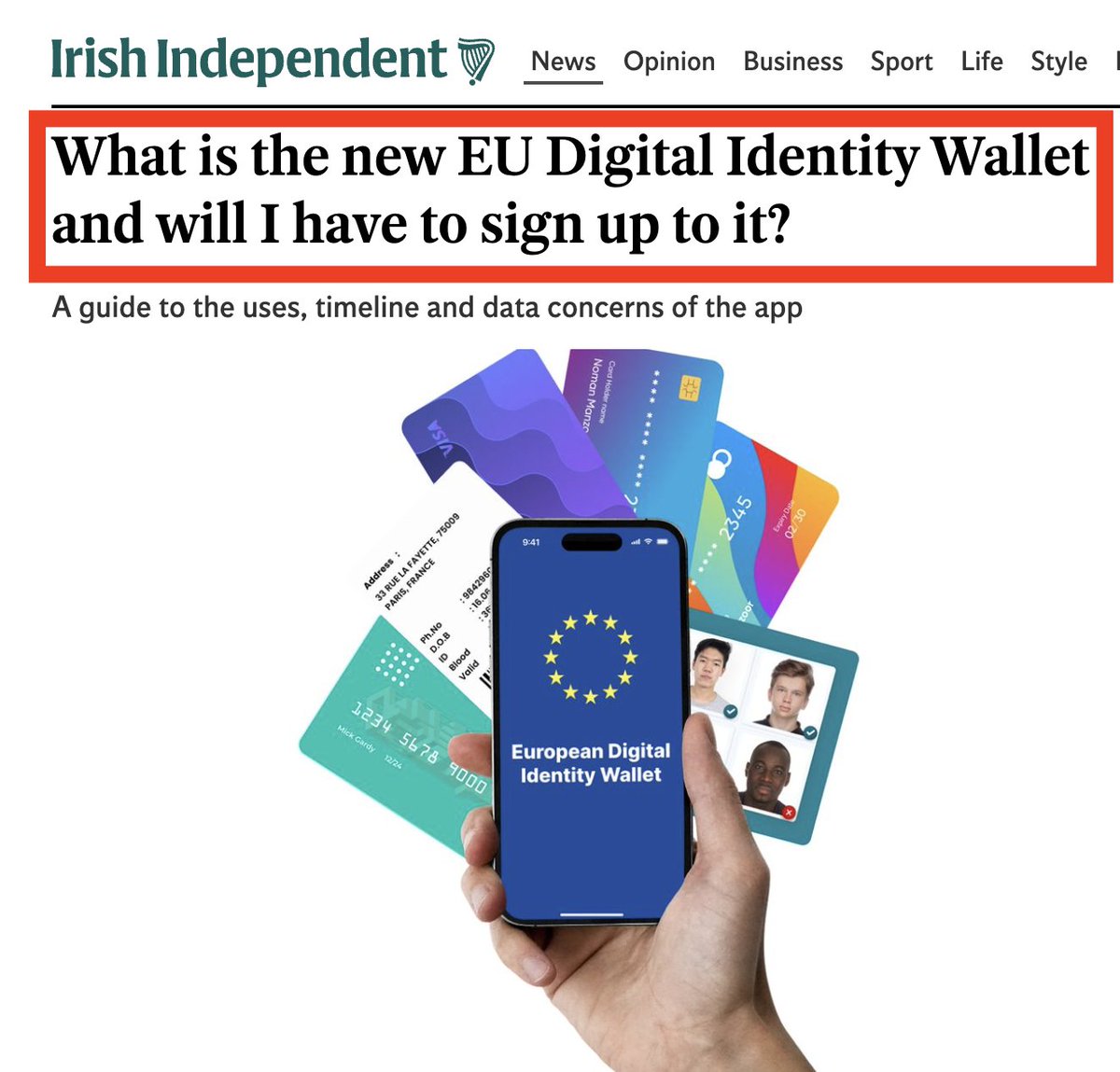
4/9 The Digital Euro (CBDC) deadline complements this Digital ID & Wallet rollout, what a coincidence!
Ireland is legally required under EU regulation to have the wallet operational for public services by end of 2026, and extended to private services by end of 2027.
"Voluntary" has an expiration date. They wrote it into law. independent.ie/irish-news/dig…
Ireland is legally required under EU regulation to have the wallet operational for public services by end of 2026, and extended to private services by end of 2027.
"Voluntary" has an expiration date. They wrote it into law. independent.ie/irish-news/dig…

5/9 Now look at the Digital Euro timeline: the ECB rollout target is 2026–2027.
The same window with the same infrastructure. A state-controlled digital ID wallet + a state-controlled digital currency, arriving together. You think it's a coincidence?
Once your ID and your money live in the same government app, every transaction can be permissioned, tracked, and cut off. ecb.europa.eu/press/key/date…
The same window with the same infrastructure. A state-controlled digital ID wallet + a state-controlled digital currency, arriving together. You think it's a coincidence?
Once your ID and your money live in the same government app, every transaction can be permissioned, tracked, and cut off. ecb.europa.eu/press/key/date…

6/9 Social Media policing is a feature, not a bug: Ireland's Communications Minister has proposed requiring the wallet for social media access; meaning Irish people will need a state-issued digital ID just to log into Facebook, Instagram, or X.
Adults who refuse? Lose their accounts.
coingeek.com/ireland-may-re…
Adults who refuse? Lose their accounts.
coingeek.com/ireland-may-re…

7/9 Surveillance net disguised as child protection:
The Irish Council for Civil Liberties put it bluntly: this would mean users can no longer browse the internet with any degree of anonymity. Every page visit, every platform login will be traceable back to a specific government ID.
The Irish Council for Civil Liberties put it bluntly: this would mean users can no longer browse the internet with any degree of anonymity. Every page visit, every platform login will be traceable back to a specific government ID.
8/9 You're watching the convergence of digital ID + internet access control + social media monitoring + CBDC rails, all running through one government-issued app and infrastructure.
Permission-based life: you exist online, move money, and access services only as long as the state allows.
This is Agenda 2030 infrastructure being rolled out, in plain sight. engadget.com/cybersecurity/…
Permission-based life: you exist online, move money, and access services only as long as the state allows.
This is Agenda 2030 infrastructure being rolled out, in plain sight. engadget.com/cybersecurity/…
9/9 They'll keep calling it "optional" until it isn't. The pilot phase is now, and the time to push back is before the legislation locks it in.
Please share.
nationaltoday.com/us/ny/new-york…
Please share.
nationaltoday.com/us/ny/new-york…
@threadreaderapp unroll
• • •
Missing some Tweet in this thread? You can try to
force a refresh