Post-mainnet reality check:
- Monad
- MegaETH
- Plasma
- Katana
- Ink
5 newly launched blockchains with attention. ~$1.06b in fundraising. Nearly $3B in combined TVL. $2.5M combined chain fees generated to date.
What the data says 🧵
- Monad
- MegaETH
- Plasma
- Katana
- Ink
5 newly launched blockchains with attention. ~$1.06b in fundraising. Nearly $3B in combined TVL. $2.5M combined chain fees generated to date.
What the data says 🧵
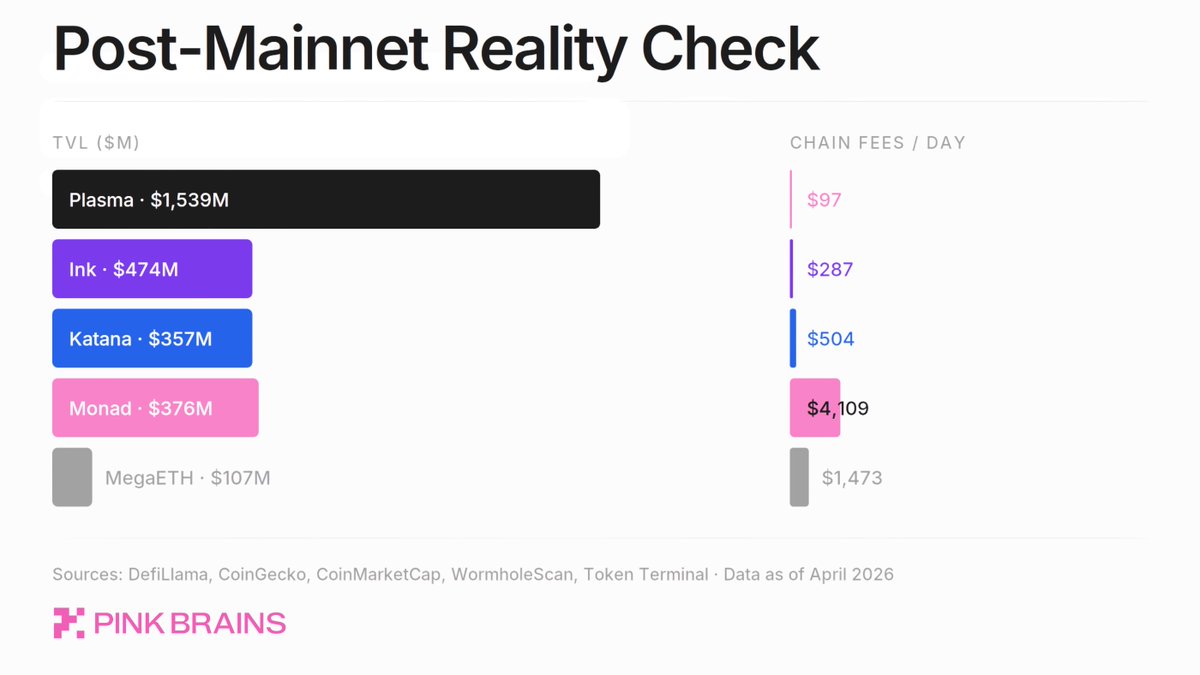
🧠 Key takeaways:
1/ TVL ≠ value capture for chains: $2.85B TVL generates just $2.4M/year (0.08% capture).
2/ Monad leads in DEX activity: Highest trading volume and DEX turnover.
3/ Katana stands out as the most sustainable incentive model for token holders with diversified revenue and a self-sustaining loop.
4/ Tech ambition ≠ adoption: Ink shows the strongest perps activity, while MegaETH is the more ideal chain for instant trading.
5/ Poor capital efficiency: $1.06B raised for ~99K DAU (~$10.7K/user); at current revenue, ROI would take centuries.
1/ TVL ≠ value capture for chains: $2.85B TVL generates just $2.4M/year (0.08% capture).
2/ Monad leads in DEX activity: Highest trading volume and DEX turnover.
3/ Katana stands out as the most sustainable incentive model for token holders with diversified revenue and a self-sustaining loop.
4/ Tech ambition ≠ adoption: Ink shows the strongest perps activity, while MegaETH is the more ideal chain for instant trading.
5/ Poor capital efficiency: $1.06B raised for ~99K DAU (~$10.7K/user); at current revenue, ROI would take centuries.
🧠 TVL & Concentration:
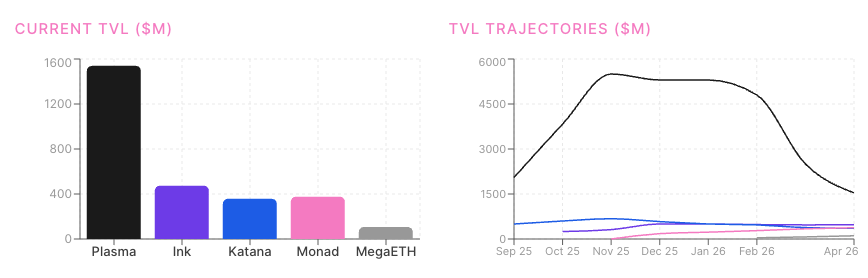
TVL trajectories show 3 patterns:
1/ Plasma peaked at $5.5B post-launch, then steadily declined as early investors exited and token price collapsed 93%
2/ Katana peaked at $677M pre-TGE, then declined post-TGE (a typical sell-the-news pattern where capital leaves once the farming catalyst (token claim) happens
3/ Monad shows the only consistent uptrend, growing from $0 to $377M over 5 months with no major retracement.
TVL trajectories show 3 patterns:
1/ Plasma peaked at $5.5B post-launch, then steadily declined as early investors exited and token price collapsed 93%
2/ Katana peaked at $677M pre-TGE, then declined post-TGE (a typical sell-the-news pattern where capital leaves once the farming catalyst (token claim) happens
3/ Monad shows the only consistent uptrend, growing from $0 to $377M over 5 months with no major retracement.
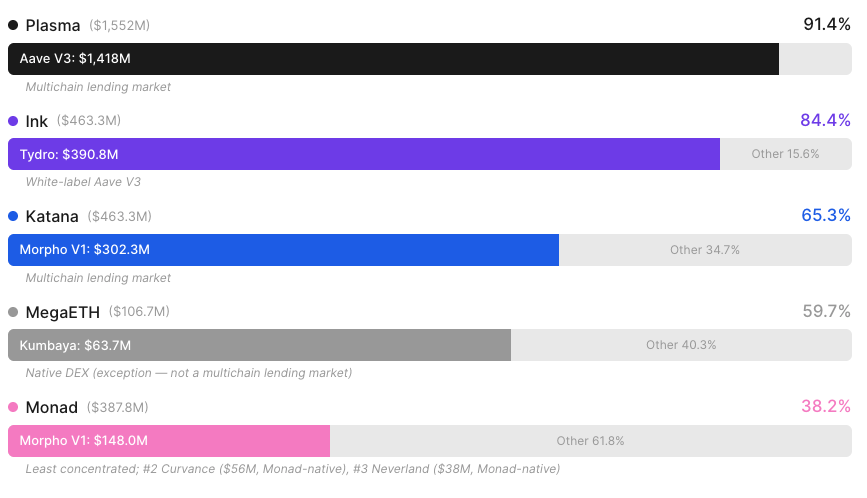
4/5 chains derive 60-97% of TVL from a single protocol.
- The Aave playbook is being used on Plasma, MegaETH, and Ink (white-label Aave), while Morpho dominates Monad and Katana.
High protocol concentration creates fragility. If the top protocol exit, pauses, or gets exploited, the chain's TVL traction may collapse.
- Monad shows the most diverse chain, with top #2 and #3 protocols being Monad-native (Curvance, Neverland).
- MegaETH is the outlier as the top protocol by TVL is a native spot DEX, not a lending protocol.
- The Aave playbook is being used on Plasma, MegaETH, and Ink (white-label Aave), while Morpho dominates Monad and Katana.
High protocol concentration creates fragility. If the top protocol exit, pauses, or gets exploited, the chain's TVL traction may collapse.
- Monad shows the most diverse chain, with top #2 and #3 protocols being Monad-native (Curvance, Neverland).
- MegaETH is the outlier as the top protocol by TVL is a native spot DEX, not a lending protocol.
🧠 DEX Volume:
Unlike TVL, which can be passively parked in lending protocols, DEX volume requires active intent. The volume-to-TVL ratio (daily turnover) shows how 'alive' the capital on a chain is.
- Monad's 9% daily DEX turnover ($35.09M on $387M TVL)
- Ink's $184M in daily perps volume on Nado is significant, while daily spot volume is modest at $1,5M.
Unlike TVL, which can be passively parked in lending protocols, DEX volume requires active intent. The volume-to-TVL ratio (daily turnover) shows how 'alive' the capital on a chain is.
- Monad's 9% daily DEX turnover ($35.09M on $387M TVL)
- Ink's $184M in daily perps volume on Nado is significant, while daily spot volume is modest at $1,5M.
To compare:
- Base: $562M/day DEX vol on $4.17B TVL (13%)
- BNB Chain: $528M/day on $5.3B TVL (10%)
- Solana: ~$920M/day on ~$5.5B TVL (16%)
Monad's 9% places it in the competitive range of BNB Chain and Base, which is notable for a 5-month-old chain.
Plasma's 0.18% turnover makes it the least actively traded chain relative to TVL in the top 50. But it's still relevant as Plasma aims to be a stablecoin-focused chain.
- Base: $562M/day DEX vol on $4.17B TVL (13%)
- BNB Chain: $528M/day on $5.3B TVL (10%)
- Solana: ~$920M/day on ~$5.5B TVL (16%)
Monad's 9% places it in the competitive range of BNB Chain and Base, which is notable for a 5-month-old chain.
Plasma's 0.18% turnover makes it the least actively traded chain relative to TVL in the top 50. But it's still relevant as Plasma aims to be a stablecoin-focused chain.
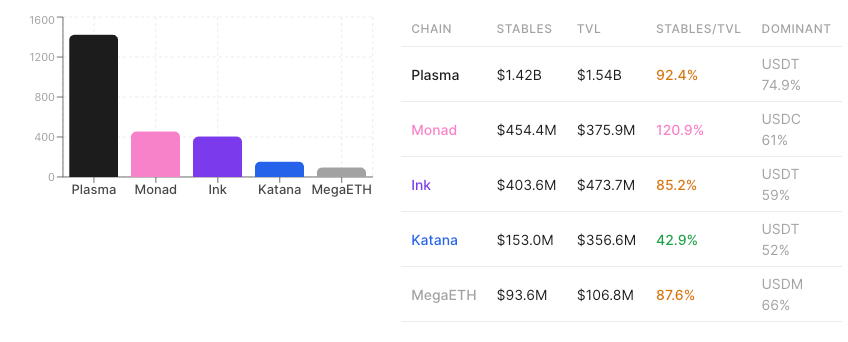
🧠 Stablecoins:
Stablecoin market cap reflects the depth of dollar-denominated liquidity available for trading, lending, and yield farming.
The dominant stablecoin choice also reveals strategic positioning:
- USDT dominance (Plasma, Ink) targets global onchain payment, CEX transfer
- USDC dominance (Monad) targets institutional/US users
- Native stablecoin dominance (MegaETH's USDM) indicates ecosystem-specific design
Stablecoin market cap reflects the depth of dollar-denominated liquidity available for trading, lending, and yield farming.
The dominant stablecoin choice also reveals strategic positioning:
- USDT dominance (Plasma, Ink) targets global onchain payment, CEX transfer
- USDC dominance (Monad) targets institutional/US users
- Native stablecoin dominance (MegaETH's USDM) indicates ecosystem-specific design
When stablecoin mcap exceeds DeFi TVL, it means significant capital is sitting in wallets undeployed.
- Monad has $78.6M more stablecoins than DeFi TVL (20% of TVL)
- Katana seems to be the healthiest with 43%, most capital is actively deployed in DeFi protocols, not parked.
- Monad has $78.6M more stablecoins than DeFi TVL (20% of TVL)
- Katana seems to be the healthiest with 43%, most capital is actively deployed in DeFi protocols, not parked.
🧠 Fee Economics
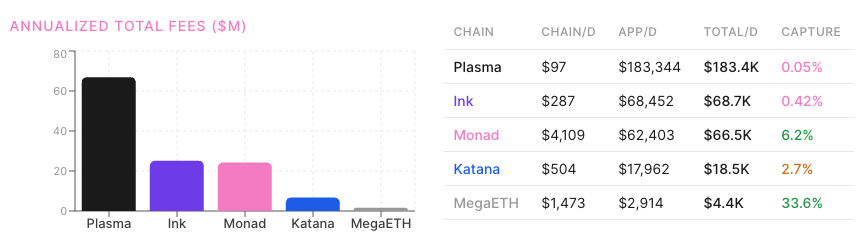
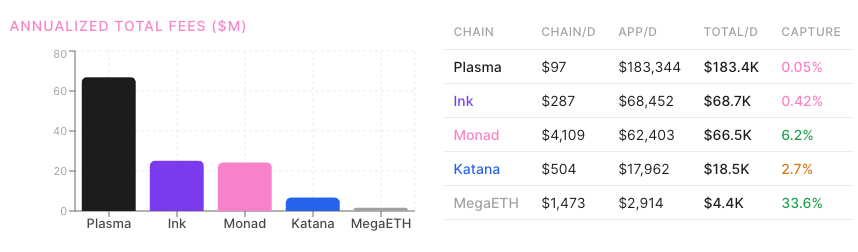
Fee analysis distinguishes between chain-level fees (gas paid to the L1/L2 protocol) and application-level fees (swap fees, lending interest, perps trading fees).
The fee capture rate (percentage of total economic activity the chain itself retains) reveals whether value accrues to the chain's token or to the apps built on it.
A chain with high app fees but low chain fees has a value-capture problem: users are active, but the chain doesn't monetize them.
Fee analysis distinguishes between chain-level fees (gas paid to the L1/L2 protocol) and application-level fees (swap fees, lending interest, perps trading fees).
The fee capture rate (percentage of total economic activity the chain itself retains) reveals whether value accrues to the chain's token or to the apps built on it.
A chain with high app fees but low chain fees has a value-capture problem: users are active, but the chain doesn't monetize them.
- Plasma generates $183K/day total, but only $97 reaches the chain (0.05% capture), as Plasma allows free USDT transfers by sponsoring gas, which makes it an ideal chain for payments & remittances.
- MegaETH captures 33.6%, but total fees are only $2.9K/day
- Monad's 6.2% capture rate is the healthiest among larger chains
This mirrors the broader L1 trend noted by CoinDesk Research: L1s now capture only 12% of ecosystem fees (down from 60% in early 2025).
- MegaETH captures 33.6%, but total fees are only $2.9K/day
- Monad's 6.2% capture rate is the healthiest among larger chains
This mirrors the broader L1 trend noted by CoinDesk Research: L1s now capture only 12% of ecosystem fees (down from 60% in early 2025).
🧠 Revenue Sustainability Models
When token incentives end and unlock sell pressure begins, what sustains each chain?
We rate each chain's post-incentive revenue model, based on fee generation, capital deployment (stables/TVL), trading volume diversity (spot + perps), token structure, and mechanical sustainability of the revenue model.
When token incentives end and unlock sell pressure begins, what sustains each chain?
We rate each chain's post-incentive revenue model, based on fee generation, capital deployment (stables/TVL), trading volume diversity (spot + perps), token structure, and mechanical sustainability of the revenue model.
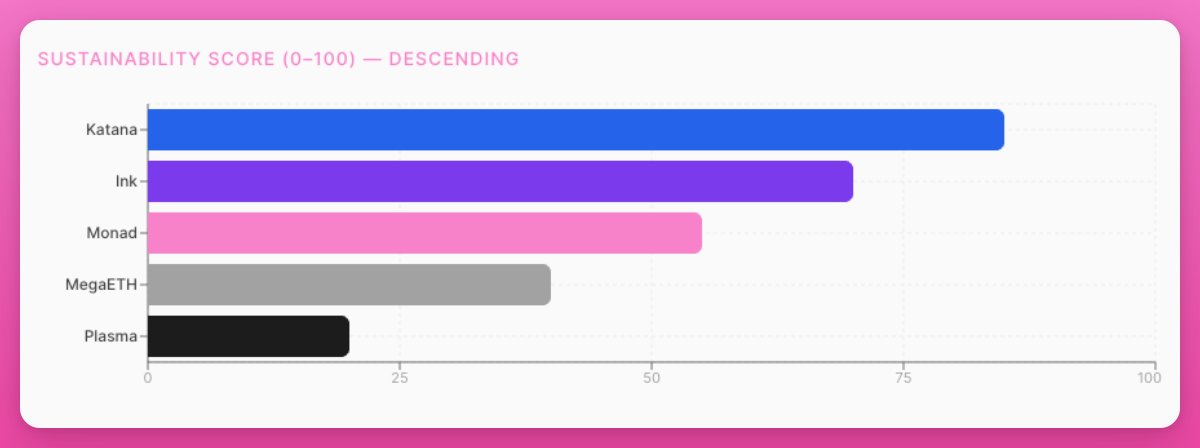
Katana (85/100):
- Chain-owned Liquidity recycles 100% sequencer fees into permanent. VaultBridge earns 3-5% on L1 assets. AUSD yield feeds the ecosystem. A roadmap to replace emissions with chain fees.
- $25.29M/day perps volume on Katana Perps adds a high-margin fee vertical
- Lowest stables/TVL (42.9%) confirms capital is deployed, not parked.
- No VC selling schedule.
Ink (70/100):
- Kraken's 10M+ users as a zero-CAC funnel
- Nado is the strongest organic trading signal in this cohort
- $10M Aave guarantee ensures Tydro operates for 5 years
- Risks: 84.4% TVL concentration in Tydro, $287/d chain capture, and post-TGE retention risk
Monad (55/100):
- Airdrop hangover is over
- Uses heavy token incentives (38.5% supply) to bootstrap ecosystem activity and staking
- Generates ~$19.7M annualized fees, but much is speculative
- TVL is on an increasing trend. App ecosystem is interesting to try out.
- Risks: big upcoming token unlocks and reliance on incentive-driven usage.
MegaETH (40/100):
- Unique model where stablecoin yield (USDm) subsidizes chain costs → potentially zero fees for users
- $149K/d perps, $2.33M DEX, 3,833 DAU. $15M+ spent bootstrapping ($10M Aave + $5M+ listings) against $1.6M ann. fees = deeply negative ROI
- KPI-gated TGE. Zero conditions met after 2 months
Plasma (20/100):
- Focused on zero-fee USDT transfers, prioritizing adoption over revenue
- Minimal direct chain revenue ($97/day); relies on Aave as top yield source.
- Risks: business model conflicts with fee generation and heavy token dilution pressure
- Chain-owned Liquidity recycles 100% sequencer fees into permanent. VaultBridge earns 3-5% on L1 assets. AUSD yield feeds the ecosystem. A roadmap to replace emissions with chain fees.
- $25.29M/day perps volume on Katana Perps adds a high-margin fee vertical
- Lowest stables/TVL (42.9%) confirms capital is deployed, not parked.
- No VC selling schedule.
Ink (70/100):
- Kraken's 10M+ users as a zero-CAC funnel
- Nado is the strongest organic trading signal in this cohort
- $10M Aave guarantee ensures Tydro operates for 5 years
- Risks: 84.4% TVL concentration in Tydro, $287/d chain capture, and post-TGE retention risk
Monad (55/100):
- Airdrop hangover is over
- Uses heavy token incentives (38.5% supply) to bootstrap ecosystem activity and staking
- Generates ~$19.7M annualized fees, but much is speculative
- TVL is on an increasing trend. App ecosystem is interesting to try out.
- Risks: big upcoming token unlocks and reliance on incentive-driven usage.
MegaETH (40/100):
- Unique model where stablecoin yield (USDm) subsidizes chain costs → potentially zero fees for users
- $149K/d perps, $2.33M DEX, 3,833 DAU. $15M+ spent bootstrapping ($10M Aave + $5M+ listings) against $1.6M ann. fees = deeply negative ROI
- KPI-gated TGE. Zero conditions met after 2 months
Plasma (20/100):
- Focused on zero-fee USDT transfers, prioritizing adoption over revenue
- Minimal direct chain revenue ($97/day); relies on Aave as top yield source.
- Risks: business model conflicts with fee generation and heavy token dilution pressure
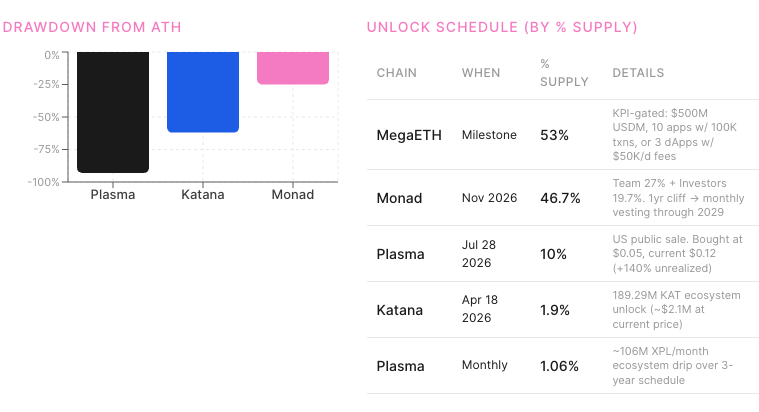
🧠 Token Performance
All chains launched tokens are underwater from ATH:
Plasma: -93%
Katana: -62%
Monad: -25%
MegaETH's milestone-gated distribution (53% of supply tied to onchain KPIs) is unique but also means no token until adoption materializes.
All chains launched tokens are underwater from ATH:
Plasma: -93%
Katana: -62%
Monad: -25%
MegaETH's milestone-gated distribution (53% of supply tied to onchain KPIs) is unique but also means no token until adoption materializes.
Every cycle, we've seen a wave of new chains that raise hundreds of millions, launch with impressive TVL, and slowly fade when the music stops.
We hope this cycle will be different as we now have faster chains, new incentive models, and crypto is no longer a niche tech.
We hope this cycle will be different as we now have faster chains, new incentive models, and crypto is no longer a niche tech.
• • •
Missing some Tweet in this thread? You can try to
force a refresh