
Today the worlds most powerful genetic predictor of IQ, CogPGT, has been published in the peer reviewed journal Intelligence and Cognitive Abilities.
When used for embryo screening, it can substantially boost expected IQ of future offspring.
Read on for the scientific details!
When used for embryo screening, it can substantially boost expected IQ of future offspring.
Read on for the scientific details!
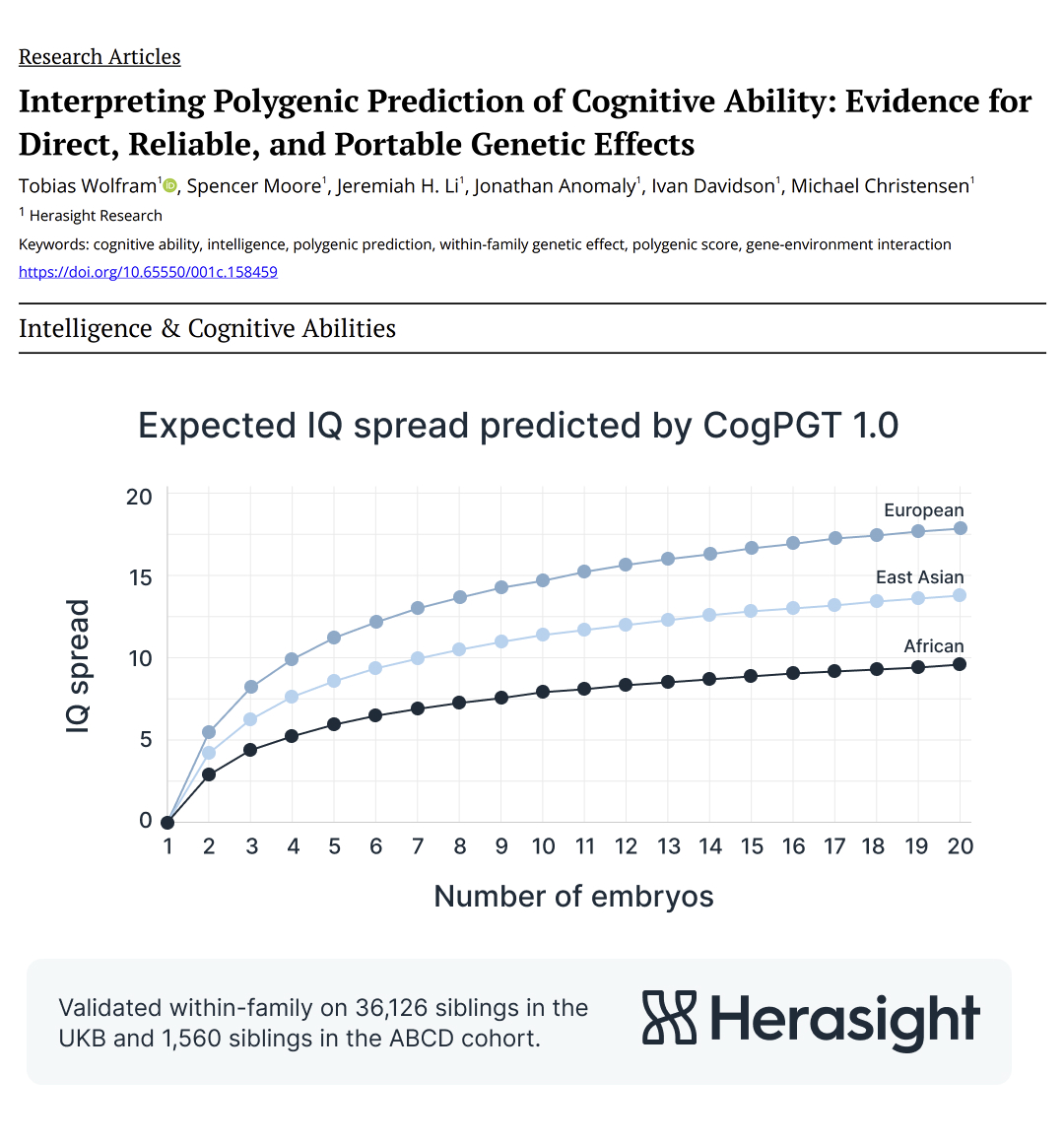
If you're interested in applying CogPGT and our disease predictors to your embryos, sign up here: herasight.com/get-access
Read our published article here: icajournal.scholasticahq.com/article/158459…
Or continue reading this thread for a summary of our findings.
Read our published article here: icajournal.scholasticahq.com/article/158459…
Or continue reading this thread for a summary of our findings.
CogPGT achieves substantially greater prediction ability than previous polygenic scores (PGS) for IQ through Innovative psychometrically informed phenotyping, functionally informed statistical genomics and extensive data curation.
CogPGT is the first powerful genetic predictor of IQ, enabling parents to boost the expected IQ of their offspring, with major implications for the future of humanity.
We compared CogPGT against a score built from the best published GWAS. All qualitative conclusions replicate, but CogPGT explains up to ~3x more within-family variance in g, with the difference most pronounced in the independent ABCD cohort.
Last October, our CogPGT preprint sparked productive debate, especially around how to properly model the g factor, the underlying trait measured by intelligence tests.
That debate helped us to make the paper better and more rigorous.
That debate helped us to make the paper better and more rigorous.
One concern raised about the initial preprint was that CogPGT’s estimated correlation with g diverged more than expected between cohorts (β = 0.521 in UKB vs. 0.425 in ABCD). As several people suggested, moving from classical test theory corrections to full latent variable modeling helped address this discrepancy.
Using full latent variable modeling, we estimated CogPGT’s correlation with g to be 0.525 (UKB) and 0.509 (ABCD), showing strong cross-cohort concordance, and implying that CogPGT explains around 27% of the variance in g.
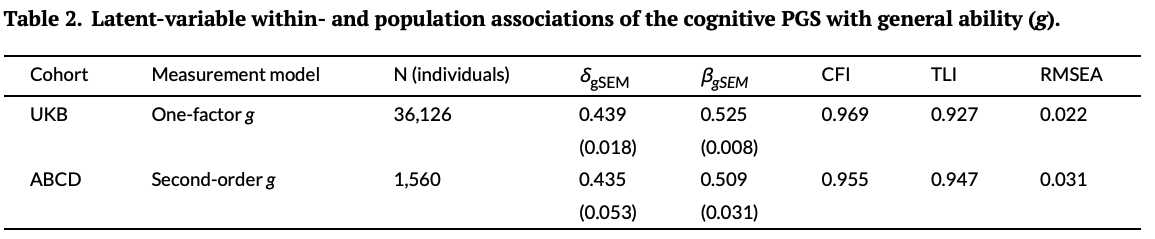
Sometimes genetic predictors lose power when predicting differences between siblings, such as in embryo screening; e.g. polygenic scores for educational attainment lose ~half of their correlation within-family, likely due to gene-environment correlation and assortative mating.
In contrast, CogPGT retains 84% of its correlation within families in UKB and 85% in ABCD, with consistent within-family correlations with g across UKB (0.439) and ABCD (0.435). CogPGT thus provides powerful within-family prediction, enabling powerful embryo selection.
In our published paper, we found that CogPGT's predictive strength for each cognitive test correlates strongly with that test's g-loading: 0.97 at population level, 0.93 within families in UKB. Results in ABCD were qualitatively similar, but slightly noisier, given the substantially smaller sample size.

This matters because it rules out the concern that the score captures some narrow cognitive skill. Measurement invariance and MIMIC models further confirm the signal operates through the latent trait itself, not through item-specific pathways.
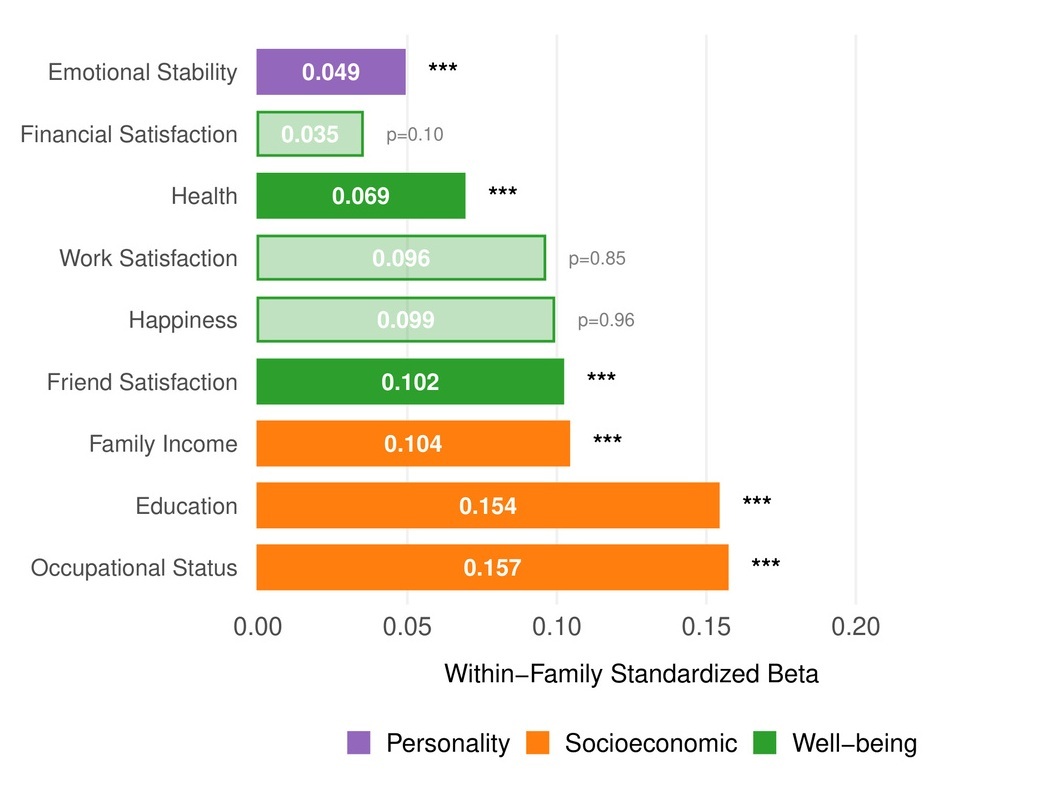
Within UKB sibling pairs, the higher-scoring sibling attains more education (β = 0.154), higher occupational status (β = 0.157), and greater income (β = 0.104). They also report better health and greater satisfaction with friendships. These are direct genetic effects on life outcomes, unconfounded by shared family background.
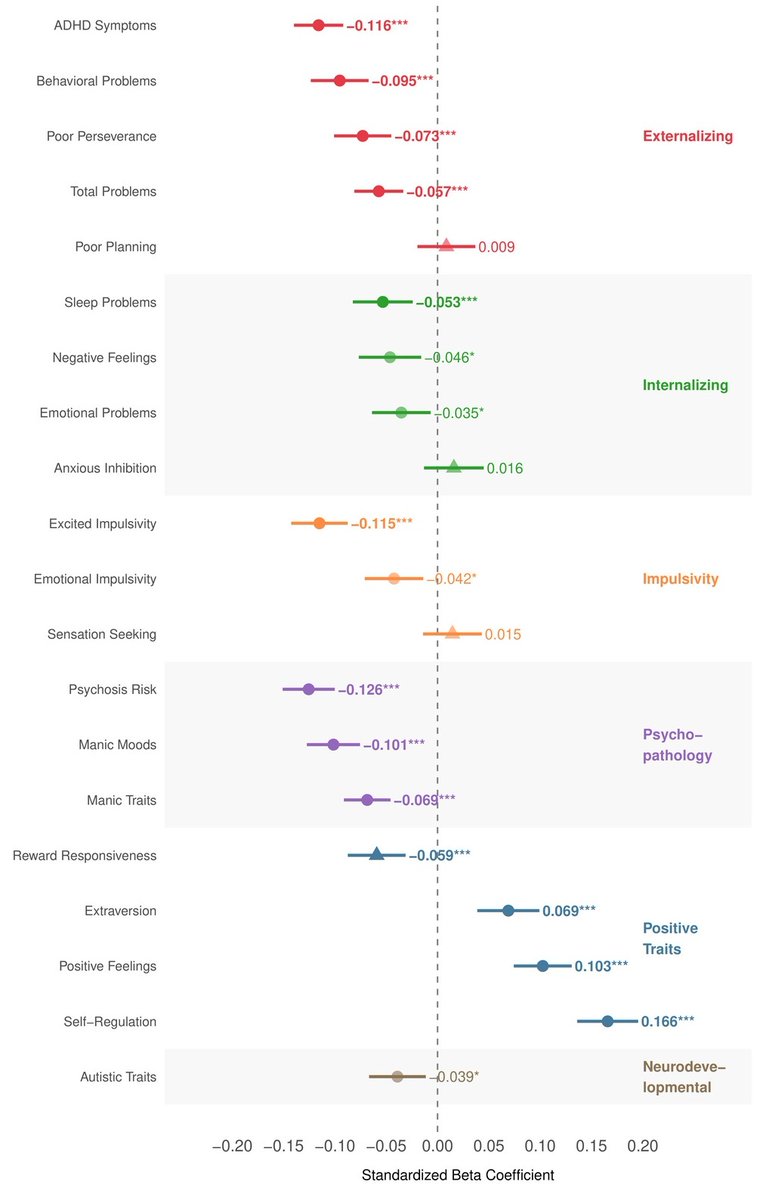
Within UKB siblings, higher CogPGT score is protective against type-II diabetes and heart disease, and no evidence for increased disease risks were found. In ABCD, higher scores are associated with fewer psychotic-like symptoms, lower ADHD symptoms, reduced externalizing behaviors, and higher positive affect. In contrast to what some have suggested, we found no association with autism symptoms.

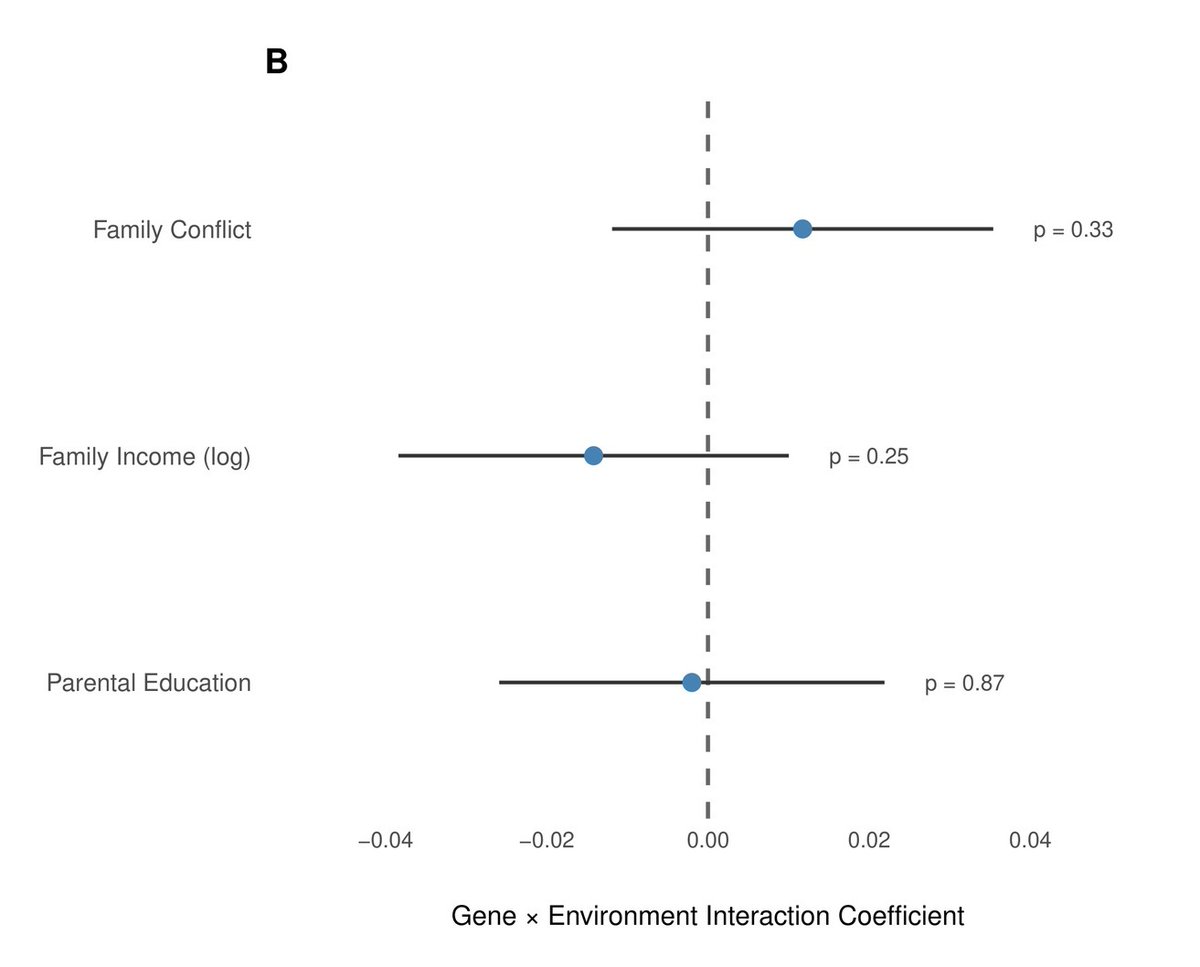
We also tested for gene-environment interactions with parental education, family income, and family conflict. None approached significance. This lines up with other failures to replicate early Scarr-Rowe studies that claimed genetic effects were moderated by these factors based on very small samples.
To check the generalizability of our findings, we repeated all analyses using a previously published score (Savage et al. 2018 + LDpred2). All qualitative conclusions held. But the variance in g explained by the previous score is only ~30% as large as CogPGT when estimated within-family.
As before, cross-ancestry portability follows theoretical expectations: ~89% effect retention in Hispanic/Latino Americans, ~88% South Asian, ~64% African American, ~59% East Asian (but check SEs). This shows that CogPGT retains a powerful level of prediction across non-European ancestries.

The main reason for the reduced performance in non-European ancestry is due to the smaller training sample available for non-European ancestries. We expect the gap to be reduced as more diverse biobanks become available.
CogPGT 1.0 is published. We're already making good progress on 2.0. Stay tuned!
• • •
Missing some Tweet in this thread? You can try to
force a refresh




