I've seen a fair few people suggest recently that the 'science of reading' can essentially be boiled down to two messages:
1. Explicitly teach kids to decode (i.e. systematic phonics).
2. Build knowledge.
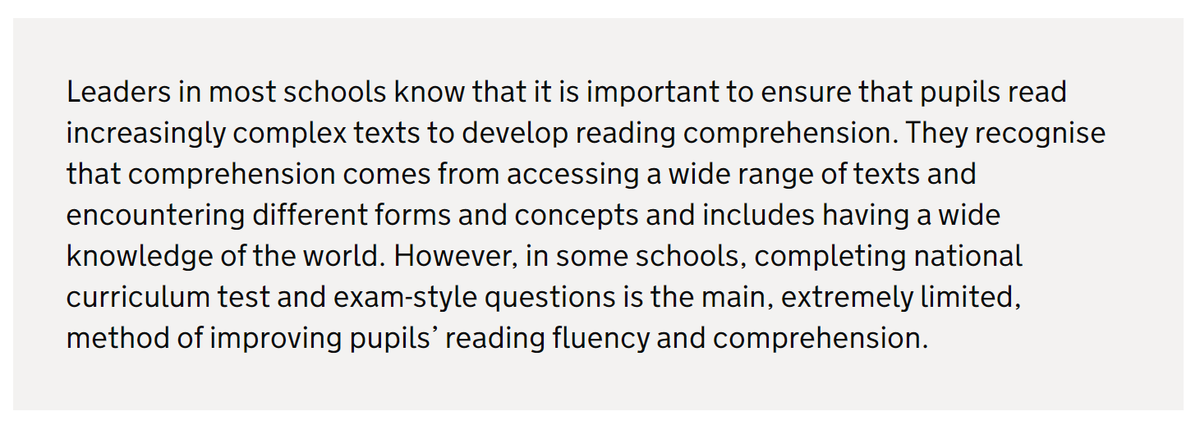
But in many schools, these two things alone will fail.
>>
1. Explicitly teach kids to decode (i.e. systematic phonics).
2. Build knowledge.
But in many schools, these two things alone will fail.
>>
In England, explicit phonics and the sequencing of knowledge have been prioritised for a decade.
Despite valuable national progress, I can say confidently that it's perfectly possible for a school to have these things in place and yet fail to secure strong reading outcomes.
>>
Despite valuable national progress, I can say confidently that it's perfectly possible for a school to have these things in place and yet fail to secure strong reading outcomes.
>>
This isn't me naysaying the value of teaching phonics explicitly or building pupils' knowledge of the world.
On the contrary, both of these things are essential, and I spend plenty of my professional life explaining to teachers and school leaders exactly why I think this.
>>
On the contrary, both of these things are essential, and I spend plenty of my professional life explaining to teachers and school leaders exactly why I think this.
>>
However, schools can have these in place and lack a crucial piece of the puzzle.
The point of teaching phonics explicitly is to provide kids with the tools to *begin* decoding words for themselves.
>>
The point of teaching phonics explicitly is to provide kids with the tools to *begin* decoding words for themselves.
>>
Crucially, explicit teaching of phonics can do this job, but kids must then apply this nascent capability to huge amounts of text to develop the word recognition automaticity required for fluency and, thus, comprehension.
>>
>>
For plenty of kids, this can't just mean teaching phonics and then asking them to read independently or listen while teachers read texts aloud.
They need scaffolded reading practice.
>>
They need scaffolded reading practice.
>>
Scaffolded reading practice basically involves helping kids to use what they've learned from phonics to accurately recognise lots of unfamiliar words.
The easiest way to achieve this is through one-to-one reading practice with an adult who offers feedback and encouragement.
>>
The easiest way to achieve this is through one-to-one reading practice with an adult who offers feedback and encouragement.
>>
Some kids will get this one-to-one practice at home, but some kids certainly won't for a variety of reasons.
And schools almost never have the number of adults available to provide enough one-to-one reading practice to every kid who needs it.
>>
And schools almost never have the number of adults available to provide enough one-to-one reading practice to every kid who needs it.
>>
This means that schools need to find whole-class structures for scaffolded reading practice as one part of their teaching of reading once kids have learned the basics of decoding via systematic phonics.
>>
>>
There's no single correct way to do this.
Lots of schools I work with use a short text in a 30-minute structure with modelling (perhaps with some echo reading), brief vocabulary teaching, paired repeated practice, performance of the text and discussion of the text's meaning.
>>
Lots of schools I work with use a short text in a 30-minute structure with modelling (perhaps with some echo reading), brief vocabulary teaching, paired repeated practice, performance of the text and discussion of the text's meaning.
>>
Other schools undertake scaffolded reading practice every day for a short period.
Others embed scaffolded reading practice into subjects across the curriculum.
Again, there are lots of ways this can be done.
>>
Others embed scaffolded reading practice into subjects across the curriculum.
Again, there are lots of ways this can be done.
>>
But all too often it simply *isn't* done because schools believe that explicit phonics alone takes care of word recognition.
It doesn't.
What it *does* do is allow the journey to fluent reading through scaffolded reading practice to begin in a productive fashion.
>>
It doesn't.
What it *does* do is allow the journey to fluent reading through scaffolded reading practice to begin in a productive fashion.
>>
There are plenty of other things that schools can learn from what is often called the 'science of reading': how to support pupils who struggle to recognise words much more than others, flexible syllabification, effective vocabulary teaching, morphology, etc.
>>
>>
But a *big* step in the right direction for schools who already teach phonics explicitly and build pupils' knowledge across the curriculum would be to provide plenty of scaffolded reading practice.
>>
>>
Without this crucial piece of the puzzle, you might well find yourself a little underwhelmed by what explicit phonics and building knowledge have to offer.
• • •
Missing some Tweet in this thread? You can try to
force a refresh