Is Exogenous Lactate the "Holy Grail" of sports fuelling?
For years, we’ve been focused on >120g/h CHO intake. But how can we explore new limits?
Lactate is not a waste. It´s the most efficient and preferential fuel in the human body.
A thread on the next metabolic frontier🧵
For years, we’ve been focused on >120g/h CHO intake. But how can we explore new limits?
Lactate is not a waste. It´s the most efficient and preferential fuel in the human body.
A thread on the next metabolic frontier🧵
Scientific knowledge around Lactate has evolved significantly over the last 50 years. Thanks to scientists like Brooks, Rabinowitz, Gladden...
We now know Lactate is not only a major energy source, but also a gluconeogenic precursor and a signalling molecule.
We now know Lactate is not only a major energy source, but also a gluconeogenic precursor and a signalling molecule.

However, the knowledge we've got is mostly focused on Endogenous Lactate, understood as the Lactate our cells produce through glycolysis under specific energetic demands. But endogenous ≠Exogenous. Our knowledge on the later one is limited.
The difference is the metabolic cost!
The difference is the metabolic cost!
Endogenous Lactate production is a "rescue" mechanism. It costs 2 ATP during the investment phase of glycolysis and releases a proton (H+). It requires a cost.
Exogenous Lactate is like an external free gift. It arrives at the mitochondria with 0 upstream glycolytic energy debt.
Exogenous Lactate is like an external free gift. It arrives at the mitochondria with 0 upstream glycolytic energy debt.
When CHO are fuelled during exercise, one of the main targets is the internal production of more Lactate, mostly through Fructose. Simply because Lactate is a preferred fuel for the cells and a more polyvalent carbon transporter across the body.
pmc.ncbi.nlm.nih.gov/articles/PMC68…
pmc.ncbi.nlm.nih.gov/articles/PMC68…

So, we mostly 120g/h CHO to drive high glycolytic rates & maximize internal lactate flux for the oxidative machinery (mitochondria), which is translated in higher energy transformation.
But why take the long way home? What if we could optimise this by fuelling Exogenous Lactate?
But why take the long way home? What if we could optimise this by fuelling Exogenous Lactate?
If the goal is to provide mitochondria with Pyruvate, why not bypass the Phosphofructokinase (PFK) rate-limiting step and ingest the downstream metabolite (Lactate) directly?
Even more considering the fuelling capacity is limited by absorption rate, which is the real bottleneck.
Even more considering the fuelling capacity is limited by absorption rate, which is the real bottleneck.
SGLT1 (Glucose) and GLUT5 (Fructose) transportes are saturated. Lactate utilizes MCTs, which saturation is not a problem. By introducing exogenous lactate, we could tap into a parallel transport system, potentially increasing total exogenous energy ox. beyond the 120g/h ceiling.
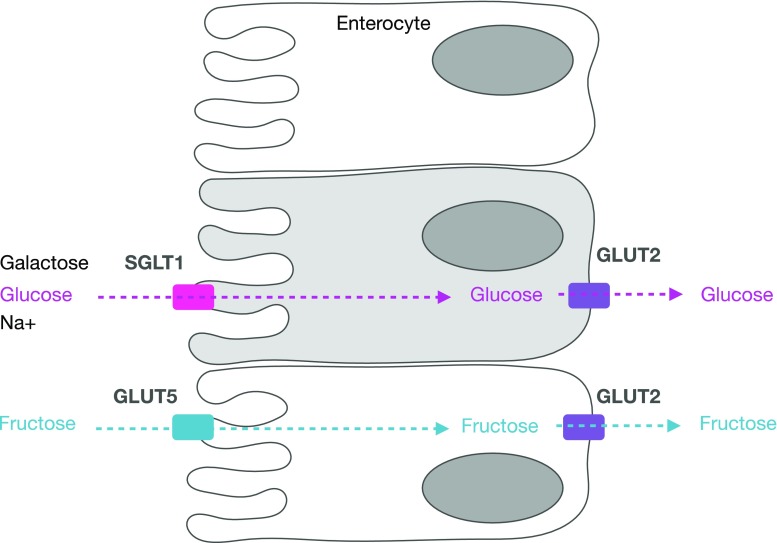
Previous picture comes from the famous paper by @Jeukendrup pmc.ncbi.nlm.nih.gov/articles/PMC53…
One of the main potential "negative" effect from high CHO fuelling is the impact on muscle glycogen utilisation. When high rates of CHO are ingested, CHO ox. becomes higher and endogenous glycogen stores seems to be depleted faster.
sciencedirect.com/science/articl…
sciencedirect.com/science/articl…

Exogenous Lactate could potentially prevent that as some studies in animals have shown. Specially at low intensity exercise.
Exogenous Lactate intake could potentially promote fat oxidation and reduce CHO oxidation.
- pmc.ncbi.nlm.nih.gov/articles/PMC74…
- linkinghub.elsevier.com/retrieve/pii/S…
Exogenous Lactate intake could potentially promote fat oxidation and reduce CHO oxidation.
- pmc.ncbi.nlm.nih.gov/articles/PMC74…
- linkinghub.elsevier.com/retrieve/pii/S…

Some evidence show that elevated BLa- via ingestion significantly reduces the rate of blood glucose oxidation and hepatic glucose production.
By providing "pre-primed" fuel, limited muscle glycogen stores could be preserved.
pubmed.ncbi.nlm.nih.gov/15475600/
By providing "pre-primed" fuel, limited muscle glycogen stores could be preserved.
pubmed.ncbi.nlm.nih.gov/15475600/
Moreover, Exogenous Lactate provides energy with a significantly blunted insulin response.
This can be translated into high energy throughput while maintaining the fat ox. pathways that are usually "shut off" by CHO loading. Metabolic flexibility through substrate selection.
This can be translated into high energy throughput while maintaining the fat ox. pathways that are usually "shut off" by CHO loading. Metabolic flexibility through substrate selection.
But what about the evidence in performance output, over metabolic outcomes?
Although literature is scarce, mostly related to the lack of safe and efficient supplement solutions, data on animals and some human studies are interesting.
Although literature is scarce, mostly related to the lack of safe and efficient supplement solutions, data on animals and some human studies are interesting.
1️⃣ Reduced RPE: Lower perceived effort at the same power output.
2️⃣ Extended Time-to-Exhaustion: Significant increases in endurance capacity.
3️⃣ Power Maintenance: Higher power output in the final stages of exercise when compared to equicaloric glucose.
2️⃣ Extended Time-to-Exhaustion: Significant increases in endurance capacity.
3️⃣ Power Maintenance: Higher power output in the final stages of exercise when compared to equicaloric glucose.
All these results are still very limited and good conclusions cannot be taken. However, coming back to biochemistry, there are mechanisms that can help us understanding how performance gains can be obtained.
At high intensity, Endo Lactate can stop the cell, but ExoLactate?
At high intensity, Endo Lactate can stop the cell, but ExoLactate?
The conversion of Lactate→Pyruvate via LDH reduces NAD+ to NADH.
By ingesting lactate, reducing equivalents can be provided directly to the mitochondria. This could maintain a favorable NAD+/NADH ratio, driving the ETC more efficiently than glucose-derived pyruvate.
By ingesting lactate, reducing equivalents can be provided directly to the mitochondria. This could maintain a favorable NAD+/NADH ratio, driving the ETC more efficiently than glucose-derived pyruvate.
And also maintaining the pH equilibrium of the cell, which is translated into higher Glycolytic rate regulation - a pathway that is absolutely key for high intensity exercise.
How does this pH regulation happen?
How does this pH regulation happen?
MCT1 is a symporter: it moves one Lactate molecule and one H+ into the mitochondria. Exogenous lactate can act as a metabolic proton sink. It can remove acidity from the cytosol and burn it inside the mitochondria, increasing the muscle's buffering capacity while providing ATP.
But what if all that Lactate machinery could also help not only acute modification of the cell, but with chronic adaptations in metabolism?
Lactate is a Mitokine. Chronic exposure to exogenous lactate upregulates PGC-1α, the master regulator of mitochondrial biogenesis.
Lactate is a Mitokine. Chronic exposure to exogenous lactate upregulates PGC-1α, the master regulator of mitochondrial biogenesis.

Daily use could signal the body to increase mitochondrial density and MCT expression transforming the athlete into a more efficient oxidative machine.
Imagine having a mimetic of exercise intensity through exogenous lactate supplementation? That would be BIG!
Imagine having a mimetic of exercise intensity through exogenous lactate supplementation? That would be BIG!
It all sounds very exciting but the biggest problem has not been addressed yet:
We cannot provide Exogenous Lactate in a safe and efficient way orally yet. At least on the amounts that could make a real difference (10-20g/h).
We cannot provide Exogenous Lactate in a safe and efficient way orally yet. At least on the amounts that could make a real difference (10-20g/h).
Historically, taking >20g/h of traditional Sodium Lactate meant massive sodium loading, causing osmotic imbalance and severe GI distress.
The effective dose has been trapped behind a stoichiometric limitation. No technological solution.
The effective dose has been trapped behind a stoichiometric limitation. No technological solution.
But technical barriers are here to be broken by science. If that is accomplished soon, we will probably be in front of the next generation fuelling for sports and performance. And of course, for some other conditions related to health (diabetes, metabolic syndrome?).
Lactate is the most preferential source of energy for the body. Faster than glucose and fructose, more efficient and with higher impact on metabolism - not only energetically.
Next fuelling generation is coming. Its name could be Exogenous Lactate. It´s only about time...
Next fuelling generation is coming. Its name could be Exogenous Lactate. It´s only about time...
• • •
Missing some Tweet in this thread? You can try to
force a refresh