
1. I see @shadihamid's post has gained a lot of attention, and deservedly so considering he touches on important concepts such as citizenship, freedom, and liberalism.
https://twitter.com/shadihamid/status/2041881645398032449
2. The first question to ask when discussing the expectations of assimilation is what constitutes "assimilation." This entails two components: 1. What traits, beliefs, practices, etc. ought to be modified for 2. what sort of social privileges?
3. In the highlight, the point of contention is the "right to be in the United States." There are two suggested dependencies: 1. Convergence with cultural mainstream and 2. Anything.
These are drastically different claims.
These are drastically different claims.
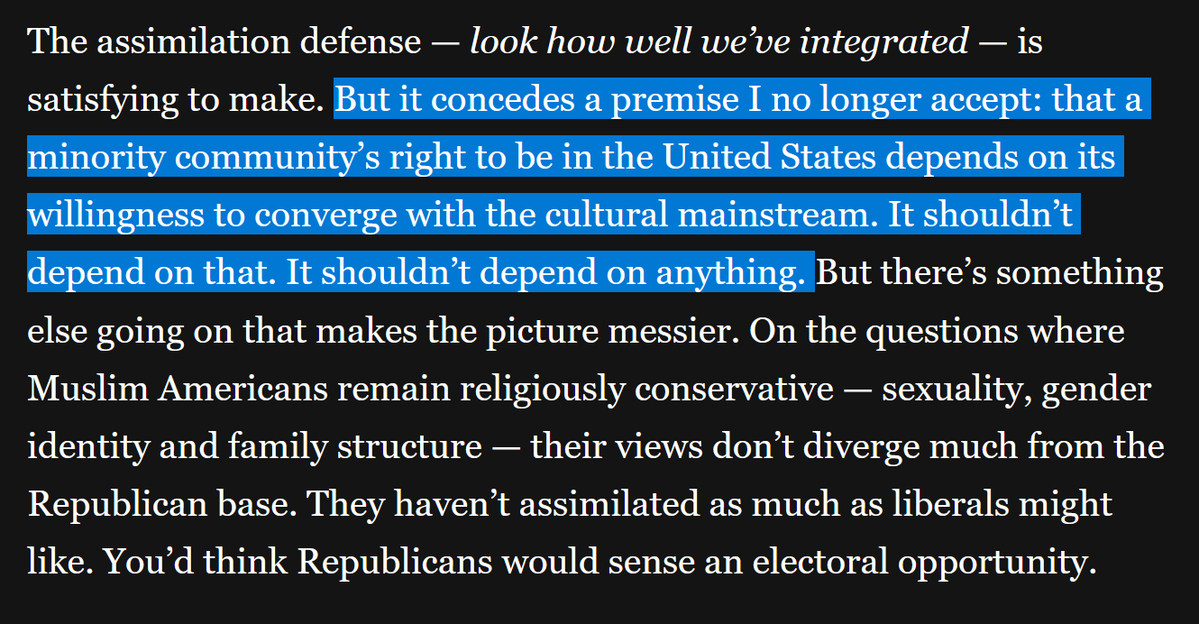
4. Acceptance in any community requires abiding by that community's standards. In the US, the minimal expectation is adherence to local and federal laws. Citizens, who have a "right" to be in the US, may be removed from society (e.g. incarcerated) for violating statutes.
5. Thus we may say that minority's "right" to be in the US, or at least part of US society, is conditional on following its laws.
Where there's a conflict between religion and state, there's a reasonable expectation for religions to "assimilate" to follow the laws of the State.
Where there's a conflict between religion and state, there's a reasonable expectation for religions to "assimilate" to follow the laws of the State.
6. States may carve out certain religious exemptions for certain practices, but these are not absolutes. Polygamy and underage marriage come to mind (I'm speaking in the abstract, but if they exist in Muslim communities they are certainly not limited to them)
7. The problem becomes more salient when discussing groups who hold "abhorrent" views. @shadihamid advocates for the largest ideological tent in the name of "democratic minimalism."
This might operate re simply existing in the country, but not towards influence/power.
This might operate re simply existing in the country, but not towards influence/power.
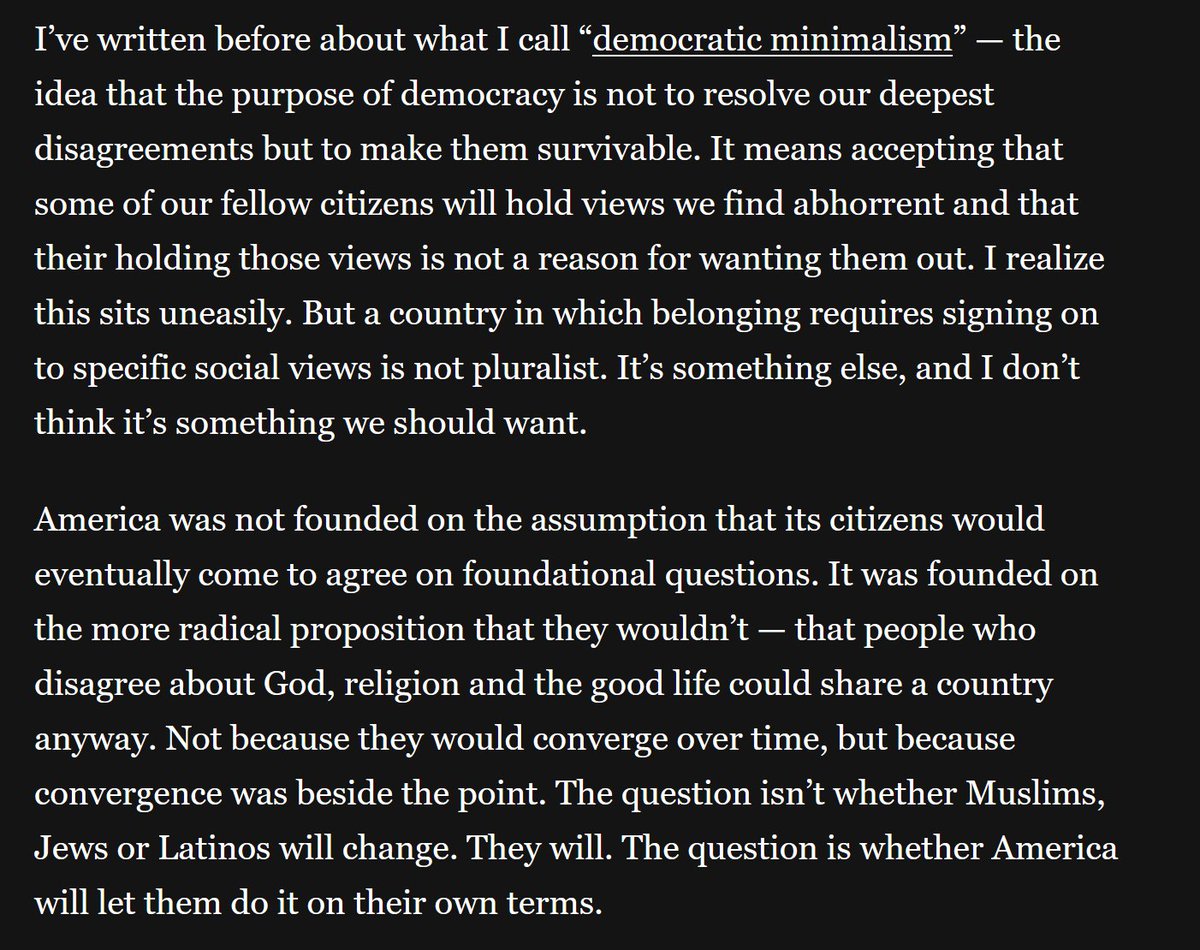
8. Politics is inherently coercive; laws are passed reflecting certain values which impose obligations/duties on the general populace regardless if they share those values.
At some point, people with these "abhorrent" values will inevitably attempt to impose them on others.
At some point, people with these "abhorrent" values will inevitably attempt to impose them on others.
9. Things get even more complicated outside of politics in a world of rampant cancel culture. True, few (if any) people call for physical expulsions of deplorables, but we're eager to impose whichever social sanctions are at our disposal however we see fit.
10. Furthermore, some may assert a key distinction between citizens and immigrants. Even if one accepts that citizens may not be expelled for wrongthink, this does not nec imply one is obligated to voluntarily accept individuals holding the aformentioned "abhorrent" views.
11. To give a parallel with religion, just as we wouldn't expect Judaism, Christianity, or Islam to accept avowed atheists as converts, there's a reasonable assumption to make immigration conditional on accepting certain values - even the "democratic minimalism" suggested earlier
12. My key point is that all ideological groups must adapt in some way to their host countries. Exactly how much depends on the nature of their respective beliefs and practices.
• • •
Missing some Tweet in this thread? You can try to
force a refresh







