3. The core idea: different types of violence leave behind distinctive patterns, not just in the total numbers killed, but in the proportions falling into detailed age/sex categories — a conflict's demographic fingerprint.
4. Using a statistical clustering method applied to 20 conflicts, I find three distinct patterns:
🟡 Combatant-skewed — deaths concentrated among young adult males. Examples: Colombia, Northern Ireland, Peru.
5. 🔵 Male-targeted — males across a wide age range systematically killed regardless of combatant status. Examples: Bosnia, Srebrenica, Kosovo.
6. 🔴 Indiscriminate — deaths spread across ages and sexes, with women, children and elderly present in substantial numbers. Examples: Rwanda and Cambodia.
7. Gaza post-October 7 falls within the Indiscriminate cluster — alongside Rwanda, Cambodia and the El Mozote Massacre from the civil war in El Salvador. This holds across two separate analyses, including one that accounts for Gaza's young population structure.
8. A common objection is that Gaza's somewhat elevated proportion of young adult male deaths proves the IDF was targeting combatants. But that male excess is modest compared to conflicts within the Combatant-skewed and Male-targeted clusters.
9. Like a fingerprint at a crime scene, this is evidence, not a verdict. It does not establish genocidal intent on its own. But it places Gaza in uncomfortable demographic company and substantially narrows the range of plausible innocent explanations.
• • •
Missing some Tweet in this thread? You can try to
force a refresh

1. Here's a thread that takes a close look at the thread of @GabrielEpsteinX I should say that I haven't tried to replicate the work but, knowing Gabriel, I'd be very surprised if anything is factually wrong. So my thread is about interpretations.
2. The main interpretive issue concerns the age/sex distribution of of deaths. Yes, youngish to pre-elderly males have been killed well out of proportion to their population numbers, but overrepresentation of this demographic is a generic feature of war.
3. In fact, a notable feature of post-October-7 Gaza is the weakness of this effect - if Gaza were a normal war then we would expect a much stronger overrepresentation of the youngish-to-pre-elderly-male demographic than what we actually see in Gaza.
1. A new @guardian investigation by @_EmmaGHreveals
and @yuval_abraham reveals an Israeli military database listing 8,900 named Hamas/PIJ fighters killed by May 2025. But we only have a reported number from an unseen list with unknown methodology. We need the actual data. 🧵
2. The transparency gap is stark: Gaza's MoH has released 12 detailed lists with names, ages, IDs - data we can analyse and examine. Israel keeps its list classified while dismissing Palestinian figures as propaganda. This double standard undermines credible assessment.
3. Without the IDF list, we can't perform basic validation: checking for duplicates, assessing demographic profiles, or identifying misclassifications.
1. New Paper "Violent and Nonviolent Death Tolls in the Gaza War: New Primary Evidence" by me, Jon Pedersen, @KShikaki , Michael Robbins, Eran Bendavid, @HavardHegre and Debarati Guha-Sapir
2. It is a household based survey of the Gaza Strip to measure both the violent and nonviolent death toll in the war. Field work was conducted between December 30, 2024 and January 5 2025.
Here are the 3 main take homes:
3. First, our violent death estimate is 75,200 (95% CI 63,600 to 86,800). The comparable figure for the Gaza Ministry of Health (GMoH) is 45,650, roughly 39% below our central estimate of 75,200 and 28% below the lower bound of our 95% confidence interval of 63,600.
1. Last week the Henry Jackson Society put out a report by @Mr_Andrew_Fox that savages the Gaza death toll statistics of the Gaza Ministry of Health (MoH) and chastises the media for credulous reporting on the Gaza death toll: henryjacksonsociety.org/publications/q…
2. Here is my reply written with Gabriel Epstein of Israel Policy Forum:
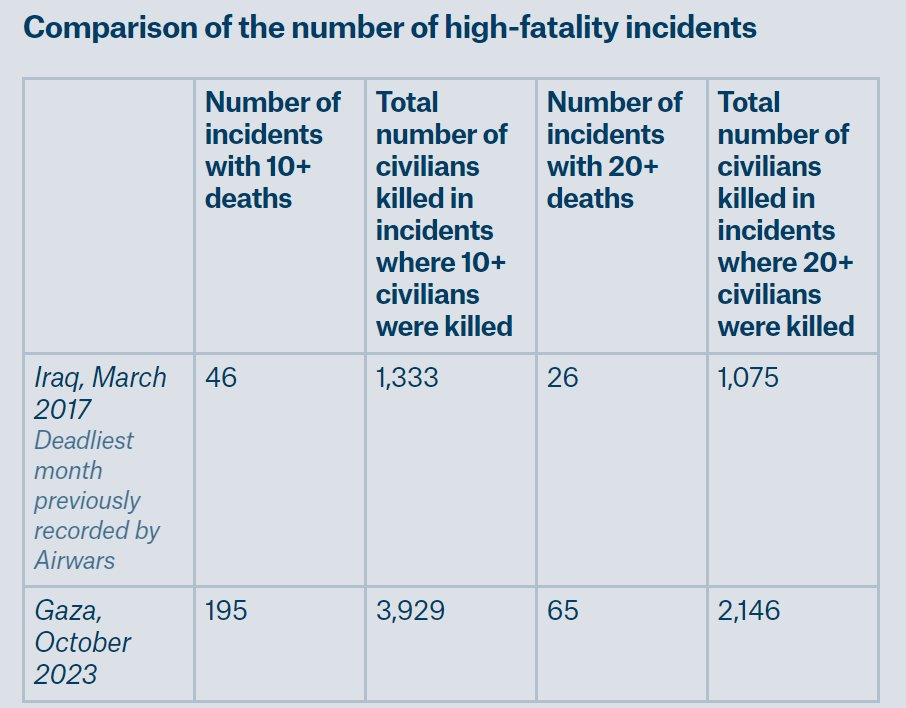
1. @airwars has just released an important new report, covering October 2023 for the war in Gaza.
Here is a tour of some of the tables and graphics.
2. Far more civilians killed compared to the battles of Raqqa and Mosul:
3. Far more incidents with at least 10 civilians killed and far more incidents with at least 20 civilians killed compared to March 2017 in Iraq, the deadliest month every recorded by @airwars until Gaza.
2. This is a very nice article, especially the text quoted above.
However, I wish that @gcaw had pointed out that UNOCHA always had a much better alternative to acting as a conveyor belt for the unreliable figures of the Government Media Office.
3. The Gaza Ministry of Health (MoH) has released four detailed lists of <named> individuals whom it has recorded as killed in the war.
This casualty recording work provides some measure of dignity to those killed.