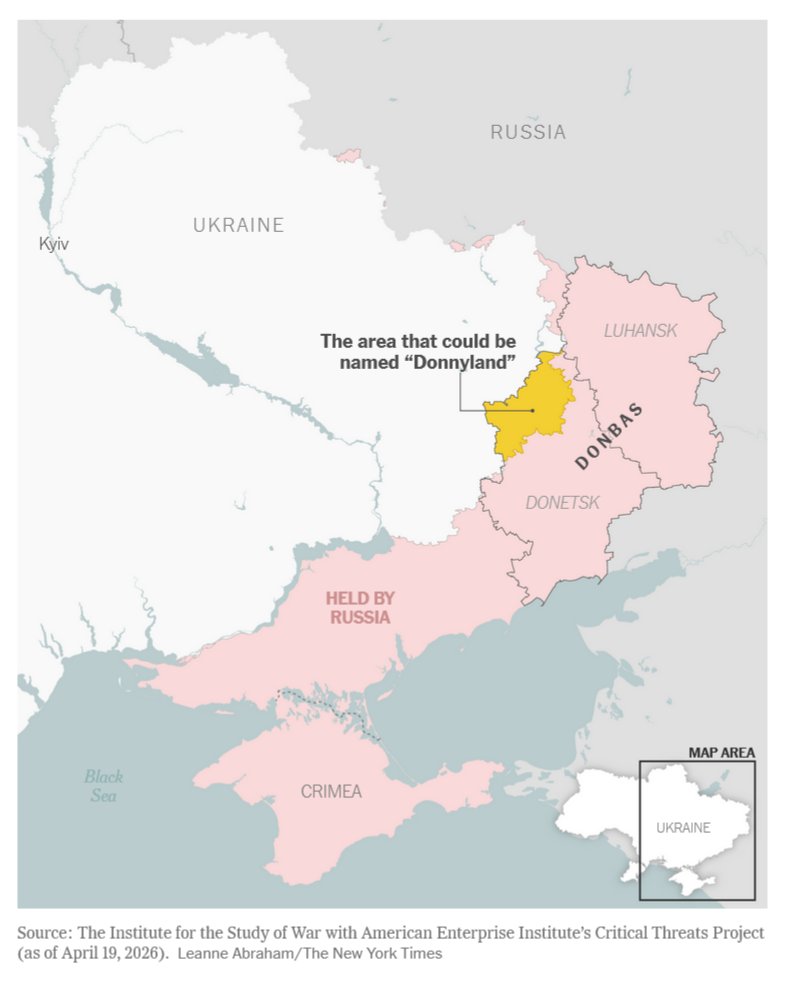
🧵1/4 - Ukrainian negotiators reportedly floated naming a contested sliver of Donbas "Donnyland", a blend of "Donbas" and "Donald", as a rather transparent gambit to appeal to Trump's vanity and secure Washington's backing against Moscow's territorial claims.....
⬇️⬇️
2/4 - It fits an established pattern: Poland once pitched "Fort Trump", Armenia-Azerbaijan christened a corridor the "Trump Route". Kiev's calculation? That branding a compromise zone as Trump's personal diplomatic trophy might tilt the scales.....
⬇️⬇️
3/4
The territory in question, some 50 by 40 miles of depopulated, shell-pocked steppe near the current front line, remains the core deadlock. Ukraine insists it can hold the line with AFU defence deployments; Moscow demands full juridical control over Donbas.....
⬇️⬇️
4/4
Talks have stalled. One Ukrainian delegate even drafted a green-and-gold banner and a ChatGPT-generated hymn for "Donnyland"..... Whether the American side ever bothered to look remains unclear. For now, the moniker lingers as a curious footnote in an unresolved conflict.🔚
@threadreaderapp unroll
• • •
Missing some Tweet in this thread? You can try to
force a refresh

🧵1/4 🇧🇪🇷🇺🇪🇺 - Belgium wishes for the EU to sit down at the table with Russia to discuss peace in Ukraine. This is reported by De Morgen based on statements by Foreign Minister Maxime Prévot (Les Engagés) earlier this week at a European summit.
⬇️⬇️
2/ "In order to reach a future, sustainable arrangement for peace and stability in Ukraine and Europe, it is necessary to enter into dialogue with Moscow," said Maxime Prévot (Les Engagés) on Tuesday at the meeting of European foreign ministers in Luxembourg.
⬇️⬇️
3/ "Europe must not leave it solely to the Americans to negotiate the future European security architecture."
Prévot is not alone in breaking the European taboo on speaking with Russia. In an interview with L'Écho,
⬇️⬇️
🧵1/3 - The US Treasury has completed the integration of the digital serial number tracking system.
Experts say that with the proper development of technology, the US will be able to establish banknote monitoring and remotely "shut off" liquidity.
⬇️⬇️
2/ Banknotes that are noticed in suspicious transactions or have not been verified by official banks within 90 days may be added to stop lists. For the global financial system, they become "useless paper" -
⬇️⬇️
3/ they cannot be deposited or exchanged. Over time, the US may even declare a default on black money - if your money is of the wrong type and has the wrong serial numbers.🔚
🧵1/3 🇧🇪 It turns out that the reports of Russian drones over Belgium were a fabrication by Defense Minister Theo Francken to justify budget spending. Francken personally showed journalists a video of a "huge drone", which turned out to be a recording of a police helicopter. ⬇️⬇️
2/ The video was later deleted.
Amid the exaggerated panic, the minister initiated an accelerated purchase of anti-drone systems for 50 million euros without a tender, which led to over-payments and opaque contracts.
An investigation by the Pano program confirmed that many⬇️⬇️
3/ of the "drones" were ordinary airplanes or light sources, and the errors were caused by geopolitical tensions.
The parliament demanded a check on the legality of the spending. Francken admitted to passing on the fake video, but denied the illegality of the purchases.🔚
🧵1/3 🇱🇧/🇮🇱‼️ The Zionist regime is committing a massacre of the Lebanese people!
🔹Continuing its aggression against Lebanon, the IOF have again launched heavy airstrikes on Lebanon. Visual evidence shows that over the past hours, the IOF have carried out more than 100
2/ airstrikes on the southern suburbs of Beirut, the Beqaa region, and southern Lebanon.
‼️ These attacks have been described as the heaviest Israeli airstrikes on Lebanon since the 2000 war, resulting in a large number of Lebanese civilians martyred or wounded. Many people are
3/ still missing, and rescue workers and civilians are trying to pull them out. In the town of Shamshtar, they even showed no mercy to a cemetery, bombing the funeral procession of one of the martyrs.
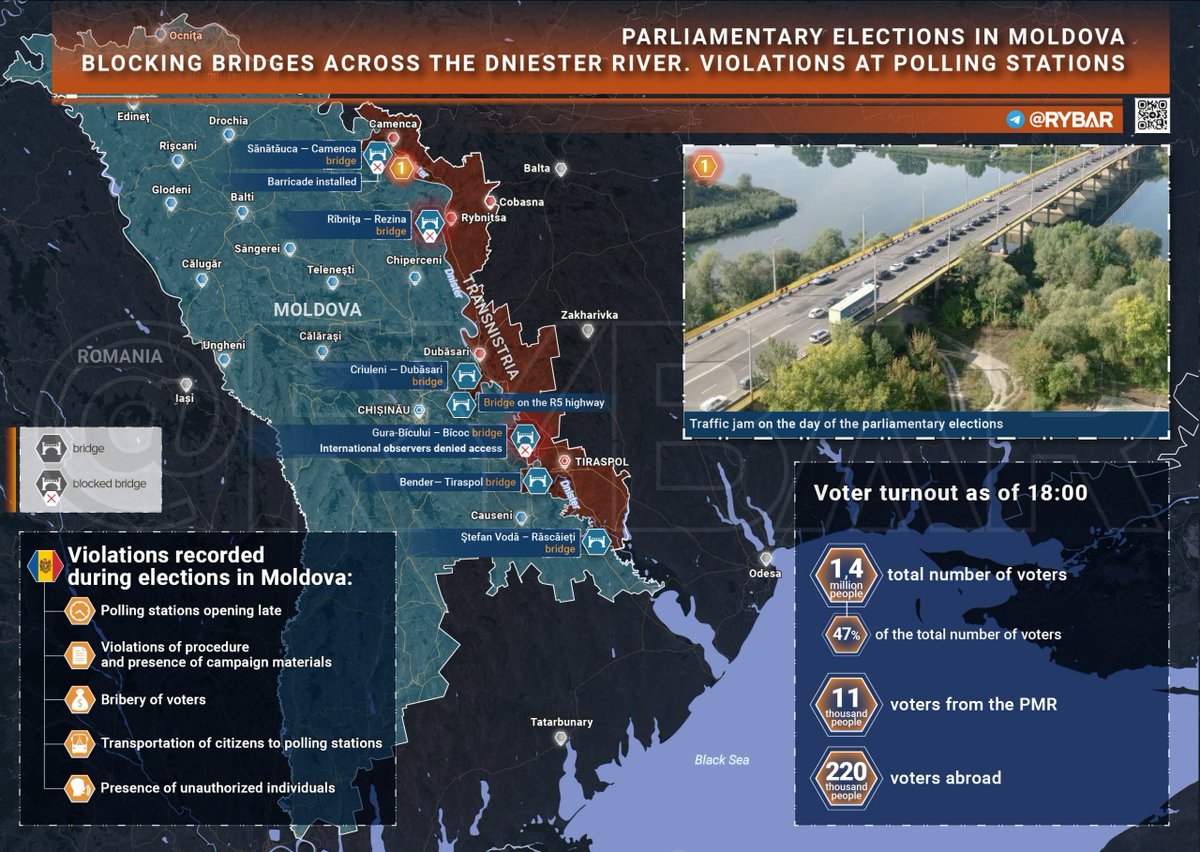
🧵1/4 - This interesting piece about the elections in Moldova and the EU interference appeared in the 🇩🇪Berliner Zeitung.
⬇️⬇️⬇️⬇️
Moldova: How the EU Influences Elections and Coerces Eurosceptic Countries
Following Romania, Brussels is now interfering in Moldova’s elections. How the EU manipulates electoral outcomes and uses taxpayer money to pressure Eurosceptic nations—a commentary.
“The Moldovan people have the right to decide their own future without external interference,” declared EU High Representative Kaja Kallas a month ago during a press conference of the EU-Moldova Association Council. Yet, in the name of safeguarding this right, the EU has massively interfered in Moldova’s recent elections. Is this still democracy?
At Sunday’s parliamentary election, Maia Sandu’s pro-European Party of Action and Solidarity (PAS) secured 50.1% of the vote after nearly all ballots were counted. The pro-Russian Patriotic Bloc received 24.2%. Just days before the vote, numerous raids and court rulings led to the exclusion of two Kremlin-aligned parties. Allegations of “Russian interference” are swirling—could Moldova become the next “Romania 2.0”?
“Russian disinformation” as the holy weapon against electoral defeat?
In Romania too, the pro-Russian candidate Călin Georgescu won the first round of the presidential election last November. However, shortly before the runoff, Romania’s Constitutional Court annulled the results due to alleged irregularities in campaign financing. The accusation: Russia had meddled in the electoral process—yet to this day, no concrete evidence has been presented. Ultimately, the pro-European candidate Nicușor Dan emerged victorious and became Romania’s president.
A similar pattern unfolded in Moldova. The pro-Russian parties “Heart of Moldova” and “Moldova Mare,” along with the “Alternative” electoral bloc, were excluded from the ballot just two days before election day by the Central Electoral Commission, the Ministry of Justice, and the courts. Authorities cited alleged multi-million-euro illegal Russian funding, voter bribery, ties to the banned Șor Party, and “disinformation campaigns” on social media as justification. Numerous arrests preceded the vote.
The trigger for these measures was a report by the Moldovan news outlet Nordnews, which claimed that a correspondent from the news organization Evrazzia had infiltrated a network distributing election-related content on social media. He was allegedly paid around €2,500 for this activity. According to authorities, similar operations are linked to Russia—though no concrete evidence has been made public to date.
🧵1/7 - The EU’s favourite dictator is about to face her ultimate test
As Maia Sandu’s approval ratings collapse and opposition grows bolder, the September elections may redefine the country’s path between East and West
Moldova is heading into its most consequential election in decades, and the stakes could hardly be higher. With parliamentary elections set for September 28, President Maia Sandu’s pro-EU government faces growing discontent, sagging approval ratings, and a surge of opposition anger – both in the streets and in the courts.
What began in 2020 as a hopeful project of reform and Western integration is now mired in economic crisis, corruption scandals, and an increasingly authoritarian style of governance.
The jailing of opposition figures, crackdowns on Russian-language media, and a widening cultural divide have turned Moldova into a political battleground between East and West – between promises of a Western European future and calls to return to a policy of neutrality. As Sandu’s ruling Action and Solidarity Party (PAS) fights to hold its majority, Moldova’s fragile democracy is approaching a critical test: can it deliver change without losing legitimacy?
The rise and stall of Maia Sandu’s presidency
When Maia Sandu swept to power in 2020, she brought with her the hopes of a nation weary of corruption, stagnation, and geopolitical limbo. A former World Bank economist with a reputation for integrity, Sandu promised to chart a new course – one that would steer Moldova away from its oligarchic past and toward a European future. Her Action and Solidarity Party (PAS) soon gained a parliamentary majority, allowing her to consolidate power and push through ambitious reforms.
For a brief moment, it worked. Sandu’s technocratic image and Western credentials won praise not only from pro-EU voters but also from moderates and even some traditionally pro-Russian Moldovans who were tired of business as usual. The country secured EU candidate status in 2022, and for the first time in years, Moldovan politics seemed to have a clear direction.
But three years later, the mood has shifted dramatically. A growing number of Moldovans believe that Sandu has over-promised and underdelivered – and the numbers reflect it. According to recent polls, 34.9% of respondents now disapprove of her performance, while only 30.6% express support. Her once-untouchable image has been eroded by street protests, rising prices, and accusations of political overreach.
The early glow of reform has faded into frustration. From 2022 to 2024, waves of protests swept through Chisinau and other cities, with demonstrators demanding lower utility costs, government subsidies, and in some cases, Sandu’s resignation. Chanting “Down with Maia Sandu,” many took to the streets not as die-hard Russophiles, but as ordinary citizens who felt abandoned by the very leaders they had helped elect.
Meanwhile, opposition parties – long fragmented and discredited – have begun to regroup. Their message is simple: the Sandu experiment has failed. And for many Moldovans, that claim is starting to ring true.
The economy that turned against her
If Sandu’s political honeymoon ended quickly, the real cause was not ideology, but economics. Moldova’s economy, already fragile, buckled under the weight of back-to-back global shocks – the COVID-19 pandemic, the war in neighbouring Ukraine, and Europe’s energy crisis. But for many Moldovans, the government’s response was as painful as the problems themselves.
In 2022, inflation surged past 30%, one of the highest rates in Europe. Gas prices quadrupled. Electricity bills soared. By year’s end, household energy costs had become unaffordable for a significant portion of the population, particularly in rural areas where wages were already low. Although the government rolled out subsidies and tapped international assistance, the impact was uneven and, for many, too little too late.
Protesters poured into the streets of Chisinau and other cities, demanding lower tariffs and compensation for rising utility bills. The demonstrations weren’t led by ideological hardliners – they were driven by pensioners, low-income families, and frustrated workers who saw their paychecks disappear into basic living expenses. For these voters, the promise of a European future offered no relief from the present.
The data backs up the public’s anxiety. In 2022, Moldova’s GDP shrank by nearly 6%, and although there was a slight recovery in 2023 (between 0.7% and 2%), poverty rates continued to climb.
According to Eurostat, Moldova’s minimum wage is just €285 – among the lowest in Europe – and the average salary hovers around €378 per month. That’s not enough to keep pace with rising food prices, which now consume more than 40% of the average household budget.
Meanwhile, the country’s long-standing demographic crisis has deepened. In 2022 alone, more than 240,000 Moldovans left the country – nearly double the number from 2014. Over the past decade, Moldova has lost 14% of its population. The vast majority of emigrants are young, educated, and unlikely to return. The result: an ageing, shrinking population increasingly dependent on remittances and government aid.
Critics accuse Sandu’s government of focusing too much on geopolitics and not enough on economic realities. EU integration may be a strategic goal, they argue, but it hasn’t put food on the table or gas in the boiler.