(🧵1/20) @Columbia just released its Senate Review Committee Report.
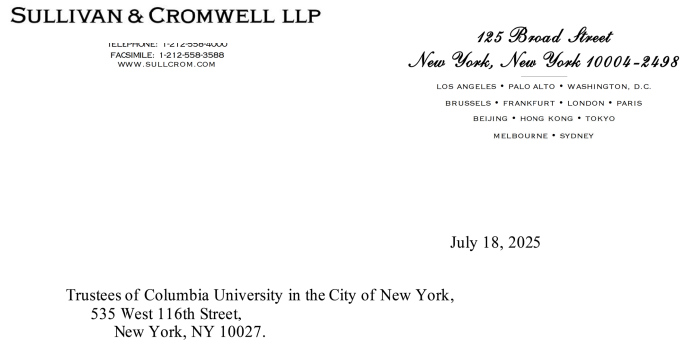
Most coverage will focus on the recommendations. The bombshell is buried in Appendix R: a Sullivan & Cromwell legal opinion dated July 18, 2025.
What it says, and why it matters.
secretary.columbia.edu/sites/secretar…
Most coverage will focus on the recommendations. The bombshell is buried in Appendix R: a Sullivan & Cromwell legal opinion dated July 18, 2025.
What it says, and why it matters.
secretary.columbia.edu/sites/secretar…
@Columbia (🧵2/20) S&C was asked one question: when Senate leaders call the Senate a "third branch" of Columbia governance, coordinate with the President and Trustees, are they right?
Answer: no. Not contested interpretation. Foreclosed on the face of the primary sources.
Answer: no. Not contested interpretation. Foreclosed on the face of the primary sources.
@Columbia (🧵3/20) Why this matters: the "third branch" framing has been asserted, repeatedly and publicly, by @CUSenate leaders and Senate-affiliated bodies for over a year.
Seven instances on the record. Each one runs into the same wall.
Seven instances on the record. Each one runs into the same wall.
@Columbia @CUSenate (🧵4/20) Exhibit 1. Student senate leader in @ColumbiaSpec (Feb 20, 2025): the Senate is "the lower chamber to the trustees' upper chamber," and "broad policymaking authority starts with the senate."
Bicameral concurrence, asserted as fact.
columbiaspectator.com/main/2025/02/2…
Bicameral concurrence, asserted as fact.
columbiaspectator.com/main/2025/02/2…

@Columbia @CUSenate @ColumbiaSpec (🧵5/20) Exhibit 2. @ColumbiaSpec news (Oct 10, 2024): Columbia "broadly operates under three branches of government, the administration, the board of trustees, and the University Senate."
Coordinate status, asserted.
columbiaspectator.com/news/2024/10/1…
Coordinate status, asserted.
columbiaspectator.com/news/2024/10/1…

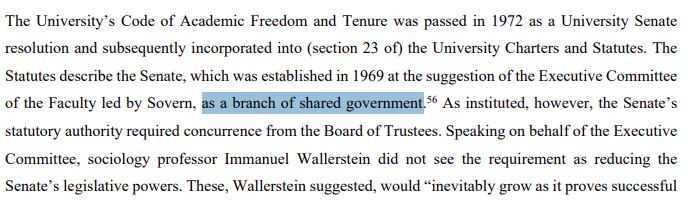
@Columbia @CUSenate @ColumbiaSpec (🧵6/20) Exhibit 3. Sundial Report (Mar 31, 2025): "The Statutes describe the Senate as a branch of shared government."
No. The Report's NEXT sentence concedes Senate authority "required concurrence from the Board."
Self-contradicted in one paragraph.
senate.columbia.edu/sites/senate.c…
No. The Report's NEXT sentence concedes Senate authority "required concurrence from the Board."
Self-contradicted in one paragraph.
senate.columbia.edu/sites/senate.c…
@Columbia @CUSenate @ColumbiaSpec (🧵7/20) Exhibit 4. Senate EC Chair D'Armiento @j34bsrisbd6f (Sundial Report): the Senate is "the third branch of University governance, as set out in the Statutes."
The Statutes contain no such language. The "as set out in" is factually false.
senate.columbia.edu/sites/senate.c…
The Statutes contain no such language. The "as set out in" is factually false.
senate.columbia.edu/sites/senate.c…

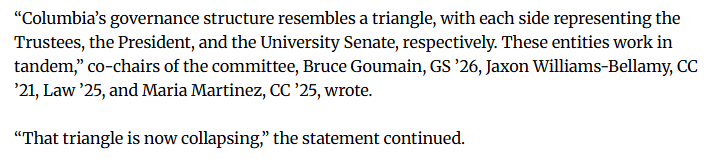
@Columbia @CUSenate @ColumbiaSpec @j34bsrisbd6f (🧵8/20) Exhibit 5. Student Affairs co-chairs (@ColumbiaSpec, Apr 23, 2025): "@Columbia's governance structure resembles a triangle... Trustees, the President, and the University Senate... work in tandem."
Trilateral concurrence. Nowhere in the Charter.
columbiaspectator.com/news/2025/04/2…
Trilateral concurrence. Nowhere in the Charter.
columbiaspectator.com/news/2025/04/2…
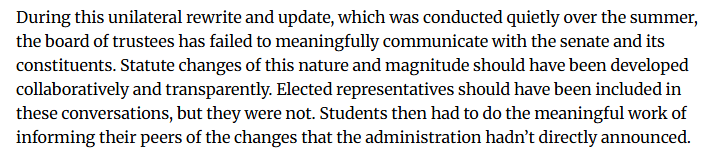
@Columbia @CUSenate @ColumbiaSpec @j34bsrisbd6f (🧵9/20) Exhibit 6. Two senators (@ColumbiaSpec op-ed, Nov 2, 2025): Trustees "failed" to consult; Statute changes "should have been developed collaboratively."
The authors' own modal verbs ("should have") concede no extant duty exists.
columbiaspectator.com/opinion/2025/1…
The authors' own modal verbs ("should have") concede no extant duty exists.
columbiaspectator.com/opinion/2025/1…
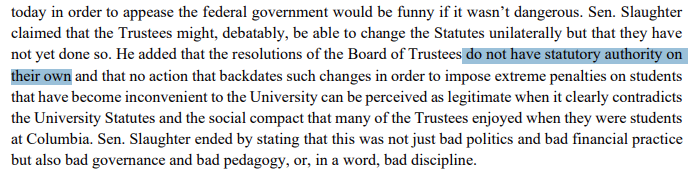
@Columbia @CUSenate @ColumbiaSpec @j34bsrisbd6f (🧵10/20) Exhibit 7. Sen. @jrslaugh, plenary (Jun 13, 2025): Board resolutions "do not have statutory authority on their own."
But, Trustees "might, debatably, be able to change the Statutes unilaterally."
He concedes the legal point in one breath.
senate.columbia.edu/sites/senate.c…
But, Trustees "might, debatably, be able to change the Statutes unilaterally."
He concedes the legal point in one breath.
senate.columbia.edu/sites/senate.c…
@Columbia @CUSenate @ColumbiaSpec @j34bsrisbd6f @jrslaugh (🧵11/20) None of these claims survives contact with reality.
Three authorities, in descending order of weight. Each independently fatal to every variant of the "third branch" framing.
Three authorities, in descending order of weight. Each independently fatal to every variant of the "third branch" framing.
@Columbia @CUSenate @ColumbiaSpec @j34bsrisbd6f @jrslaugh (🧵12/20) Authority 1. Charter of 1810, Article VIII. External law, enacted by NY State.
Vests in the Trustees ALONE the power to make, amend, and repeal University ordinances. No mandatory role for any other body. Zero.
secretary.columbia.edu/sites/secretar…
Vests in the Trustees ALONE the power to make, amend, and repeal University ordinances. No mandatory role for any other body. Zero.
secretary.columbia.edu/sites/secretar…

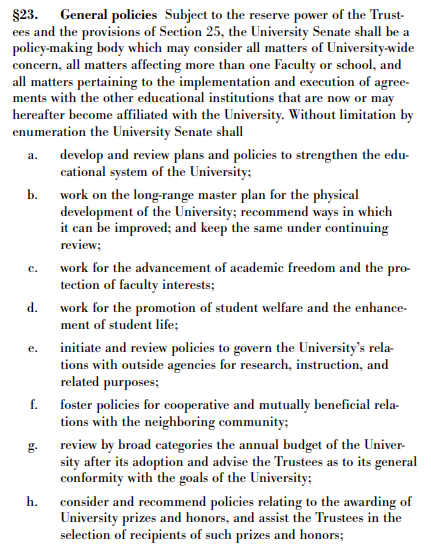
@Columbia @CUSenate @ColumbiaSpec @j34bsrisbd6f @jrslaugh (🧵13/20) Authority 2. The University Statutes, which the speakers themselves invoke.
The Statutes establish the Senate by Trustee enactment. They contain no instance of "third branch of government" or "triangle."
That vocabulary is the speakers' own.
secretary.columbia.edu/sites/secretar…
The Statutes establish the Senate by Trustee enactment. They contain no instance of "third branch of government" or "triangle."
That vocabulary is the speakers' own.
secretary.columbia.edu/sites/secretar…
@Columbia @CUSenate @ColumbiaSpec @j34bsrisbd6f @jrslaugh (🧵14/20) Authority 3. NY Not-for-Profit Corporation Law § 701. Management of a NY nonprofit is vested in its board.
A bylaw rendering board action contingent on a delegated body's concurrence is beyond scope. The legal floor. Not Columbia-specific.
nysenate.gov/legislation/la…
A bylaw rendering board action contingent on a delegated body's concurrence is beyond scope. The legal floor. Not Columbia-specific.
nysenate.gov/legislation/la…

@Columbia @CUSenate @ColumbiaSpec @j34bsrisbd6f @jrslaugh (🧵15/20) Which brings us back to Appendix R.
S&C reaches the same conclusions on the same primary sources.
Three findings. Each addressed to a specific variant of the Senate-side claim.
secretary.columbia.edu/sites/secretar…
S&C reaches the same conclusions on the same primary sources.
Three findings. Each addressed to a specific variant of the Senate-side claim.
secretary.columbia.edu/sites/secretar…
• • •
Missing some Tweet in this thread? You can try to
force a refresh