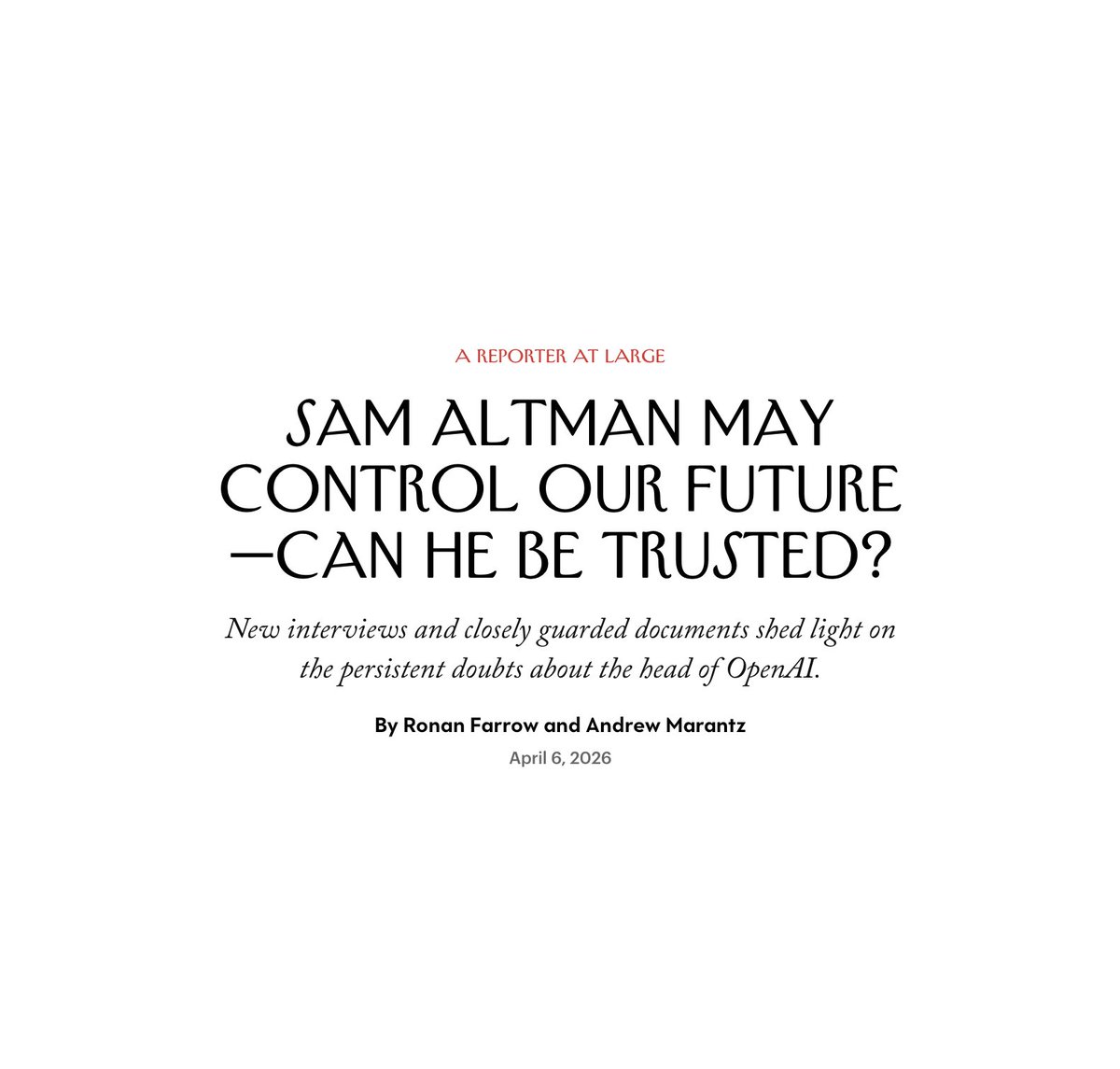
(🧵1/10) With renewed attention on my recent @NewYorker reporting about Sam Altman and OpenAI, it's worth revisiting a piece I wrote for the magazine about another tech billionaire who has accumulated unusual leverage over the US government—and whose hand many readers have lately seen at work in their feeds.
For that story, I spent months interviewing more than thirty of Elon Musk's current and former colleagues, along with current and former officials at NASA, the Department of Defense, the FAA, the Department of Transportation, and OSHA. Many of their observations have only grown more relevant since.
Read the full investigation here: newyorker.com/magazine/2023/…
And a thread on a few of its findings below.
For that story, I spent months interviewing more than thirty of Elon Musk's current and former colleagues, along with current and former officials at NASA, the Department of Defense, the FAA, the Department of Transportation, and OSHA. Many of their observations have only grown more relevant since.
Read the full investigation here: newyorker.com/magazine/2023/…
And a thread on a few of its findings below.

(2/10) In 2022, SpaceX gave the Pentagon an ultimatum: pay roughly $400 million a year for Starlink service in Ukraine—crucial infrastructure the country's military was relying on for battlefield communication—or it would be cut off.
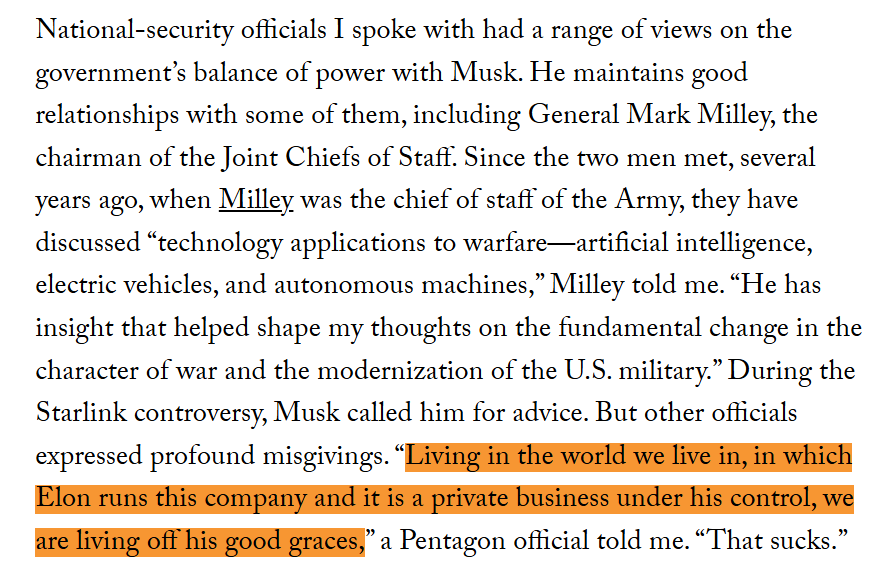
Colin Kahl, then Under-Secretary of Defense for Policy, called Elon Musk and pleaded with for more time. Officials told me lives hung in the balance. But they had to be deferential. "Even though Musk is not technically a diplomat or statesman, I felt it was important to treat him as such, given the influence he had on this issue," Kahl told me. A Pentagon official described the dynamic more bluntly: "We are living off his good graces. That sucks."
Colin Kahl, then Under-Secretary of Defense for Policy, called Elon Musk and pleaded with for more time. Officials told me lives hung in the balance. But they had to be deferential. "Even though Musk is not technically a diplomat or statesman, I felt it was important to treat him as such, given the influence he had on this issue," Kahl told me. A Pentagon official described the dynamic more bluntly: "We are living off his good graces. That sucks."
(3/10) The stakes were not theoretical. Ukrainian forces advancing into contested territory in the south found their Starlink connections suddenly severed—American and Ukrainian officials told me they believed SpaceX had cut access via geofencing.
"Communications became dead, units were isolated," a signal-corps soldier told me. "Commanders had to drive to the battlefield to be in radio range, risking themselves. It was chaos." (A @Reuters investigation last year by @joroulette, @CassellBryanLow and @BalmforthTom also found that Musk personally ordered a Starlink shutdown during a Ukrainian counteroffensive.)
On the call with Kahl, Musk volunteered that he had spoken with Putin personally. (Musk later denied discussing Ukraine with Putin.) Weeks earlier, at a conference in Aspen, Musk had appeared onstage to suggest the U.S. should negotiate peace with Putin. Reid Hoffman, who helped start PayPal with Musk, told me Musk seemed to have "bought what Putin was selling, hook, line, and sinker."
"Communications became dead, units were isolated," a signal-corps soldier told me. "Commanders had to drive to the battlefield to be in radio range, risking themselves. It was chaos." (A @Reuters investigation last year by @joroulette, @CassellBryanLow and @BalmforthTom also found that Musk personally ordered a Starlink shutdown during a Ukrainian counteroffensive.)
On the call with Kahl, Musk volunteered that he had spoken with Putin personally. (Musk later denied discussing Ukraine with Putin.) Weeks earlier, at a conference in Aspen, Musk had appeared onstage to suggest the U.S. should negotiate peace with Putin. Reid Hoffman, who helped start PayPal with Musk, told me Musk seemed to have "bought what Putin was selling, hook, line, and sinker."
(4/10) In a podcast interview, Musk was asked whether he has more influence than the American government. He replied immediately: "In some ways."
Hoffman put it differently: "Like Louis XIV: 'L'état, c'est moi.'"
Hoffman put it differently: "Like Louis XIV: 'L'état, c'est moi.'"

(5/10) The grip extends into how the government talks about him. A Pentagon spokesman told me he was keeping Musk apprised of my inquiries about his role in Ukraine, and would grant an interview with an official about the matter only with Musk's permission. "We'll talk to you if Elon wants us to," he told me.
(6/10) Regulators who tried to enforce against Musk's companies described a similar pattern.
In December 2020, the FAA explicitly told SpaceX it was not cleared to launch a Starship prototype. SpaceX launched anyway. The rocket exploded on landing. In a series of letters, the FAA's space division accused SpaceX of "a concerning lack of operational control and process discipline that is inconsistent with a strong safety culture."
Wayne Monteith, then head of the FAA's space division, told me a fine wouldn't have mattered: "He could pull that out of his pocket."
In December 2020, the FAA explicitly told SpaceX it was not cleared to launch a Starship prototype. SpaceX launched anyway. The rocket exploded on landing. In a series of letters, the FAA's space division accused SpaceX of "a concerning lack of operational control and process discipline that is inconsistent with a strong safety culture."
Wayne Monteith, then head of the FAA's space division, told me a fine wouldn't have mattered: "He could pull that out of his pocket."
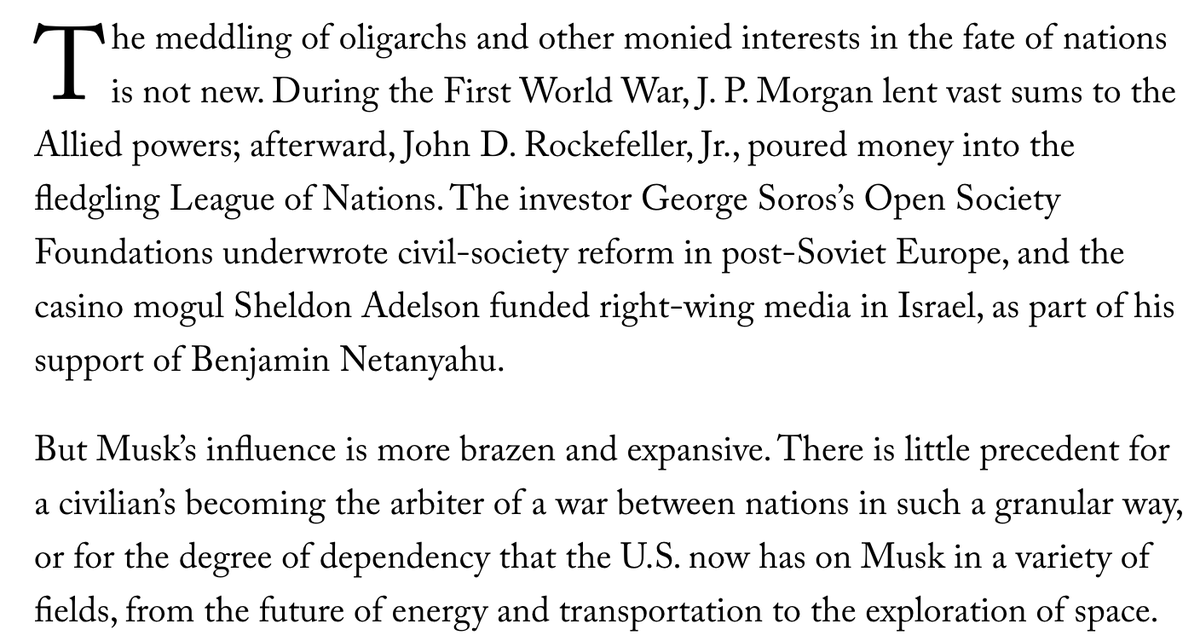
(7/10) Officials told me that Musk's disproportionate wealth and influence allowed him either to flout their regulation efforts or to strong-arm them, across multiple industries.
Musk spent four months in 2025 leading DOGE, an effort to restructure and cut staff at many of the same federal agencies he had previously clashed with.
Musk spent four months in 2025 leading DOGE, an effort to restructure and cut staff at many of the same federal agencies he had previously clashed with.

(8/10) The piece documents Musk's use of his platform against individual critics.
After Yoel Roth, Twitter's head of trust and safety when Elon acquired the site, resigned, Musk posted an excerpt from Roth's doctoral dissertation and suggested Roth supported children's access to adult content—the opposite of what Roth had actually argued. The post drew nearly seventeen thousand quote tweets and retweets.
"The moment that it went from being a moderation conversation to being a Pizzagate conversation, the risk level changed," Roth told me.
He and his husband fled their home. As they were packing the car, the Daily Mail published an article that gave readers what amounted to a map to their address. They ultimately had to sell the house.
After Yoel Roth, Twitter's head of trust and safety when Elon acquired the site, resigned, Musk posted an excerpt from Roth's doctoral dissertation and suggested Roth supported children's access to adult content—the opposite of what Roth had actually argued. The post drew nearly seventeen thousand quote tweets and retweets.
"The moment that it went from being a moderation conversation to being a Pizzagate conversation, the risk level changed," Roth told me.
He and his husband fled their home. As they were packing the car, the Daily Mail published an article that gave readers what amounted to a map to their address. They ultimately had to sell the house.
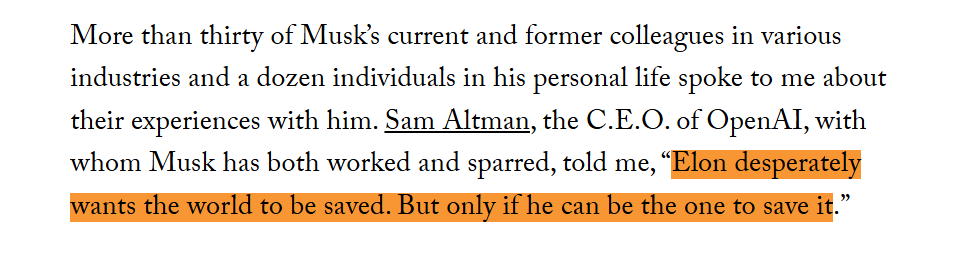
(9/10) Sam Altman, in an interview for that 2023 piece, told me: "Elon desperately wants the world to be saved. But only if he can be the one to save it."
In an open letter calling for a pause on advanced A.I. development, Musk and dozens of fellow tech leaders posed the question themselves: "Should we risk loss of control of our civilization? Such decisions must not be delegated to unelected tech leaders."
In an open letter calling for a pause on advanced A.I. development, Musk and dozens of fellow tech leaders posed the question themselves: "Should we risk loss of control of our civilization? Such decisions must not be delegated to unelected tech leaders."
(10/10) Musk still controls everything the original piece described. He has since won shareholder approval for a pay package that could make him the world's first trillionaire; become the largest political donor in modern American history; spent months running a federal agency; and embedded his AI chatbot across federal agencies, including the Pentagon's classified networks.
When national security officials and other experts raise warnings about the dangers presented by the current generation of Silicon Valley tycoons, the point isn't just individual, it's structural. In some cases, political and economic structures can no longer meaningfully contain them.
When national security officials and other experts raise warnings about the dangers presented by the current generation of Silicon Valley tycoons, the point isn't just individual, it's structural. In some cases, political and economic structures can no longer meaningfully contain them.
• • •
Missing some Tweet in this thread? You can try to
force a refresh