I don't think we (academics) realize how vulnerable we are. I'm not sure how much longer tenure will last in an era when a) we've lost the public trust (for a lot of reasons, b) college/academia is a partisan political issue, and c) college-educated white-collar workers are losing their jobs to AI. We are in an incredibly privileged position relative to others, but that privilege also makes us far more precarious than most academics realize bc it makes us a target--and the threat is not just conservative politicians gunning for us but the much larger group of regular people who don't mind if we get put in our place or start losing our jobs like similar others or being asked to do tasks we don't want to do.
Because this wasn't clear in the original: it is not clear to me we can make the case persuasively that we deserve tenure or academic freedom. I think these protections are vital for knowledge production and are generally social goods, but we have also completely shit the bed in a lot of different ways. We're going to have to earn these privileges back. But the idea that we are uniquely knowledgeable or that we deserve job protection when so many others don't have it (and are even more vulnerable to job loss) is no longer convincing. We need to make a more compelling case, which will also require a clear structure in place to keep us in check so that people don't have to just take our word for it that they should trust us. Until we acknowledge our contribution to the lack of trust, the abuse of these privileges by faculty, and make the case of what we offer in the era of AI, our arguments to defend tenure and academic freedom sound hollow.
• • •
Missing some Tweet in this thread? You can try to
force a refresh

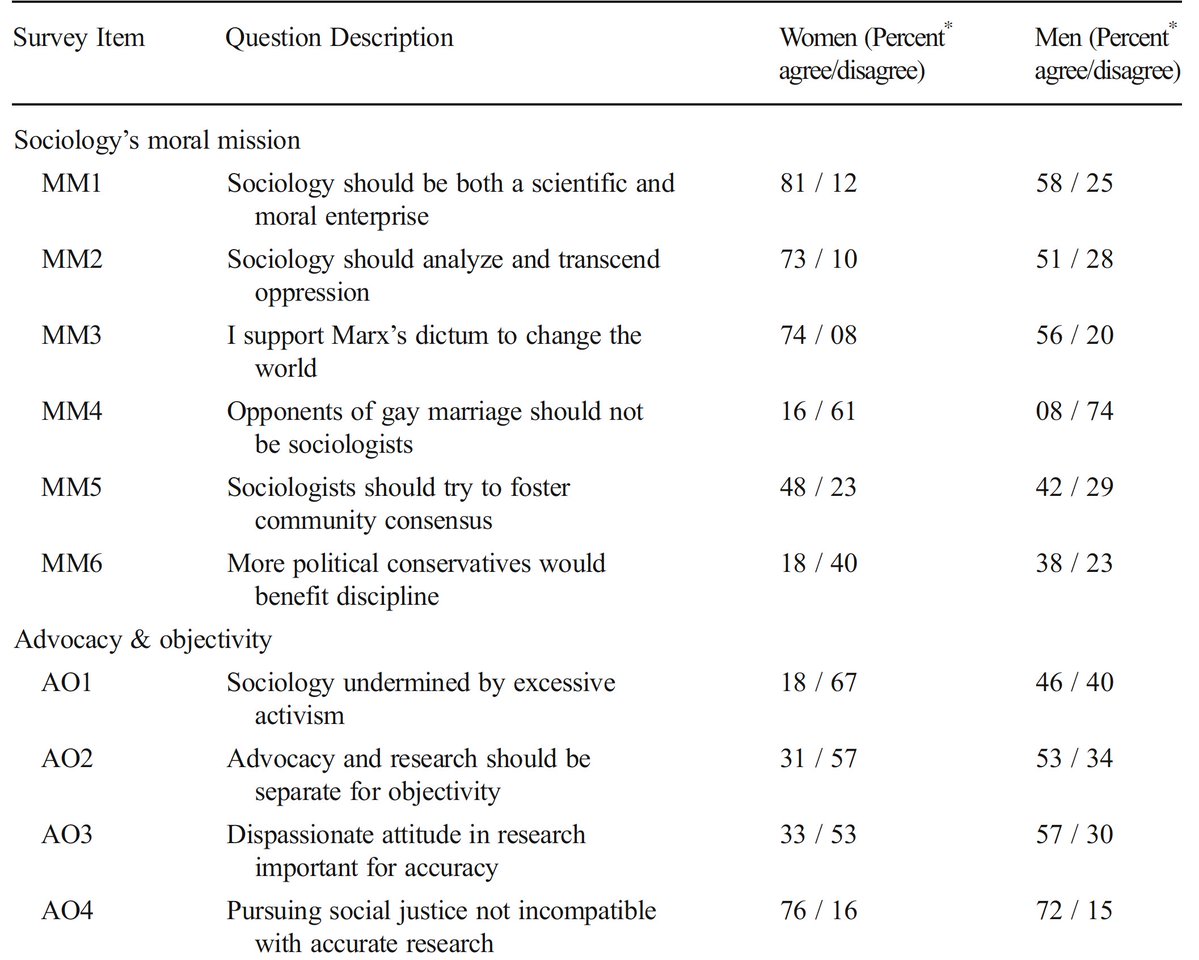
I really don't want the feminization hypothesis to be right, but when you see results like these (from Horowitz et al. 2018's survey of soc faculty -- 14% response rate)...
It's worth noting that the men's scores don't inspire confidence, but the women's scores are striking.
Before folks say we should ban women from academia (using the same logic as we need affirmative action for conservatives), what we should really take away is: we need to be teaching, hiring, and tenuring/promoting via scientific standards.
One criticism I have with the affirmative-action-for-conservatives recommendation (that I'm open to, but am not generally in favor of) is the assumption that bringing in more conservatives will make research more rigorous bc they'll call out unrigorous ideological research. 1\
My key objection to that premise: non-conservative scholars are already calling out unrigorous research but they are getting called conservatives for doing it. First, by associating politics with critique of shitty research, we're reifying the assumption that critics are conservative rather than just proper scientists. We're making it about ideology rather than science. 2\
Second, the problem is not that fields are dominated by lefty academics; the problem is fields are dominated by ideological academics who are putting their ideological preferences above their commitment to science. This trend has been enabled by decades of policies and practices that rejected meritocracy in favor of (a slim reading of) redistribution and social justice. \3
Something I see a lot in qualitative research is a lack of analysis. Basically a rundown of what's in the data, but without doing anything with it (analysis). It's the qualitative equivalent of descriptive stats. Short thread.
Some tricks to move past this: go back to your research question. Some RQs are purely descriptive, which can be okay in some settings, but usually are less exciting.
On the purely descriptive front, too often, I'm seeing variations of trying to convince the audience that something is good or bad, which is not often good social science. It's more argument rather than RQ-driven work.
Something I think a lot of scholars don't understand: the more generalist the journal, the more generalist a given article's appeal is supposed to be. What does this mean? 1/
Something focused on advancing our knowledge of an empirical topic goes in a specialist journal. I write something on prisons, I want other scholars interested in prisons to read it. 2/
Something focused on advancing theory or perhaps methodology that can be useful across subfields or topics goes in a generalist journal. I write something that uses prisons as an example, but I want it to be useful to scholars of hospitals, schools, workplaces, neighborhoods,....
Okay, I've been wanting to write this thread for a while and the final piece just came out so:
2020-2022 has been a banger time for new qualitative methods books. Here's a thread of some great new books!
It's important to note that these are often FUN books to read. I think that's really important.
A lot of them present the range of steps you take when doing research, from coming up with the project all the way through to data collection, analysis, and writing.
It's a genuinely interesting question about politics in the university, but lets also be super clear about what the data actually show. Short thread. 1/
The study is about top liberal arts colleges (according to US News), not research universities (which teach way more students) or universities in general. 3/