Big news on the transnational repression beat: RightsCon, the world's biggest digital human rights conference, has been CANCELED just days before it was set to begin in Lusaka, Zambia. The government of Zambia — which signed an agreement with China on April 24 — canceled it:
The Zambian govt's statement does not mention China or Taiwan.
But people close to the matter believe that the Chinese consulate was demanding information on Taiwanese participants and programming related to Taiwan.
That may be what the Zambian government's demand for "comprehensive disclosure of critical information relating to key thematic issues" is referring to.
RightsCon has a significant focus on Taiwan. Last year, RightsCon was held in Taipei.
Extraordinarily problematic and unserious article from an epistemological perspective. This article claims to present how we know what we know about Xinjiang, but includes zero mention of years worth of reporting on Xinjiang, including an entire series that won a Pulitzer Prize.
This article's frame simply repeats a factually untrue narrative pushed by Chinese state media and The Grayzone — which is that one single scholar, Adrian Zenz, is the key source of knowledge regarding Xinjiang.
Prashad spends a big chunk of the article tracing out how we came to know what we know about Xinjiang, but he leaves out much of the most crucial reports and articles.
This is a (very) incomplete list of what the authors left out:
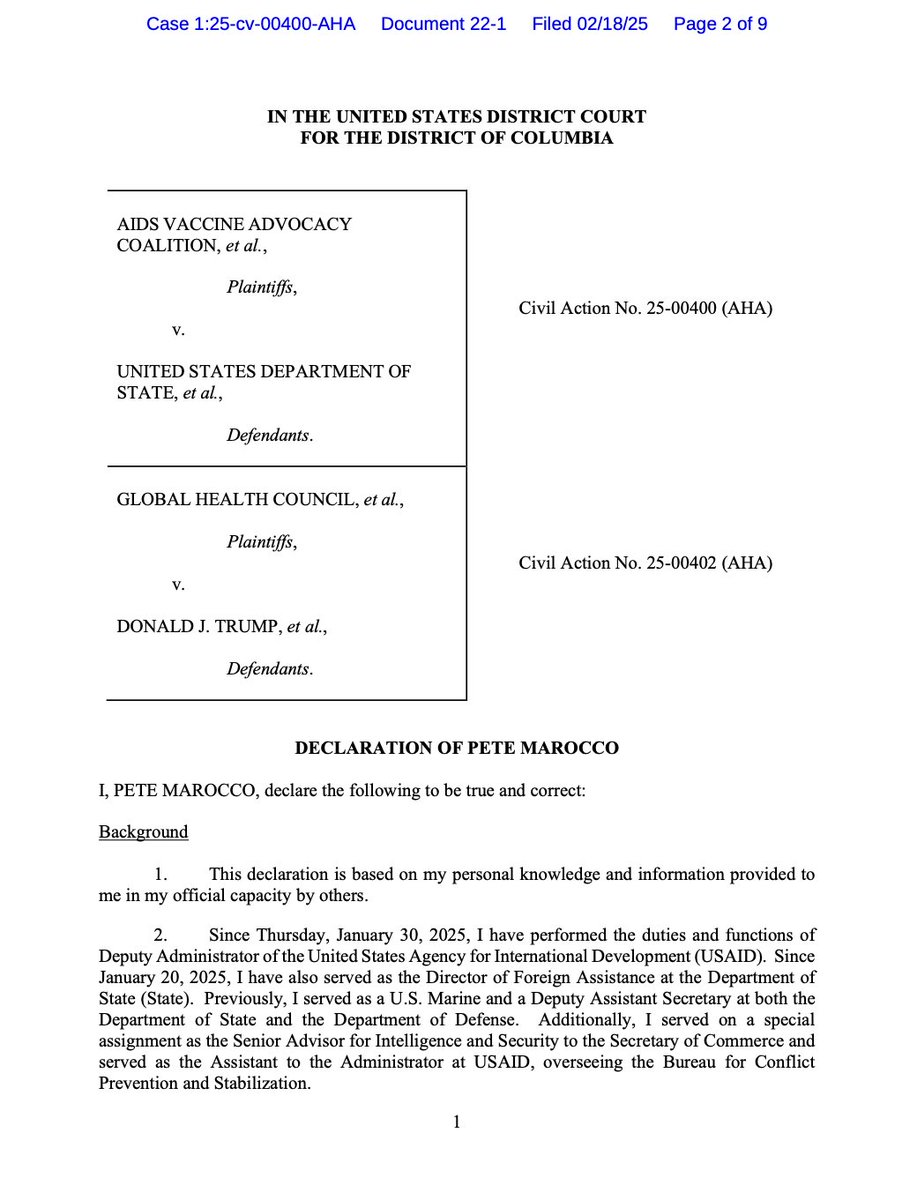
NEW: The Trump administration has just told a federal judge in a court filing that it will not comply with the court's order to resume funding for USAID and State Department foreign assistance.
Last Thursday, U.S. District Judge Amir Ali wrote in a filing in the U.S. District Court for the District of Columbia that the Trump administration must unfreeze foreign assistance payments to USAID and State Department grantees.
The Trump admin's response, filed by Pete Marocco, the new Director of the Office of Foreign Assistance at State, states that the administration will continue its freeze on funds for both USAID and State:
Because of the U.S. funding freezing, the entire global ecosystem of China nonprofits is facing an extinction event.
I'm not exaggerating for clicks. This is really what is happening. Read my piece below:
In many cases, these orgs provide our last window into what is actually happening in China. They do the painstaking, risky work of tracking Chinese censorship, tallying local protests, uncovering rights violations, & documenting the Uyghur genocide.
The research and other work done by these nonprofits is invaluable. It largely isn’t replicated by think tanks, universities, private firms, or journalists. If it disappears, nothing will replace it, and Beijing’s work to crush it will be complete.
Tim Walz brings a level of interest in China that is rare in a politician nominated for so high an office. In recent years, Walz has focused on China's human rights record. This is a man who will be unlikely to value market access over democratic values.
Criticism that Walz is pro-CCP is silly, and I don't say that lightly. Walz was pro-engagement with China for a long time. So was I, and no one would ever call me pro-CCP. China changed, and my views (and that of many others) changed with it.
Walz appears to actually LIKE the country and people of China, as do I. That's an enormous strength. One of the best ways to counter the CCP is by not letting the CCP define China or its people.
Friday is my last day at Axios, after 4 wonderful years. I'm looking for new opportunities to continue doing journalism and/or investigations related to China. Please DM with leads if you have any!
A thread of my best work at Axios over the years:
Our editor-in-chief said this week that I "led some of our most ambitious investigative stories and journalism." Another colleague described me as a "one-woman investigative powerhouse."
If you're interested in bringing that powerhouse to your own newsroom, DM me.
This data-based investigation uncovered Airbnb rentals in Xinjiang hosted on land owned by a sanctioned entity. It took real ingenuinity to get and use this data the way we did. Airbnb left the China market entirely a few months later.
I'm so proud of this amazing reporting series we did at Axios — five beautifully laid out longform dispatches from Tanzania, Okinawa, and Micronesia — with support from the @pulitzercenter.
@pulitzercenter This story about the CCP-funded party training school was very difficult to report out. But through ingenuity and dedication, we did it — we managed to get an inside look at the closed-door CCP-led training sessions despite being blocked at every turn by Tanzania's ruling party.
@pulitzercenter My 2nd Tanzania story provides a nuanced inside look at the overseas Chinese help center there & its director. The centers have attracted scrutiny in the west. They provide needed services but also replicate China's domestic structures of social control.