T. Greer Profile picture
May 4 24 tweets 4 min read Read on X
Recently turned down an invitation to attend a conference.

If you are organizing conferences in Washington you must realize a few things:
1. The main reason people attend any conference is to meet people. Interesting people, useful people, old friends. This is the actual reason people are coming to your conference. Everything else is ancillary to this.
2. Your programming can either aid attendees in their aim or impede them.

Programming 8:00 to 8:00 panels and speeches is impeding their aim. It is difficult to meet anyone sitting quietly in a conference hall while you all listen to some guy on a stage talk.
2. Conferences do not in fact have to be this way—especially if you are capping attendance or not opening up attendance to the general public.
For example, the very best conference I have attended structures the entire thing as a series of small discussion groups between 5-8 people.
That is at the extreme end. There are many less extreme variations on the the general theme, however.
How much time do you schedule for in between sessions where attendees can meet and talk? Is the event space conducive for relaxed, small group or 1-on-1 discussion?
Do you have open-ended breakout sessions where attendees have the chance to exchange views? Smaller Q&As with prominent attendees?
3. A secondary reason to attend a conference is to listen to what an important person has to say.

But in the age of YouTube this is mostly moot; of the conference is filming proceedings, then you can watch what that person has to say from home.
The exception are closed door conferences under some sort of Chatham house rules. In this case attending had added value on Youtube—but even here conference organizers need to communicate to said important people the importance of being frank and honest.
If off the record remarks are just echoes of old talking points then again, there is no value added.
3. This is all especially true when the conference is located in a place where many of the people invited to attend the conference live. I do not live in Washington but I have enough friends there that it is not difficult for me to stay over night.
In this situation what incentive do I have to actually register for the conference? I can watch the talks on YouTube and I can network with the people the conference brings to town without registering for anything.
Yes, this is parasitical on your efforts but you are trying to waste my time.
4. As a final note—with the exception of a few very carefully prepared presentations, I think most attendees at conferences learn more from small group discussions/breakouts than they do from formal speeches (much less formal moderated panels) .
This was my takeaway from a conference I recently attended. I asked 6 or so people who attended what they benefited most from during the conference and discovered that almost everyone said their favorite part were the breakout group discussions.
This is just a better way to do most conferences. Have a few scene setting speeches and addresses to set the tone of the event and create common grist for the communal mill, then arrange the rest of the conference to maximize active participation over passive listening.
Ok 2 final thoughts:

If you must have a panel, make it a panel between two people who disagree. explicitly stage it as something like a debate. Most people are more interested in conflict than concord. Most movements are better off when they can surface tensions constructively.


This is by far the best way to do things but is not practical for most organizations unless the conference is small. Splitting attendees up into dozens of balanced discussion groups requires a large logistical tail.
One passable, overhead substitute for this is to allow attendees to do the sorting themselves by having them create the discussions/panels/debates themselves at the conference itself.
^low overhead
This style of conference is usually called an “unconference” and it has its charms.

The strength of this sort of conference really rests on the strength of its attendees.
But that is IMHO an asset—it forces you change your question from “what is the best panel we can put together” to “ what attendees would add the most to this conference?”
The only other way to solve this problem is to create a conference that the big men of prestige find value in attending *themselves.*

• • •

Missing some Tweet in this thread? You can try to force a refresh

 

Keep Current with T. Greer

T. Greer Profile picture

Stay in touch and get notified when new unrolls are available from this author!

Read all threads

This Thread may be Removed Anytime!

PDF

Twitter may remove this content at anytime! Save it as PDF for later use!

Try unrolling a thread yourself!

how to unroll video
  1. Follow @ThreadReaderApp to mention us!

  2. From a Twitter thread mention us with a keyword "unroll"
@threadreaderapp unroll

Practice here first or read more on our help page!

More from @Scholars_Stage

Mar 30
@zenahitz I’ll bite on this. Let’s say the goal is something like “broad based scientific literacy” — the ability to understand the broad strokes of how the physical world works, as well as fluency in mathematical techniques you’d need to understand the average paper somewhere.
@zenahitz One way to do this might be to look at what different science degrees require of their students and see where there are commonalities—especially when those degrees require coursework outside their major.
I’ll list a few of these by major:

Neuroscience - 2 semesters of gen Chem, 2 semesters of organic chem, 2 semesters of physics (calculus based), calc I-II, 2 semesters entry bio, statistics.

Geology: - 2 semesters of gen Chen, 2 semesters of physics (calculus based based), calc 1-2, statistics.

Civil and mechanical engineering: 1 semester of gen chemistry, 2 semesters of physics (calculus based), calc 1-3, linear algebra, differential equations, statistics

Electrical engineering – 1 semester of gen chemistry, 2–3 semesters of physics (calculus-based, including electricity & magnetism), calc I–III, linear algebra, differential equations, statistics.

Computer science – calc I–II, discrete mathematics, linear algebra, probability/statistics (sometimes calc III depending on program).

Atmospheric sciences (meteorology) – 2 semesters of gen chemistry, 2 semesters of physics (calculus-based), calc I–III, differential equations, statistics.

Premed (typical med school prerequisites) – 2 semesters of gen chemistry, 2 semesters of organic chemistry, 2 semesters of biology, 2 semesters of physics, 1 semester of biochemistry, statistics, (often calc I and/or psychology/sociology depending on school).

Oceanography (marine science) – 2 semesters of gen chemistry, 2 semesters of physics, 2 semesters of biology, calc I–II (sometimes III), statistics.

Economics (BA/BS track) – calc I–II, statistics, econometrics, (more math-heavy programs: calc III, linear algebra, differential equations).

Chemical engineering – 2 semesters of gen chemistry, 2 semesters of organic chemistry, 2 semesters of physics (calculus-based), calc I–III, linear algebra, differential equations, statistics.

Environmental science – 2 semesters of gen chemistry, 2 semesters of biology, 1–2 semesters of physics, calc I (sometimes II), statistics.
Read 16 tweets
Mar 21
New essay: China and the Future of Science Image
A few quotes:

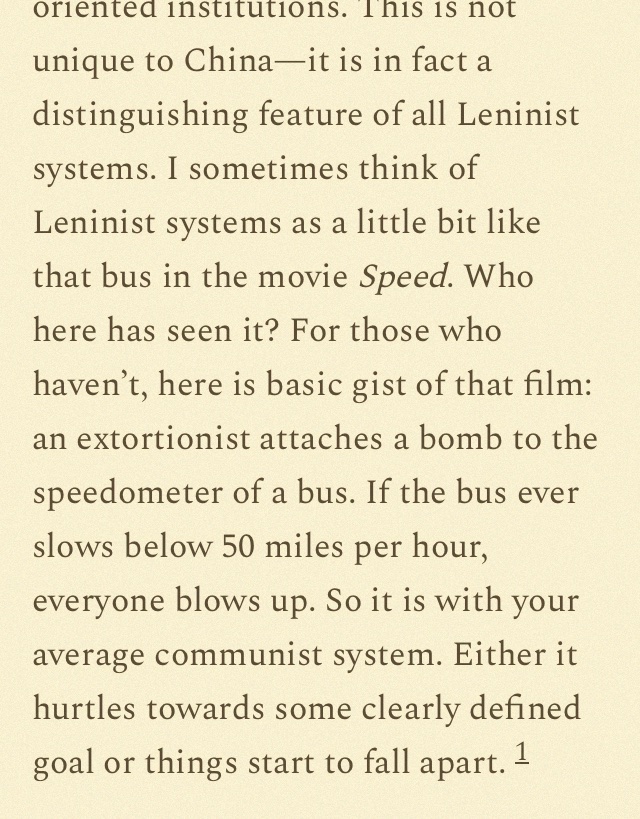
“ I sometimes think of Leninist systems as a little bit like that bus in the movie Speed…. Either it hurtles towards some clearly defined goal or things start to fall apart.” Image
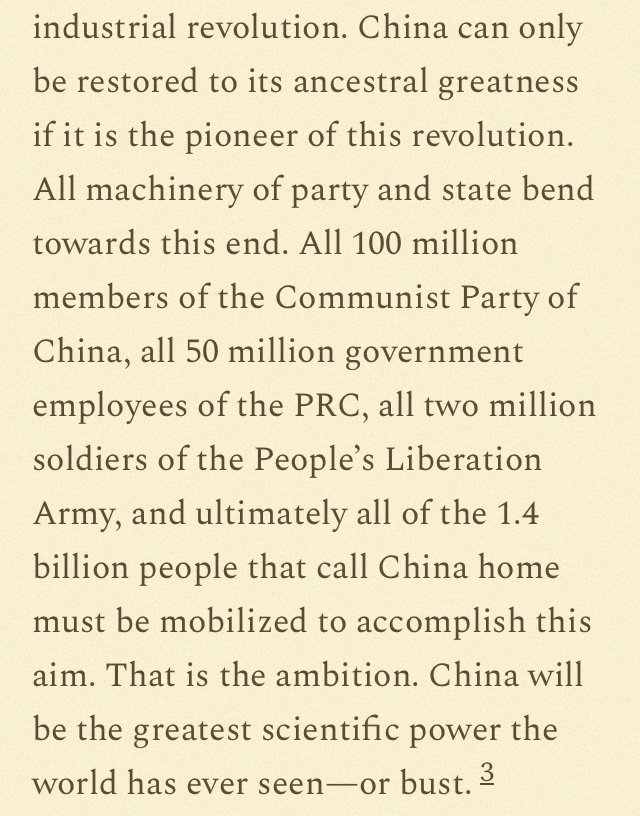
“ The Chinese leadership believes humanity stands on the cusp of the next industrial revolution. China can only be restored to its ancestral greatness if it is the pioneer of this revolution. All machinery of party and state bend towards this end. ” Image
Read 7 tweets
Mar 17
I spent most of the last week in the hospital and not reading the news.

Catching up on the Iran stuff now.

My main conclusion: the epistemic certainty you all have on this is *crazy.*
One of the helpful things that comes from reading blow-by-blow, day-by-day military histories is that you see how wildly assessments of past wars whose outcomes are now known changed as the wars progressed.
Read 4 tweets
Mar 7
This is a very good thought experiment. Who are the five authors that most 20th c writers have read but most 21st c writers have not?

What about 19th c writers?
The obvious answer is something like “the top 5 poets of each era” because 21st century writers do not consume much poetry.
But there are other options. Most 19th century authors would have read Carlyle, and you can make the case that a lot of 19th century prose is downstream his influence (see Moby Dick).
Read 10 tweets
Mar 5
The idea that the Iran operation was mostly about China, that it fundamentally changes Chinese perceptions of American strength, or that it has already altered the balance of power between China and America in any real way, is bizarre to me.
We know what metrics the Chinese judge their competition with the US by. We know the military measures they care about and we know the non-military elements of national power that they think are most important.
Very honestly: the upcoming war powers resolutions vote on Iran will likely matter more to Chinese perceptions of American capacity (if the admin fails to get the vote) than the actual military attacks on Iran. Not hard to predict the sort of analysis the Xie Tao types will write up.
Read 9 tweets
Jan 9
I would only want Rubio to run in 2028 if it is clear he can win. Too valuable a candidate to waste on a unwinnable election.

But it is insane to me that people are pushing Vance to run when Rubio is clearly the star player of this administration thus far.

My 2c.
Marco Rubio is the only Republican who can make basically every faction of the GOP happy.

He is pretty funny, doesn't come off as angry and resentful at the world. Very good on camera.

Performs under pressure. A competent statesman.
Has a much higher chance of getting the senate to do what he wants.

Has a much higher chance of getting the federal bureaucracy to do what he wants.
Read 7 tweets

Did Thread Reader help you today?

Support us! We are indie developers!


This site is made by just two indie developers on a laptop doing marketing, support and development! Read more about the story.

Become a Premium Member ($3/month or $30/year) and get exclusive features!

Become Premium

Don't want to be a Premium member but still want to support us?

Make a small donation by buying us coffee ($5) or help with server cost ($10)

Donate via Paypal

Or Donate anonymously using crypto!

Ethereum

0xfe58350B80634f60Fa6Dc149a72b4DFbc17D341E copy

Bitcoin

3ATGMxNzCUFzxpMCHL5sWSt4DVtS8UqXpi copy

Thank you for your support!

Follow Us!

:(