Can't believe I only just found out what 'institutional racism' as in the Stephen Lawrence enquiry actually means. I'd always assumed (and I'm sure this was the intention of the language) that it meant something like what people think of as racism, but rampant and normalised within an institution.
But in fact their idea of institutional racism is a mix of unprovable 'unconscious bias', insensitivity, and observations of things like black people being more likely to be stopped and searched. The actual deficiencies in the murder case are just generalised incompetence.
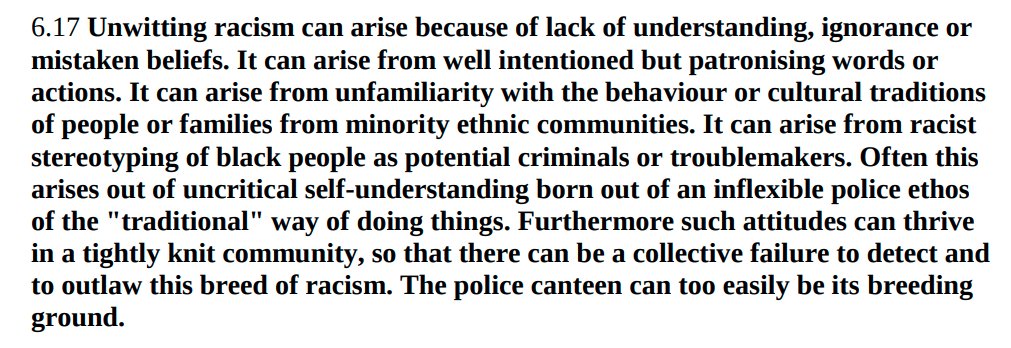
As they say: "In this Inquiry we have not heard evidence of overt racism or discrimination". What they're really talking about is: "Unwitting racism can arise because of lack of understanding, ignorance or mistaken beliefs. It can arise from well intentioned but patronising words or actions. It can arise from unfamiliarity with the behaviour or cultural traditions of people or families from minority ethnic communities. It can arise from racist stereotyping of black people as potential criminals or troublemakers."
This was the basis on which vast amounts of the British state was transformed.
Much of the evidence seems to be that the police didn't deal sensitively with family and friends, and didn't view is as solely a racist attack. Whatever the truth of this, it's not very relevant to actually solving the case.
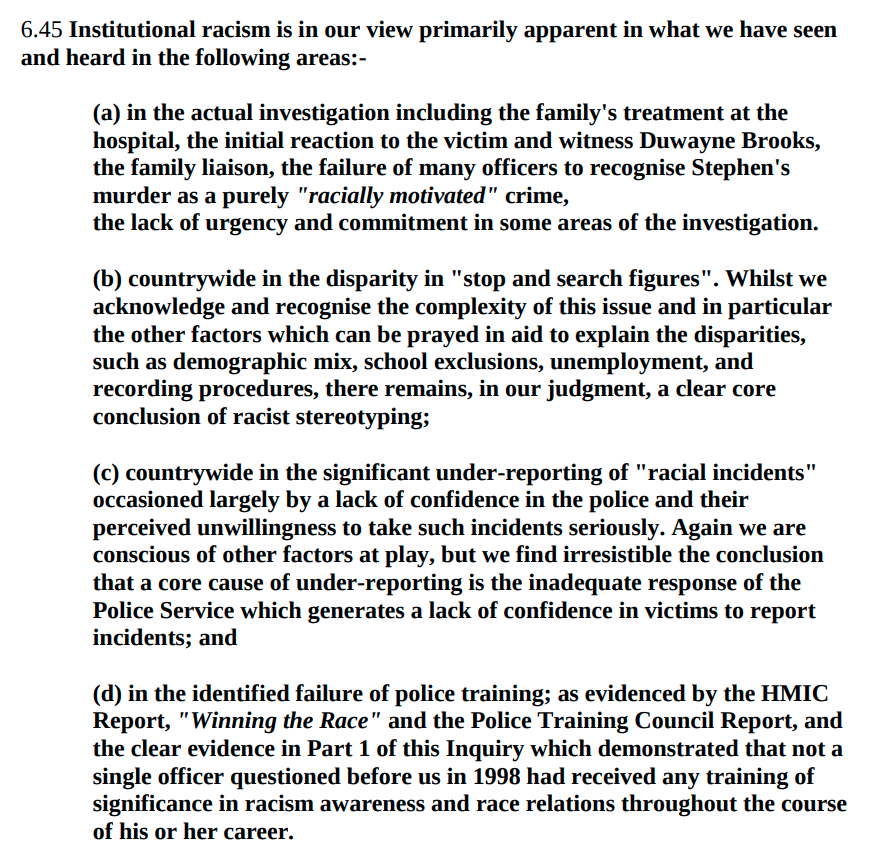
The full evidence for institutional racism: inensitivity, stop and search, under reporting of racist incidents, and not giving race awareness training to officers.
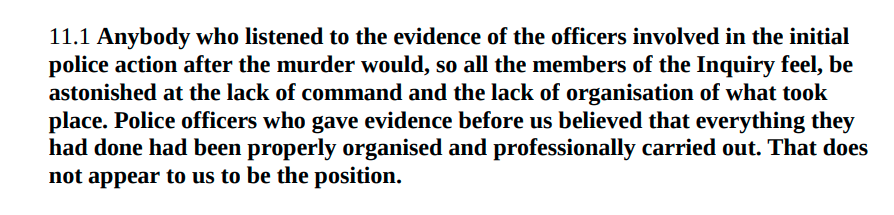
The evidence relating to the actual Stephen Lawrence case is just generalised incompetence.
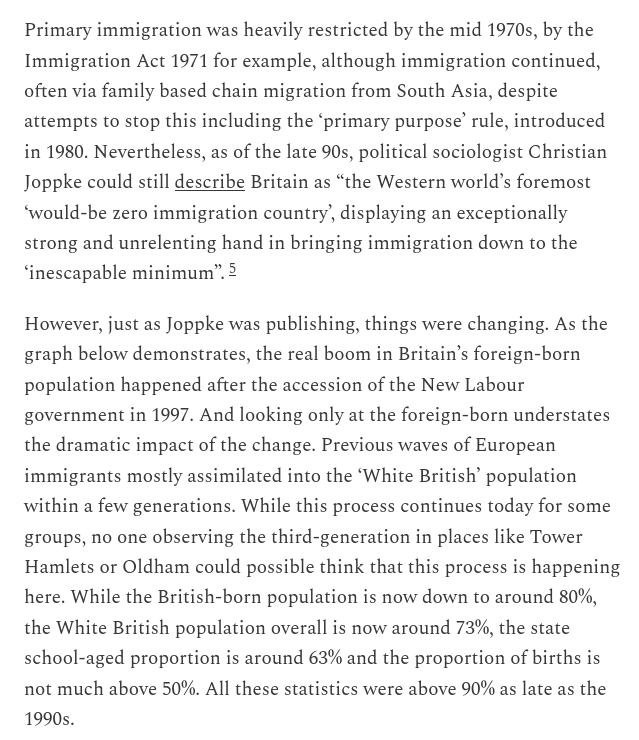
From my recent article, how as late as the late 1990s, Britain could still be described as the Western world’s foremost ‘would-be zero immigration country'.
Sometimes I think about had we continued like this, we could have been somewhat of a beacon to the rest of Europe, a larger Denmark.
Of course the 80s and early 90s still had their issues. We failed to properly grasp the refugee issue, nor chain migration via marriage from South Asia. But it was a lot better than today.
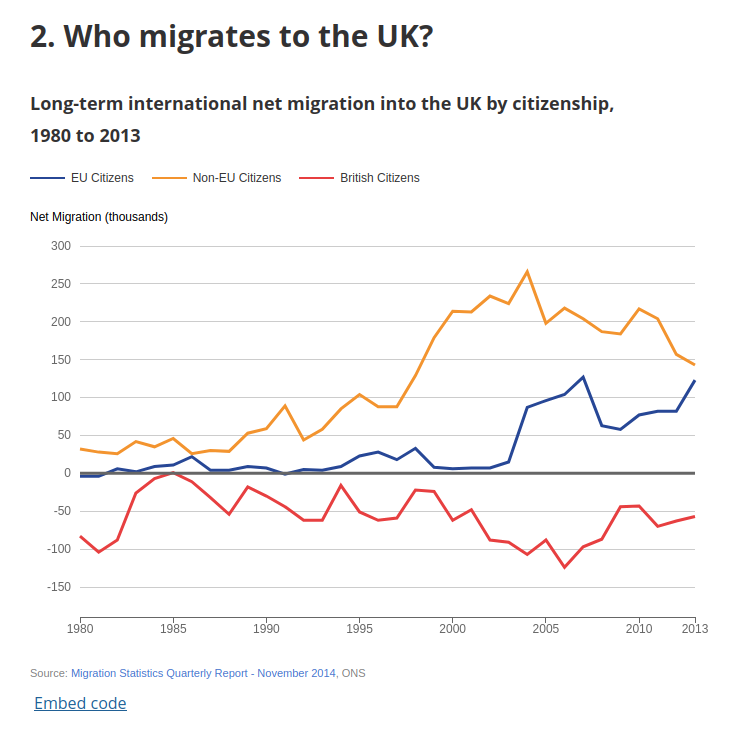
In the Thatcher era in most years there was less than 50k net migration per year. Really the Thatcher govt's only big mistake on immigration was not stopping family chain migration from South Asia. They did try, with the primary purpose rule etc, but frankly it should have been banned entirely.
It's always useful to remember, for all the historical attention given to them, just how few European ships sailed to Asia before the 19th century. Around 5-10 a year in the 16th century, 30 a year in 1650, 75 a year in 1750. And these were not large ships either.
It's always a struggle to get a sense of the relative importance of various things to premodern economies. You have things like this Asian trade, which is very historically interesting and arouses strong passions, but is small in scale. Vs things like making rivers more navigable, and draining marshes in Europe, which isn't quite as exciting.
Other things I find interesting about this graph
- Strange that over the 16th century trade actually declined. Could Portugal just not make it work?
- It's often said that after the glorious revolution of 1688 trade primacy passed to England, but going by this graph that took another century, with the final blow being the Napoleonic wars, which really fucked Britain's competitors re Asian trade, especially the Netherlands.
Interesting example in this video of the transformation of Islam in Britain - Mothin Ali's mother didn't wear a niqab, but his wife does.
Other than that, I thought it was hilarious that he seems to be claiming that back when the working class had more political power, they didn't see ethnic difference, only their shared 'chains of hardship and debt.' This has always been a left-wing fantasy with very little connection to reality. Working class British people have always strongly opposed mass immigration.
It's actually pretty slanderous to claim that people only oppose mass immigration and demographic replacement because Thatcher closed down their steel mills, meaning they fell under the sway of, formerly, the Daily Mail and, latterly, shadowy online right-wing influencers probably funded by the Russians.
People opposed it just as strongly in the 60s and 70s before deindustrialisation. False rhetoric like this obscures their agency and desire and willingness to stand up for their identity.
On the transformation of Islam thing, I also strongly doubt that any south asian Muslims who won council elections in Britain in the 20th century would ever have screamed allahu akbar in their victory speech
Best moment in the Louis Theroux manosphere doc so far is about 20 minutes in when he asks this guy:
"So how many kids have you got?"
"I've got some, yeah."
"You know how many you've got, right?"
"Yeah, I think so."
"What's the number?"
"It's two."
And it later turns out he lives with these kids and their mother. Bizarre shift from the past where men would hide their indiscretions/illegitimate children behind a facade of monogamous family life. These guys promote a harem-style image while living conventional lives.
Same with the Myron Gaines scene later where he gets Myron to say in front of his girlfriend that he might take multiple wives in future. You can see from the dynamic that this will never happen, but he has to say it for his audience.
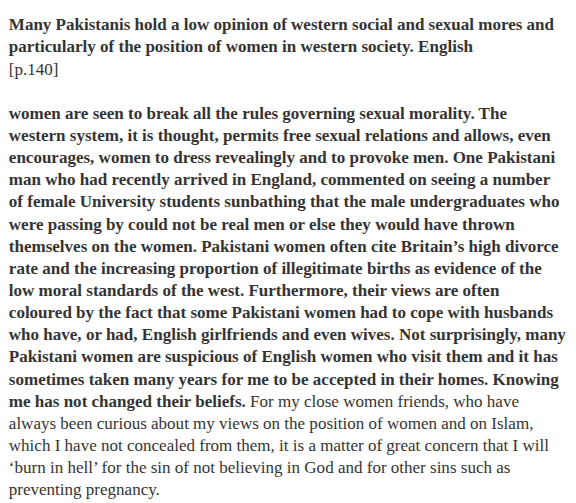
New article — Grooming gangs and the failure of social science: How a 1980s study into Oxford's Pakistani community highlights the blindness of our institutions.
Stimulated by recently reading Alison Shaw's study, which put a lot of things into context.
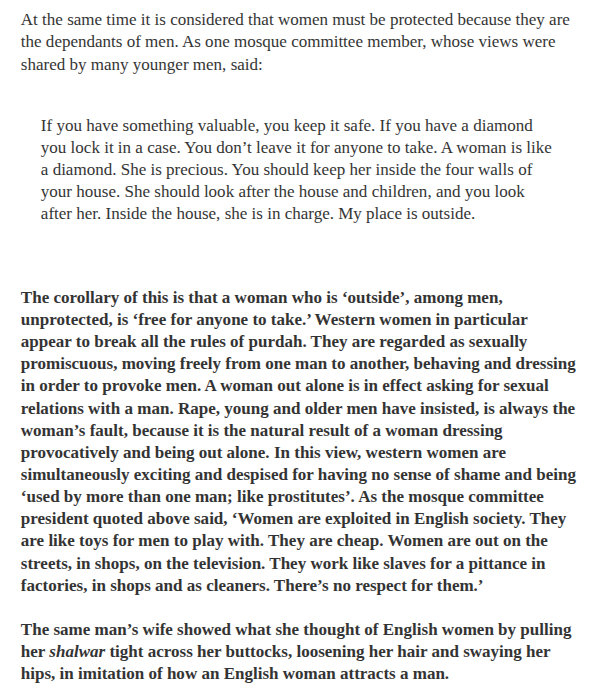
Only just discovered Alison Shaw's study from 1988: A Pakistani Community in Britain. It's incredible reading as it explains the context of how the rape gangs developed so well.
In a better world this would have formed the basis of an official enquiry into immigration policy.
What's especially poignant about this study is that it was of the Pakistani community in Oxford, from where one of the many grooming gangs would emerge some years later.
This is something you always see. All this was known, and nothing was done.
One thing that's hardest to get your head round is the view of sexual morality whereby it's expected that men will, basically, rape women if they are unprotected by other men. And therefore nothing really has been done wrong if other men have left the women unprotected.