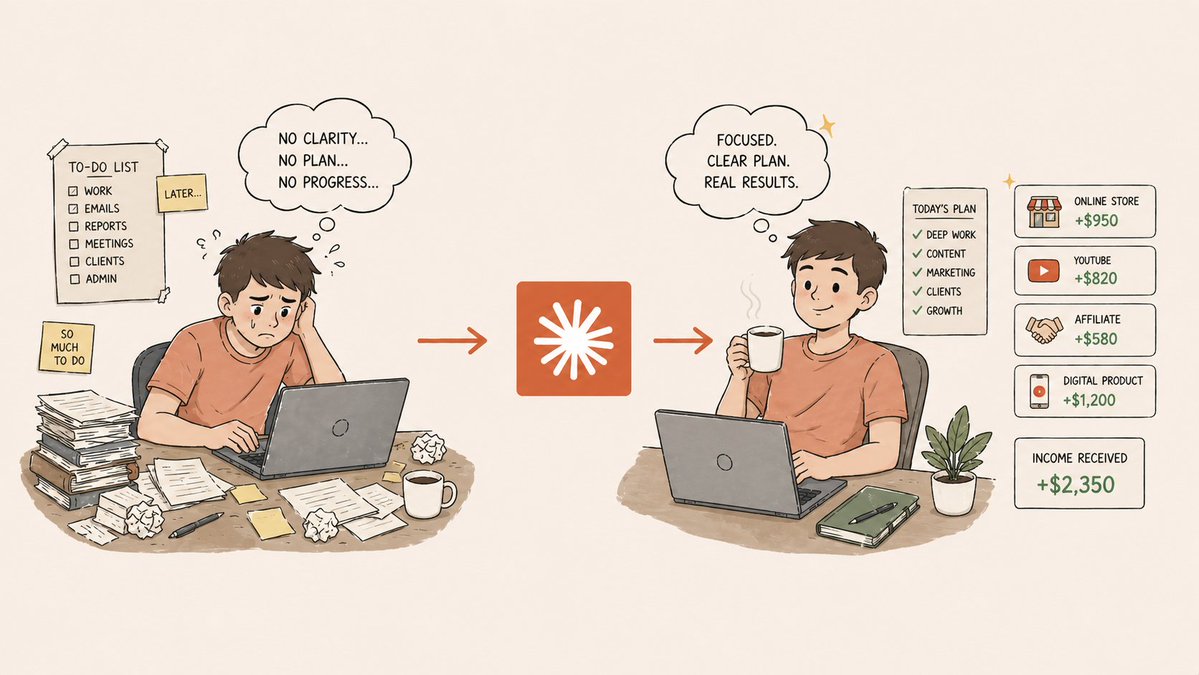
Most professionals spend $5,000+ per year on SaaS subscriptions.
Project manager. Copywriter. Analyst. Coach. Scheduler. Note-taker. Designer. Researcher.
Claude can now replace 8 of them at once — for free.
Here are 8 prompts that cancel $400/month in subscriptions you forgot you were paying for:
Save this thread 🧵👇
Project manager. Copywriter. Analyst. Coach. Scheduler. Note-taker. Designer. Researcher.
Claude can now replace 8 of them at once — for free.
Here are 8 prompts that cancel $400/month in subscriptions you forgot you were paying for:
Save this thread 🧵👇
Prompt 1: Audit Your Entire SaaS Stack
You can't cancel what you haven't seen.
This prompt builds your subscription kill list:
Act as a SaaS cost-cutting consultant who has
audited subscription stacks for solopreneurs
and small teams.
Here's my honest SaaS situation:
- Subscriptions I actively use weekly: [LIST
WITH MONTHLY COST]
- Subscriptions I use occasionally: [LIST WITH
COST]
- Subscriptions I haven't opened in 30+ days:
[LIST WITH COST]
- Annual subscriptions I forgot I had: [LIST]
- Free trials that auto-converted: [LIST]
- My role and workflow needs: [DESCRIBE]
Run a full SaaS audit:
1. Total monthly and annual spend across all
tools
2. The 5 tools doing real work I'd actually
miss
3. The tools that overlap (where I'm paying
2x for the same job)
4. The tools Claude can fully replace today
5. The tools Claude can mostly replace (with
one cheaper backup tool)
6. A prioritized cancellation list (highest
ROI cuts first)
7. Realistic monthly savings if I follow this list
Show me the money I'm leaking every single
month.
You can't cancel what you haven't seen.
This prompt builds your subscription kill list:
Act as a SaaS cost-cutting consultant who has
audited subscription stacks for solopreneurs
and small teams.
Here's my honest SaaS situation:
- Subscriptions I actively use weekly: [LIST
WITH MONTHLY COST]
- Subscriptions I use occasionally: [LIST WITH
COST]
- Subscriptions I haven't opened in 30+ days:
[LIST WITH COST]
- Annual subscriptions I forgot I had: [LIST]
- Free trials that auto-converted: [LIST]
- My role and workflow needs: [DESCRIBE]
Run a full SaaS audit:
1. Total monthly and annual spend across all
tools
2. The 5 tools doing real work I'd actually
miss
3. The tools that overlap (where I'm paying
2x for the same job)
4. The tools Claude can fully replace today
5. The tools Claude can mostly replace (with
one cheaper backup tool)
6. A prioritized cancellation list (highest
ROI cuts first)
7. Realistic monthly savings if I follow this list
Show me the money I'm leaking every single
month.
Prompt 2: Replace Your Project Manager (Notion, Asana, ClickUp, Monday)
Most project management tools are bloated dashboards you barely touch.
This prompt replaces them with one Claude system:
You are a productivity strategist who has helped
solopreneurs and small teams ditch bloated
project management tools.
My current PM tool: [NOTION / ASANA / CLICKUP
/ MONDAY / TRELLO / OTHER]
What I use it for: [LIST]
The features I actually need: [LIST]
The features I never use: [LIST]
Build me a Claude-based project management
system:
1. A "single source of truth" structure I can
maintain in one document or chat
2. A weekly planning template (what to ask
Claude every Monday)
3. A daily standup template (5-minute check-in)
4. A task tracking system that doesn't require
me to update 14 fields
5. A project review template for end-of-week
reflection
6. How to handle deadlines, dependencies, and
priorities without a Gantt chart
7. The 3 things a tool like Notion does better
(so I know when to keep one tool around)
Make this lightweight enough that I'll actually
use it.
Most project management tools are bloated dashboards you barely touch.
This prompt replaces them with one Claude system:
You are a productivity strategist who has helped
solopreneurs and small teams ditch bloated
project management tools.
My current PM tool: [NOTION / ASANA / CLICKUP
/ MONDAY / TRELLO / OTHER]
What I use it for: [LIST]
The features I actually need: [LIST]
The features I never use: [LIST]
Build me a Claude-based project management
system:
1. A "single source of truth" structure I can
maintain in one document or chat
2. A weekly planning template (what to ask
Claude every Monday)
3. A daily standup template (5-minute check-in)
4. A task tracking system that doesn't require
me to update 14 fields
5. A project review template for end-of-week
reflection
6. How to handle deadlines, dependencies, and
priorities without a Gantt chart
7. The 3 things a tool like Notion does better
(so I know when to keep one tool around)
Make this lightweight enough that I'll actually
use it.
Prompt 3: Replace Your Copywriter (Jasper, Copy .ai, Writesonic)
AI copywriting tools charge $50-$200/month for what Claude does natively — better.
This prompt builds your in-house copywriter:
Act as a senior direct-response copywriter who
has written for SaaS, ecommerce, and personal
brands.
I want to use you as my full-time copywriter
instead of paying for [JASPER / COPY .AI /
WRITESONIC / OTHER].
Build me a complete copywriting workflow:
1. A "voice and tone" template I can paste at
the start of every session (so my brand
voice stays consistent)
2. A library of 10 reusable copywriting prompts
for the most common assets (email, sales
page, landing page, ad, social, newsletter,
bio, headline, CTA, product description)
3. The "research → draft → polish" 3-step
workflow that beats any AI copywriting tool
4. A self-editing checklist to refine drafts
5. A "hook generator" prompt for any topic
6. How to feed in customer testimonials to
generate copy that uses real customer language
7. A weekly copywriting routine that produces
10x more output than any SaaS tool
Stop charging me $90/month for a worse version
of yourself.
AI copywriting tools charge $50-$200/month for what Claude does natively — better.
This prompt builds your in-house copywriter:
Act as a senior direct-response copywriter who
has written for SaaS, ecommerce, and personal
brands.
I want to use you as my full-time copywriter
instead of paying for [JASPER / COPY .AI /
WRITESONIC / OTHER].
Build me a complete copywriting workflow:
1. A "voice and tone" template I can paste at
the start of every session (so my brand
voice stays consistent)
2. A library of 10 reusable copywriting prompts
for the most common assets (email, sales
page, landing page, ad, social, newsletter,
bio, headline, CTA, product description)
3. The "research → draft → polish" 3-step
workflow that beats any AI copywriting tool
4. A self-editing checklist to refine drafts
5. A "hook generator" prompt for any topic
6. How to feed in customer testimonials to
generate copy that uses real customer language
7. A weekly copywriting routine that produces
10x more output than any SaaS tool
Stop charging me $90/month for a worse version
of yourself.
Prompt 4: Replace Your Analyst (Mixpanel, Tableau, Power BI for basics)
Most professionals don't need a $300/month BI tool. They need someone who can read data and explain it.
This prompt replaces the analyst:
You are a senior data analyst with experience
at McKinsey and Stripe. You can read raw data
and translate it into clear insights.
I want to use you instead of [MIXPANEL /
TABLEAU / POWER BI / GA / OTHER ANALYTICS TOOL]
for my recurring analysis.
Here's my data: [PASTE CSV, NUMBERS, OR
DESCRIBE]
Context for the data: [WHAT IT MEASURES]
The question I'm trying to answer: [QUESTION]
Run a full analysis:
1. The 3 most important insights in this data
2. The 1 trend most people would miss
3. Specific anomalies worth investigating
4. What this data DOESN'T tell me (and what I
should track instead)
5. A 3-sentence executive summary I could share
with a stakeholder
6. The next action I should take based on this
7. The 3 questions I should ask of this data
next week
Don't give me a chart. Give me an answer.
Most professionals don't need a $300/month BI tool. They need someone who can read data and explain it.
This prompt replaces the analyst:
You are a senior data analyst with experience
at McKinsey and Stripe. You can read raw data
and translate it into clear insights.
I want to use you instead of [MIXPANEL /
TABLEAU / POWER BI / GA / OTHER ANALYTICS TOOL]
for my recurring analysis.
Here's my data: [PASTE CSV, NUMBERS, OR
DESCRIBE]
Context for the data: [WHAT IT MEASURES]
The question I'm trying to answer: [QUESTION]
Run a full analysis:
1. The 3 most important insights in this data
2. The 1 trend most people would miss
3. Specific anomalies worth investigating
4. What this data DOESN'T tell me (and what I
should track instead)
5. A 3-sentence executive summary I could share
with a stakeholder
6. The next action I should take based on this
7. The 3 questions I should ask of this data
next week
Don't give me a chart. Give me an answer.
Prompt 5: Replace Your Coach (BetterUp, Reclaim, Coachly)
Coaching apps charge $200-$500/month for generic prompts.
This prompt replaces them with personalized coaching that adapts to you:
Act as my executive coach — the kind that
costs $400/hour and works with senior leaders
at top companies.
Here's my current state:
- Role and responsibilities: [DESCRIBE]
- My biggest challenge right now: [DESCRIBE]
- A decision I'm avoiding: [DESCRIBE]
- The skill I'm trying to build: [DESCRIBE]
- My typical week: [DESCRIBE]
Run my weekly coaching session:
1. The pattern you see in my struggles this
week
2. The question I'm asking that's the wrong
question
3. A reframe that would change how I see this
4. The 1 action I should take this week (and
the cost of NOT taking it)
5. A specific behavior to start, and one to
stop
6. A "blind spot" prompt — what am I missing
about myself right now?
7. The 1 question I should sit with this week
Coach me. Don't just affirm me. Don't just
agree with me.
Coaching apps charge $200-$500/month for generic prompts.
This prompt replaces them with personalized coaching that adapts to you:
Act as my executive coach — the kind that
costs $400/hour and works with senior leaders
at top companies.
Here's my current state:
- Role and responsibilities: [DESCRIBE]
- My biggest challenge right now: [DESCRIBE]
- A decision I'm avoiding: [DESCRIBE]
- The skill I'm trying to build: [DESCRIBE]
- My typical week: [DESCRIBE]
Run my weekly coaching session:
1. The pattern you see in my struggles this
week
2. The question I'm asking that's the wrong
question
3. A reframe that would change how I see this
4. The 1 action I should take this week (and
the cost of NOT taking it)
5. A specific behavior to start, and one to
stop
6. A "blind spot" prompt — what am I missing
about myself right now?
7. The 1 question I should sit with this week
Coach me. Don't just affirm me. Don't just
agree with me.
Prompt 6: Replace Your Note-Taker & Meeting Tool (Otter, Fireflies, Loom)
Most note-taking apps capture everything and synthesize nothing.
This prompt replaces them with a real-time meeting brain:
You are an executive assistant who specializes
in meeting notes and follow-up workflows.
Here's a meeting I just had: [PASTE TRANSCRIPT
/ NOTES / KEY POINTS]
Process this meeting for me:
1. A 3-bullet executive summary (no fluff)
2. The decisions that were made
3. The decisions that were AVOIDED (often more
important)
4. Action items with owners and deadlines
5. Follow-up questions I should ask before next
meeting
6. A summary email I can send to attendees
7. Topics that came up that deserve their own
future meeting
Make me look like the most prepared person in
the next conversation.
Most note-taking apps capture everything and synthesize nothing.
This prompt replaces them with a real-time meeting brain:
You are an executive assistant who specializes
in meeting notes and follow-up workflows.
Here's a meeting I just had: [PASTE TRANSCRIPT
/ NOTES / KEY POINTS]
Process this meeting for me:
1. A 3-bullet executive summary (no fluff)
2. The decisions that were made
3. The decisions that were AVOIDED (often more
important)
4. Action items with owners and deadlines
5. Follow-up questions I should ask before next
meeting
6. A summary email I can send to attendees
7. Topics that came up that deserve their own
future meeting
Make me look like the most prepared person in
the next conversation.
Prompt 7: Replace Your Researcher (Perplexity Pro, Glean, paid research tools)
Research tools charge $20-$200/month to find information.
This prompt does it as a research analyst:
Act as a senior research analyst at a top
consulting firm. Your job isn't just to find
information — it's to synthesize it.
My research question: [QUESTION]
The decision this research will support:
[CONTEXT]
What I already know: [LIST]
What I'm trying to figure out: [LIST]
Run a full research workflow:
1. The 5 most reliable angles to investigate
this question
2. The key data points or facts I need to
establish first
3. The strongest case FOR a given position
4. The strongest case AGAINST it
5. The 3 sources or experts I should look up
for primary research
6. The "second-order" questions this opens up
7. A 1-page synthesis ready to send to a
decision-maker
Don't just summarize. Help me think.
Research tools charge $20-$200/month to find information.
This prompt does it as a research analyst:
Act as a senior research analyst at a top
consulting firm. Your job isn't just to find
information — it's to synthesize it.
My research question: [QUESTION]
The decision this research will support:
[CONTEXT]
What I already know: [LIST]
What I'm trying to figure out: [LIST]
Run a full research workflow:
1. The 5 most reliable angles to investigate
this question
2. The key data points or facts I need to
establish first
3. The strongest case FOR a given position
4. The strongest case AGAINST it
5. The 3 sources or experts I should look up
for primary research
6. The "second-order" questions this opens up
7. A 1-page synthesis ready to send to a
decision-maker
Don't just summarize. Help me think.
Prompt 8: The Monthly SaaS Review
Subscriptions creep back if you don't audit them.
This prompt is your monthly cancellation ritual:
You are my fractional CFO running my monthly
SaaS review.
This month's data:
- Total SaaS spend: $[X]
- Subscriptions I added this month: [LIST]
- Subscriptions I cancelled this month: [LIST]
- Subscriptions I haven't opened in 30+ days:
[LIST]
- Annual renewals coming up in next 60 days:
[LIST]
- New tools I'm tempted to subscribe to: [LIST]
Run my full monthly SaaS review:
1. Total spend trend (up or down vs. last
month)
2. Subscriptions to cancel TODAY (with reasoning)
3. Annual renewals to evaluate before they
auto-charge
4. Tools I'm tempted to add — but should resist
(and why)
5. Tools I should actually pay for and use
harder
6. A "consolidation opportunity" — places where
2 tools could become 1
7. Total annual savings if I act on this review
Most subscriptions are quiet thefts. Catch them
before they renew.
Subscriptions creep back if you don't audit them.
This prompt is your monthly cancellation ritual:
You are my fractional CFO running my monthly
SaaS review.
This month's data:
- Total SaaS spend: $[X]
- Subscriptions I added this month: [LIST]
- Subscriptions I cancelled this month: [LIST]
- Subscriptions I haven't opened in 30+ days:
[LIST]
- Annual renewals coming up in next 60 days:
[LIST]
- New tools I'm tempted to subscribe to: [LIST]
Run my full monthly SaaS review:
1. Total spend trend (up or down vs. last
month)
2. Subscriptions to cancel TODAY (with reasoning)
3. Annual renewals to evaluate before they
auto-charge
4. Tools I'm tempted to add — but should resist
(and why)
5. Tools I should actually pay for and use
harder
6. A "consolidation opportunity" — places where
2 tools could become 1
7. Total annual savings if I act on this review
Most subscriptions are quiet thefts. Catch them
before they renew.
That's the full system.
8 prompts. One Claude session. SaaS consolidation that saves you $400-$800/month — and replaces tools that charge thousands per year.
Most professionals don't have an income problem. They have a subscription problem.
Audit it. Cancel ruthlessly. Use Claude for the rest.
8 prompts. One Claude session. SaaS consolidation that saves you $400-$800/month — and replaces tools that charge thousands per year.
Most professionals don't have an income problem. They have a subscription problem.
Audit it. Cancel ruthlessly. Use Claude for the rest.
• • •
Missing some Tweet in this thread? You can try to
force a refresh