
#HemeOncHeroes Series. Story #2
In 2010, advanced pancreatic cancer outcomes were still grim. Median survival with gemcitabine was about 6 months, and only ~22% of patients were alive at 12 months in trials.
Gemcitabine was the main standard, with response rates under 10%.
Then a French oncologist pushed a bold idea: treat it with four drugs at once.
Today, on May 12, one of the most prominent clinical trials in pancreatic cancer was published in 2011 in NEJM.
🧵 1/14
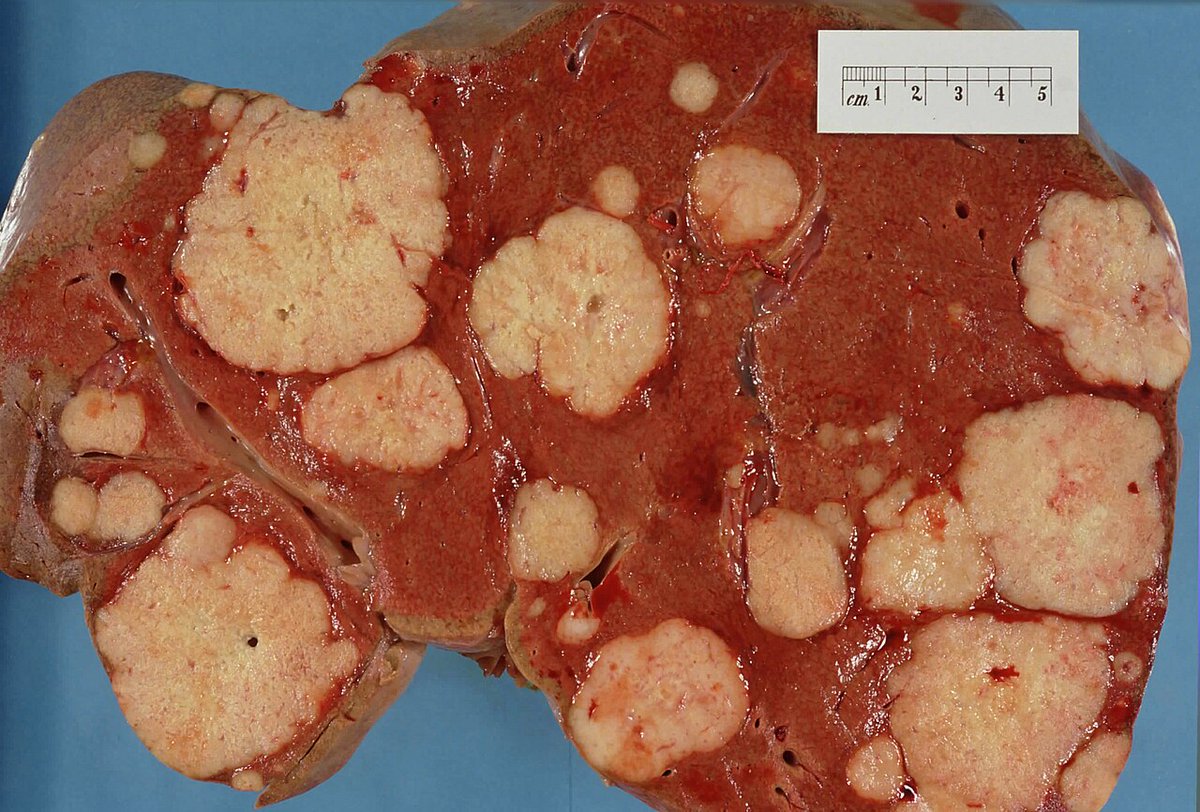
pic: Pancreatic cancer with liver metastases. The disease FOLFIRINOX made survivable for many patients.
In 2010, advanced pancreatic cancer outcomes were still grim. Median survival with gemcitabine was about 6 months, and only ~22% of patients were alive at 12 months in trials.
Gemcitabine was the main standard, with response rates under 10%.
Then a French oncologist pushed a bold idea: treat it with four drugs at once.
Today, on May 12, one of the most prominent clinical trials in pancreatic cancer was published in 2011 in NEJM.
🧵 1/14
pic: Pancreatic cancer with liver metastases. The disease FOLFIRINOX made survivable for many patients.
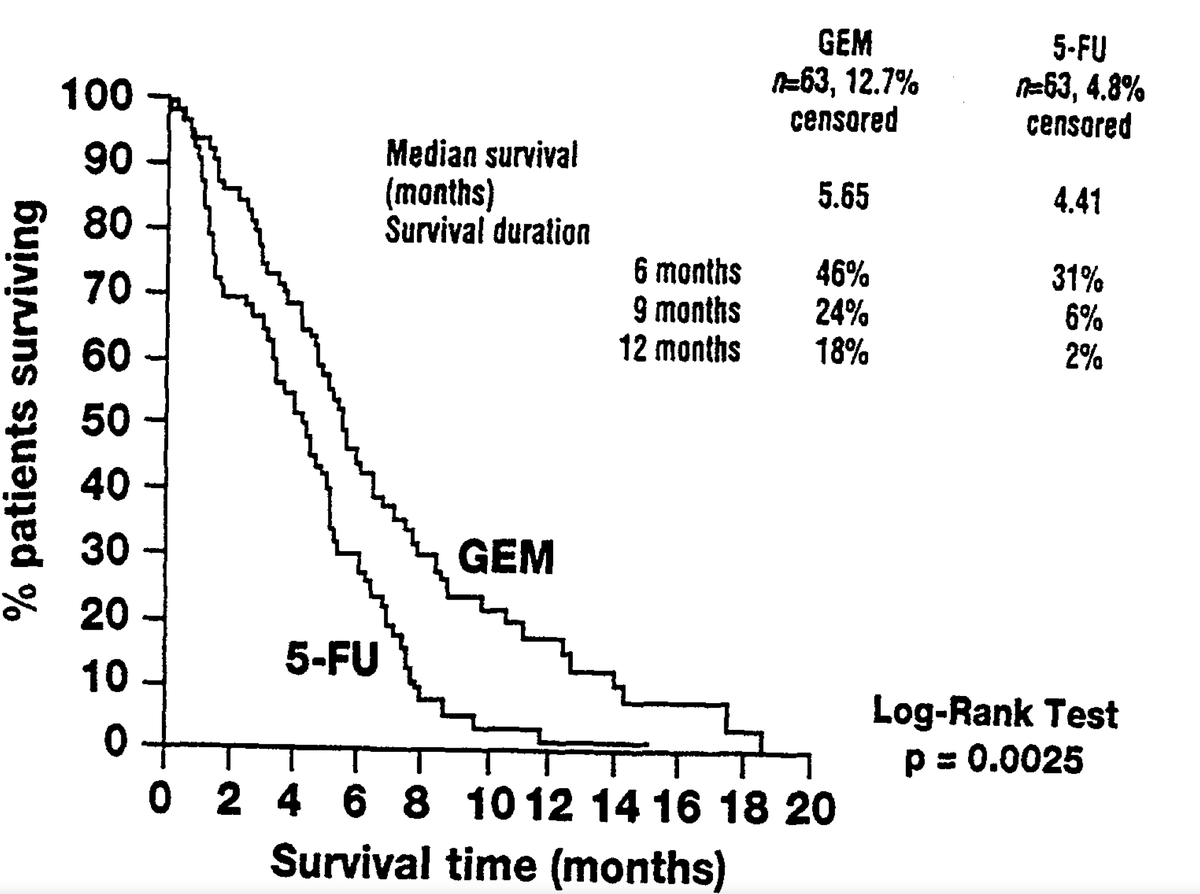
Gemcitabine produced response rates under 10%. It extended median survival from ~4 months to ~6 months. Pancreatic cancer was, in clinical terms, the worst major solid tumor in oncology.
2/14
pic: OS from Gemcitabine vs 5FU 5.6mo vs 4.1 months, 1997, PMID: 9196156
2/14
pic: OS from Gemcitabine vs 5FU 5.6mo vs 4.1 months, 1997, PMID: 9196156
In 2003, a French oncologist began designing a trial that would change all of that.
His name is Thierry Conroy.
3/14
pic: Thierry Conroy.
His name is Thierry Conroy.
3/14
pic: Thierry Conroy.

He worked at the Institut de Cancérologie de Lorraine @icl_lorraine in Vandoeuvre-les-Nancy, France. He had spent his career as a clinical investigator in gastrointestinal oncology.
He had a hypothesis.
4/14
He had a hypothesis.
4/14
Gemcitabine alone was not enough. But the standard colorectal cancer regimens (FOLFOX, FOLFIRI) had multiple active agents that worked across several solid tumors. What if you combined them all?
5/14
5/14
The regimen he designed combined oxaliplatin, irinotecan, leucovorin, and 5-FU.
He called it FOLFIRINOX. (It sounds French!🇫🇷)
The toxicity was severe. Patients required dose modifications. Many lost weight, developed neuropathy, became neutropenic.
6/14
He called it FOLFIRINOX. (It sounds French!🇫🇷)
The toxicity was severe. Patients required dose modifications. Many lost weight, developed neuropathy, became neutropenic.
6/14
He restricted the trial to patients with good performance status.
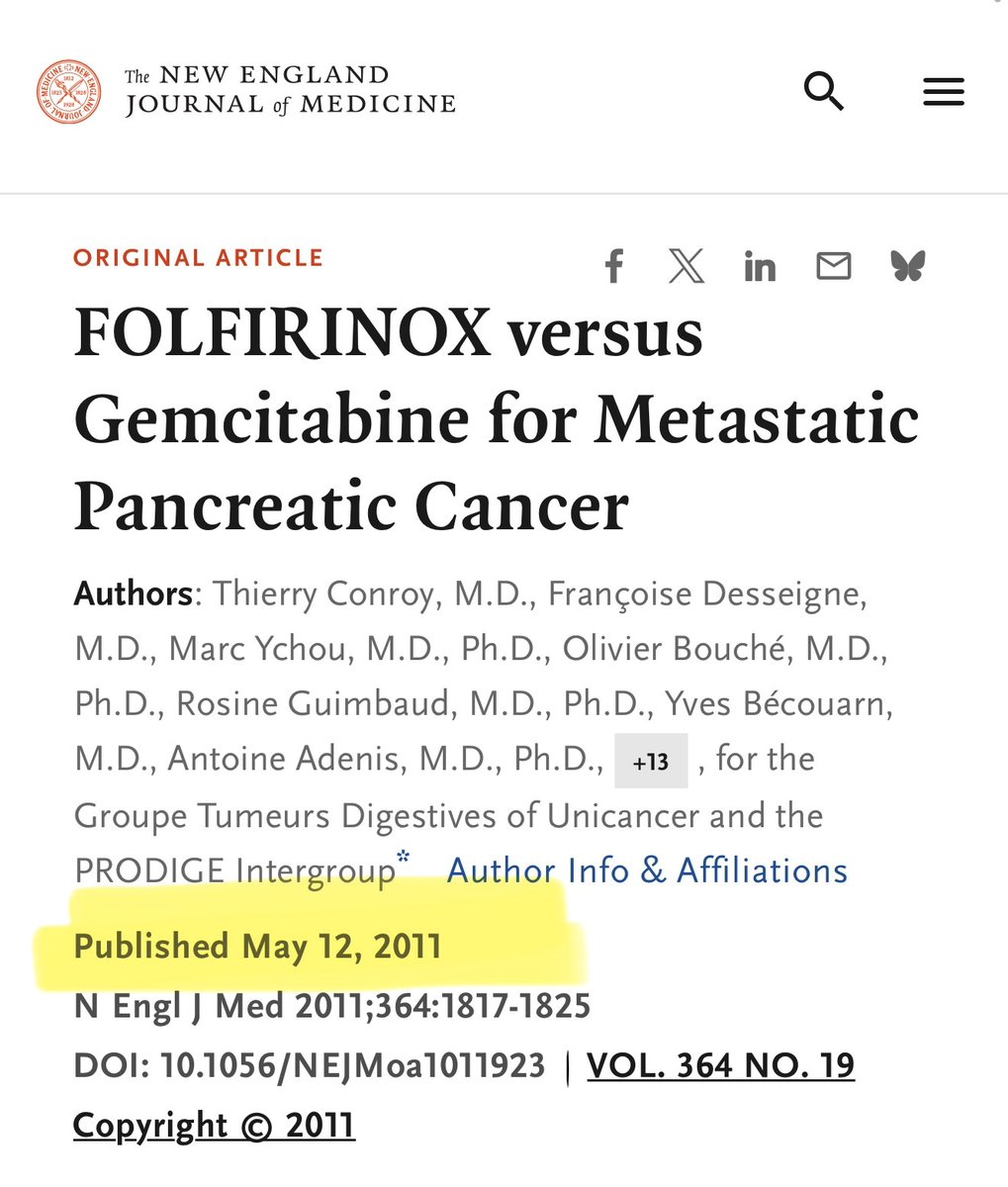
PRODIGE 4 / ACCORD 11 randomized 342 patients with metastatic pancreatic cancer to FOLFIRINOX versus gemcitabine.
The trial reported in 2011.
7/14
pic: RODIGE 4 / ACCORD 11, NEJM, PMID: 21561347
PRODIGE 4 / ACCORD 11 randomized 342 patients with metastatic pancreatic cancer to FOLFIRINOX versus gemcitabine.
The trial reported in 2011.
7/14
pic: RODIGE 4 / ACCORD 11, NEJM, PMID: 21561347
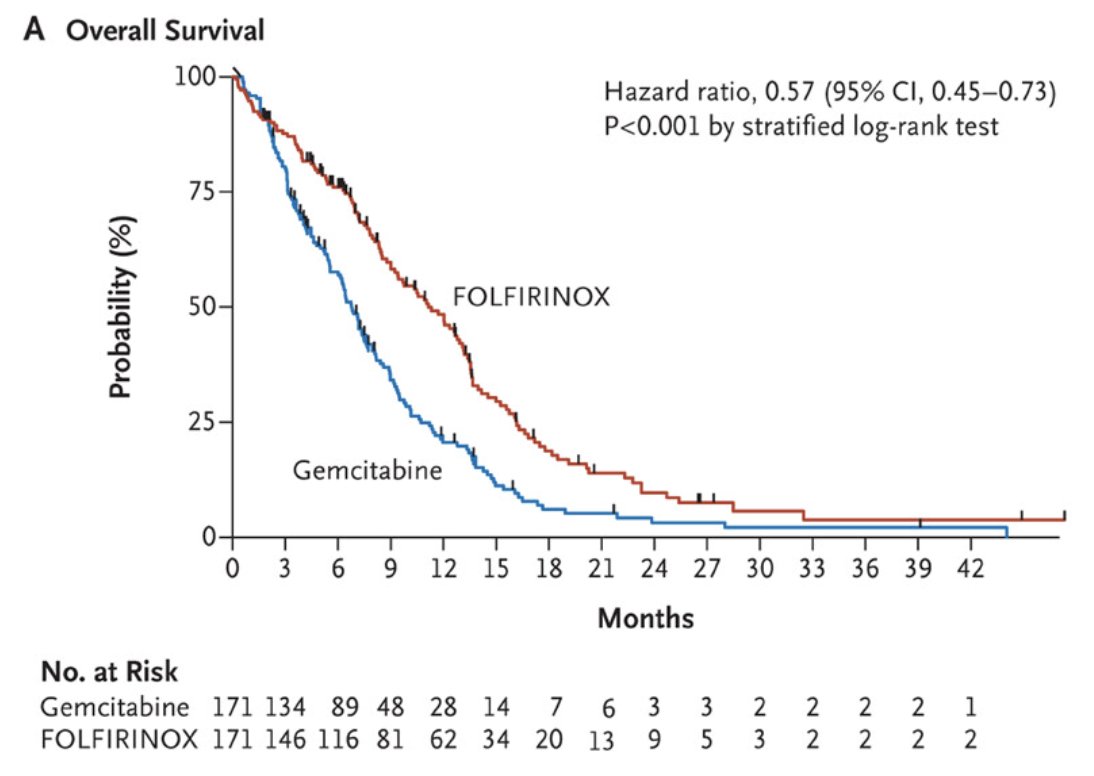
FOLFIRINOX produced an amazing results
mOS 11.1 months vs 6.8 months
ORR 32% versus 9%.
It was the largest single-trial improvement in pancreatic cancer survival ever seen.
8/14
pic: OS in PRODIGE 4 / ACCORD 11, PMID: 21561347
mOS 11.1 months vs 6.8 months
ORR 32% versus 9%.
It was the largest single-trial improvement in pancreatic cancer survival ever seen.
8/14
pic: OS in PRODIGE 4 / ACCORD 11, PMID: 21561347
FOLFIRINOX immediately became the standard of care for metastatic pancreatic cancer in patients with good performance status.
9/14
9/14
Modified FOLFIRINOX (typically omitting the bolus 5‑FU and using a reduced irinotecan dose of 150 mg/m² in PRODIGE 24) became widely used to improve tolerability, including in older or less robust patients.
FOLFIRINOX also moved into the neoadjuvant and adjuvant settings.
10/14
FOLFIRINOX also moved into the neoadjuvant and adjuvant settings.
10/14
For borderline resectable pancreatic cancer, neoadjuvant FOLFIRINOX has become standard as well.
11/14
11/14
For resected pancreatic cancer, adjuvant FOLFIRINOX (PRODIGE 24/CCTG PA.6) reported in 2018 with a median overall survival of 54.4 months in the FOLFIRINOX arm versus 35.0 months with gemcitabine.
12/15
pic: PRODIGE 24, PMID: 30575490
12/15
pic: PRODIGE 24, PMID: 30575490
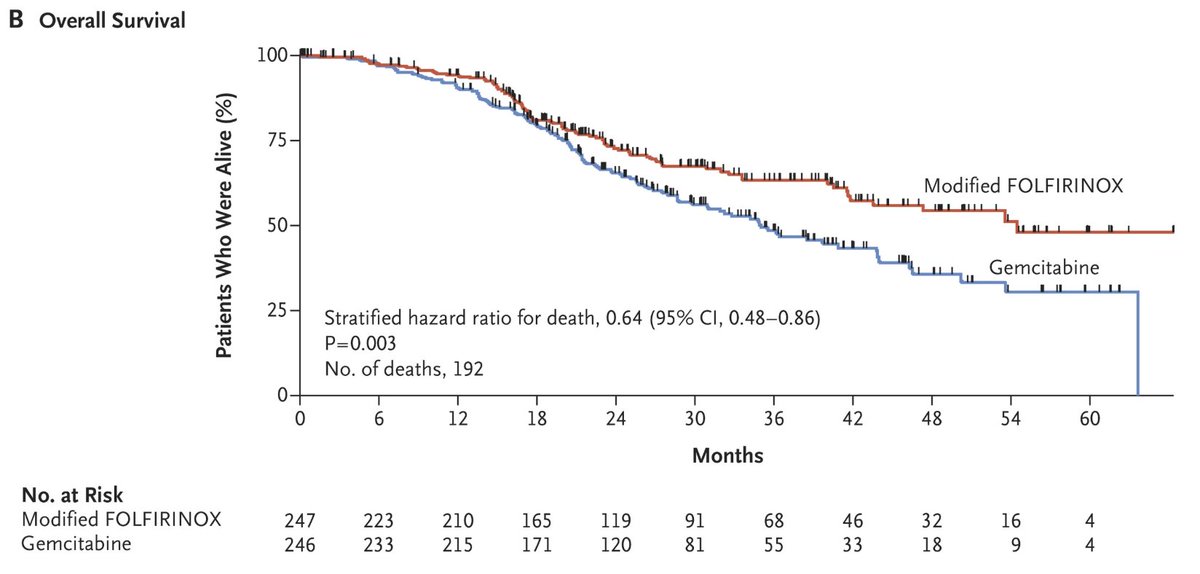
Resectable pancreatic cancer survival, with modern multimodality therapy, now approaches 30 percent at five years for patients who reach surgery.
Pancreatic cancer remains a difficult disease.
It is no longer the same disease.
Conroy continues his work in France. He has been one of the most consequential pancreatic cancer trialists of his generation.
FOLFIRINOX is now a global standard.
It is given in cancer centers from Lyon to Lima to Mumbai.
13/14
Pancreatic cancer remains a difficult disease.
It is no longer the same disease.
Conroy continues his work in France. He has been one of the most consequential pancreatic cancer trialists of his generation.
FOLFIRINOX is now a global standard.
It is given in cancer centers from Lyon to Lima to Mumbai.
13/14
Patients with pancreatic cancer in 2026 are sometimes living three or four years after a diagnosis that, fifteen years ago, gave them six months.
FOLFIRINOX changed pancreatic cancer management.
@ASCO
#OncTwitter #GITwitter
Sources and further reading:
Primary: nejm.org/doi/full/10.10…
Background: en.wikipedia.org/wiki/FOLFIRINOX
14/14
FOLFIRINOX changed pancreatic cancer management.
@ASCO
#OncTwitter #GITwitter
Sources and further reading:
Primary: nejm.org/doi/full/10.10…
Background: en.wikipedia.org/wiki/FOLFIRINOX
14/14
• • •
Missing some Tweet in this thread? You can try to
force a refresh






