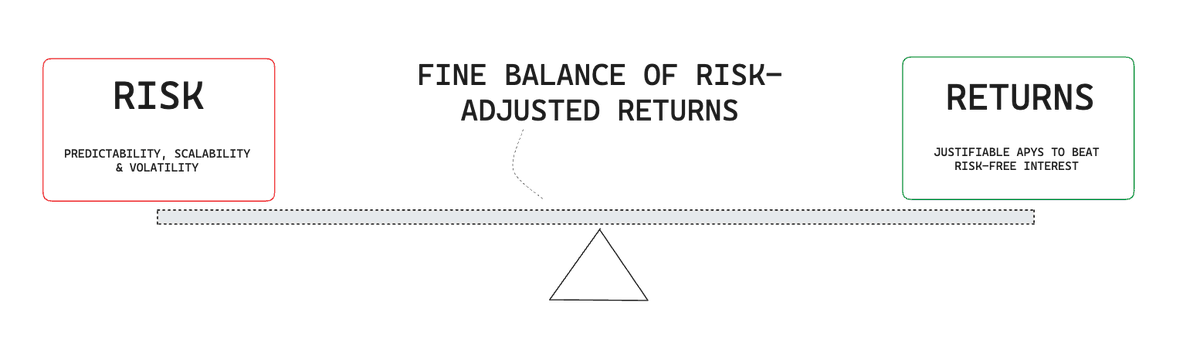
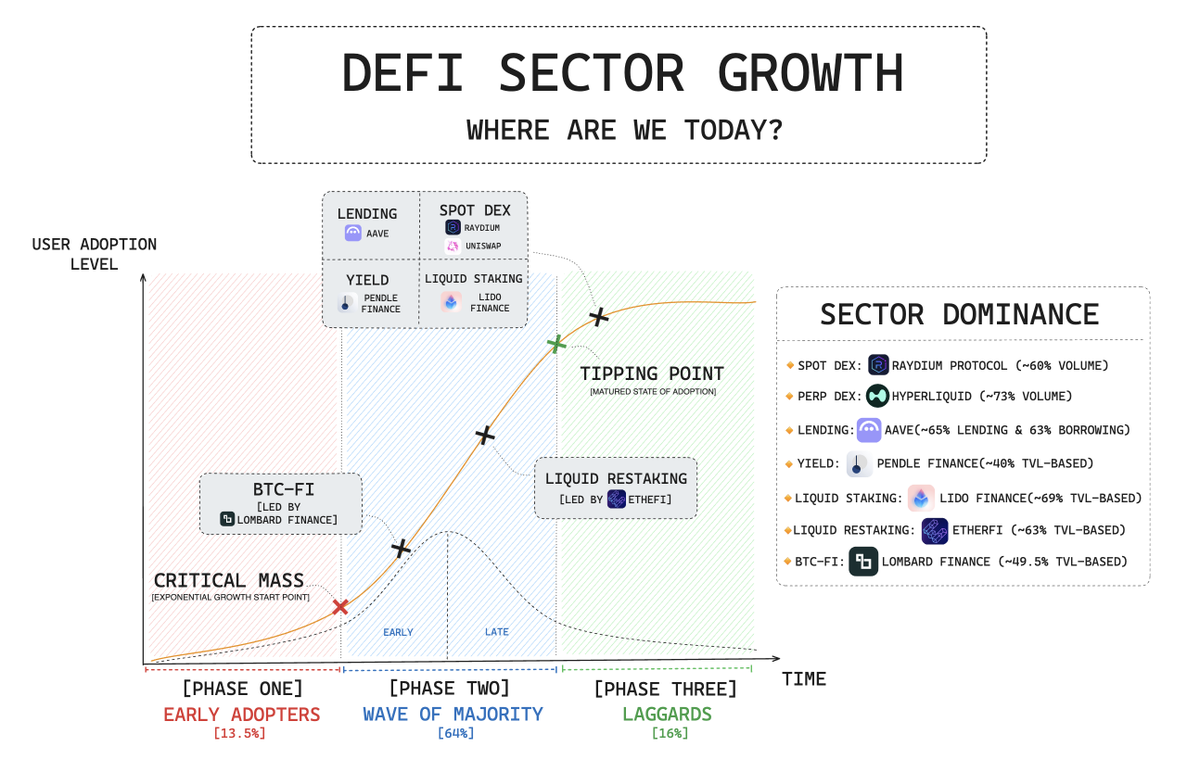
We’ve reached a point where the DeFi credit layer is mature enough to support more advanced credit primitives.
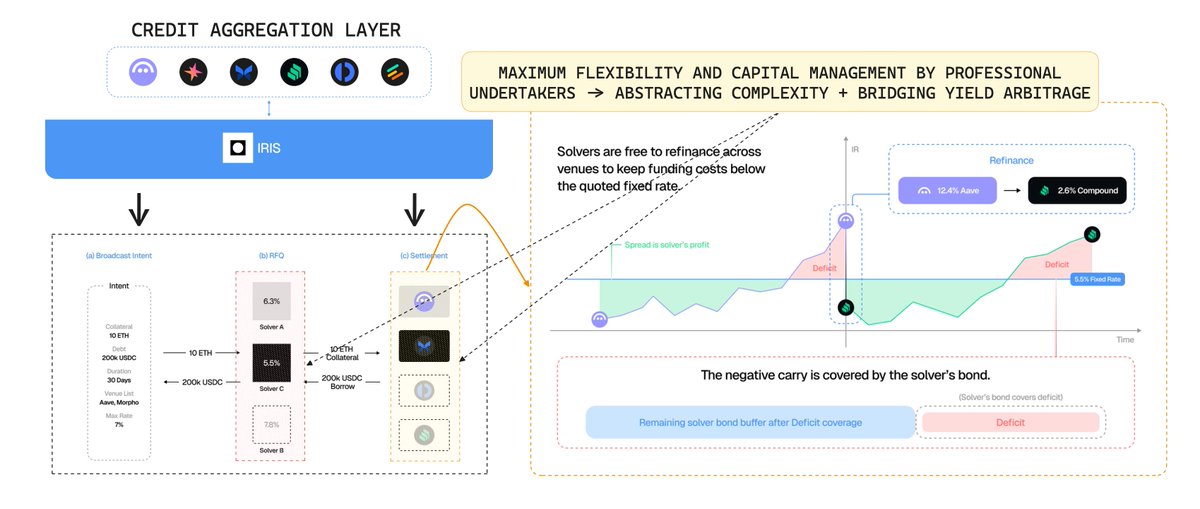
Wanted to highlight @iris_credit here, which introduces a fixed-rate credit aggregation layer powered by solvers.
Fixed rates (as seen in TradFi) are fundamental to predictability in financing costs and long-term capital planning, and this is something DeFi has yet to deliver effectively at scale.
The key innovation lies in the intent-based model, which introduces flexibility and abstraction, allowing solvers to operate without being constrained by rigid, single-venue structures.
This unlocks a workflow much closer to how TradFi institutions manage long-term fixed-rate loans.
Banks don’t fund loans by perfectly matching liabilities with equivalent fixed-rate deposits. Instead, they actively manage liabilities over time via continuously adjusting funding sources to optimise cost + control risk.
That’s exactly what IRIS brings into DeFi.
With IRIS, solvers are no longer bound to a single venue’s rate. They can tap into a broader opportunity set across multiple integrated lending markets.
This fundamentally changes loan pricing.
Rather than anchoring to a static rate at a single point in time, loans are priced based on a solver’s ability to actively manage the liability across its full lifecycle.
That includes:
1. refinancing across venues (illustration eg. in diagram)
2. dynamically rebalancing positions
3. capturing rate differentials wherever they arise
All of which leads to greater capital efficiency and a more optimised cost of funding.
With meaningful lending activity + participation across accredited funds/institutions, it's obvious that the liquidity depth and diversity of robust lending venues provides a plausible environment for IRIS to build on top of this.
You can view this as introducing a meta-layer of aggregation and competition that leverages multi-venue liquidity to push credit markets into their next phase.
This marks the beginning of a broader shift towards a dynamic, actively managed credit system imo.
Disclosure: investor
Wanted to highlight @iris_credit here, which introduces a fixed-rate credit aggregation layer powered by solvers.
Fixed rates (as seen in TradFi) are fundamental to predictability in financing costs and long-term capital planning, and this is something DeFi has yet to deliver effectively at scale.
The key innovation lies in the intent-based model, which introduces flexibility and abstraction, allowing solvers to operate without being constrained by rigid, single-venue structures.
This unlocks a workflow much closer to how TradFi institutions manage long-term fixed-rate loans.
Banks don’t fund loans by perfectly matching liabilities with equivalent fixed-rate deposits. Instead, they actively manage liabilities over time via continuously adjusting funding sources to optimise cost + control risk.
That’s exactly what IRIS brings into DeFi.
With IRIS, solvers are no longer bound to a single venue’s rate. They can tap into a broader opportunity set across multiple integrated lending markets.
This fundamentally changes loan pricing.
Rather than anchoring to a static rate at a single point in time, loans are priced based on a solver’s ability to actively manage the liability across its full lifecycle.
That includes:
1. refinancing across venues (illustration eg. in diagram)
2. dynamically rebalancing positions
3. capturing rate differentials wherever they arise
All of which leads to greater capital efficiency and a more optimised cost of funding.
With meaningful lending activity + participation across accredited funds/institutions, it's obvious that the liquidity depth and diversity of robust lending venues provides a plausible environment for IRIS to build on top of this.
You can view this as introducing a meta-layer of aggregation and competition that leverages multi-venue liquidity to push credit markets into their next phase.
This marks the beginning of a broader shift towards a dynamic, actively managed credit system imo.
Disclosure: investor
also, attaching this insightful post by @0xyanshu outlining the current fixed-yield landscape 👇
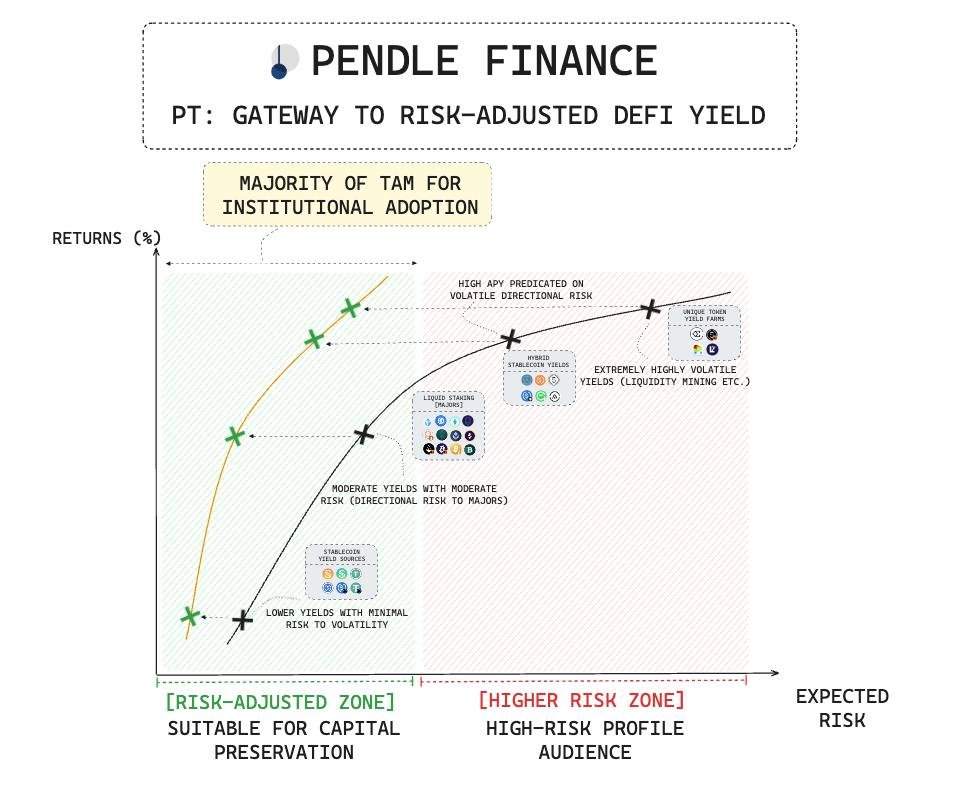
The institutionalisation of PTs from @pendle_fi as a foundational primitive within DeFi is a strong early signal to the prospects of 'fixed yield'.
It's only a matter of time fixed yield dynamics advance.
The institutionalisation of PTs from @pendle_fi as a foundational primitive within DeFi is a strong early signal to the prospects of 'fixed yield'.
It's only a matter of time fixed yield dynamics advance.
https://x.com/0xyanshu/status/2053527820731863284
Feel free to check out, website just went live⬇️
https://x.com/iris_credit/status/2054559157878190477
• • •
Missing some Tweet in this thread? You can try to
force a refresh