Jamie Clark Profile picture
May 14 9 tweets 2 min read Read on X
1/ Not all retrieval practice is equal.

A 2025 study compared two modes most teachers use without thinking about them.

The difference in outcomes is worth knowing. 🧵
2/ Overt retrieval: writing, typing, or saying your answer out loud.

Covert retrieval: thinking through the answer silently in your head.

One approach produced significantly better retention than the other.
3/ Overt retrieval consistently outperformed covert retrieval — particularly for complex material like definitions and multi-part concepts.

The reason is that students doing covert retrieval tend to stop too early.

A partial sense of "I know this" substitutes for actually retrieving the full thing.
4/ This matters more than it sounds.

When you ask a class to think of an answer before taking responses, most students are doing covert retrieval.

And many of them are stopping short of complete recall. So, before taking answers, give them time to think and write it down first.
5/ There's a twist though…

Covert retrieval was more efficient — more learning per minute of practice.

So the best strategy depends on what you're optimising for: maximum retention, or time efficiency.
6/ The practical implication for teachers:

If the content is complex — definitions, multi-part concepts, interconnected ideas — build in structures that require a complete response.

Whiteboards. Written answers. Cold calling. Anything that requires a complete response, not just a feeling of knowing.

But if the content is simpler, covert retrieval may be sufficient — and more time-efficient.
7/ One underrated finding: students consistently overestimate how much they've recalled during covert retrieval.

Teaching them to check their response against a worked answer — part by part, not just the overall feeling of knowing — significantly reduced that overconfidence.
8/ Overall:

A student quietly thinking "yeah, I know that" is not the same as retrieving it.

Overt or covert — the choice shapes how deeply students actually process the material. Worth being deliberate about it.
9/ Source:

Rivers, M.L., Northern, P.E. & Tauber, S.K. (2025) 'Does Retrieval Demand Moderate the Effectiveness of Covert Retrieval Practice?'

Worth a read if retrieval practice is part of your practice.

bit.ly/4daxOqa

• • •

Missing some Tweet in this thread? You can try to force a refresh

 

Keep Current with Jamie Clark

Jamie Clark Profile picture

Stay in touch and get notified when new unrolls are available from this author!

Read all threads

This Thread may be Removed Anytime!

PDF

Twitter may remove this content at anytime! Save it as PDF for later use!

Try unrolling a thread yourself!

how to unroll video
  1. Follow @ThreadReaderApp to mention us!

  2. From a Twitter thread mention us with a keyword "unroll"
@threadreaderapp unroll

Practice here first or read more on our help page!

More from @XpatEducator

May 13
1/ Retrieval practice works best when teachers apply it thoughtfully and reflectively rather than treating it as a mandated "one-size-fits-all" technique.

Strong evidence. Patchy practice. Here's where the gaps are. 🧵
2/ Task complexity.

Retrieval works well for foundational knowledge. For highly complex tasks — where students must hold many interacting elements in mind simultaneously — it can stall or even inhibit learning without appropriate scaffolding.

Complexity changes the equation.
3/ Prior knowledge.

Difficulty is only desirable when it's within reach. The same retrieval task that consolidates learning for one student may be cognitively inaccessible for another.

Getting that level right — for each student — is the hard part.
Read 8 tweets
Apr 12, 2025
WHY INQUIRY-BASED APPROACHES HARM STUDENTS’ LEARNING

🧵A thread translating John Sweller’s key insights from his 2021 paper into practical takeaways.

⚠️ SPOILER: Explicit instruction isn’t just more efficient—it’s essential.

cis.org.au/wp-content/upl…
FALLING RESULTS, RISING INQUIRY

Sweller says Australia’s rankings on international tests have been falling concurrent with an increased emphasis on inquiry learning.

Translation: Over-relying on student-led discovery may be doing more harm than good.
HUMAN COGNITIVE ARCHITECTURE

Sweller says we learn in two ways:

1. Biologically Primary knowledge (e.g., talking) – automatic
2. Biologically Secondary knowledge (e.g., algebra) – needs explicit teaching

Translation: Don’t assume students will just “pick it up.” They won’t.
Read 11 tweets
Sep 15, 2024
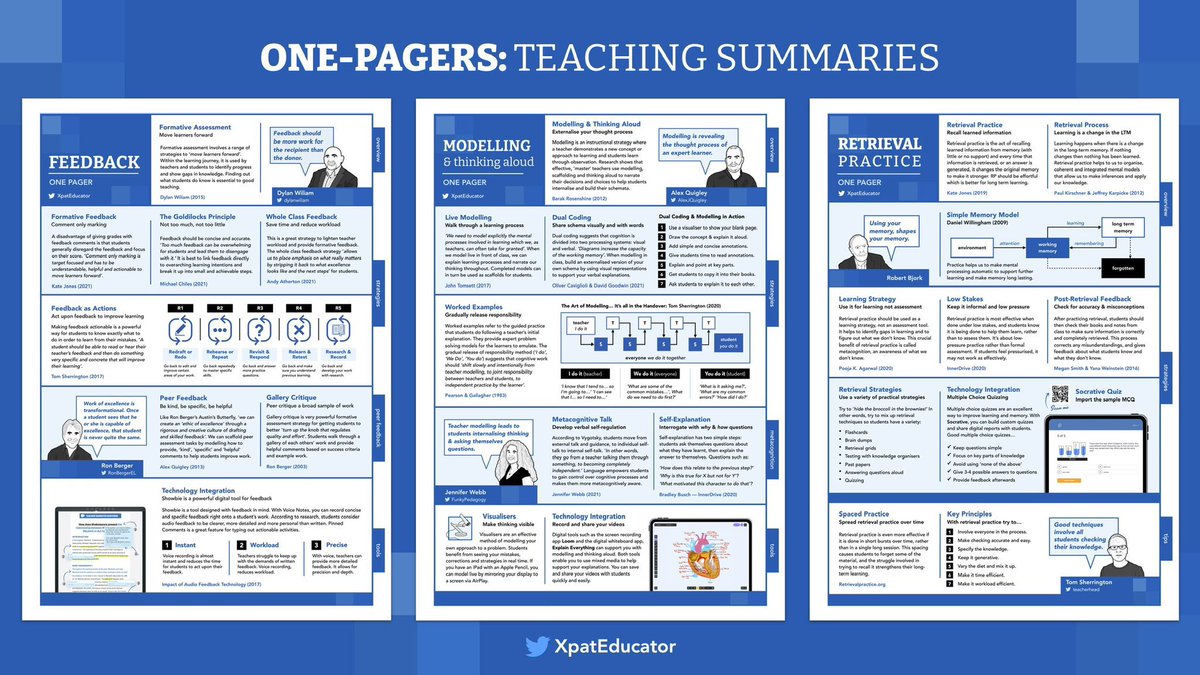
🧵 THREAD! Since introducing these one-pagers in my school in 2022, I’ve seen teachers’ engagement with evidence informed ideas sky-rocket. Teachers are time-poor, so distilling important ideas into an easily digestible format offers a practical solution. Here are 7 ways one-pagers support educators…Image
1/ WIDER READING: One-pagers spotlight the most important evidence-informed ideas and inspire wider reading. Our teachers have been able to focus on deeper exploration at a later date and learn at their own pace.
2/ BUILD KNOWLEDGE: One-pagers serve as a practical tool to introduce or refresh pedagogical knowledge. They have proved to be invaluable for teachers at all experience levels.
Read 12 tweets
Sep 2, 2024
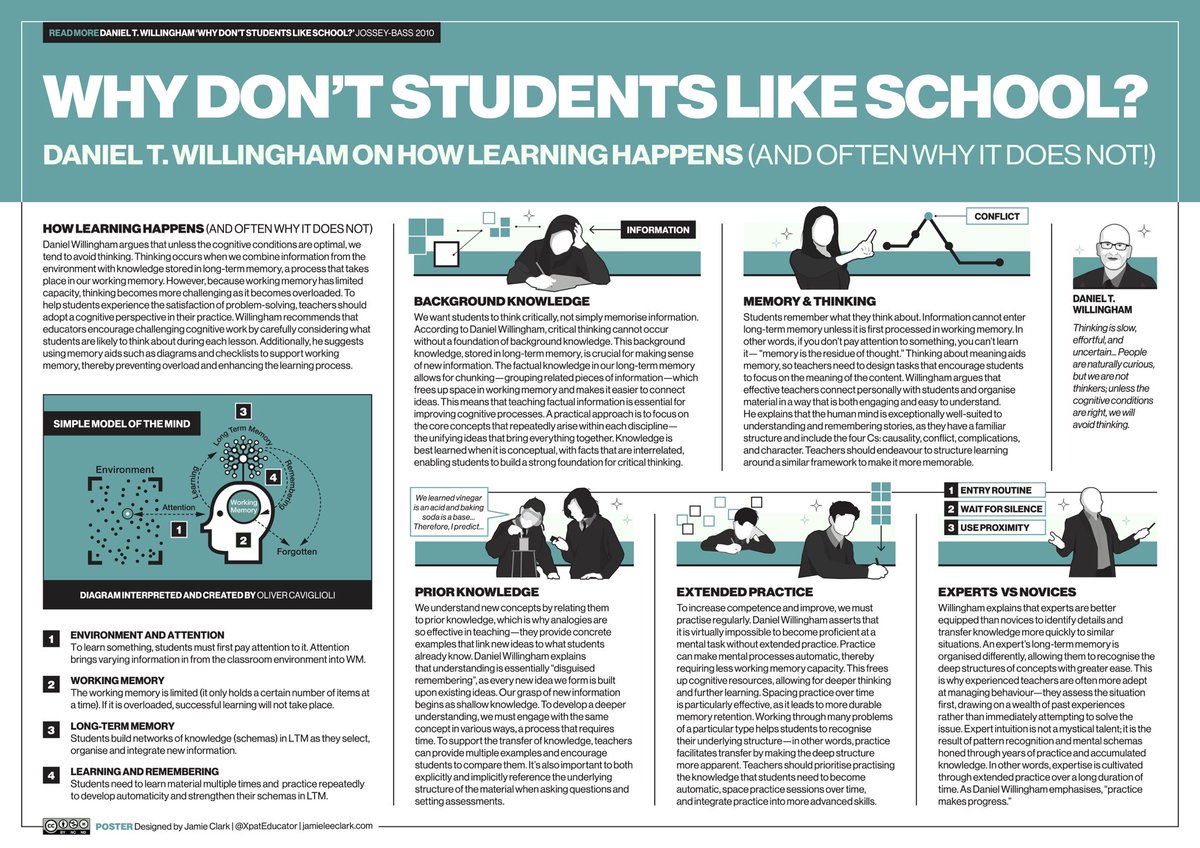
🧠 ‘Why Don’t Students Like School?’ by Daniel Willingham is one of the most influential books for teachers on cognitive science. It explores how students’ minds work and how to use this knowledge to be a better teacher.

🧵THREAD! Here are some of my main takeaways…

Thanks again to @olicav for the excellent learning and memory diagram! 🙌Image
🧠 WM has limited space and thinking becomes increasingly difficult as it gets crowded. ‘Unless the cognitive conditions are right, we avoid thinking.’ Teachers should promote challenging cognitive work by reviewing each lesson in terms of what students will THINK about.
🧠 ‘Background knowledge from our LTM helps us to make sense of new information’. Knowledge is best learned when it is conceptual and facts are interrelated. A practical way to do this is to get students to learn the unifying ideas of each discipline - the most common concepts.
Read 8 tweets
May 15, 2024
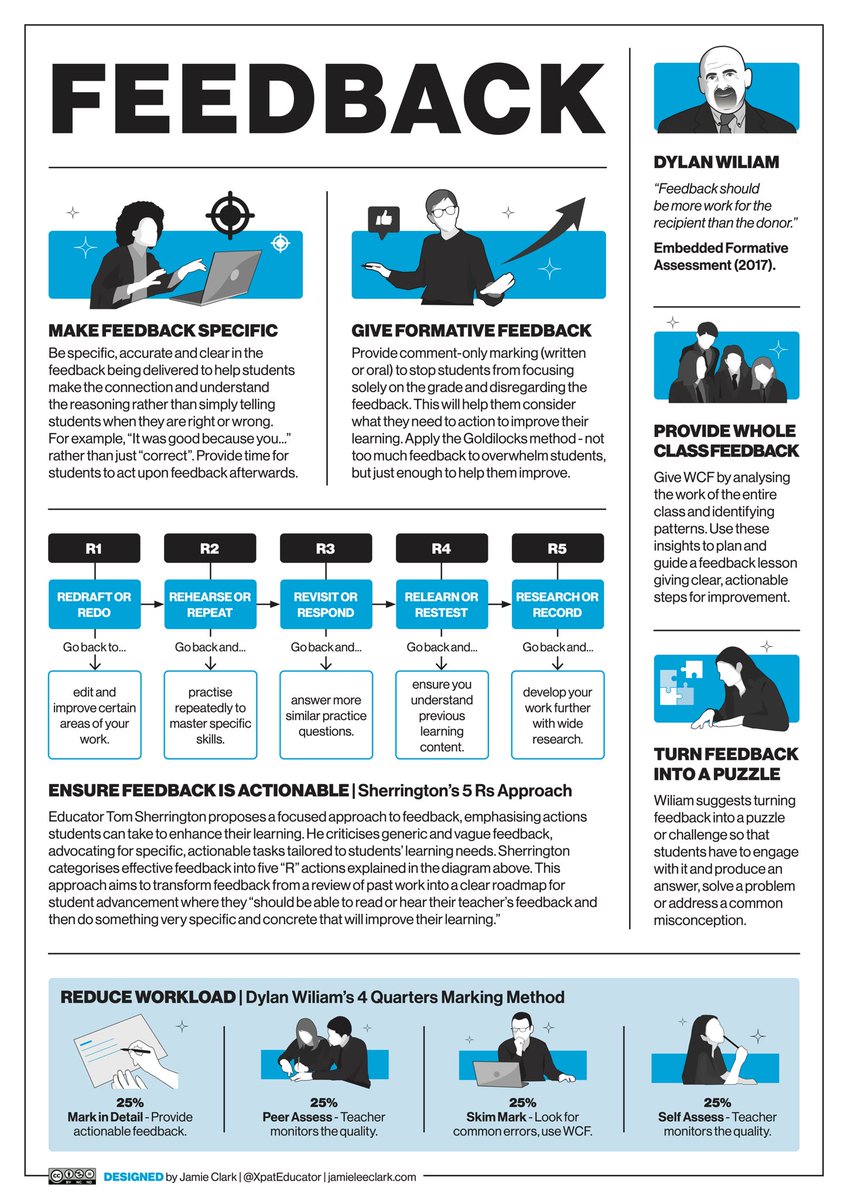
🧵 FEEDBACK! Feedback should guide students toward improvement, be clear and specific, and encourage action. Here's a breakdown of key strategies to make the feedback process more impactful and move students forward!

Get the FREE one-pager: jamieleeclark.com/graphics
Image
🎯 **Make Feedback Specific**: Avoid generic comments like "good work" or "needs improvement." Be precise and clear. For example, “Your analysis is strong because you used…” This approach helps students understand exactly what they did well or need to improve.
🔍 **Make Feedback Understandable, Helpful, and Actionable**: @KateJones_teach explains that teacher must ensure students grasp the feedback and know how to improve.

1. Understandable: Do pupils understand the feedback? Do they understand what they need to do to improve?

2. Helpful: If the feedback isn't helping the learner move forwards and progress with their learning, then the feedback is not effective.

3. Actionable: Can pupils act on the feedback? Teachers should provide a task and time to respond and act on all feedback provided.
Read 14 tweets
Apr 24, 2024
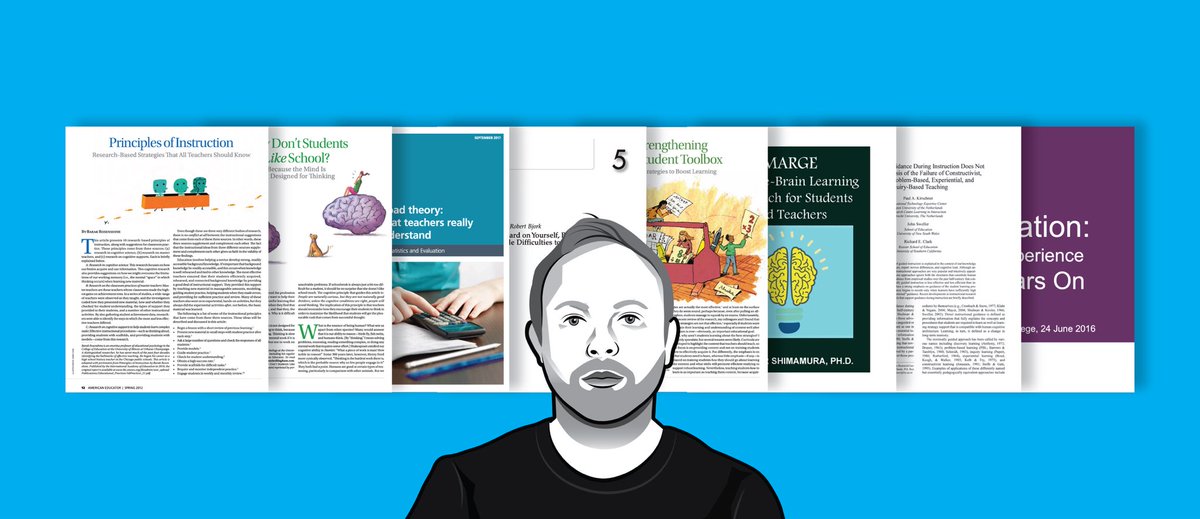
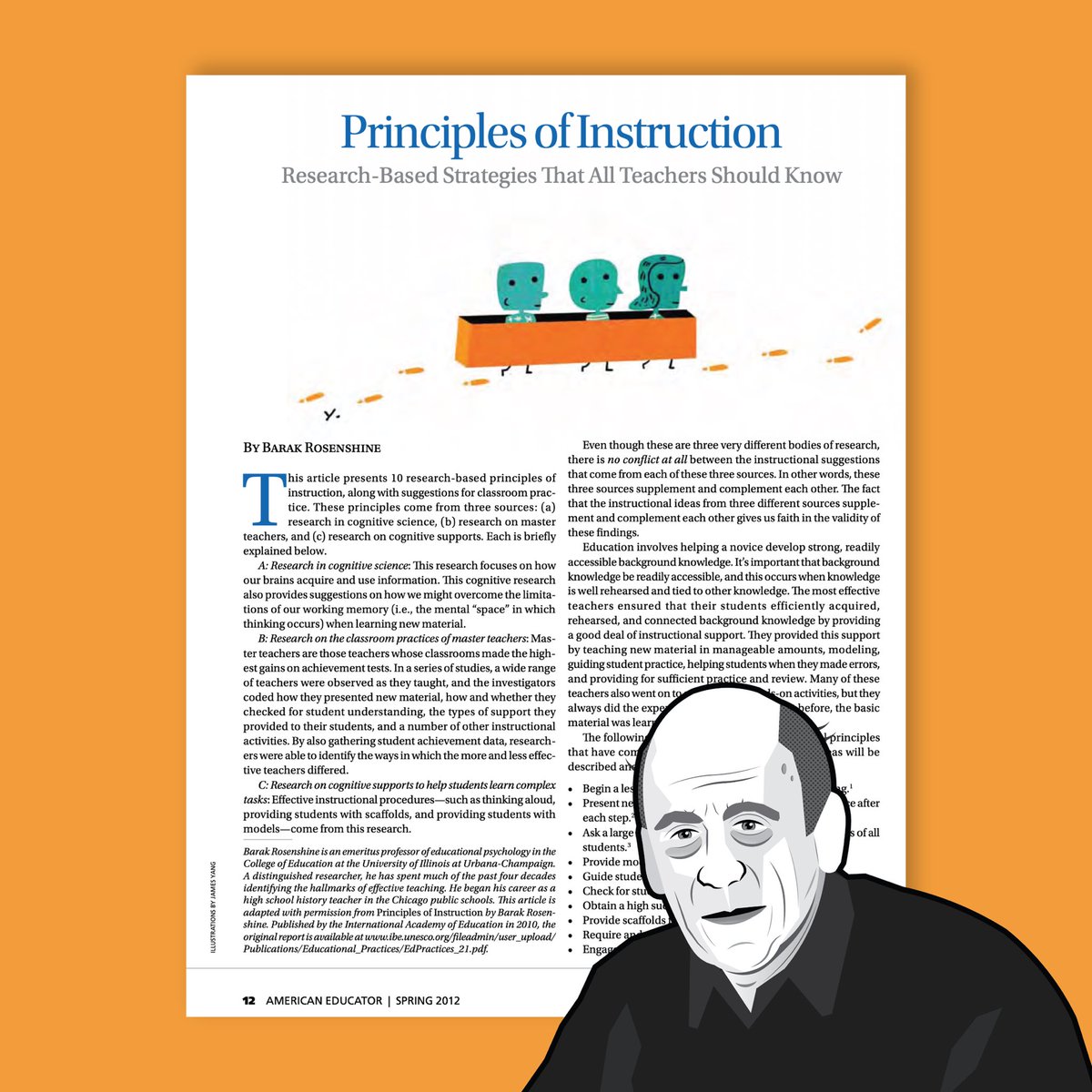
**🧵** Being evidence-informed involves blending insights from various educational research. Here’s a list of my favourite papers and reports that can help to refine and improve classroom instruction. Image
🪜 Principles of Instruction: Research Based Strategies That All Teachers Should Know by Barak Rosenshine

In 2012, Rosenshine formulated ten key principles, which he argued underpin any effective approach to instructional teaching.

aft.org/sites/default/…
Image
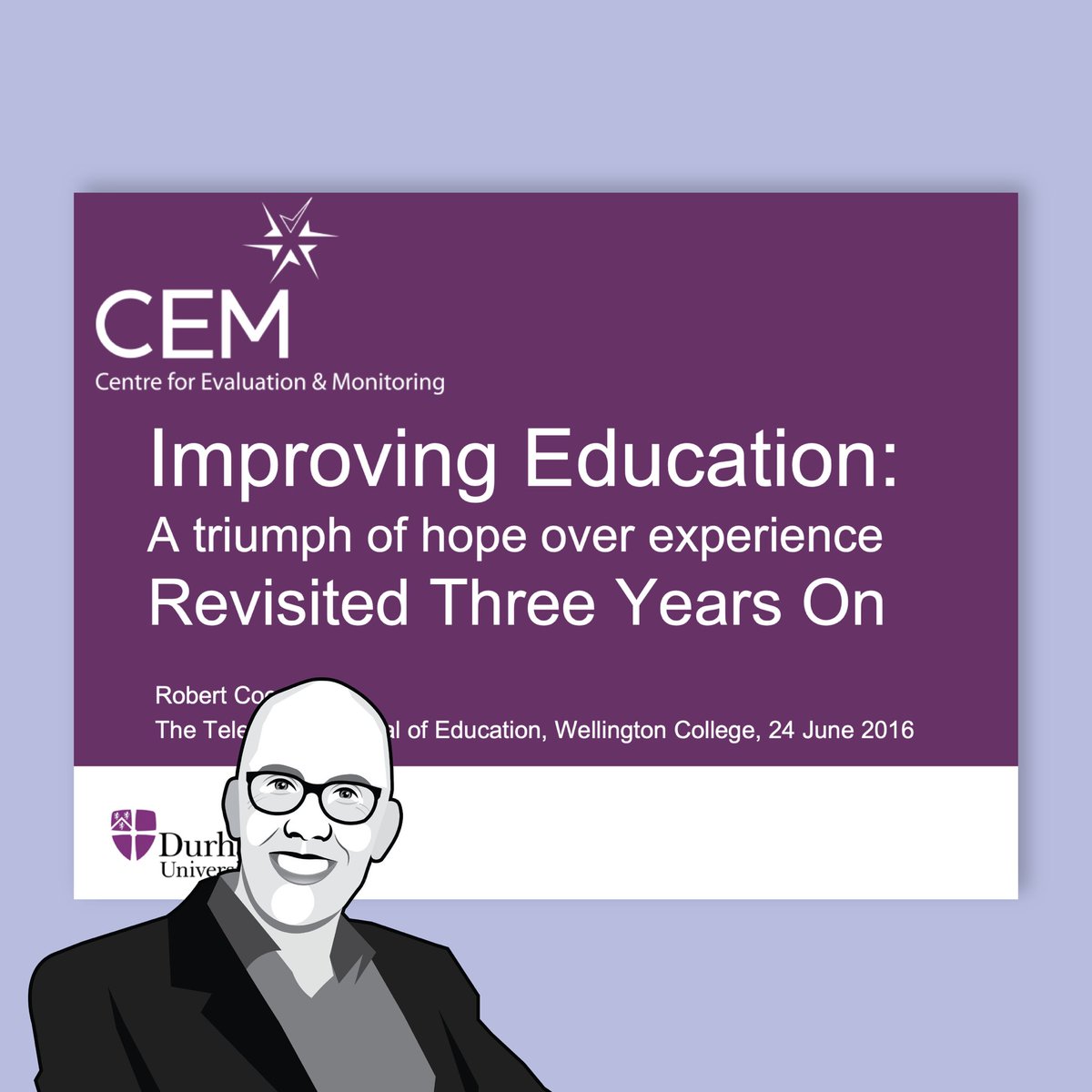
Improving Education: A Triumph of Hope Over Experience (Inaugural Lecture Slides) of @ProfCoe

Coe outlines a series of ‘poor proxies for learning’ that, even now, offer a reminder of prioritising task design and compliance over ‘thinking hard’.

f.hubspotusercontent30.net/hubfs/5191137/…
Image
Read 9 tweets

Did Thread Reader help you today?

Support us! We are indie developers!


This site is made by just two indie developers on a laptop doing marketing, support and development! Read more about the story.

Become a Premium Member ($3/month or $30/year) and get exclusive features!

Become Premium

Don't want to be a Premium member but still want to support us?

Make a small donation by buying us coffee ($5) or help with server cost ($10)

Donate via Paypal

Or Donate anonymously using crypto!

Ethereum

0xfe58350B80634f60Fa6Dc149a72b4DFbc17D341E copy

Bitcoin

3ATGMxNzCUFzxpMCHL5sWSt4DVtS8UqXpi copy

Thank you for your support!

Follow Us!

:(