"AI is hiking your energy bill" is the most popular political talking point of 2026. The data doesn't support it. A thread:
I sorted 50 states into data center intensity quintiles. States with the highest datacenter energy share (Q5) VA, TX, NV, IA, OR, AZ... collectively have the lowest and slowest rising mean residential energy prices
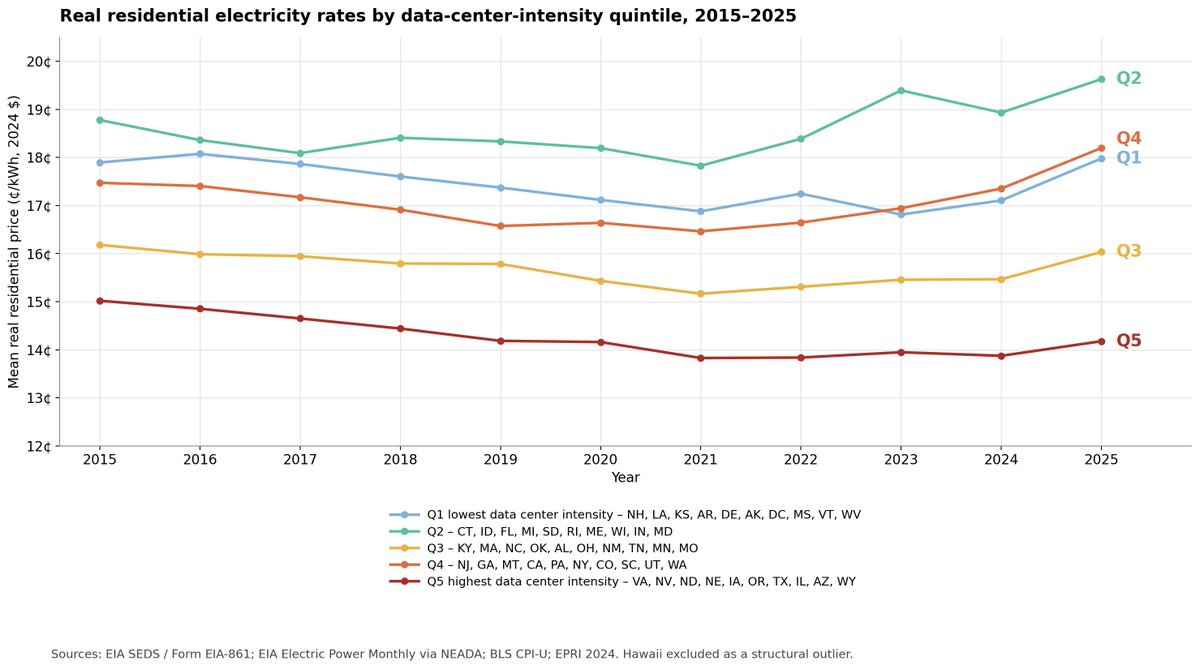
"but I live in one of those states and my bill went up" – in nominal dollars. in real terms, bills are down in the most datacenter-intense states.
it's inflation, not AI, which is driving up energy prices.
Case study: Texas
ERCOT's large flexible load capacity went from ~1.2 GW (2018) to ~9.5 GW (2025) – a gargantuan AI + crypto buildout.
Real residential prices barely moved. Cheap natgas, huge solar/wind/battery additions, and behind-the-meter campuses absorbed almost all of it.
Now zoom into the top 10 AI datacenter states.
Real rates ARE ticking up in 2025 – especially in PJM (OH, VA). That's where the buildout is finally starting to bite.
But the magnitude is small, and most of these states still sit well below the US average.
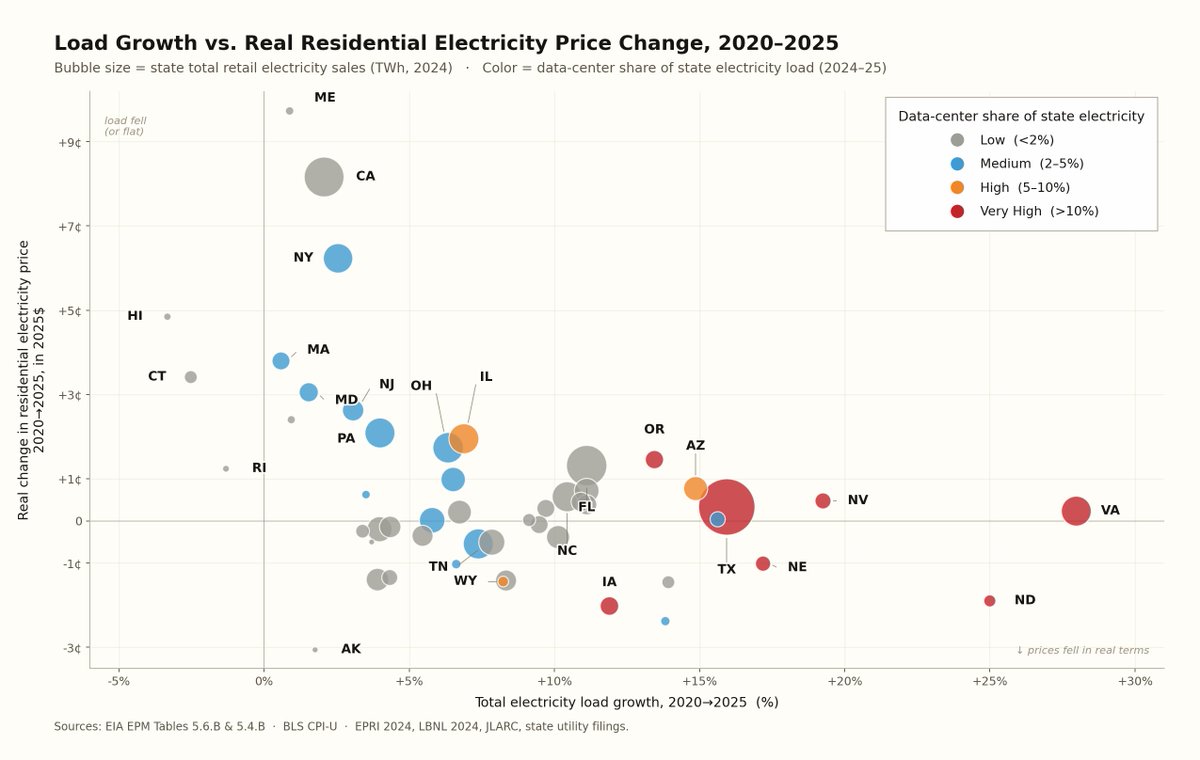
This is the single most important chart.
If AI were driving prices, you'd see a cluster top-right. You don't.
States with huge load growth (VA, TX, NV, ND, IA) sit at ~0c change in 5y. States with massive price hikes (CA, NY, MA, CT) have basically NO load growth.
AI is also getting more efficient.
For a fixed unit of intelligence, energy per query has fallen ~200x in 3.5 years (conservative estimate)
Aggregate demand is still climbing, yes. (cc Jevons) But intelligence is getting cheaper faster than any commodity in modern history.
If not AI, then what?
Politics.
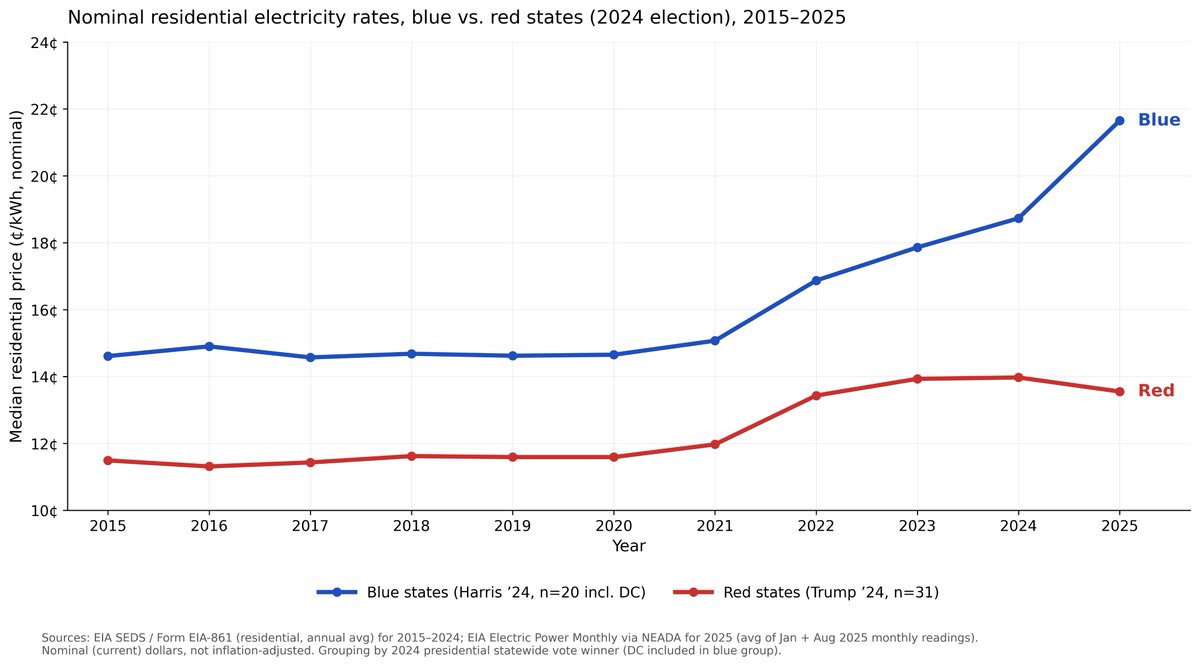
Blue states pay ~6c/kWh more than red states, and the gap is widening.
Denuclearization, blocked pipelines, rigid renewable mandates, NIMBYism, expensive union labor – these are stated policies, not market forces and not AI.
States with lots of datacenters have cheap power, and datacenters go to cheap states.
Blue states have costly power because they are pursuing climate transitions, have NIMBY dynamics, and don't build pipelines & deprecate nuclear.
Biggest real price hikes since 2019: CA, RI, DC, CT, ME, NY, MD, MA. All blue. All low data-center exposure.
Falling real prices: mostly red, many with heavy data centers.
AI isn't (yet) the villain. Policymakers complaining about AI might be.
Full writeup and complete methodological information for every chart available here:
AI datacenters don't cause high electricity prices
Democrats cause high electricity prices.
the above chart is obviously too highly compressed to be useful but you can visually sanity-check the data here. data center load doesn't really correlate with residential rates. politics does.
sources, assumptions caveats for top chart:
Sources
- Residential electricity prices, 2015–2024: EIA State Energy Data System (SEDS) Table ET3, residential electricity column (ultimately Form EIA-861). Final values, last revised October 2025 release.
- Residential electricity prices, 2025: EIA Electric Power Monthly, monthly state retail prices (Form EIA-861M), compiled in NEADA's Nov 2025 Energy Price Update
- State grouping: 2024 presidential election statewide results
Assumptions
- Nominal (current-year) ¢/kWh – no CPI adjustment
- 2025 estimate = (Jan 2025 + Aug 2025) / 2, used as a midpoint proxy for the calendar-year average
- DC included in blue group; ME and NE grouped by statewide outcome (ME→Harris, NE→Trump), ignoring split electoral votes.
- Group line = median of member states (resistant to Hawaii ~40¢ and California ~30¢ outliers).
Caveats
- 2025 figures are not final EIA annual data; final releases October 2026. Could revise ±0.3¢/kWh per state.
- Residential price = total residential revenue ÷ total residential kWh sales. Mixes generation, delivery, taxes, riders, regulated and competitive supply.
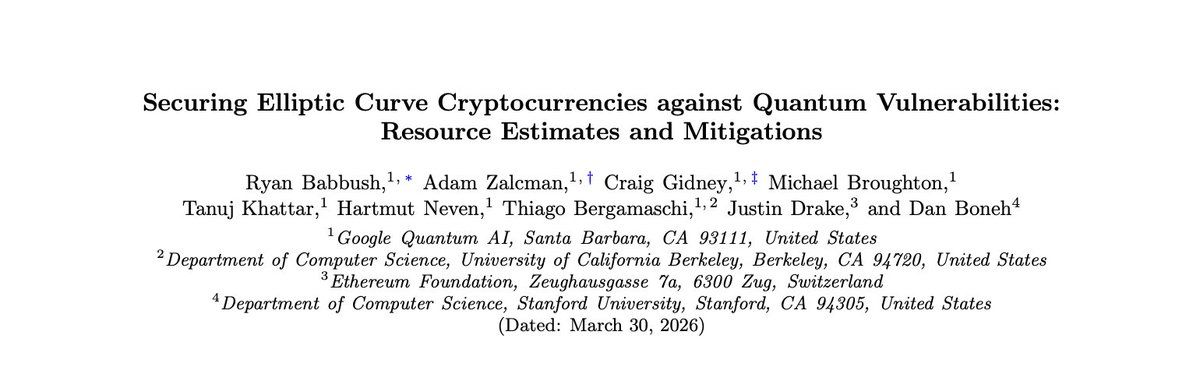
Specifically, this paper. It's a brand new resource estimate that's wildly lower than prior estimates of what it would take to break ECC-256. Featuring the Google Quantum AI team + Justin Drake + Dan Boneh
Situational Awareness LP 13F filing for Q3 dropped friday:
- Massive >$500m new CRWV position
- Big adds to CORZ and IREN
- Added new miners RIOT, HUT, BITF
- INTC calls unch
- trimmed AVGO & EQT, exited APLD / CEG / CIFR
- added new AI infra LITE, COHR, MOD, WDC, STX
(all of these numbers as of 9/30, many of these names sold off since then)
portfolio value counting notional value of options doubled from $2.12b to $4.15b, mostly due to $1.5b of new cash injection, appreciation ~$700m
TDLR massive new CRWV position (plus added puts and calls, but overall very very long CRWV). big adds to CORZ, IREN, RIOT. added AI adjacent names LITE, COHR, MOD, and storage WDC and STX. added smaller BTC miner names.
the most important thinker in AI, in my opinion, is this 23 year old. leo aschenbrenner.
he has been more right, both in a testable predictive sense and in a market sense than virtually anyone else.
and most importantly, he's not an AI doomer, he's not an e/acc, but rather a secret third thing.
leo was a reseacher on the openai superalignment team before he was fired in april 2024 (and before that, he worked at FTX of all places). in june 2024 he published an astonishing essay on AI called "Situational Awareness: The Decade Ahead"
in the 165-page essay (really, more of a book) he predicts that we will obtain recursively self-improving AI by 2027, leading to an intelligence implosion & AGI. he thinks AI will become a matter of national security and that the US has no choice but to beat China. he thinks we will have full-fledged agents in 2026. he thinks AI efforts will and should be nationalized. he thinks we will build trillion-dollar datacenters before the decade is out. he thinks AI will use 20%+ of US electricity by 2030.
a lot of his analysis is based on simply extrapolating straight lines into the future (compute, FLOPs, model capabilities). the thing is, this has totally held up.
agreed. it can be fixed sans soft fork for anyone that's live on the network, but old/abandoned coins in vulnerable addresses (p2pk, reused p2pkh) are at risk. no easy way to fix. some quantum timelines have a break by 2030.
and yes bitcoin is more vulnerable than other systems that rely on cryptography, because they can be upgraded to post quantum encryption whereas there's millions of coins in old addresses (assumed lost/inactive owners) which are fundamentally at risk.
basically you have to make your peace with the fact that there's a 2-6m BTC (aka $200b-600b) prize waiting to be claimed by the first entity to achieve quantum supremacy. the other alternative is getting everyone to agree to pre-emptively burn/steal the coins which is unpalatable
unfortunately the yale academics are at it again and are trying to gaslight everyone into thinking that debanking crypto didn't happen. it did, everyone dealt with it, everyone knows it, and the evidence is excruciatingly clear. full treatment soon
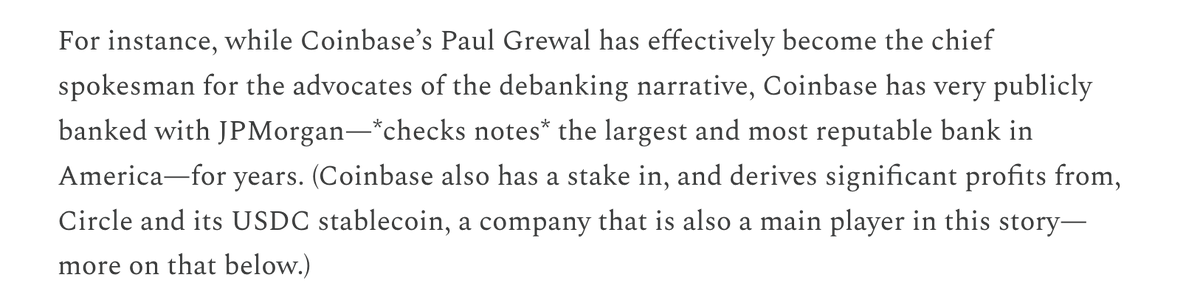
1. Steven points out that Coinbase has banking. Yes. They actually have had struggles with banking and are only really around today because a16z had to intervene to ensure they had bank access prior to 2020 when they landed the JPM relationship. One of the reasons Coinbase emerged as the winner in the US is precisely because they had better bank relationships than others. It proves our point that banking is a weird thing that determines winners and losers in crypto, and it shouldn't be that way.
But that's not really what we're complaining about. Coinbase is the largest and most credible crypto firm in the US, they are publicly traded. Obviously they're able to get banking. It's everyone else that has suffered. Especially startups, who aren't able to easily make the case that they are a valuable relationship to a bank that's already leery of banking crypto / facing pressure from regulators. Coinbase being adequately banked is largely irrelevant.
2. Steven says the FDIC showed favoritism to crypto banks SVB and SBNY by making depositors whole. This is silly. First of all, there was a massive regional banking crisis going on, and the FDIC had to step in to stop the run. SVB in particular was systemic to US tech and startups. They had to be saved or most of the dynamism in our tech sector would have evaporated overnight. Saving them was the right decision. They also only had one (1) crypto client, Circle.
SBNY are a different story. They had more crypto clients. But they were not shown favoritism. Arguably, they were executed for serving crypto. That's what the board member Barney Frank alleges. They were sent into receivership on a sunday night without being given a chance to raise capital and save themselves. Also, when they were sold to Flagstar, all their crypto related deposits and IP (Signet) were stripped out. The resolution of SBNY shows no preference towards crypto, only animosity. The refusal to transfer the crypto business was one of the most obvious signs in early 2023 that something was amiss.