Public blockchains make financial activity easy to verify, but also easy to trace.
@zano_project is built around a private-by-default financial infrastructure with verifiable accounting:
🔹 Privacy enforced at protocol level
🔸 Confidential financial infrastructure
A technical deep dive into Zano 🧵
@zano_project is built around a private-by-default financial infrastructure with verifiable accounting:
🔹 Privacy enforced at protocol level
🔸 Confidential financial infrastructure
A technical deep dive into Zano 🧵

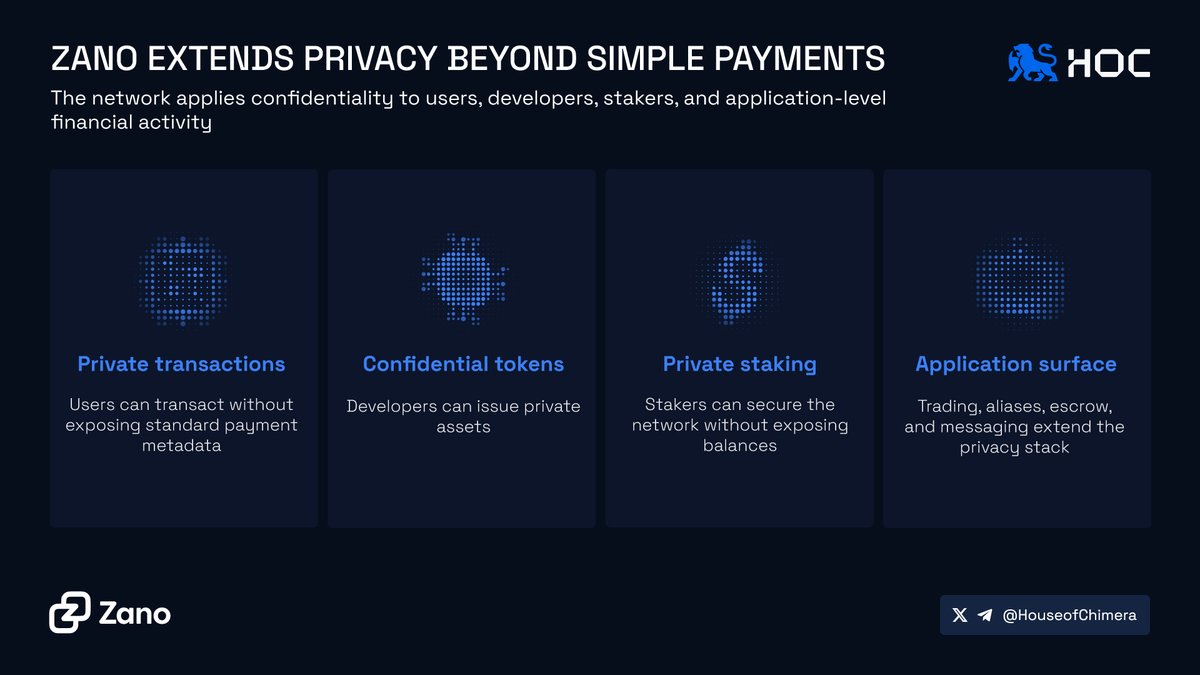
Zano is not only a privacy payment chain.
🔹 Users can transact privately
🔸 Developers can issue confidential tokens
🔹 Stakers can secure the network privately
🔸 Apps can build around private trading, aliases, escrow, and messaging
The broader thesis is private financial infrastructure.
🔹 Users can transact privately
🔸 Developers can issue confidential tokens
🔹 Stakers can secure the network privately
🔸 Apps can build around private trading, aliases, escrow, and messaging
The broader thesis is private financial infrastructure.
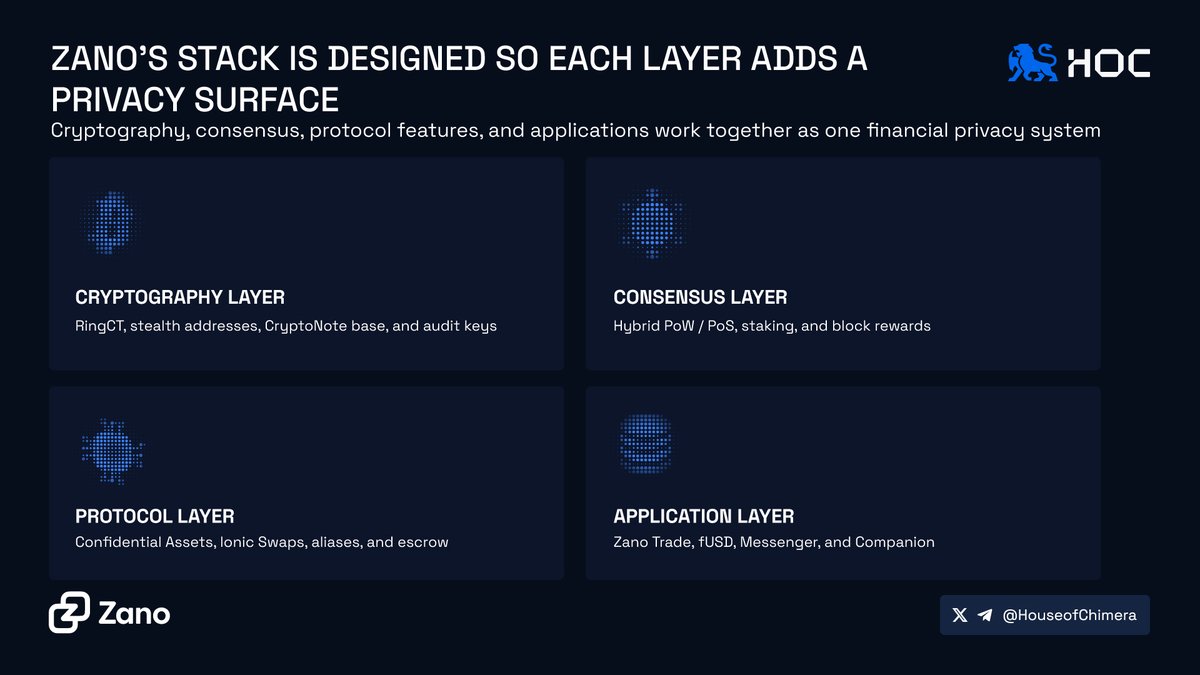
Zano’s architecture is organized across four layers.
🔹 Cryptography: RingCT, stealth addresses, CryptoNote base, audit keys
🔸 Consensus: hybrid PoW/PoS, staking, block rewards
🔹 Protocol: Confidential Assets, Ionic Swaps, aliases, escrow
🔸 Apps: Zano Trade, fUSD, Messenger, Companion
Each layer adds a privacy surface.
🔹 Cryptography: RingCT, stealth addresses, CryptoNote base, audit keys
🔸 Consensus: hybrid PoW/PoS, staking, block rewards
🔹 Protocol: Confidential Assets, Ionic Swaps, aliases, escrow
🔸 Apps: Zano Trade, fUSD, Messenger, Companion
Each layer adds a privacy surface.
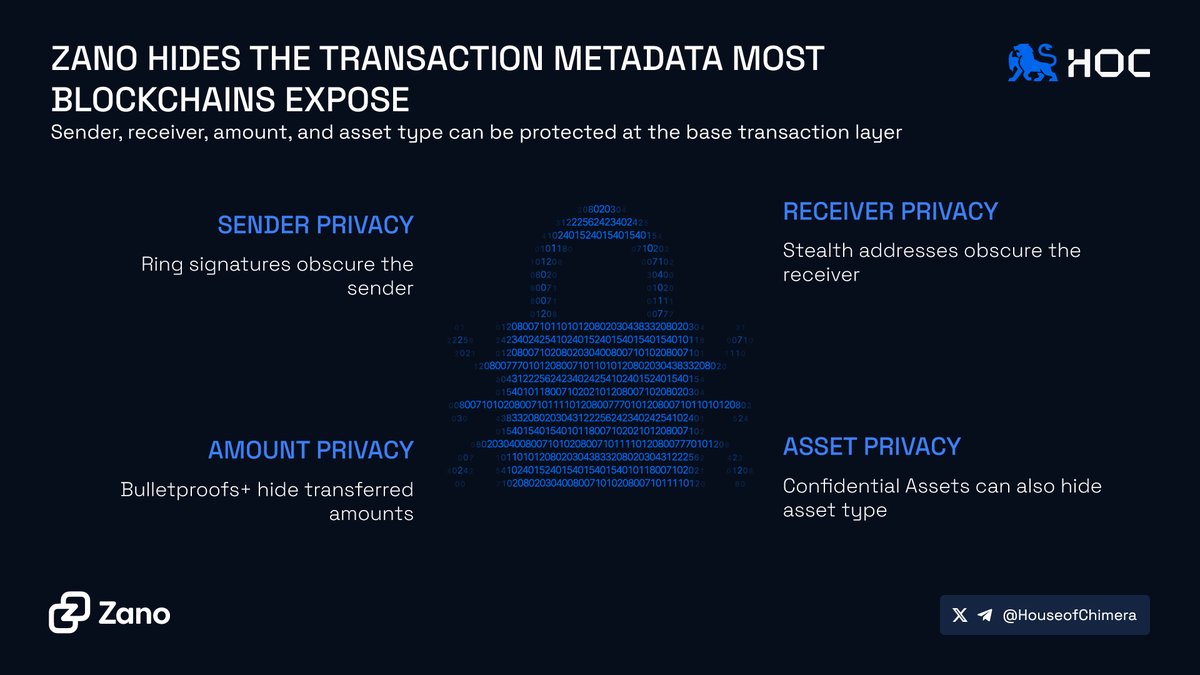
The base transaction layer hides the metadata most chains expose.
🔹 Ring signatures obscure the sender
🔸 Stealth addresses obscure the receiver
🔹 Bulletproofs+ hide transferred amounts
🔸 Confidential Assets can also hide the asset type
Privacy is treated as default infrastructure.
🔹 Ring signatures obscure the sender
🔸 Stealth addresses obscure the receiver
🔹 Bulletproofs+ hide transferred amounts
🔸 Confidential Assets can also hide the asset type
Privacy is treated as default infrastructure.
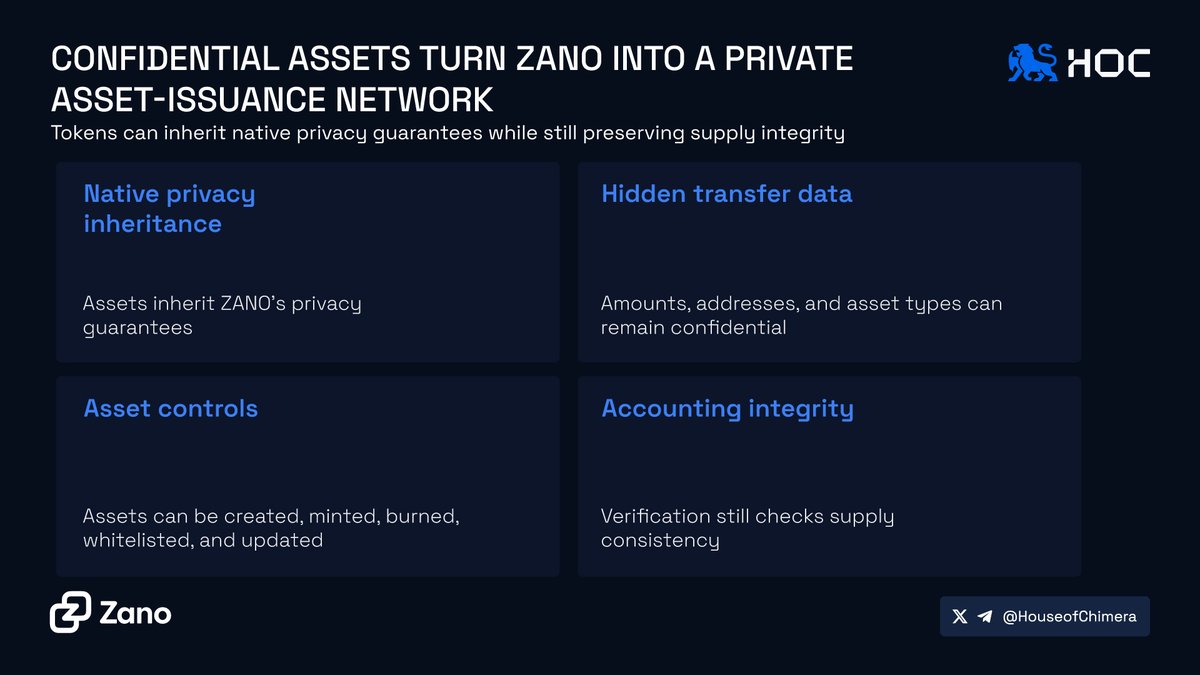
Confidential Assets are one of Zano’s main differentiators.
🔹 Assets inherit native ZANO privacy guarantees
🔸 Amounts, addresses, and asset types can remain hidden
🔹 Assets can be created, minted, burned, whitelisted, and updated
🔸 Verification still checks supply integrity
This makes Zano a private asset network.
🔹 Assets inherit native ZANO privacy guarantees
🔸 Amounts, addresses, and asset types can remain hidden
🔹 Assets can be created, minted, burned, whitelisted, and updated
🔸 Verification still checks supply integrity
This makes Zano a private asset network.
The Confidential Assets model has real architecture behind it.
🔹 Asset descriptors define ticker, supply, metadata, and controls
🔸 Asset tags are derived from those descriptors
🔹 Blinded tags hide which asset is being transferred
🔸 Balance and range proofs preserve public verifiability
The system hides data without breaking accounting.
🔹 Asset descriptors define ticker, supply, metadata, and controls
🔸 Asset tags are derived from those descriptors
🔹 Blinded tags hide which asset is being transferred
🔸 Balance and range proofs preserve public verifiability
The system hides data without breaking accounting.

Zano’s consensus is also designed around privacy.
🔹 Hybrid PoW/PoS combines mining and staking
🔸 Attacking the chain requires pressure on both hashpower and stake
🔹 Zarcanum enables staking with hidden amounts
🔸 Stakers can participate without exposing balances
This differs from transparent PoS networks.
🔹 Hybrid PoW/PoS combines mining and staking
🔸 Attacking the chain requires pressure on both hashpower and stake
🔹 Zarcanum enables staking with hidden amounts
🔸 Stakers can participate without exposing balances
This differs from transparent PoS networks.

The application layer turns privacy into usable products.
🔹 Zano Trade supports private DEX flows through Ionic Swaps
🔸 P2P trading uses escrow contracts
🔹 Aliases simplify payments and identity
🔸 Anonymous onchain voting gives stakers governance without public exposure
The design targets private usage, not just private holding.
🔹 Zano Trade supports private DEX flows through Ionic Swaps
🔸 P2P trading uses escrow contracts
🔹 Aliases simplify payments and identity
🔸 Anonymous onchain voting gives stakers governance without public exposure
The design targets private usage, not just private holding.

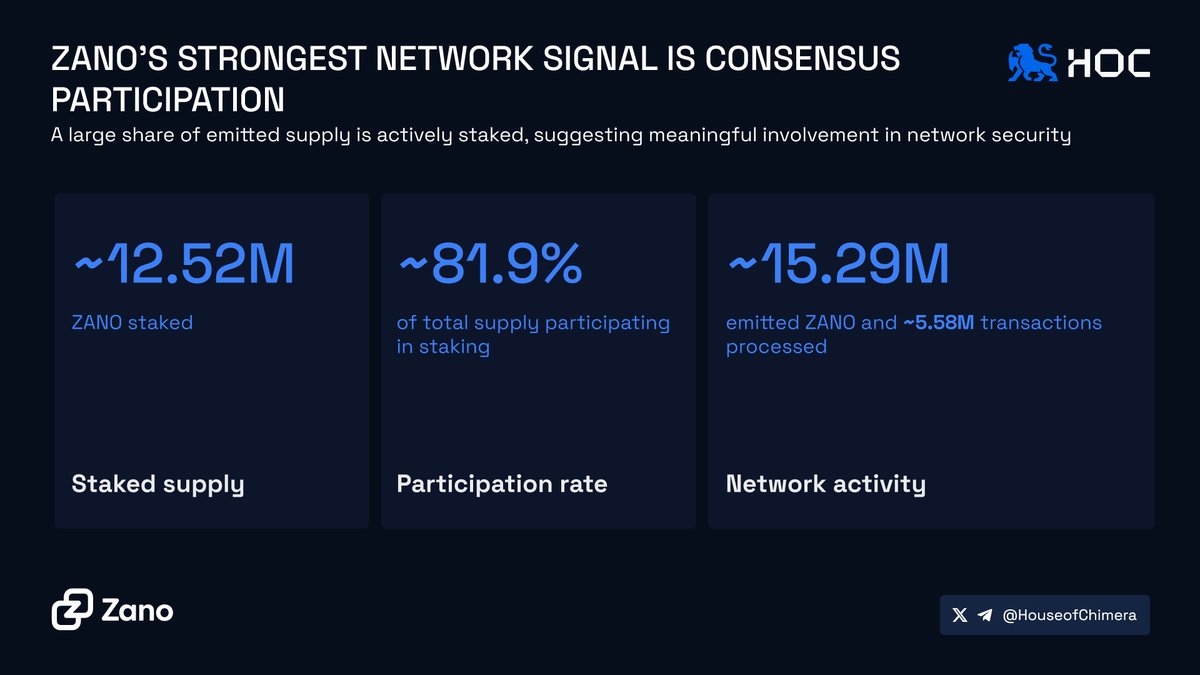
Network participation is one of Zano’s stronger signals.
🔹 Around 12.42M ZANO is staked, representing 81.22% of total supply
🔸 Emitted supply sits near 15.29M ZANO, with ~5.58M transactions processed
🔹 PoW hash rate is around 965.5 GH/s, while real-time staking APY is ~2.1%
The standout metric is the share of supply participating in consensus.
🔹 Around 12.42M ZANO is staked, representing 81.22% of total supply
🔸 Emitted supply sits near 15.29M ZANO, with ~5.58M transactions processed
🔹 PoW hash rate is around 965.5 GH/s, while real-time staking APY is ~2.1%
The standout metric is the share of supply participating in consensus.
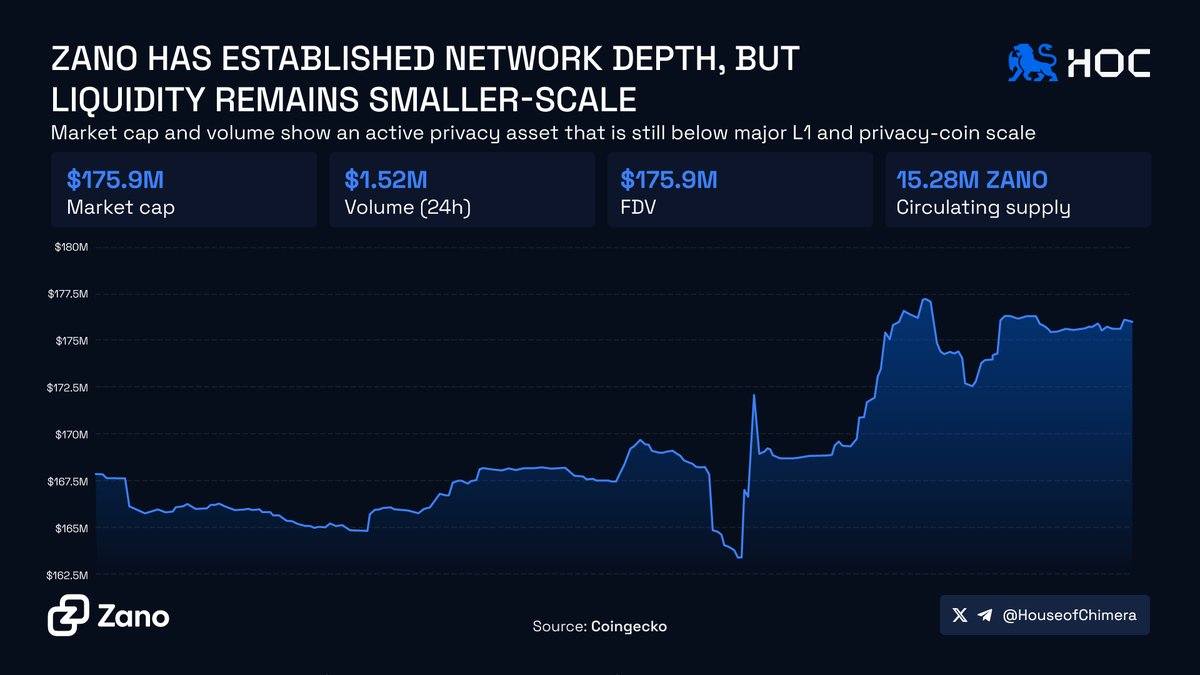
Market metrics give context on size and liquidity.
🔹 ZANO’s market cap sits around $175M
🔸 Circulating supply is about 15.29M ZANO
🔹 CMC rank is around #224
🔸 Daily volume remains in the low single-digit millions
Zano is established, but still smaller than major privacy and L1 assets.
🔹 ZANO’s market cap sits around $175M
🔸 Circulating supply is about 15.29M ZANO
🔹 CMC rank is around #224
🔸 Daily volume remains in the low single-digit millions
Zano is established, but still smaller than major privacy and L1 assets.
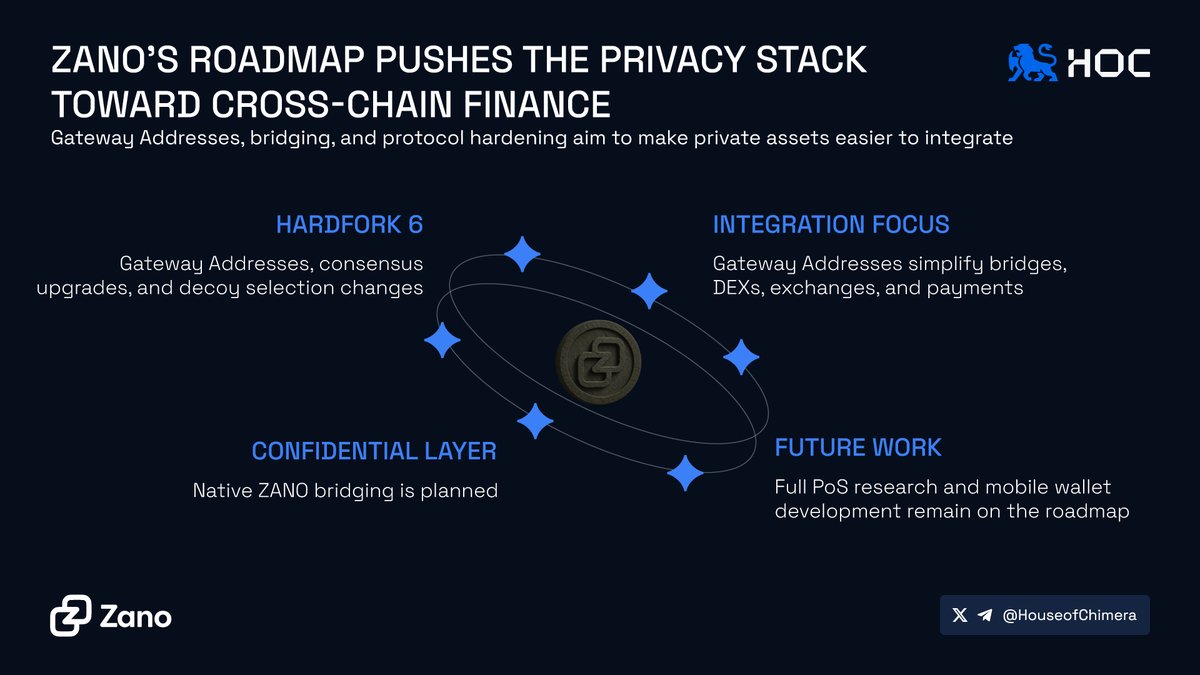
The roadmap is focused on interoperability and protocol hardening.
🔹 Hardfork 6 introduces Gateway Addresses, consensus upgrades, and decoy selection changes
🔸 Gateway Addresses simplify bridges, DEXs, exchanges, and payment integrations
🔹 Native ZANO bridging through Confidential Layer is planned
🔸 Full PoS research and mobile wallet work are also on the roadmap
The next phase is private cross-chain finance.
🔹 Hardfork 6 introduces Gateway Addresses, consensus upgrades, and decoy selection changes
🔸 Gateway Addresses simplify bridges, DEXs, exchanges, and payment integrations
🔹 Native ZANO bridging through Confidential Layer is planned
🔸 Full PoS research and mobile wallet work are also on the roadmap
The next phase is private cross-chain finance.
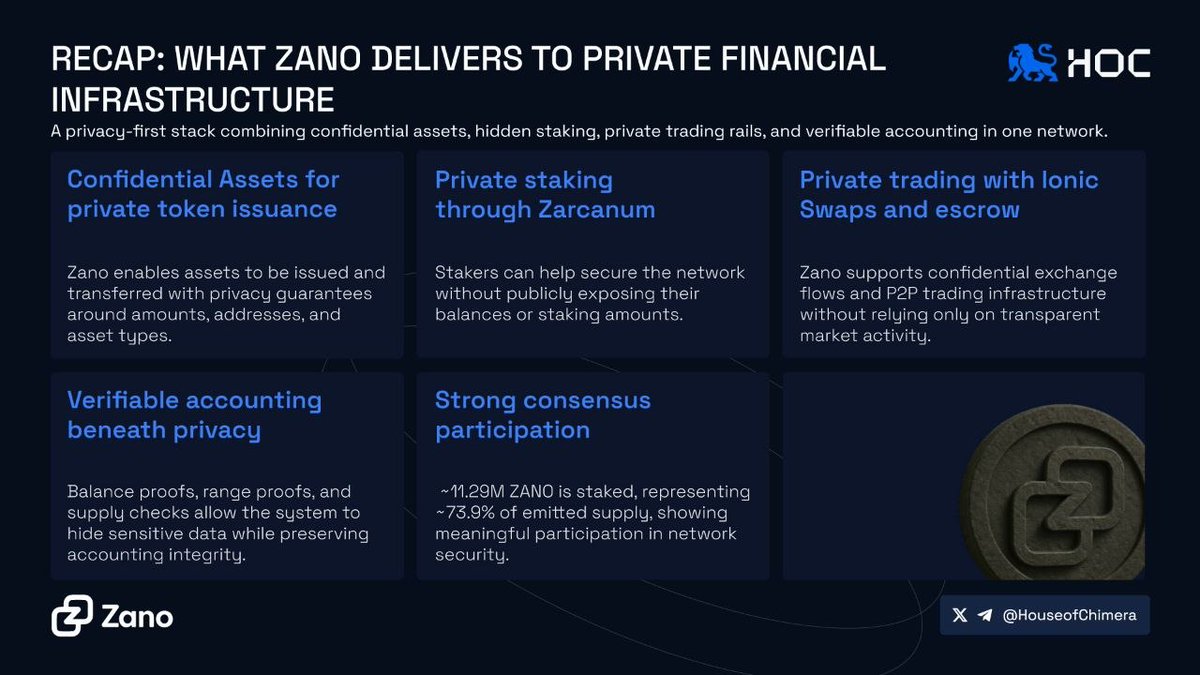
Recap: Zano’s thesis is built around private financial infrastructure with verifiable accounting:
🔹 ~12.42M ZANO staked, representing ~81.22% of emitted supply
🔸 Confidential Assets for private token issuance and transfers
🔹 Zarcanum enables private staking, while Ionic Swaps and escrow support private trading
Zano is building toward a privacy-first financial stack, and the key test is whether private assets become real usage
🔹 ~12.42M ZANO staked, representing ~81.22% of emitted supply
🔸 Confidential Assets for private token issuance and transfers
🔹 Zarcanum enables private staking, while Ionic Swaps and escrow support private trading
Zano is building toward a privacy-first financial stack, and the key test is whether private assets become real usage
• • •
Missing some Tweet in this thread? You can try to
force a refresh