Sonu Bhaskar Profile picture
May 24 4 tweets 3 min read Read on X
Who gave a Parisian clique the moral monopoly to grade the world on press freedom?

Every April, the world bows to the Reporters Without Borders (RSF) World Press Freedom Index like it’s the "Olympic medal table for journalism".

Norway #1. Finland close behind. India? 157th out of 180 in 2026, lumped with autocracies, its score a dismal 31.96.

Brazil scrapes by higher some years, South Africa clings to “satisfactory” on a good day.

The message is clear: the Global South’s democracies are failing the free press test.

Except the test is rigged. RSF’s vaunted ranking rests on two pillars.

One is a tally of “abuses”, real enough in places.

The other?

A qualitative questionnaire answered by a secret handful of “press freedom specialists”: journalists, academics, researchers, human rights defenders.

RSF won’t name them, won’t reveal how many, won’t disclose selection criteria or political leanings.

A seven-member European panel in Paris then crunches the numbers.

That’s it. No transparency.
No peer review. No accountability.

Just a cloistered group of ideologues scoring countries through a Western-liberal lens that treats any pushback against disinformation, foreign-funded NGOs, or elite media cartels as “intimidation.”

This isn’t measurement. It’s narrative enforcement.

India, the world’s largest democracy, with thousands of outlets, hyper-local languages, and raucous social media that bypasses legacy gatekeepers, gets hammered for “highly concentrated ownership” and journalists facing violence. Context?

An explosion of fake news, election meddling, and opposition capture of big media houses that RSF’s experts conveniently frame as plucky independence. Laws to curb it? “Attacks on press freedom.”

Meanwhile, the same Index shrugs at Western social media giants throttling heads of state or European states quietly regulating “hate speech” that somehow always targets the wrong voters.

Cultural bias baked in: the questionnaire, even in 24 languages, was written by Europeans for European norms. Non-Western realities, tribal media wars, post-colonial state fragility, development-first governance, don’t compute. They penalize.

Funding tells the rest. Over half of RSF’s cash flows from public-sector grants: the European Union, French Development Agency, Swedish International Development Cooperation.

The very governments that top the Index bankroll the referee. Past grants from U.S.-linked outfits like the National Endowment for Democracy add the cherry. Coincidence? Hardly.

This is soft-power colonialism dressed as human rights.

The Global South isn’t blameless. But pretending a Parisian echo chamber can fairly adjudicate messy, sovereign democracies fighting for information sovereignty is gaslighting on a planetary scale.

It ignores how the same Index once flirted with funding scandals and founder baggage that reeked of ideological crusading.

It tells emerging powers: your messy pluralism is “problematic.” Ours is pristine.

Enough.

The world doesn’t need another Eurocentric report card. The Global South, and every democracy tired of being lectured, needs its own platforms.

A "just" Global Press Freedom Index. An African Union-led ranking. An Asian/Latin American framework built by journalists who actually live the context: balancing freedom with stability, truth with development, sovereignty with scrutiny.

Transparent respondents. Public methodology. No sacred cows.

One that calls out real repression and the hypocrisy of legacy powers who lecture while their own media consolidates and their algorithms amplify chaos.

The RSF Index isn’t broken.

It’s working exactly as designed: to keep the Global South on the defensive while the North pats itself on the back.

Time to build our own table.

The rest of the world has waited long enough for a seat at it.

FACTS >>> NARRATIVES

Note: If you found this informative, or learnt something new, please share it with your network by reposting/RT. Follow for more such deep dives into history, science, medicine, geopolitics, civilisation, and the stories that must not be forgotten.Image
CC

@HelleLyngSvends @bbcworldservice @TOIIndiaNews @ndtv @SwarajyaMag @BrutIndia @Algemeiner @Jerusalem_Post @haaretzcom @Jedi_Law_Oz @nationalpost @the_hindu @IndianExpress @foIha_sp @Revista_da_TV @OGlobo_Rio @africannewsnet @SaharaWire @decolonialatlas @decolonialatlas @navedaham @TheIndian1954 @krodhrajbhairav
We still await answers from @HelleLyngSvends to the questions raised.

No answers yet.

So where is the free press, when uncomfortable questions are directed at those who claim to defend it?

@krodhrajbhairav

@HelleLyngSvends @bbcworldservice @TOIIndiaNews @ndtv @SwarajyaMag @BrutIndia @Algemeiner @Jerusalem_Post @haaretzcom @Jedi_Law_Oz @nationalpost @the_hindu @IndianExpress @foIha_sp @Revista_da_TV @OGlobo_Rio @africannewsnet @SaharaWire @decolonialatlas @krodhrajbhairav @threadreaderapp unroll, gracias.

• • •

Missing some Tweet in this thread? You can try to force a refresh
 

Keep Current with Sonu Bhaskar

Sonu Bhaskar Profile picture

Stay in touch and get notified when new unrolls are available from this author!

Read all threads

This Thread may be Removed Anytime!

PDF

Twitter may remove this content at anytime! Save it as PDF for later use!

Try unrolling a thread yourself!

how to unroll video
  1. Follow @ThreadReaderApp to mention us!

  2. From a Twitter thread mention us with a keyword "unroll"
@threadreaderapp unroll

Practice here first or read more on our help page!

More from @DrSonuBhaskar

May 11
🧵 1/2 Why non proselytizing faiths like Hinduism and Judaism encourage a deeper inner churning rather than proselytizing assault on others through force and destruction?

I have long contemplated on this deeper question. Let’s do a deep dive!

The distinction between proselytizing and non-proselytizing faiths is not accidental.

It emerges from deep theological, historical, and sociological roots that shape where religious energy is directed: outward toward expansion or inward toward refinement.

Judaism and Hinduism, as classic examples of the latter, do not command or incentivize active conversion of outsiders.

This absence of a universal missionary mandate channels spiritual, intellectual, and communal effort into what you aptly call “inner churning”. A rigorous self-examination, philosophical debate, ethical precision, and personal realization.

By contrast, proselytizing faiths like Islam (in their dominant historical expressions) often frame truth as universally obligatory, creating urgency to spread it, sometimes peacefully through persuasion, but historically also through coercion when political power aligned with zeal.

This is not a moral binary (good inner vs. bad outer), but a structural one rooted in how each tradition defines salvation, community, and truth.

Let’s first look at the theological foundations.

Judaism and Hinduism are both ethnic or embedded traditions in origin, without a doctrinal imperative to make everyone join.

Judaism views itself as a covenant between the One God and a specific people (the descendants of Israel), sealed at Sinai. The Torah and later rabbinic tradition (e.g., Talmud) emphasize halakha (law) and ethical monotheism for Jews, while righteous non-Jews follow the simpler Noahide laws and merit a share in the World to Come. There is no belief that non-Jews are lost without conversion; correct behavior matters more than creedal uniformity. Proselytizing is absent because it is not needed for cosmic order. God does not demand everyone become Jewish. Conversion is possible (and was more common in antiquity), but the process is deliberately rigorous (rabbis traditionally reject candidates three times to test sincerity), reflecting no salvific urgency.

Hinduism (more accurately Sanatana Dharma) is even more pluralistic. The Rig Veda declares “Truth is One, but the wise call it by many names” (ekam sat viprā bahudhā vadanti). There is no single founder, no exclusive one true faith, and no concept of eternal damnation for outsiders. Liberation (moksha) comes through inner realization, via knowledge (jnana), devotion (bhakti), action (karma), or yoga, available to anyone pursuing their dharma (duty/path). Hinduism does not convert in the Western sense; one awakens to it through personal transformation, often within cultural contexts.

Proselytizing would contradict this: why impose affiliation when truth manifests in diverse ways and the goal is inner awakening, not institutional membership?

Proselytizing faiths operate differently. Islam’s emphasis on dawah (invitation) stem from radical universalism: one God, one final revelation for all humanity, with eschatological stakes (salvation or judgment).

This creates an outward imperative absent in Judaism or Hinduism.

The difference is not zeal vs. apathy, but ontology.

Particularist/pluralist systems optimize for depth within the group; universalist ones for breadth.

@Shlomo_MartinImage
🧵 2/2 Next, let’s look into why non proselytizing faiths like Judaism and Hinduism encourage a deeper inner churning rather than proselytizing assault on others through force and destruction?

History reinforces this. Judaism was briefly more open to converts during the Second Temple period (roughly 516 BCE to 70 CE), with estimates suggesting Jews comprised up to 10 percent of the Roman Empire by the 1st century CE through attraction rather than force. But after the diaspora, Roman, Christian, and Islamic laws (e.g., 407 CE Roman edict banning conversion to Judaism under penalty of death) made proselytizing suicidal for a persecuted minority. Survival demanded internal fortification: Talmudic academies, endless textual commentary, and ethical rigor. Energy went into pilpul (sharp dialectical analysis) and mysticism (Kabbalah), not outreach. There are no historical Jewish campaigns of forced conversion or holy war for expansion, defensive wars yes, but never missionary conquest.

Hinduism evolved in the Indian subcontinent’s vast, diverse ecology. It absorbed and synthesized (e.g., incorporating Buddhist and folk elements) without a central authority to enforce uniformity or export dogma. Spread to Southeast Asia (e.g., via trade and culture in the first millennium CE) was organic, not militarized. Under Islamic rule (Delhi Sultanate, Mughals) and later British colonialism, Hinduism faced invasions, temple destructions, and missionary pressure, but responded with internal resilience: philosophical schools (darshanas), bhakti movements emphasizing personal devotion, and social structures like caste that insulated communities. No Hindu armies marched abroad to convert; the tradition’s strength lay in its multicentric, adaptive depth rather than centralized doctrine. Modern reconversion efforts (e.g., Arya Samaj shuddhi) were reactive defenses, not proactive proselytism.

By comparison, proselytizing religions’ universal claims, when fused with state power, repeatedly produced coercion: Charlemagne’s Saxon Wars (8th century, forced baptisms or death); the Spanish Inquisition and 1391 Iberian pogroms (mass Jewish conversions under duress); Almohad North Africa (12th century, Jews and Christians given convert-or-die); colonial evangelization in the Americas and India (often tied to conquest).

These were not universal constants, many conversions were peaceful, but the pattern exists because theology supplied justification when opportunity arose.

Judaism and Hinduism, lacking both the mandate and the power dynamic, never developed equivalent mechanisms.

So, next one wonders why this leads to internal churning? Without an outward assault mandate, conquering souls or territories, religious vitality turns inward. In Judaism, this manifests as perpetual study (talmud torah), debate, and teshuvah (inner return or repentance). The Talmud itself is a monument to intellectual churning: generations refining law, ethics, and metaphysics through argument. Mystical traditions (e.g., Zohar) probe the soul’s ascent. Persecution only intensified this: diaspora Jews became disproportionately intellectual and ethical precisely because identity was preserved through inner discipline, not numbers.

In Hinduism, the churning is literal and metaphorical, echoing the cosmic samudra manthan (ocean churning) that yields nectar through struggle. Upanishads demand self-inquiry (Tat tvam asi, you are That; Who am I?). The Bhagavad Gita maps inner battlefields of duty and detachment. Yoga, meditation, and the six darshanas represent millennia of refined psychology and metaphysics.

Pluralism allows fierce internal debate without needing to demonize outsiders, freeing energy for realization over recruitment. The focus is sadhana (personal practice) leading to atman-Brahman unity, not external victory. This inward turn sustains resilience.

Both traditions endured millennia of minority status or invasion without reciprocal holy wars.Image
What is interesting is: this churning produces profound outputs.

Jewish ethical monotheism and intellectualism; and Hindu philosophical systems that influenced global thought (e.g., via yoga, Vedanta).

Proselytizing faiths built empires and global reach but sometimes at the cost of internal fragmentation or justifying violence when resistance met zeal.​​​​​​​​​​​​​​​​​​​​​​​​​​​​​​​​​​​​​​​​​​​​​​​​​​

What do you think?

Leave your comments!

🧵🪷🧵🕉️✡️🕍🛕🧵🪷🧵
Read 4 tweets
May 9
Do you often hear the "Red-Green" alliance speak endlessly about “colonisation”?

Let's dig into history and show the mirror.

What they do not want you to know is the history they have tried so hard to subdue, distort, and erase.

Perhaps that is because the “devil” speaks first of its own sins.

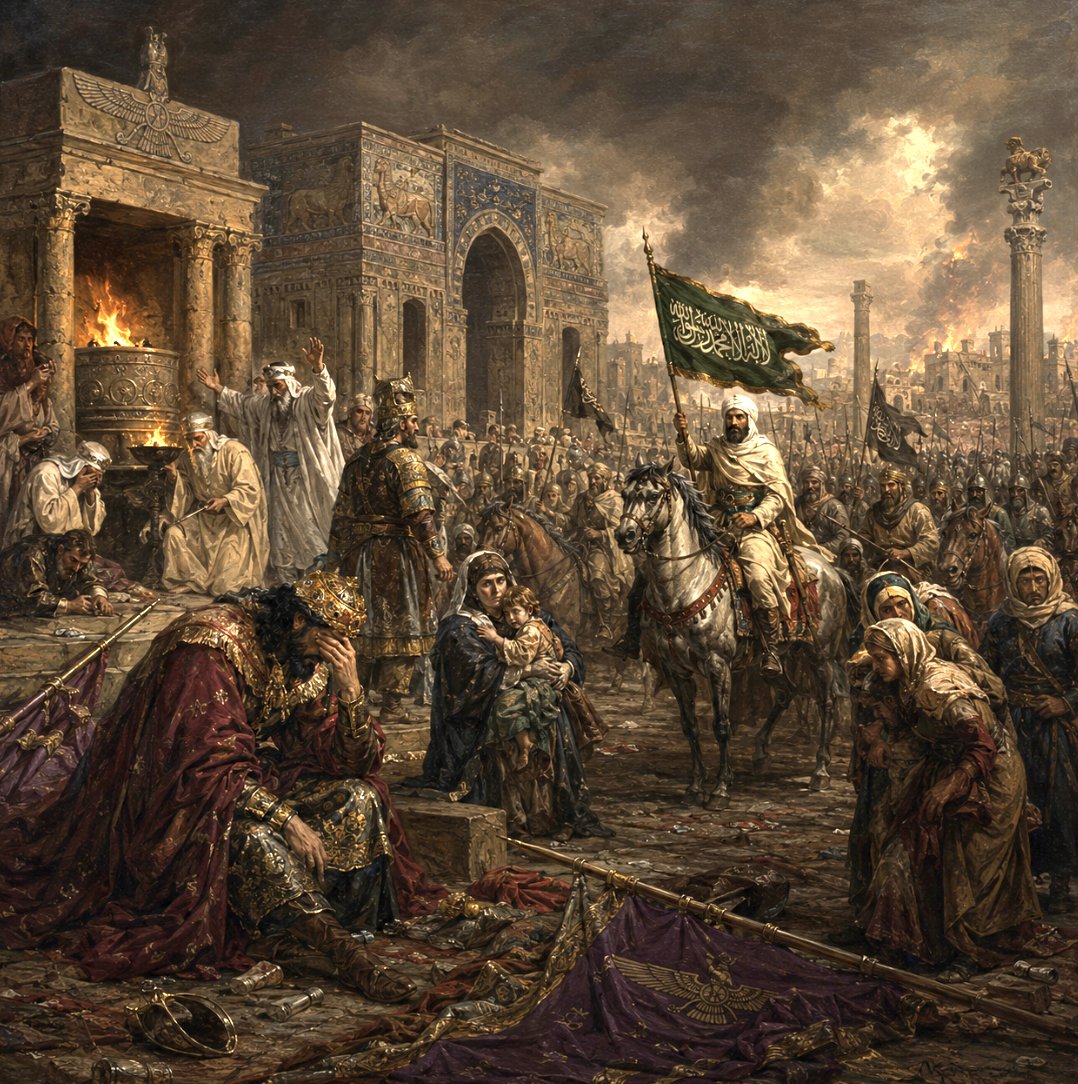
One of the bloodiest and most consequential conquests in the history of the great Persian civilisation was the 7th-century Arab-Islamic invasion of Sasanian Persia.

This was a conquest that shattered an ancient imperial order, weakened Zoroastrian institutions, and transformed Iran’s civilisational destiny.

A haunting Middle Persian ballad remembers this conquest not as “change,” but as civilisational death.

It cries out for Shah Vahrām to return from India with elephants and banners, to restore the sacred fires, avenge the fallen kings, and free Zoroastrian Iran from humiliation.

History is not just dates and battles. Sometimes it survives as a wound, a prayer, and a song.

Here is a deeper dive. 🧵

The reel is referring to a real Zoroastrian/Pahlavi literary tradition, most likely the poem “Abar Madan ī Shah Wahrām ī Warzāwand”, roughly, “On the Coming of Shah Wahrām the Miraculous.”

It is a short Middle Persian poem that imagines a saviour-king, Shah Vahrām, arriving from India with elephants and armies to defeat the Arab conquerors and restore the old Iranian-Zoroastrian order.

Historically, the Arab conquest of Sasanian Persia unfolded in the 7th century.

The decisive defeat came at Nahāvand in 642 CE, after which Arab armies consolidated control.

By 651 CE, with the death of Yazdegerd III, the last Sasanian emperor, the conquest of Iran was effectively complete.

This was not merely a political transition.

It was a civilisational rupture that led to the fall of the Sasanian state, the weakening of Zoroastrian institutions, and the beginning of a long process of Islamisation, taxation, social demotion, displacement, and migration.

The scale was immense because Sasanian Persia was not a minor kingdom.

It was one of the two great late-antique superpowers, alongside Byzantium, with Zoroastrianism deeply embedded in statecraft, law, ritual, kingship, and cultural identity.

After the conquest, Zoroastrians survived; but increasingly as a diminished community under Islamic rule.

Many preserved their faith under immense pressure. Others migrated.

This is where the Indian connection becomes deeply significant.

The Qissa-i Sanjan, written much later around 1599–1600 CE by the Parsi priest Bahman Kaikobad, preserves the Parsi memory of flight from Iran to Gujarat after the Arab conquest.

Modern scholarship also notes that Parsi tradition traces the community’s migration to western India to the aftermath of the 7th-century Arab invasion of Iran.

So when the poem looks toward India, it is not accidental.

India 🇮🇳 appears not only as geography, but as refuge, memory, and civilisational hope.
A place from which the lost dignity of Zoroastrian Persia might one day return.

That is why this ballad is so moving.

It is the cry of a people who saw their empire fall, their sacred fires threatened, their kingship destroyed, and their homeland transformed.

Yet, they still imagined restoration.
Not surrender.
Not forgetting.
Restoration.

Note: The persian ballad referred here is in the tweet quoted (below) 👇. If you found this informative, or learnt something new, please share it with your network by reposting/RT. Follow for more such deep dives into history, geopolitics, civilisation, and the stories that must not be forgotten.

FACTS >>> NARRATIVES

#history #debunk #truth #satyamevjayateImage
Here is the Ballad of King Vahram.

Here is the English Translation of Ballad of King Vahram. 👇Image
Read 5 tweets
May 7
What if the women who chose to join ISIS and actively helped enforce the caliphate’s system of sexual slavery and genocide against the Yazidis were handed Western passports and allowed to resettle in Australia, the United States, or Europe with their children?

That question is no longer hypothetical. It is the reality Western governments are confronting right now as they repatriate ISIS-linked women and families from Syrian detention camps.

Let's dive deep into this!

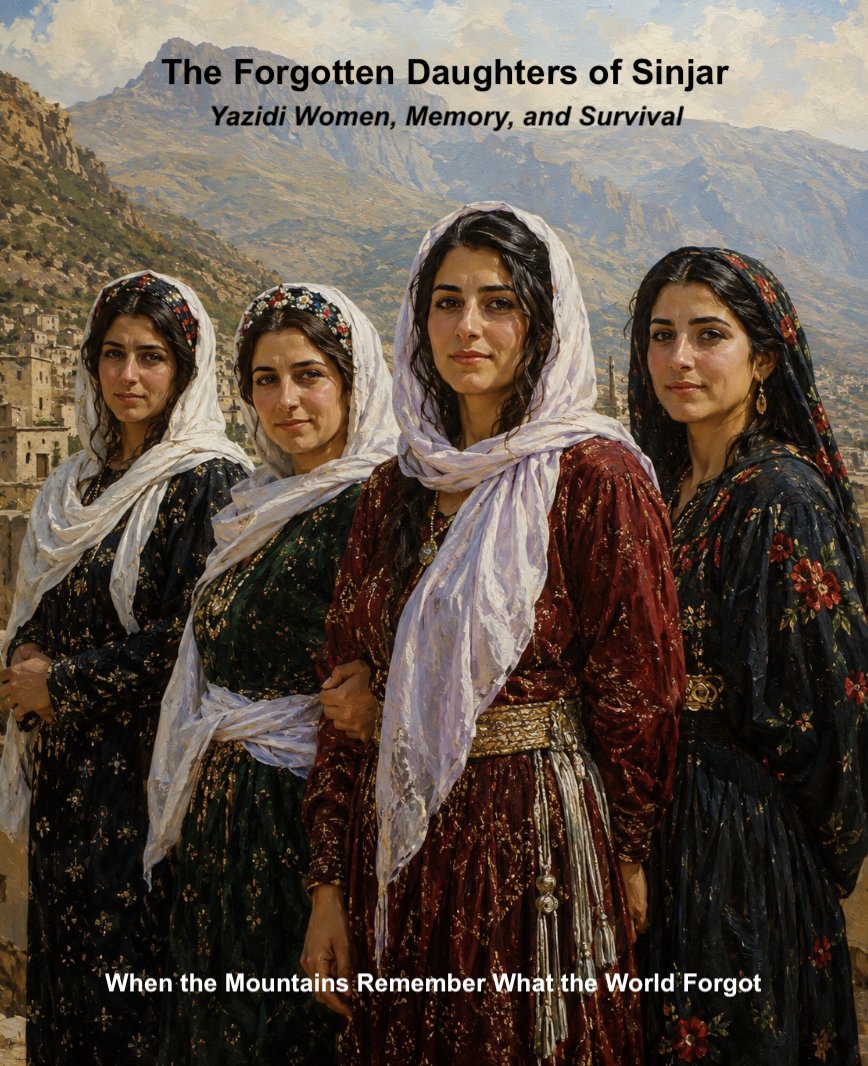
In August 2014, ISIS launched a deliberate genocidal assault on the Yazidi people in Sinjar, Iraq. Fighters massacred around 5,000 men and elderly women, leaving bodies in mass graves that are still being uncovered.

They abducted between 6,000 and 7,000 women and girls, some as young as nine, registering them like livestock and selling them in open slave markets for as little as $30.

These captives endured daily rape, forced “marriage,” torture, beatings, and repeated trafficking between fighters.

Nearly 2,800 remain missing more than a decade later. Boys as young as seven were stolen as “Cubs of the Caliphate,” brainwashed, and turned into child soldiers.

Over 400,000 Yazidis were displaced; tens of thousands still live in camps today, their homes in ruins.

ISIS didn’t hide its intentions. It published religious justifications for treating Yazidi women as “spoils of war,” a theological license for systematic rape and forced conversion designed to erase an entire ancient faith.

The Western and local women who flocked to the caliphate were not passive wives dragged along by husbands. Many were eager participants who embraced the ideology and put it into practice.

The evidence of their complicity is overwhelming and documented by survivors:ISIS wives routinely restrained Yazidi sex slaves, pinning their arms and legs, applying makeup, dressing them in lingerie, so their fighter husbands could rape them without resistance.

Afterward, the wives forced the victims to clean the house and mocked them in front of guests.

Members of the all-female al-Khansaa Brigade served as ISIS’s feared morality police. The brigade included many educated Western women.

They patrolled the streets and punished women for supposedly “immodest” dress. They whipped and tortured women who violated ISIS’s rules.

They also guarded brothels where Yazidi captives were held. In some cases, they directly supervised the sexual exploitation and trafficking of enslaved girls.

These women oversaw “rest houses” where Yazidi slaves were held for rotating use by fighters, enforced strict rules that prevented escape, and used violence to maintain the system of enslavement.

These were not reluctant bystanders.

Many radicalised themselves online, celebrated the caliphate on social media, and chose to raise the next generation inside a regime that treated genocide and rape as official policy.

And that radicalisation has not faded.

In the al-Hol and al-Roj camps in northeast Syria, hardline ISIS mothers continue to indoctrinate their children in the same hateful ideology.

Boys are taught to glorify violence; girls are raised to accept the rules that enabled the Yazidi atrocities.

Intelligence agencies across the West have repeatedly warned that these camps are factories for future terrorists. Children raised there, some now teenagers, have known nothing but ISIS propaganda since birth.

Australia🇦🇺 has already brought back groups of these women and children in recent years, including in 2025 and 2026. Some were arrested on terrorism charges the moment they landed.

Europe and the United States face the same dilemma: the camps are humanitarian disasters and potential incubators of extremism, yet repatriation carries real risks.

Security officials openly state that insufficiently vetted returnees, and especially their radicalised older children, pose threats of further radicalisation, recruitment, or worse inside our communities.

Yazidi survivors, including Nobel laureate Nadia Murad @NadiaMuradBasee and leaders from the Free Yezidi Foundation, have been crystal clear: these women were complicit in their suffering.

Many Yazidi refugees now living in the West have expressed heartbreak and fear at the prospect of encountering their former tormentors in the same cities they fled to for safety.

They watched ISIS wives lock them in rooms, beat them, and facilitate their nightly rapes. To them, treating these women as ordinary “victims” needing compassion erases the very real hierarchy of harm.

Repatriating unrepentant or inadequately screened ISIS-linked women and their deeply indoctrinated children is not a compassionate policy; it is a gamble with public safety and moral clarity.

It risks importing not just trauma for survivors, but the very ideology that nearly wiped out an entire people.

Western societies deserve governments that place the security of their citizens and the voices of genocide survivors above political optics or feel-good narratives.

The Yazidi women who survived hell have one simple request: listen to us first.

The women who helped build the nightmare do not deserve a free pass to rebuild their lives in the same countries that took us in.

Ignoring that truth doesn’t make the threat disappear; it only brings it closer to home.

Note: If you found this informative, or learnt something new, please share it with your network by reposting/RT. Follow for more such deep dives into history, geopolitics, civilisation, and the stories that must not be forgotten.

FACTS >>> NARRATIVES

#YazidiGenocide #JusticeForYazidis #ISISBrides #NeverForgetImage
Further reading and resources:

x.com/DrSonuBhaskar/…

New York Times (2015). ISIS Enshrines a Theology of Rape. t.co/3dmnSrYL9g

United Nations OHCHR (2024). Ten years after the Yazidi genocide: UN Syria Commission of Inquiry calls for justice. ohchr.org/en/press-relea…

Nadia’s Initiative (n.d.). The Genocide. nadiasinitiative.org/the-genocide

Cetorelli, V. et al. PLOS Medicine (2017). Mortality and kidnapping estimates for the Yazidi population in the area of Mount Sinjar, Iraq, in August 2014. journals.plos.org/plosmedicine/a…

The Atlantic (2014). ISIS Is Now Bragging About Enslaving Women and Children. theatlantic.com/international/…

The Citizen (2017). How ISIS Wives Helped Husbands Rape Yazidi Sex Slaves. thecitizen.in/index.php/en/n…

NBC News (2016). How All-Female ISIS Morality Police ‘Khansaa Brigade’ Terrorized Mosul. nbcnews.com/storyline/isis…

Georgetown Security Studies Review (2021). ISIS’s Female Morality Police. georgetownsecuritystudiesreview.org/2021/05/13/isi…

Lowy Institute (2025). Australia’s quiet returnees from Syria are in fact a loud warning. lowyinstitute.org/the-interprete…

ABC News Australia (2026). AFP warn of arrests on arrival for ISIS-linked families after flights booked from Syria. abc.net.au/news/2026-05-0…

Nadia’s Initiative (n.d.). Nadia Murad: Escaped Sexual Slavery at the Hands of ISIS – This Is Her Story. nadiasinitiative.org/news/nadia-mur…
Yazidi survivors are asking Australia and the West for one thing: accountability before repatriation.

Their voices must come first.

#YazidiGenocide #ISISBrides
Read 4 tweets
Apr 26
🧵 [1/5] Have you ever wondered why “apostates” from the radical Left and other totalitarian regimes treated like traitors who deserve destruction, the same way radical Islamists treat anyone who leaves their faith?

Both ideologies have a death sentence for dissenters.

It’s not a bug.
It’s the feature.
History has lessons for us.

In this thread 🧵, we dive deep into this.

Communism has always crushed “ideological deviation” with the same brutality radical Islamists reserve for "riddah" (apostasy).

Let's look at the Red (radical Left/Communism) first.

Remember the Stalin’s Great Purge (1936–38)? Stalin executed the old Bolsheviks themselves. Lifelong revolutionaries such as Bukharin, Zinoviev, and Kamenev were shot or gulaged for the crime of “deviating” from the party line.

Leon Trotsky, founder of the Red Army, was hunted across continents and murdered in Mexico in 1940 with an ice pick.

Mao’s Cultural Revolution turned children into execution squads against teachers, parents, and party veterans guilty of “bourgeois” or “revisionist” thoughts.

Today, ex-leftists who break ranks face doxxing, career annihilation, and social exile.

“Cancel culture” is the Western gulag.

Now let’s turn to the Green (Radical Islamism).

Apostasy is explicitly a capital crime in classical Islamic jurisprudence, backed by hadiths: “Whoever changes his religion, kill him.”

The Ridda Wars after Muhammad’s death slaughtered tribes trying to leave Islam.

Today, 13 countries still prescribe death for leaving the faith. In nations such as Pakistan, the Islamic Republic of Iran, and others, the punishment for apostasy is death, and thousands have been executed or killed under these laws and proxy charges like blasphemy and “enmity against God.”

Ex-Muslims live under fatwas, in hiding, or are murdered (think Rushdie or honour killings).

Note: The attached image is the cover of the book Icon of Evil: Hitler’s Mufti and the Rise of Radical Islam by David G. Dalin and John F. Rothmann, showing Grand Mufti Haj Amin al-Husseini in private conversation with Adolf Hitler, a chilling historical snapshot of the alliances that still echo in today’s Red-Green axis.The attached image is the cover of the book Icon of Evil: Hitler’s Mufti and the Rise of Radical Islam by David G. Dalin and John F. Rothmann, showing Grand Mufti Haj Amin al-Husseini in private conversation with Adolf Hitler, a chilling historical snapshot of the alliances that still echo in today’s Red-Green axis.
🧵 [2/5] Red and Green are married: a toxic alliance of convenience.

They march together, share platforms, fund causes, and scream “solidarity” against the West, Israel, and liberal democracy.

The radical Left defends Islamist grievances and imports Islamist voters while ignoring Sharia’s stance on apostasy, gays, and women.

Islamists adopt leftist “oppression” language as camouflage.

This isn’t new.

History is littered with Red-Green pacts, tactical marriages of sworn enemies against a common foe.

Let's start with the 1920 Baku Congress.

Soviet leaders (Zinoviev and others) summoned Muslim delegates to a “true people’s holy war” against British imperialism, an explicit early attempt to fuse communist revolution with jihad.

Then there’s the Grand Mufti of Jerusalem’s Nazi ties and enduring legacy. Haj Amin al-Husseini forged a direct alliance with Nazi Germany.

Contacts began in 1933 when he praised Hitler’s anti-Jewish policies. In 1941, after backing the pro-Axis coup in Iraq that sparked the Farhud pogrom against Baghdad’s Jews, he fled to Berlin as Hitler’s honored guest.

On November 28, 1941, he met the Führer and declared that Arabs and Nazis shared the same enemies: the English, the Jews, and the Communists.

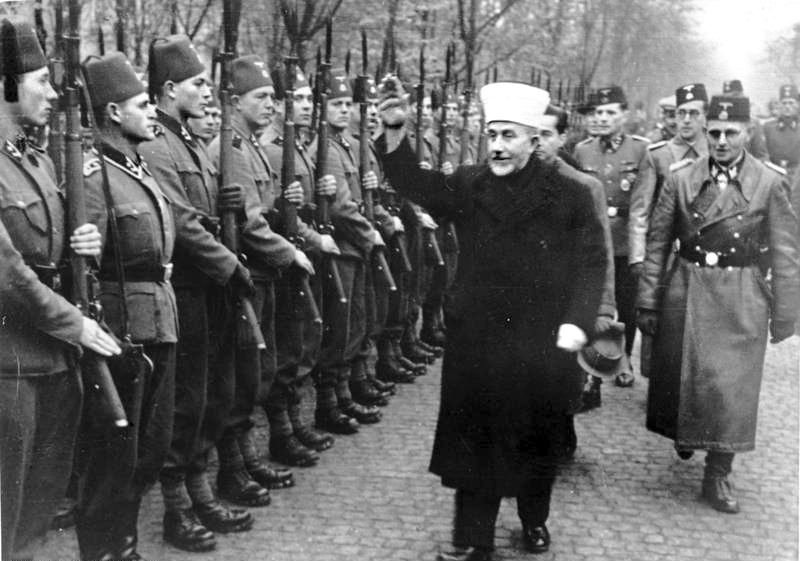
He broadcast vicious anti-Jewish and anti-Allied propaganda across the Arab world via Radio Berlin, recruited thousands of Bosnian Muslims into the Waffen-SS “Handschar” division, and lobbied relentlessly to block Jewish emigration from Europe to Palestine.

His influence extended far beyond 1945.

The Mufti escaped to Egypt (via French protection) and continued shaping Palestinian rejectionism from exile in Cairo.

He opposed the 1947 UN Partition Plan, formed the Army of the Holy War militia, and in September 1948 presided over the short-lived All-Palestine Government in Egyptian-ruled Gaza, a symbolic rejectionist entity he led as president.

The government relocated to Cairo as a government-in-exile in late October 1948.

In the 1950s, from his villa in Heliopolis, Cairo, the Mufti directed the increasingly fragmented Arab Higher Committee, issued anti-Israel statements, supported "fedayeen guerrilla" activities against the Jewish state, and rallied Arab opposition to any compromise or peace with Israel.

By the 1960s, after leaving Egypt for Beirut in 1959, his once-dominant Cairo-based influence had sharply declined under Nasser’s secular pan-Arab regime and the rise of newer Palestinian leadership. He was increasingly sidelined and discredited after the 1948 defeat, yet he remained a vocal symbolic figure of uncompromising rejectionism, issuing statements against Israel and any negotiated settlement until his death in 1974.

Though his direct political power waned, his uncompromising fusion of Islamist anti-Semitism, Arab nationalism, and total rejection of Jewish sovereignty shaped the Palestinian cause for generations.

Not to also forget the Mufti’s influence on Arafat. Yasser Arafat, his distant relative and “spiritual godson”, explicitly carried forward this legacy. Arafat was the founding member of the Fatah political party which he led from 1959 until 2004, chairman of the Palestine Liberation Organization from 1969 to 2004, President of Palestine from 1989 to 2004, and President of the Palestinian Authority from 1994 to 2004.

Arafat, who mourned the Mufti as chief mourner at his 1974 Beirut funeral, inherited the PLO leadership and the core rejectionist stance.

Note: This image is from November 1943: Grand Mufti Haj Amin al-Husseini greeting Bosnian Muslim volunteers of the Waffen-SS “Handschar” division with a Nazi salute. At right is SS General Karl-Gustav Sauberzweig, chilling proof of the Mufti’s direct role in recruiting thousands of Muslims into Hitler’s elite SS units as part of the Nazi-Islamist alliance.Note: This image is from November 1943: Grand Mufti Haj Amin al-Husseini greeting Bosnian Muslim volunteers of the Waffen-SS “Handschar” division with a Nazi salute. At right is SS General Karl-Gustav Sauberzweig, chilling proof of the Mufti’s direct role in recruiting thousands of Muslims into Hitler’s elite SS units as part of the Nazi-Islamist alliance.
🧵 [3/3] Nazi ties to Arab nationalists ran even deeper.

The Mufti (Haj Amin al-Husseini) closely allied with Iraqi Prime Minister Rashid Ali al-Gaylani, whose 1941 “Golden Square” pro-Axis coup (backed by Nazi Germany and Fascist Italy) briefly installed a Nazi-friendly regime in Baghdad before British forces crushed it.

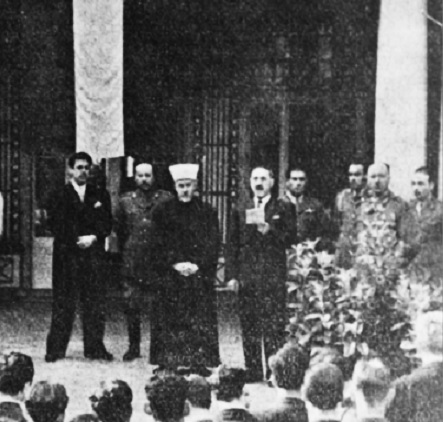
Both men fled to Berlin. In Berlin, Rashid Ali was received by Hitler, recognised as the leader of an Iraqi government-in-exile, and collaborated with the Mufti on anti-British and anti-Jewish propaganda while working to rally Arab support for the Axis powers.

They appeared together at events, and Nazi Germany tailored radio broadcasts that fused Koranic verses with Nazi-style anti-Semitism, framing the war as a jihad against Jews, Britain, and Bolshevism.

Another key figure was Fawzi al-Qawuqji, a prominent Syrian Arab nationalist and military commander who fought in the 1936–39 Arab Revolt in Palestine.

After fleeing British pursuit, al-Qawuqji too found refuge in Nazi Germany. Here, he was commissioned as a colonel in the Wehrmacht, recovered from wounds sustained in Iraq, and collaborated closely with the Mufti and Rashid Ali on propaganda and recruitment efforts.

Post-war, al-Qawuqji was appointed field commander of the Arab League’s Arab Liberation Army (ALA) during the 1948 Palestine War, leading volunteer forces in northern Palestine against the nascent Jewish state.

This is another direct link in the chain of Nazi-Arab nationalist collaboration extending into the fight against Israel.

Broader Nazi strategy cultivated Arab nationalists across the region.

Nazis exploited anti-British and anti-Zionist sentiment, supporting pan-Arab movements and recruiting Muslim volunteers while building on earlier German-Ottoman alliances from World War I.

Note: This image is from Berlin during the Second World War, showing Rashid Ali al-Gaylani, the pro-Axis former Iraqi prime minister, and Haj Amin al-Husseini, the Grand Mufti of Jerusalem, speaking at an anniversary event commemorating the 1941 pro-Axis coup in Iraq. They are pictured before black-white-green banners, symbolically linking Arab nationalist politics with Axis propaganda networks in wartime Germany.This image is from Berlin during the Second World War, showing Rashid Ali al-Gaylani, the pro-Axis former Iraqi prime minister, and Haj Amin al-Husseini, the Grand Mufti of Jerusalem, speaking at an anniversary event commemorating the 1941 pro-Axis coup in Iraq. They are pictured before black-white-green banners, symbolically linking Arab nationalist politics with Axis propaganda networks in wartime Germany.
Read 6 tweets
Apr 25
Has the Red and Green Alliance ruined West Bengal? How did she move from being an Industrial Powerhouse to a State in Decline?

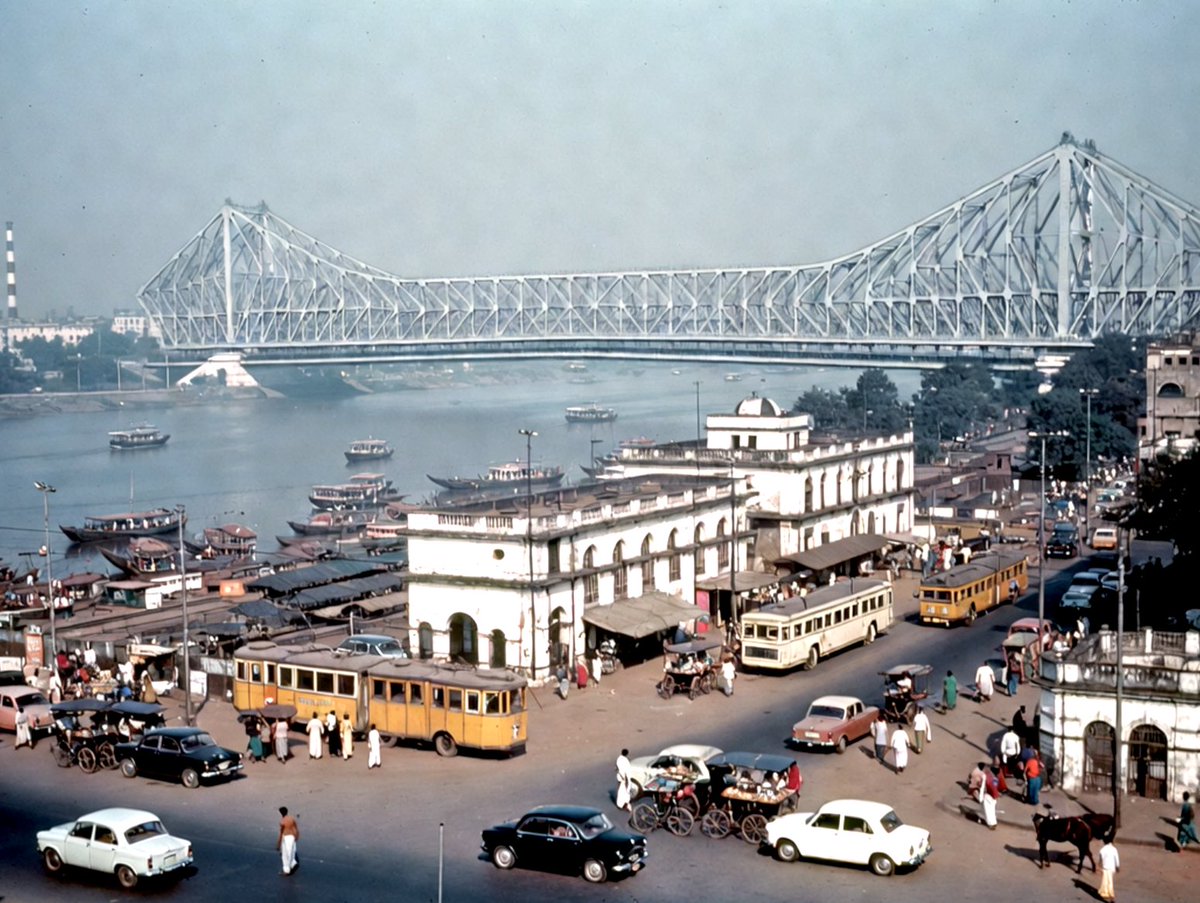
In January, I visited Kolkata after many years, revisiting the places that once defined my memories of the city. It was a flood of nostalgia mixed with deep sadness.

I walked through Thakurbari (Rabindranath Tagore's birthplace), Victoria Memorial, Burrabazar, the iconic Coffee House, College Street, and the Planetarium – spots I had last explored with my family so long ago.

Those visits brought back waves of warmth. But Kolkata has stagnated. The lack of infrastructure and the frail, crumbling buildings were disheartening enough.

What truly broke my heart was going from bookstore to bookstore, unable to find even a single compilation of Tagore’s complete works.

Individual titles were scattered on the shelves, but no collected editions. In stark contrast, massive compilations of Marx, Lenin, and every other left-leaning authors proudly adorned the frontages and display tables.

It was a deeply sad thing to witness – a quiet symbol of how the soul of Bengal has been overshadowed.

For over five decades, West Bengal has been governed by the Red and Green Alliance – first the CPI(M)-led Left Front (Red) under Jyoti Basu (1977-2000, and the Front until 2011), then Mamata Banerjee’s Trinamool Congress (with its Green appeasement politics) since 2011.

What was once India’s third-largest economy and an industrial engine of the East has been reduced to stagnation, demographic upheaval, and rising insecurity.

The facts are stark, drawn from official data and published reports. This isn’t rhetoric – it’s the record of ideology over development, appeasement over security, and neglect over progress.

Firstly, economically speaking, from Top 3 to Near the Bottom
In 1960-61, West Bengal contributed 10.5% of India’s GDP – ranking 3rd nationally – with per capita income at 127.5% of the national average.

By 2023-24, its GDP share has plummeted to just 5.6%, and per capita income has fallen to 83.7% of the national average (ranking around 24th). This consistent slide, documented in the Prime Minister’s Economic Advisory Council (EAC-PM) working paper (2024), began under militant unionism and anti-capitalist policies during the Red Front era.

Jyoti Basu famously told struggling industrialists that “capitalists are class enemies” and they should expect “no sympathy.” Factories fled, investment dried up, and the state’s share of registered factory production collapsed from nearly 30% at Independence to under 6% by the early 1990s.

The decline didn’t reverse under the Green phase of the Alliance – it continued, with thousands of industries shuttered and youth forced to migrate for jobs.

Secondly, vis a vis demographics, West Bengal is witnessing a rapid, unchecked shift. Official Census data paints a clear picture of transformation. In 1951, Hindus formed ~78.9% of West Bengal’s population and Muslims 19.85%.

By the 2011 Census (the latest comprehensive official religious data), Hindus were down to 70.54% while Muslims rose to 27.01% (24.65 million out of 91.28 million total). The Muslim population grew by 381.7% between 1951-2011, compared to 210.2% for Hindus – a divergence official Census tables attribute to differential growth rates.

Districts flipped. Murshidabad went from 55.2% Muslim (1951) to 66.27% (2011); Malda from 37.4% to 51.27%; Uttar Dinajpur neared 50%. These are not abstract numbers – they reflect real shifts in social fabric, voting patterns, and local governance in a state with porous borders. (Sources: Census of India 1951 & 2011, as compiled in official tables and Pew Research Center’s 2021 analysis of state religious demography).

Thirdly, growing Islamic radicalisation and appeasement politics that fuels extremism pose a grave danger. Under the Red and Green Alliance, policies perceived as minority appeasement have coincided with rising radicalisation threats, especially in border districts.

The Bangladesh-based Jamaat-ul-Mujahideen Bangladesh (JMB) has repeatedly used madrasas in Murshidabad, Burdwan, and Malda for radicalisation and recruitment of Indian youth, according to the Union Home Ministry and National Investigation Agency (NIA) probes.

Multiple modules have been busted, with arrests linking JMB to terror plots, bomb-making camps, and cross-border networks.

SATP (South Asia Terrorism Portal) records document ongoing terrorism-related incidents tied to these groups in West Bengal from 2007 onward. Intelligence reports highlight exploitation of porous borders, madrasa networks, and soft policing – a pattern that intensified in the Green phase post-2011.

When ideology trumps security, vulnerable youth become cannon fodder and communal tensions rise.

West Bengal’s story is a cautionary tale: decades of Red and Green Alliance governance - rigid socialism under Basu, followed by populist appeasement under Banerjee - have hollowed out industry, altered demographics through unchecked growth and migration pressures, and allowed radical elements to gain footholds.

Once a beacon of culture, education, and enterprise, Bengal now exports its youth and imports instability.

The data doesn’t lie.

The people of West Bengal deserve better – development, security, and equal opportunity, not ideological experiments of the Red and Green Alliance.

It’s time to confront these facts before the “Red-Green Zones” become the new normal and the state’s decline becomes irreversible.

May 4 may be the turning point we are all waiting for.
Towards "Amar Sonar Bangla".

Share if you believe Bengal needs a real change.
Facts over fear.
Development over decline.

FACTS >>> NARRATIVES

Note: Links to data and evidence used are provided in next tweet.

#BengalElections #assemblyelections2026 #WestBengalLegislativeAssemblyelection2026 #AmarSonarBanglaImage
For data discussed above, and further reading, here are some resources:

1. Census of India (1951, 2011) via censusindia.gov.in

2. EAC-PM Working Paper on Relative Economic Performance of States (2024) eacpm.gov.in/wp-content/upl…

3. Pew Research Center: Religious Demography of Indian States (2021) pewresearch.org/religion/2021/…

4. NIA/Home Ministry alerts & SATP terrorism database satp.org
Here are some photos from the visit earlier this year.

Read 4 tweets
Apr 21
Consider this.

Imagine going back to the 1980s and ’90s.

Flip on the BBC and you’d catch a panel discussion - politicians, journalists, academics - where voices rose and fell but never quite shattered.

Questions were sharp, replies were pointed, yet everyone waited their turn.

No one shouted “gotcha” before the other had finished a sentence.

Switch to Doordarshan, India’s state broadcaster, and the same quiet gravity prevailed: anchors moderated with measured courtesy.

Guests from opposing camps addressed one another with courtesy, and even heated disagreements ended with a nod of acknowledgment rather than a smirk of triumph.

Or step into a school or college auditorium. A debate competition wasn’t theatre for the cameras; it was a ritual.

You stood, stated your proposition, listened to the rebuttal, then replied without once descending into name-calling or caricature.

The adjudicator’s verdict rested on logic, evidence, and delivery - not on who could trigger the loudest applause from the partisan gallery.

Good faith was simply the air everyone breathed.

So where did that air go?

We traded slow, deliberate exchange for the “dopamine hit of instant reaction”.

The screen that once carried a calm BBC studio or a Doordarshan roundtable now streams a thousand simultaneous shouting matches, each engineered to keep you scrolling.

Nuance became a liability.

Charity became weakness.

And somewhere along the way, we stopped wondering aloud together and started declaring at one another.

The question lingers, quiet but insistent. When did we decide that winning the argument mattered more than understanding the person across the table?

Don’t we witness or experience this on social media/spaces?

And more importantly, are we brave enough to choose the older, slower, kinder way again?Image
Ancient Jewish and Hindu theologies offer timeless models for exactly this kind of wisdom.

They converge on a powerful truth: genuine dialogue is a spiritual practice.

They emphasise debate not as a battle for ego or victory, but as a sacred path to truth, conducted with humility, respect, and good faith.

Let's dive deep into these two traditions.
Let's first look at the Jewish theology.

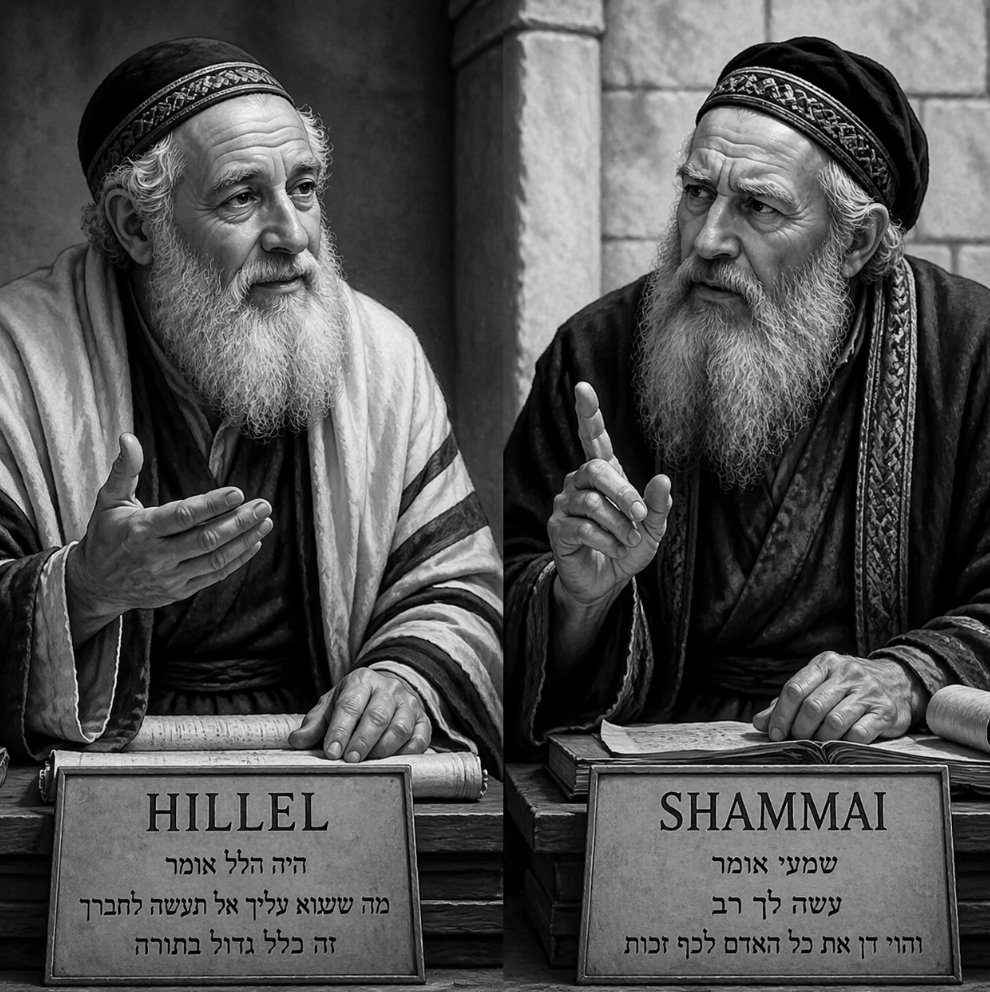
In the Talmud (particularly Eruvin 13b), the schools of Beit Hillel and Beit Shammai represent one of the most famous examples of rigorous yet respectful disagreement.

These two groups of sages disagreed sharply on hundreds of points of Jewish law (halakha), yet they treated each other as “friendly adversaries.”

They studied each other’s views deeply, quoted each other’s arguments fairly, and never descended into personal attacks or cancellation.

A heavenly voice (bat kol) ultimately declared: “These and these are the words of the living God”.

It affirmed that both sides reflected divine truth, even though the law ultimately followed the more compassionate views of Hillel.

This is explicitly praised in Pirkei Avot (Ethics of the Fathers 5:17) as a “controversy for the sake of Heaven” (machloket l’shem shamayim) that endures and elevates everyone.

Controversies not for Heaven (like Korach’s rebellious power grab) crumble into destruction.

There is wisdom from above for today.

Disagreement is not the enemy of truth. It can be its partner.

When we debate with sincerity and mutual respect (rather than to “own” the other side), multiple perspectives can all contain sparks of the divine.

This fosters humility: no one has a monopoly on wisdom.

In our polarised times, it reminds us to ask, “What truth might the other person be seeing that I’m missing?” instead of rushing to silence or shame them.Image
Read 6 tweets

Did Thread Reader help you today?

Support us! We are indie developers!


This site is made by just two indie developers on a laptop doing marketing, support and development! Read more about the story.

Become a Premium Member ($3/month or $30/year) and get exclusive features!

Become Premium

Don't want to be a Premium member but still want to support us?

Make a small donation by buying us coffee ($5) or help with server cost ($10)

Donate via Paypal

Or Donate anonymously using crypto!

Ethereum

0xfe58350B80634f60Fa6Dc149a72b4DFbc17D341E copy

Bitcoin

3ATGMxNzCUFzxpMCHL5sWSt4DVtS8UqXpi copy

Thank you for your support!

Follow Us!

:(