This is pretty insane: the U.S. just tried to literally re-colonize part of the Philippines.
They did so under the so-called "Pax Silica" initiative, the brainchild of - surprise, surprise - an ex-Palantir guy named Jacob Helberg who now runs U.S. economic "diplomacy" from the State Department.
It's causing a big outcry in the Philippines, which is quite a feat given this is by far the most US-friendly country in Southeast Asia.
If you're the US and you're getting the Marcos administration - of all governments - to push back on sovereignty, you've really overplayed your hand.
What is the "Pax Silica" initiative? In a nutshell it's about the US getting other countries to commit to restructuring their AI tech infrastructure around a US-led stack. It's basically vendor lock-in: you hand over your critical minerals, align your export controls with Washington's, regulate AI the way America wants, and in return you get to be a US "trusted partner," whatever that means these days.
In essence, let's not kid ourselves, it's all about China: this is the US's initiative to "win the AI race" by getting other countries to contractually commit to keeping China out of their tech supply chains. When you can't preserve your lead through innovation, you seek to lock countries in contractually.
For instance as a country, this would mean telling Huawei they can't sell you AI chips, and telling Chinese firms they can't invest in your data centers - even if they're better and cheaper. It's not about choosing the best technology, it's about choosing the right flag.
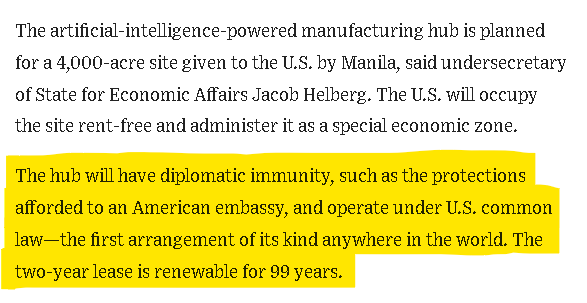
But in this instance, the US went much further still: they literally tried to carve out 4,000 acres of Philippine territory (in New Clark City, 60 miles north of Manila) to be governed under US common law with diplomatic immunity - the first arrangement of its kind anywhere in the modern world.
This is according to the WSJ who ran the story last month (wsj.com/world/asia/u-s…) as if it was a done deal (it wasn't).
Heard about the "French concession" or "British concession" in China during the century of humiliation? Same thing: the US basically asked for an "American concession" in the Philippines.
Unsurprisingly, there was quite a bit of backlash in the country with for instance the Peasant Movement of the Philippines (KMP) calling it a “massive sellout” of the country’s land, minerals, and sovereignty (punto.com.ph/us-led-pax-sil…).
So much so that the Philippines' government - namely Joshua Bingcang, president and chief executive of the Bases Conversion and Development Authority (BCDA) - issued a statement saying that the Philippines had rejected US proposals that would place the project beyond local jurisdiction (asianews.network/philippines-re…).
Note, by the way, this delicious irony: the BCDA is the government agency that was created in 1992 specifically to convert former US military bases at Clark and Subic Bay after the Philippines spent decades negotiating their closure. New Clark City - where the Pax Silica's hub would go - is built on the old Clark Air Base.
So the agency whose entire reason for existing is to turn former American colonial territory (i.e. US military bases) into sovereign Philippine land is the one now being asked to hand part of that very same land back under US jurisdiction (and, apparently, declined).
Of course though, blocking this specific jurisdiction grab doesn't change the bigger picture. The Philippines is still a Pax Silica signatory, and Pax Silica itself is structurally neocolonial: you supply the cheap labor and raw materials, align your export controls and regulations with Washington's, cut yourself off from the world's rising technological powerhouse - and in exchange you get assembly jobs and the privilege of getting a pat on the head and being called a "trusted partner."
They dropped the most cartoonishly colonial demand - governing Philippine soil under US law - but the underlying architecture is the same: you serve America's supply chain, on America's terms, and you relinquish your sovereign right to trade with whoever offers the best deal.

• • •
Missing some Tweet in this thread? You can try to
force a refresh

Best evening of our Xinjiang RV roadtrip so far: I think a good claim could be made we are as close as you can possibly get to the Garden of Eden on this Earth.
We drove the RV for 7 hours to arrive in an amazingly charming little town called Wenquan (温泉), which literally means "hot spring," right on China's border with Kazakhstan.
It's called this because (the smartest among you will have guessed it 😋) this place has natural hot springs, which is the central feature of the town: as you can see on the videos 👇there's a stunning hot spring lake packed with migratory birds where people can dip their feet in the water.
And, this is where you'll get the Garden of Eden reference, this place is where apples originally come from! All the apple trees worldwide descend from a tree species native to this area - the Malus Sieversii.
So, natural hot springs, wild birds, and the original apple tree - I don't know, rings a bell to me...
Another fascinating fact about this place: it's mostly inhabited not by Han Chinese, nor Uyghurs, nor even Kazakhs but by Mongols!
If you walk around town you'll see all the street signs are written in the Mongol script. In fact we're in a wider county called the Bortala Mongol Autonomous Prefecture (博尔塔拉蒙古自治州).
Why is that? It's because in the 1760s, Qing dynasty emperor Qianlong needed loyal troops to protect the border right here so he sent a group of around 2,000 Chahar Mongol soldiers and their families all the way from near Beijing to settle here permanently. 260 years later, and their descendants are still here, and many of them actually still guarding the border! Quite literally multi-centennial commitment to duty.
And, if that wasn't enough, we also had our best meal of the trip by far in this place, see next tweet 👇
We were lucky enough to be introduced to a mutual friend in this town who treated us to an absolute feast in the town's best restaurant called Wang Fu Lou (旺福楼), which specializes in salmon.
Now I already hear the sceptics and cynics amongst you saying "boo, there's nothing local about eating salmon in Xinjiang": well you'd be dead wrong about this. Xinjiang is actually a massive salmon producer, raising them in the cold glacial meltwater from the nearby snow mountains.
And this place, Wenquan (温泉), happens to have such a salmon raising facility (which is open to the public and which we'll actually visit tomorrow so watch this space!): as such the salmon we ate tonight possibly couldn't have been more local!
As you can see on the video they prepared the salmon six ways: 1) Sashimis 2) Salmon soup with homemade tofu and locally grown saffron (because, yes, this place apparently grows saffron too!) 3) Salmon jiaozis (which were insanely delicious with a mix of salmon and mushrooms inside the buns) 4) Fried salmon skin 5) Salmon head Hunan style 6) Salmon fried rice
And if that wasn't enough we also had local lamb, a type of local beef kebab eaten in thin crepes, and a whole lot of local fruits!
That's the restaurant if anyone among you happens to pass by Wenquan (温泉) one day, that's the place where you should eat!
It says an awful lot about France - and not in a good way - that there is "political divide" on using air conditioning when temperatures literally exceed those of the Sahara desert, and when France has one of the greenest energy mixes in the world (thanks to nuclear).
And it says even more that those who oppose AC are often the same as those who oppose nuclear: the view - presumably - is that you should neither adapt to climate change (AC) nor prevent it (nuclear).
Also the same people, incidentally, who oppose pesticides and fertilizers - basically modern farming - and push for all-organic: a prescription that, if universally applied, would literally starve billions of people (and, ironically, would require so much additional farmland it would devastate the world's remaining forests).
It's all part of the same logical fallacy, the notion that if something causes a problem, then that thing is the problem.
Yes progress and technology caused and continue to cause plenty of environmental issues. And there is indeed something seductive in saying "we've gone too far, let's change tracks, let's head towards a simpler, slower life, we used to be like that."
But not only is this just not feasible without causing far greater harm to ourselves, it's also a fundamentally nihilistic and mortiferous ideology. One that rests on a profound discomfort with what's arguably the single most defining feature of humanity: our ability to shape our environment to suit us, to fight our circumstances rather than surrender to them. That's been the case ever since we discovered fire and invented farming.
It is, at the end of the day, the transformation of humanity's genius - our need to create and improve our condition - into a vice. They make it sound like a humanistic project but how could it be since the core premise is fear of humans and contempt for our very nature?
Conclusion: yes, 100 times yes, use AC. You'd need to be a complete moron to let yourself boil under 43C heat in order to "save the planet." If climate change is to be solved, it will be by getting the ideologues out of the way of the people who actually fix things.
Every year, this has to be the one report I look forward to the most: the Democracy Perception Index, compiled by the Alliance of Democracies Foundation (in partnership with Nita Data).
In fact, my yearly thread on the report is apparently such a tradition that, this year, its lead researcher personally sent me the report with this message: "every year, I look forward to your thread about it!". That's how you start wondering whether you tweet too much 😅
Why do I like this report so much? A few reasons:
1) The Alliance of Democracies Foundation, the organization behind the report, cannot even remotely be suspected of being some sort of anti-West outlet: it was started by an ex-NATO Secretary General (Anders Fogh Rasmussen) and its stated purpose is "to unite world democracies"
2) It's surprisingly honest and the methodology is actually democratic. Unlike other reports on democracy the scoring isn't done by the report's authors (like the report by Freedom House or The Economist's "Democracy Index"). It simply asks people what they think and, when it comes to democracy, that's kind of the point 🤷♂️
3) I love the expression "perception is reality" because, like it or not, what people believe about their system is what determines its legitimacy. A democracy that nobody actually experiences as one can't credibly claim to be one. And conversely, a so-called "autocracy" that its people overwhelmingly believe is actually a democracy might... actually be a democracy.
Anyhow, this year's edition did not disappoint. The data is absolutely fascinating and frankly, a little terrifying. So here you go: my thread on the 2026 Democracy Perception Index 🧵
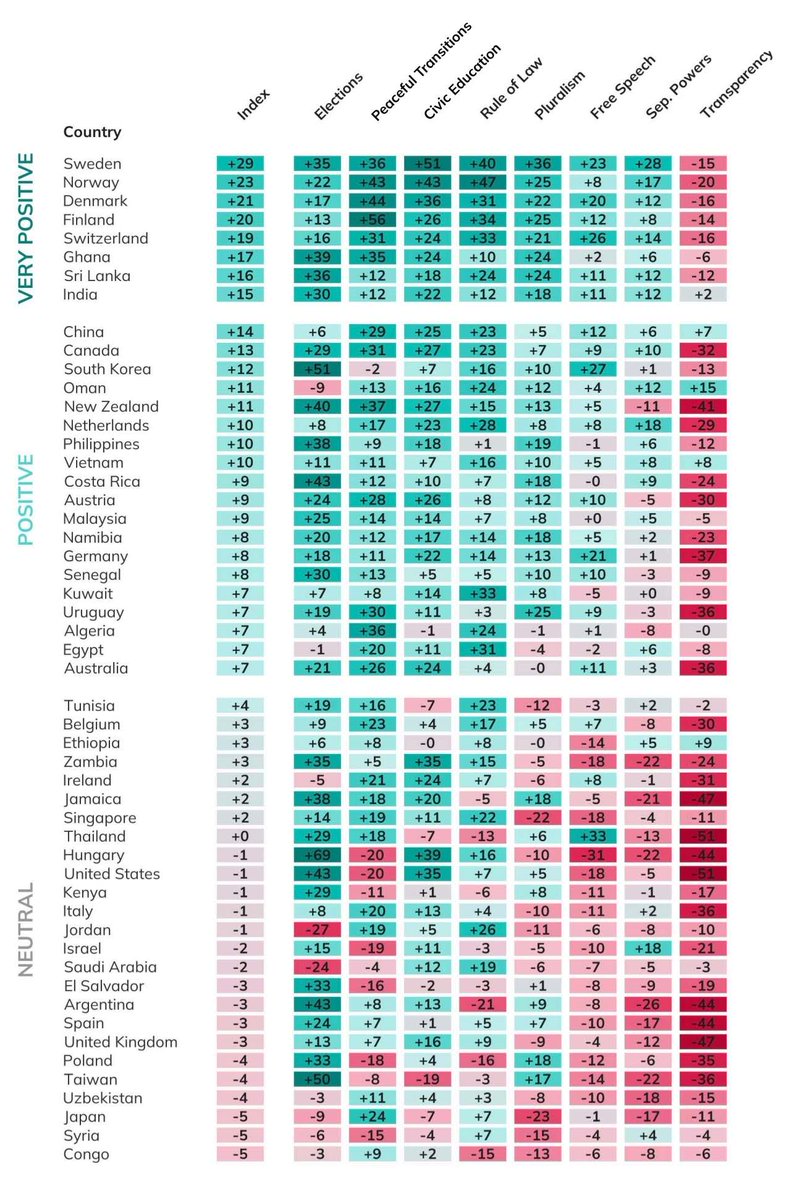
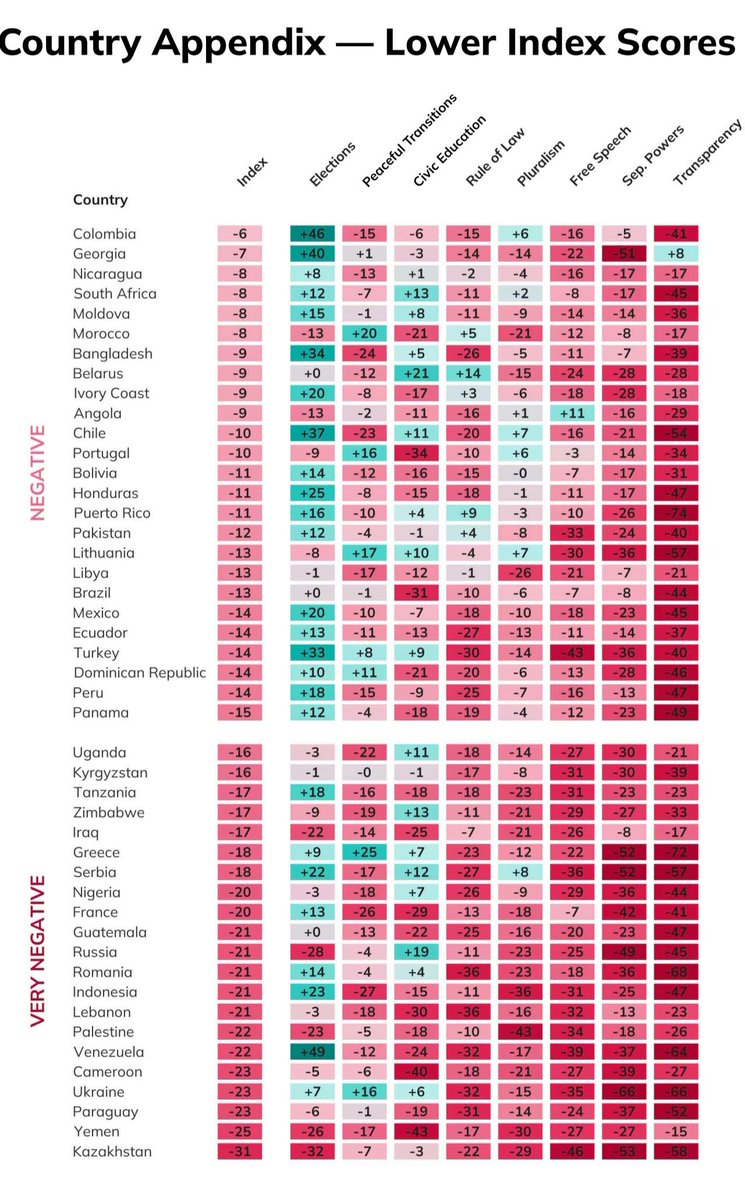
Let's start with what's always the highlight of the report: the actual ranking of countries based on democracy perception by their own people.
Which, this year, as a French man, is utterly depressing: France is now, according to the French people themselves, one of the least democratic countries in the world, alongside countries like Kazakhstan, Yemen or Zimbabwe. It's insane but sadly unsurprising given the fact that Macron made a complete mockery of the results of the previous elections, and altogether only has utter contempt for his people.
Also fascinating, like every single year, is the fact that China is - according to the Chinese people themselves - one of the most democratic countries in the world. According to the ranking, the world's most democratic countries are: Scandinavian countries, Switzerland, Ghana, Sri Lanka, India and... China!
Every year I get the same argument back so let me preempt it: no it's not because the Chinese people would be "afraid" to express their opinion.
If that were the case you'd see the same dynamic in other presumed "authoritarian" countries. But Russia scores -21, Belarus -9, Kazakhstan -31. If "fear of the regime" explained China's +14, why aren't Russians and Belarusians equally "afraid"?
Professor Jason Hickel - an economic anthropologist - also wrote a fascinating article on exactly this topic titled "Support for government in China: is the data accurate?" (open.substack.com/pub/jasonhicke…) in which he systematically dismantles the "fear bias" argument by examining studies that used anonymized and implicit methodologies. The verdict: across every methodology tested, Chinese people mean what they say.
So, for better or worse, as far as people's perceptions are concerned, we now live in a world where China is one of the most democratic countries in the world and France one of the least.
How does the US fare? Not great, far below China (although better than France): its ranking is "neutral" meaning there's roughly an equal amount of U.S. citizens who think they're a democracy as those who don't.
For the self-proclaimed "leader of the free world," that's not exactly a ringing endorsement...
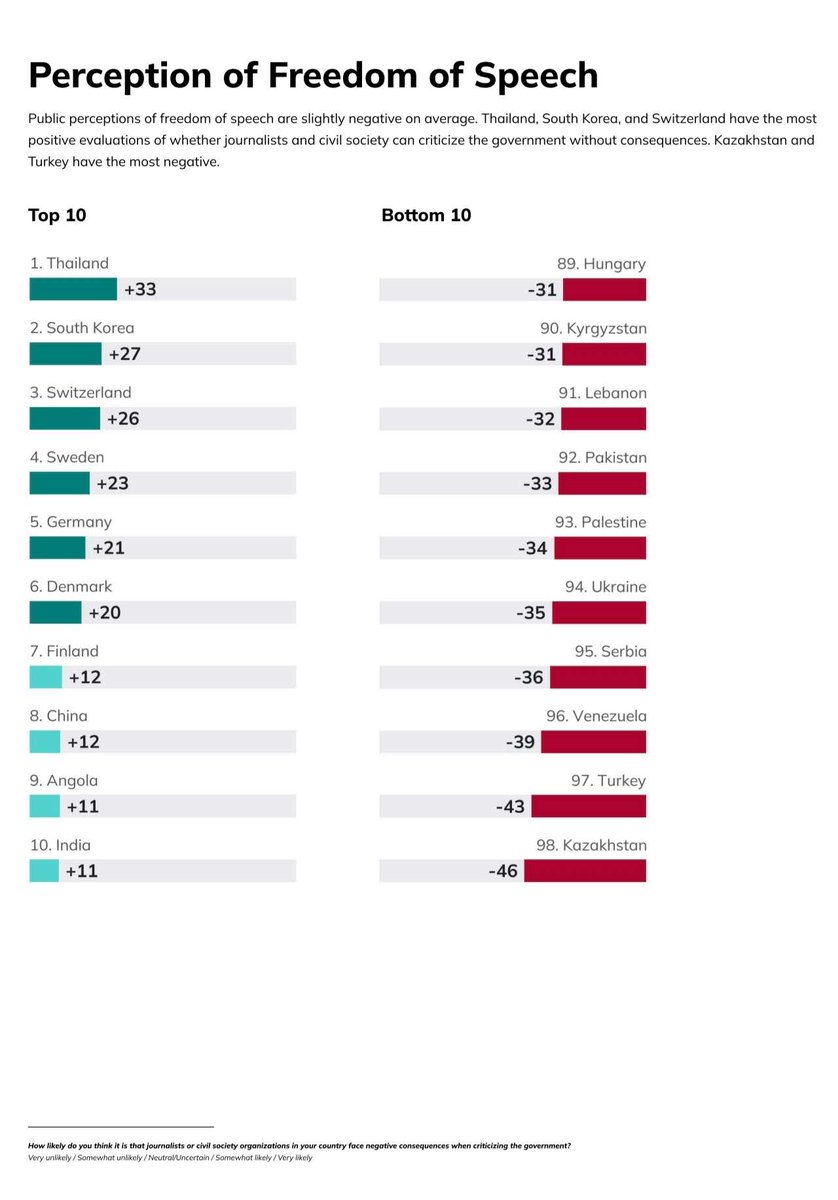
Another finding of the report that I found fascinating this year: there's now a higher perception of freedom of speech in China than in the immense majority of Western countries, including in the United States.
Meaning that when you ask the Chinese people, a higher proportion of them feel they "can criticize the government without consequences" than in the US.
I'm personally not surprised about this at all. I posted many times about the different initiatives taken by the Chinese government to encourage feedback and criticism, including the 12345 hotline, a 24/7 phone number you can call anywhere in China if you have any complaint that's related to the government (and which I myself called a few times).
And anyone familiar with China will tell you (and this is one way the Chinese are actually spiritually quite similar to the French), Chinese people LOVE to complain, and are definitely not shy about it. Speak about government policies to anyone in China and get ready for an hours-long dizzying discussion about the myriads of ways in which China does NOT work.
The notion that Chinese people can't complain is something only someone who's never shared a dinner table with a Chinese family could possibly believe...
AND, most importantly, as this report's results indicate, the Chinese government - unlike many Western governments - actively listens to and acts upon people's feedback (a striking example I stumbled upon just today: x.com/i/status/20531…). Which - last I checked - is supposed to be what democracy is all about: having your policies guided by the will of the people.
What's the freaking point of being allowed to complain or expose whatever government failure if nothing changes? 🤷♂️ That's not democracy, it's just theater.
Wow, this is huge, after months of speculation and the U.S. running a massive pre-emptive discreditation campaign (x.com/RnaudBertrand/…), DeepSeek-V4 is finally out!
I haven't studied it in depth but here are the most striking aspects as far as I can tell:
- Fully open sourced with open weights (available for download on huggingface: huggingface.co/deepseek-ai)
- Zero CUDA dependency anywhere in its stack, which is probably the biggest deal of all. For those who don't know, CUDA is Nvidia's software layer - the foundation nearly every frontier AI model in the world is built on. Except, as of today, DeepSeek V4, which can run entirely on Huawei Ascend chips via Huawei's CANN framework (finance.yahoo.com/sectors/techno…). Very concretely it means that China now not only has its own frontier AI models, but its own domestic AI stack, top to bottom.
- The prices are insanely low. V4-Pro is roughly 3x cheaper than GPT-5.5 on input and 8.6x cheaper on output. And V4-Flash is an order of magnitude cheaper still, at $0.14/$0.28 per million tokens vs OpenAI's $5/$30 - so 30-100x cheaper than GPT-5.5 (!). And remember, these are the prices DeepSeek charges on its own API - anyone can download the weights and run them for "free" on their own server.
- It is at or near the frontier on most benchmarks that matter. V4-Pro-Max matches or beats GPT-5.4 and Claude Opus 4.6 on competitive programming (Codeforces rating 3206), coding (LiveCodeBench 93.5), and math (HMMT 95.2, IMO AnswerBench 89.8). It trails the very newest GPT-5.5 and Opus 4.7 on a handful of the hardest agentic and knowledge benchmarks, but it's in the same league.
In effect the value proposition is: "Same league as frontier US AI, at a fraction of the price, open-source and freely modifiable, and hardware-agnostic - you can run it on whatever infrastructure you choose."
Which is insanely good. I now understand the need for a preemptive discreditation campaign: they had every reason to be worried. For the vast majority of use cases, you'd have to be a literal idiot to keep paying OpenAI or Anthropic's prices when this exists.
This 👇 is indeed interesting. It means:
a) V4-Pro is genuinely being served on Huawei chips (since limited by Huawei 950 supernode availability)
b) they expect far bigger compute scale in H2 2026, and that API prices will drop significantly further
Wow, that's extremely rare for a U.S. treaty ally.
South Korea's president, addressing Israel: "It’s disappointing that you don’t even once reflect on the criticisms from people around the world who are suffering and struggling due to your relentless anti-human rights and anti-international law actions."
He said this after posting this yesterday (x.com/Jaemyung_Lee/s…), a video of IDF soldiers throwing a young Palestinian off a rooftop and commenting that "there is no difference between this and the Japanese wartime sexual slavery issue we raise, the massacre of Jews, or wartime killings."
Israel's Foreign Ministry responded that his post was "unacceptable" but President Lee obviously - and courageously - chose to double down 👇
Also probably says a lot about where U.S.-South Korea relations are at right now.
He's backed by other senior South Korean political figures, like Choo Mi-ae (the first female leader of South Korea's Democratic Party) 👇
- A US F-15E fighter jet got shot down over Iran, despite Trump saying 2 days beforehand in his nationwide address that Iran has "no anti-aircraft equipment. Their radar is 100% annihilated." (apnews.com/article/donald…)
- The plane's weapons systems officer - a "highly respected Colonel," according to Trump - ejected from the plane and got "seriously wounded" (still according to Trump: truthsocial.com/@realDonaldTru…)
- He still managed to "hike up a 7,000-foot [2.1km] mountain ridgeline and hide in a crevice" in the Zagros Mountains, despite his wounds (time.com/article/2026/0…)
- U.S. MQ-9 Reaper drones started killing all "Iranian military-aged males believed to be a threat who got within three kilometers of [the American's location]" (x.com/ByChrisGordon/…)
- To retrieve him the U.S. managed to seize an "abandoned airport," 200 miles deep inside Iran, near Isfahan (bbc.com/news/articles/…), which happens to be where Iran's largest atomic scientific center is located (en.wikipedia.org/wiki/Isfahan_N…)
- Both MC-130 planes got "stuck in the sand" and the U.S. destroyed them themselves "to prevent them from falling into Iranian hands" (theaviationist.com/2026/04/05/u-s…)
- There are videos circulating online of "heavy clashes" with presumably Iranian missiles raining down in Kohgiluyeh County, in the Zagros Mountains during that night (x.com/Afshin_Ismaeli…)
- Iran sent pictures of the aftermath at the "abandoned airport" and it's a sight of utter destruction, with US plane and MH-6 helicopter parts scattered all over the ground, still smoking (turkiyetoday.com/region/wreckag…). Iran claims they are the ones who in fact destroyed all the aircraft.
- Meanwhile a second U.S. plane, an A-10 Warthog, also crashed on Friday near the Strait of Hormuz according to two U.S. officials speaking to the NYT (nytimes.com/live/2026/04/0…). In that instance too the lone pilot was apparently "safely rescued."
- In all this, after the multiple planes and helicopters destroyed or shot down, the documented heavy clashes, the "hundreds of special forces troops and military personnel" operating deep inside Iran, not a single US soldier was reported killed "or even wounded" (according to Trump: truthsocial.com/@realDonaldTru…).
- And the 'highly respected Colonel' this was all for? No name. No photo. No interview. Nobody has spoken to him nor knows who he is.
So to sum up: anti-aircraft equipment that supposedly didn't exist shot down an F-15 (and, apparently, an A-10 Warthog the same day). A seriously wounded man climbed a 2.1km mountain. The US seized an airfield 200 miles inside a country it's at war with, next to one of its most strategic nuclear sites, and deployed hundreds of troops all apparently unimpeded. Lost two planes to "sand" and destroyed their own helicopters. Videos show heavy clashes, missiles raining down - but not a single person got "even wounded". And the man at the center of it all? Nobody knows who he is, completely anonymous, zero pictures, but Trump says he is "SAFE and SOUND." And so is the rescued A-10 Warthog pilot, who also remains anonymous.
Trump concludes this all proves the US has "achieved overwhelming Air Dominance and Superiority over the Iranian skies" (truthsocial.com/@realDonaldTru…), despite the whole episode only happening because Iran shot his planes out of the sky.
Basically, the only thing that's "overwhelming" here is the audacity of the storytelling...
Iran's count is that the US lost 12 aircraft in the rescue operation (on top of course of the downed F-15 and A-10 Warthog) 👇
Which, if accurate, would be a disaster of unprecedented proportions. x.com/upholdreality/…
Heck, even the count semi-officially acknowledged by the US (5-6 aircraft destroyed: 2 MC-130Js, 1-2 Little Birds, F-15E, A-10) is remarkably disastrous for what's being sold as a triumph.