It is with profound sadness that we announce the unexpected passing of Nathan Allman, Ondo's founder. Our hearts are with his family and loved ones.
Nate’s brilliance, humility, and drive shaped every part of what Ondo is today. His belief in the power of technology to create a more open, accessible financial system lives on in everything we build. The impact he had on this industry, and on all of us personally, cannot be overstated.
Nate also helped us build a durable organization with experienced leaders across all facets of the business. Ian De Bode, Ondo Finance’s longtime President, will serve as CEO. Ian has been leading our strategy, product, and day-to-day operations for over two years and has the full confidence of the leadership team.
We will continue building what Nate started. That is the most meaningful way we know to honor him.
• • •
Missing some Tweet in this thread? You can try to
force a refresh

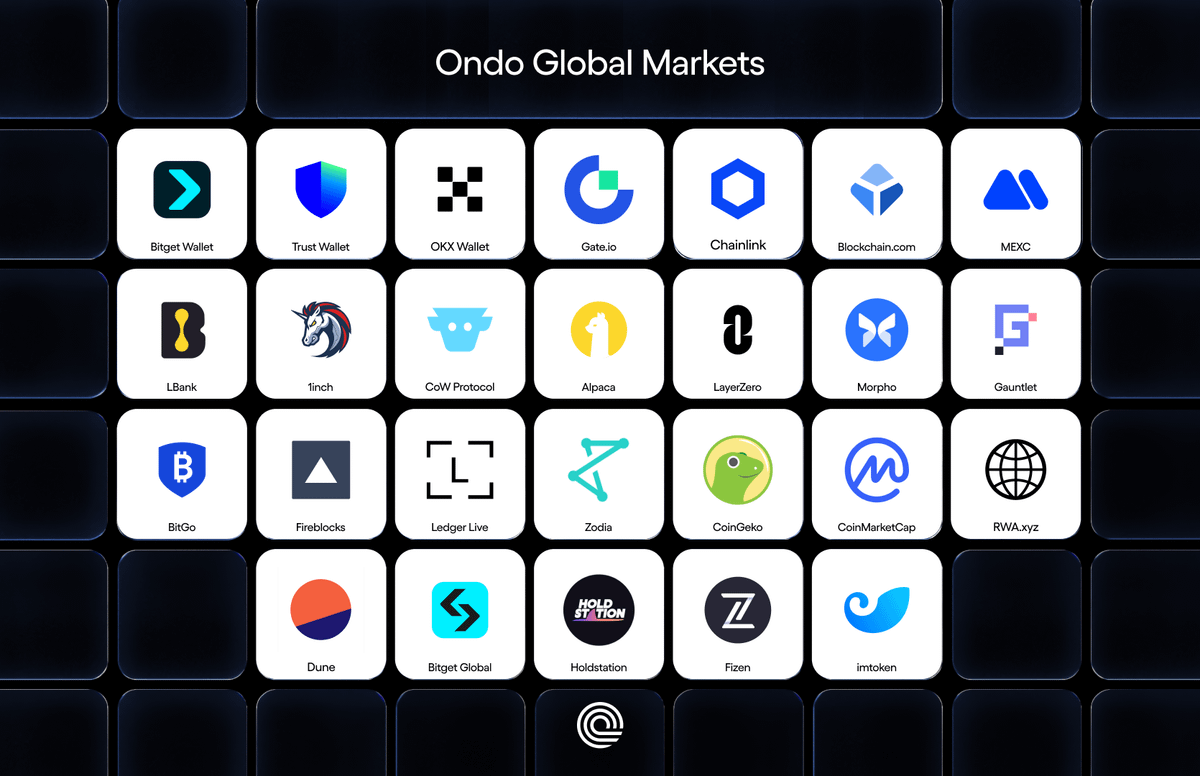
Ondo Global Markets is now live, providing one of the largest-ever selections of tokenized U.S. stocks & ETFs onchain with the liquidity of traditional finance, starting on @Ethereum.
100+ assets now live, with hundreds more on the way.
2/ Ondo Global Markets launches with support from many of the world's leading applications and platforms, including:
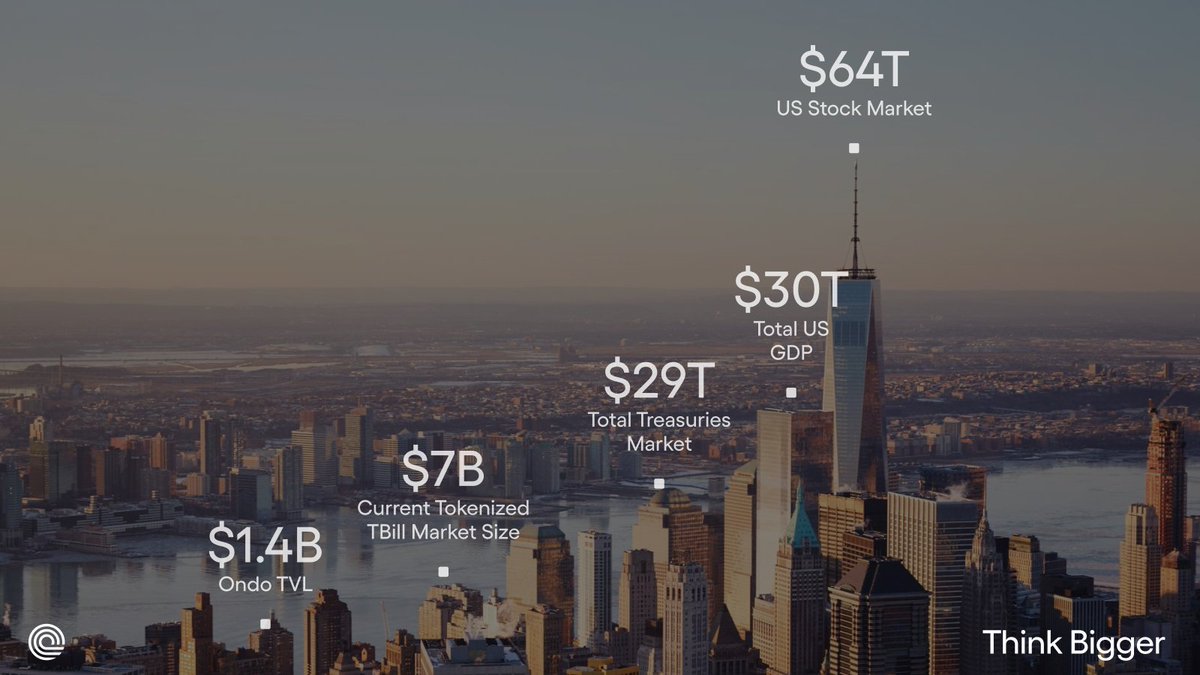
The current investment ecosystem is broken. Global investors have historically faced barriers to accessing the $64 trillion U.S. securities markets due to high fees, limited access, transfer frictions, platform fragmentation, and geographic exclusions.
These problems have persisted for decades, locking millions out of capital markets and stifling innovation. Ondo Global Markets breaks through these limitations and transforms how securities are issued, accessed, and traded.
1/ Kinexys by J.P. Morgan (@jpmorgan), Ondo Finance, and @chainlink are teaming up to connect bank settlement infrastructure to Ondo Chain.
Today, we are excited to announce the debut transaction on Ondo Chain testnet — a cross-chain, atomic DvP settlement of OUSG.
2/ This milestone marks the the first use of Ondo Chain’s infrastructure, and is a first-of-its-kind cross-chain, atomic Delivery versus Payment (DvP) settlement of a tokenized asset (OUSG) between Kinexys Digital Payments’ permissioned blockchain network and a Layer 1 blockchain network (Ondo Chain), via Chainlink’s cross-chain orchestration infrastructure.
This also marks an expansion of the Kinexys platform’s settlement integrations to date beyond fully private chains.
3/ Ondo Chain, our next-generation blockchain purpose-built to scale the tokenization of RWAs, combines the openness of public blockchains with the compliance and security standards required by institutions, laying the foundation for institutional-grade financial markets to move onchain.
1/ Today, we’re thrilled to announce Ondo Chain, our new Layer 1 blockchain purpose-built for institutional-grade RWAs.
Design advisors for the chain include new members of the Ondo Ecosystem: Franklin Templeton, Wellington Management, WisdomTree, Google Cloud, ABN Amro, Aon, and McKinsey. The Ondo Ecosystem already includes notable industry leaders such as BlackRock, PayPal and Morgan Stanley.
2/ Over the past year, as we built Ondo Global Markets—our platform for tokenized securities—we realized that today’s public blockchains lack the features necessary for regulated assets to thrive onchain at scale.
For tokenized RWAs to fulfill their potential, we need infrastructure that enables large-scale institutional adoption while maintaining the open access that makes blockchain powerful. This requires addressing five key challenges:
Incompatibility with DeFi. Public securities have unique requirements, including corporate actions like stock splits and dividend distributions, that DeFi smart contracts are not designed for. Oracles must also support large-scale, reliable data feeds across thousands of assets.
Cross-chain liquidity fragmentation. Tokenized RWAs need to be issued across multiple chains. Issuing these assets compliantly, and managing the liquidity across chains takes significant resources. It also makes bridging a necessity, but many of today’s bridges introduce security risks and add additional points of failure.
High and volatile transaction fees. On many blockchains, gas fees are paid in volatile native tokens, making costs unpredictable.
Inadequate network and protocol security. Many existing security models rely on staking native crypto tokens, but RWAs are far less volatile than crypto. During market downturns, this mismatch can undermine security, and it needlessly increases the costs to run the chain.
Institutional regulatory concerns. Regulated institutions face significant barriers to transacting on public blockchains, from compliance risks to gas fees to front-running concerns. If institutions can’t participate, the RWA space remains limited.
3/ Key Features of Ondo Chain:
Ondo Chain is designed from the ground up to solve these problems and enable true institutional-scale RWAs. It combines the best aspects of public and permissioned blockchains to provide the infrastructure for institutions, and the financial system, to come onchain. Features include:
Institutional-Grade Security via RWAs. Ondo Chain validators can stake RWAs to secure the network. This enhances security for the chain, while also lowering cost. It also enables RWAs to tap into new crypto native primitives, like staking.
Permissioned Validators. To prevent MEV and front-running, Ondo Chain validators are permissioned and will only include reputable and/or regulated institutions. This enhances investor protections and makes Ondo Chain suitable for institutions that need best execution guarantees.
Institutional Network Connectivity. A subset of validators will be run by financial institutions, allowing seamless connectivity to TradFi networks. This reduces latency for transactions involving RWAs and expands access to off-chain assets and liquidity.
Scalable and Secure Data Feeds. Ondo Chain validators will act as enshrined oracles, publishing key offchain data—like asset prices and interest rates—directly onchain. This ensures accuracy, reduces manipulation risk, and improves scalability.
Native Omnichain Messaging & Bridging. Ondo Chain natively incorporates the Ondo Bridge. Primary security will be provided by the Ondo Chain validators that run their own decentralized verifier network (DVN), with additional DVNs used at higher transaction amounts. Ondo Chain will also make it easy for developers to create natively omnichain applications by acting as the ‘source of truth’ for key pieces of information across supported chains.
Enshrined Proof of Reserves & Collateral. Ondo Chain validators will verify that every tokenized RWA is fully backed by the underlying asset. This reduces counterparty risk, increases transparency, and shifts trust from a single minter to a distributed validator network.
Open Access & Development. While validators are permissioned, the chain is open. Anyone can issue tokens, develop apps, and participate. Built-in identity and permissioning features allow issuers to apply compliance rules at the contract level.
Native DeFi Support for RWAs. RWAs will have full native support across borrowing, lending, and staking. Ondo Chain’s architecture enables DeFi protocols to seamlessly integrate tokenized securities without breaking existing DeFi mechanics.
Institutional-Grade Governance. Governance will be decentralized, with key financial institutions acting as permissioned validators. This model ensures Ondo Chain operates as an industry utility—similar to the DTCC—while remaining adaptable to evolving regulations.
1/ Today, we’re excited to unveil a first look at the next evolution for Ondo Global Markets (Ondo GM), our RWA tokenization platform designed to enable onchain access to stocks, bonds, and ETFs. What stablecoins did for dollars, Ondo Global Markets will do for securities.
2/ The current investment ecosystem is broken. High fees, limited access, transfer frictions, platform fragmentation, and hidden risks create barriers for all participants. These problems have persisted for decades, locking millions out of capital markets and stifling innovation.
3/ At Ondo, we believe there’s a better way. By leveraging blockchain technology, we can bring institutional-grade financial markets onchain, making them more accessible, transparent, and efficient. That’s why, last year, we announced our intention to build what we call Ondo Global Markets, a tokenization platform designed to bring public securities onchain.
President @realDonaldTrump's inauguration has spurred excitement in institutional tokenization. Executive orders and bold visions are setting the stage for transformative growth.
Here are the key recent developments in tokenization that you might have missed. 👇
1️⃣ President Trump signs a landmark executive order to “strengthen US leadership in digital finance”
Addressing the World Economic Forum in Davos, President Trump declared to the world that “the United States will be the world capital of crypto.”
Following his statement, he signed a landmark executive order to establish the Presidential Working Group on Digital Asset Markets, aiming to bolster US leadership in digital finance.
At Ondo, we look forward to supporting leadership that can make this vision a reality.
2️⃣ CEOs of US financial institutions lean into digital assets
At the World Economic Forum, CEOs of major US financial institutions expressed interest in further embracing digital assets, including:
@BlackRock’s CEO, Larry Fink: “As a huge believer in crypto, blockchain and tokenization, I want the SEC to rapidly approve the tokenization of bonds and stocks."
@BNYglobal's CEO, Robin Vince: “Digital assets represent a new, innovative technology that we believe could play a vital role in the financial system over the next 10 to 20 years.”
@MorganStanley's CEO, Ted Pick: “We are working with the Treasury and other regulators to figure out how to offer [crypto transactions] safely."
1/ 🚨 @OndoFinance is solving the RWA liquidity problem 🚨
Introducing Ondo Global Markets, a platform to bring all publicly traded securities onchain with native access to traditional securities exchange liquidity (e.g. Nasdaq/NYSE/LSE).
2/ The biggest challenge today in making RWAs useful at scale is liquidity.
For years, RWAs have failed to achieve material adoption because they have been illiquid. The RWA industry was, until recently, largely focused on the tokenization of illiquid assets like private credit.
Given their lack of liquidity, these RWAs don’t make for quality collateral for onchain lending, derivatives, or other protocols.
3/ A year ago we launched OUSG, the world’s first tokenized US Treasuries product, which wrapped a Blackrock Treasuries ETF.
We launched OUSG in part out of a belief that the RWA space should focus instead on tokenizing assets that have deep existing liquidity as those assets would make better collateral in DeFi.