📢Japan has just posted meeting materials for their annual COVID strain selection, and there’s some good news, but also, by my estimation, some potentially very bad news…
Here is the presentation from Takeda, which is Novavax’s partner in Japan who completes strain selection duties and manufacturers the Nuvaxovid antigen: mhlw.go.jp/content/109060…
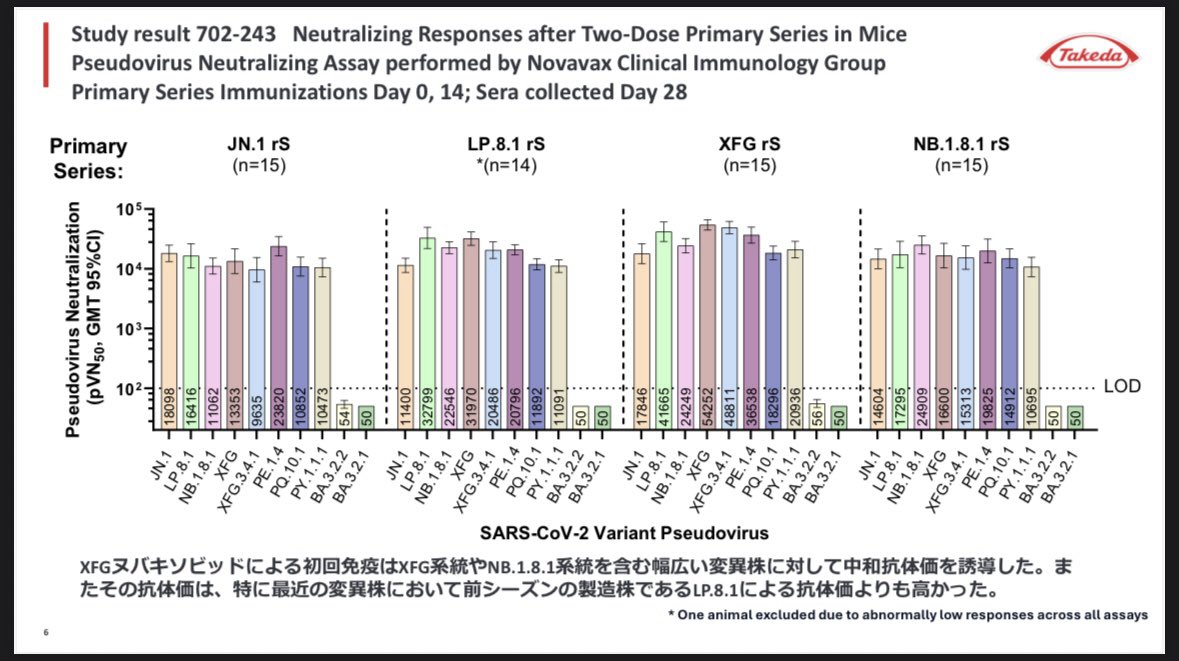
In the first slide, they directly compare a priming series of JN.1, LP.8.1, XFG, and NB.1.8.1. The result is very clearly that XFG provides the best response across the entire JN.1 lineage, so it’s a good thing that the FDA and Sanofi have chosen XFG as the 2026-2027 variant. Notably, however, there is almost no neutralization at all against BA.3.2 variants.
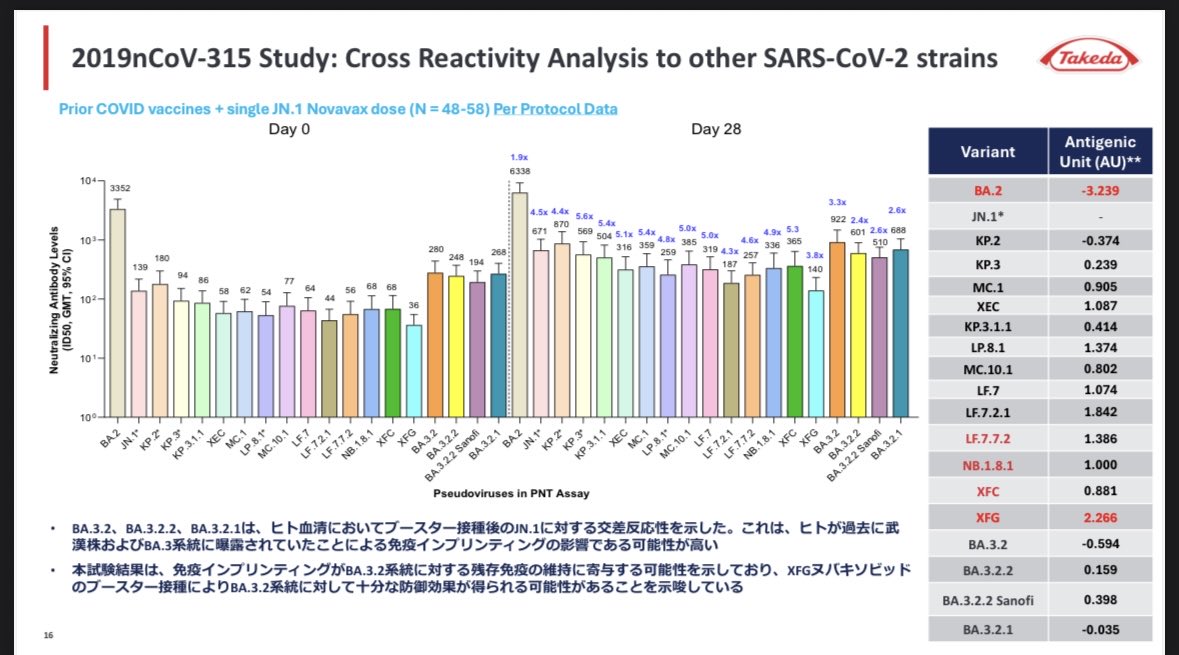
On the next slide, they’re showing that the JN.1 vaccine actually has really good cross-reactivity to BA.3.2 variants. The weakest cross-reactivity is against the XFG variant, so once again, this shows that it’s the best choice for the 2026-2027 update.
When it comes to the conflicting BA.3.2 results, my takeaway is that current JN.1/XFG vaccines can expand antibody coverage against it pretty well, but that is entirely reliant upon having imprinting against early SARS2 variants (which someone would’ve gotten either through exposure or vaccination). Well, if someone has never had COVID before, and they’ve also never gotten an ancestral mRNA vaccine (which causes stronger imprinting), then that may put that person at a significant disadvantage when it comes to protection against BA.3.2. That includes myself…and I’m guessing many of my followers as well.
There’s not much that we can do about that, except to hope that multiple doses of Nuvaxovud keep doing their thing to expand antibody coverage across a wide range of variants. This is part of why I always stress the importance of completing a new 3-dose series within a year when someone is switching to Nuvaxovid for the first time - it’s not a “one and done” type deal if you want to get the best results. And it’s also why folks should consider dosing every 6 months, instead of only once annually. Nothing is guaranteed either way, but that will gives it a much better chance of expanding the antibody range to cover BA.3.2 in a meaningful way.
Sanofi’s data presented at the FDA meeting last week does essentially show this same thing, with these 2 slides, but in a *much* more convoluted way. I wouldn’t have pieced two and two together here without the Takeda slides
• • •
Missing some Tweet in this thread? You can try to
force a refresh

While we *still* wait for Novavax to roll out, since today is Sunday and pharmacies & customer support lines are closed, I’m taking a step back to a very basic concept and giving a reminder of WHY we’re all waiting for Novavax in the first place. And why nobody should be considering rushing out to get mRNA right now.
Some forget in the midst of all the panic, and some people looking at us “holdouts” from the outside may still be confused about why anyone would ever bother to wait for Novavax in the first place.
This will also be the topic of the next article that @DonEford releases, so keep an eye out for a much more in-depth and scientific analysis than this thread will offer.
You often hear Novavax discussed as a “traditional protein-based vaccine”, which makes it similar to vaccines like Influenza, Hepatitis B, Tdap, & HPV. This is true, which is a testament to Novavax’s safety profile, but it’s not an entirely accurate characterization.
While protein is traditional, Novavax also makes use of cutting-edge technology in two distinct ways when compared to other vaccines.
Technology 1: Sf9 cells from the Fall Armyworm moth.
This is what makes it possible to produce a high-quality protein vaccine targeting a respiratory virus in the first place. Many vaccines, like traditional flu shots, are “inactivated virus vaccines”. These products are made by growing the virus in eggs, and then inactivating it to include in the finished shot. In that process, adaptation becomes an issue. The virus is required to adapt to grow in the eggs, which means the finished product may contain antigen that is clinically significantly different from the antigen seen in the virus actually circulating in the real world.
Novavax uses a completely different process, where they skip the step of needing to “grow” the entire virus. Instead, they take the gene for the SARS2 spike protein, insert it into a baculovirus, which then infects Sf9 insect cells that come from the fall armyworm moth. Those cells then produce pure spike protein that is used in the finished product. This allows them to produce antigen that is much more closely matched to circulating viruses, just like mRNA, while still using the more traditional protein base.
Technology 2: Matrix-M adjuvant.
Matrix-M, which is a saponin-based adjuvant developed by Novavax, is the star of the entire show here. Saponins are natural plant compounds that form soap-like foams in water. Matrix-M specifically comes from the bark of the Quillaja saponaria tree, aka “soapbark tree.” An adjuvant is a substance oftentimes added to vaccines to enhance the immune response to the antigen, and Matrix-M is a next-gen adjuvant that is showing an amazing amount of promise. For example, it’s now being used in a childhood malaria vaccine in Africa, and providing 70% efficacy, compared to the 35% efficacy from previous vaccines! In addition to driving strong antibody responses (B cells) which is pretty much the only thing that older adjuvants do well, Matrix-M also elicits a strong cellular response and memory among T Cells. The Matrix-M mechanism of action is illustrated below.
Okay, cool, thanks to the soapbark tree and the fall armyworm moth. Nature is great! But how do these technologies play out in the real world when it comes to the COVID vaccine?
Do we have evidence of them *actually* providing us particularly noteworthy protection?
Yes! The following categories and studies are all proof of that, and are just a selected handful out of many dozens of studies that prove why Novavax is the best vaccine choice.
There are 5 main categories (in addition to the benefit of the JN.1 antigen target, which I’ve already described in the past) that illustrate why Novavax is the best choice:
1. Less waning/better infection protection
2. “Universal-like” variant coverage
3. Better mucosal protection
4. Less side effects
5. No IgG4 class switching
1/4
🔵Novavax wanes less over time, and provides meaningful protection against actual infection.
Study 1:
One-year follow-up of the immunogenicity and safety of a primary series of the NVX-CoV2373 (TAK-019) vaccine in healthy Japanese adults: Final report of a phase I/II randomized controlled trial: sciencedirect.com/science/articl…
This study found that priming series of Novavax induced persistent immune responses up to 1 year after the second dose.
Study 2:
Real-world effectiveness of NVX-CoV2373 and BNT162b2 mRNA COVID-19 vaccination in South Korea: sciencedirect.com/science/articl…
Novavax performed better than the Pfizer vaccine for preventing lab-confirmed SARS-CoV-2 infection. Novavax has an aHR of 0.78 after the third dose and 0.86 after the fourth dose, meaning it was 14% to 22% better at preventing infection.
Study 3:
Effectiveness of NVX-CoV2373 and BNT162b2 COVID-19 Vaccination in South Korean Adolescents: pubmed.ncbi.nlm.nih.gov/40865116/
This is the same type of study as the previous one, except this time, it was conducted in an adolescent population. Once again, it found that Novavax performed better than the Pfizer vaccine. Novavax had an aHR of 0.57 for a priming series and 0.68 for a booster dose, meaning it was 32% to 43% better at preventing infection:
Study 4:
Characteristics and Outcomes for Recipients of NVX-CoV2373: A Real-World Retrospective Study in Germany: mdpi.com/2076-393X/12/4…
Within the 10 months after receiving Novavax, there was a 95% reduction in the amount of doctor’s visits associated with COVID-19 diagnosis.
🔵Additional Novavax doses shrink the antigenic range. This means that the breadth of protective antibodies, against additional and future variants, increases.
This study found that “Boosting with Novavax resulted in enhanced cross-reactive immunity to SARS-CoV-2 variants, a decreased gap between immune recognition of the variants and the ancestral strain, and the induction of a potentially more universal-like response against SARS-CoV-2 variants.”
🔵Novavax provides better protection in the upper respiratory tract, which is extremely important when trying to avoid infections in general, long covid, and translocation to the brain & lower respiratory tract:
Study 1:
Efficacy of mRNA-1273 and Novavax ancestral or BA.1 spike booster vaccines against SARS-CoV-2 BA.5 infection in non-human primates: pmc.ncbi.nlm.nih.gov/articles/PMC10…
Novavax blunted virus replication and showed a significant reduction in viral load in the airway early post-infection, at days 2 and 4. Conversely, the mRNA shot offered only limited protection at days 2 and 4, and took longer to “catch up”.
Study 2:
Detection of anti–SARS-CoV-2 mucosal IgA in clinical saliva samples after a dose of Novavax COVID-19 vaccine: medrxiv.org/content/10.110…
Salivary samples collected 28 days after vaccination showed a significant increase in anti-SARS-CoV-2 spike antibodies.
For this study, it’s notable Novavax actually had to develop their own test to establish a way to test for mucosal IgA, because we didn't have one before, because we never needed one, because no vaccines in the past have even came close to providing this level of mucosal immunity. Let that sink in.
2/4
🔵Lower reactogenicity (less side effects):
Study 1:
Burden and Impact of Reactogenicity among Adults Receiving COVID-19 Vaccines in the United States and Canada: Results from a Prospective Observational Study: mdpi.com/2076-393X/12/1…
This study found lower rates of local and systemic reactogenicity symptoms reported for Novavax compared to mRNA. Additionally, a larger proportion of reported events were grade 1 (mild) for Novavax when compared to mRNA.
Conclusion: “Following receipt of NVX-CoV2373 than an mRNA vaccine. The data suggest that Novavax booster recipients trended toward being less impaired overall than recipients of an mRNA booster.”
Study 2 (SHIELD-Utah study):
mRNA and Protein Subunit COVID-19 Vaccine Reactogenicity and the Relationship to Productivity for Healthcare Workers and First Responders: medrxiv.org/content/10.110…
Workers who received Novavax were 60% less likely to report a systemic side effect (like fatigue) and 90% less likely to report a local side effect (like injection site pain). Novavax recipients lost 50% fewer work hours and 66% fewer productive hours.
Repeated mRNA vaccination was associated with an increase in Spike-specific IgG4. By contrast, IgG4 class switch was not observed following four doses of Novavax. SARS-CoV-2 specific IgG3, an IgG subclass known to induce potent neutralization and Fc functions, was higher after Novavax (>10X Vs. mRNA). There’s a whole lot to unpack here, but the basic idea is that igG4 class switch results in lower neutralizing antibodies and immune tolerance to SARS2 spike.
3/4