This is Clint Ober.
He spent 30 years grounding electrical systems in the cable industry.
Then he asked one question medicine never asked:
What happens when the human body is no longer connected to earth?
The answer is 40+ studies & a mechanism behind chronic inflammation: 🧵
He spent 30 years grounding electrical systems in the cable industry.
Then he asked one question medicine never asked:
What happens when the human body is no longer connected to earth?
The answer is 40+ studies & a mechanism behind chronic inflammation: 🧵


1/ Before 1960, humans were grounded most of the time.
People wore leather-soled shoes, which absorbed moisture & body salts — making them electrically semi-conductive.
In rain, people often removed their shoes to keep them dry.
Kids spent hours barefoot outside.
Then came mass-produced plastic soles. Synthetic carpeting. Television, that led to more indoor living.
In 60 years, 95% of shoes sold became fully insulating rubber or synthetic soles.
Humans spent millions of years electrically connected to the earth.
Then within a few decades, we disconnected completely.
People wore leather-soled shoes, which absorbed moisture & body salts — making them electrically semi-conductive.
In rain, people often removed their shoes to keep them dry.
Kids spent hours barefoot outside.
Then came mass-produced plastic soles. Synthetic carpeting. Television, that led to more indoor living.
In 60 years, 95% of shoes sold became fully insulating rubber or synthetic soles.
Humans spent millions of years electrically connected to the earth.
Then within a few decades, we disconnected completely.
2/ Every electrical system is grounded except the human body.
Ober spent 30 years installing grounding rods in the cable industry.
Everything electrical had to be grounded to prevent static buildup, interference, and fires.
Then one day in Sedona, watching tourists walk by in rubber-soled shoes, he realized:
Humans are electrical systems too.
Brain activity, nerve signaling, muscle contraction, immune function — everything depends on electrical gradients and electron movement.
The human body is electrical first, chemical second.
In 1960, most doctor visits were for infections, acute injuries, and childbirth.
Today, most are for inflammation-related health disorders.
Complete inversion in 60 years.
Ober spent 30 years installing grounding rods in the cable industry.
Everything electrical had to be grounded to prevent static buildup, interference, and fires.
Then one day in Sedona, watching tourists walk by in rubber-soled shoes, he realized:
Humans are electrical systems too.
Brain activity, nerve signaling, muscle contraction, immune function — everything depends on electrical gradients and electron movement.
The human body is electrical first, chemical second.
In 1960, most doctor visits were for infections, acute injuries, and childbirth.
Today, most are for inflammation-related health disorders.
Complete inversion in 60 years.
3/ The earth is a battery.
When your feet touch the ground, your body equalizes to earth potential.
Any excess positive charge you've built up from friction, EMFs, synthetic clothes, carpets is neutralized first.
Your body then equalizes to the Earth's negative electrical potential.
So you end up with a small negative charge, matching the Earth's surface.
The battery works like this:
The negative pole is the earth's surface.
The positive pole is the ionosphere, 60–100km above it.
Powered continuously by the sun through global thunderstorms — primarily over Africa and South America.
There are roughly 2,000 thunderstorms active at any given moment, producing 40–50 lightning strikes per second globally.
Scientists calculated:
If all thunderstorms stopped simultaneously, the earth's charge would dissipate in 45 minutes.
Every living thing in contact with the earth shares that negative electrical charge — trees, animals, plants.
That's not metaphor.
That's atmospheric physics.
When your feet touch the ground, your body equalizes to earth potential.
Any excess positive charge you've built up from friction, EMFs, synthetic clothes, carpets is neutralized first.
Your body then equalizes to the Earth's negative electrical potential.
So you end up with a small negative charge, matching the Earth's surface.
The battery works like this:
The negative pole is the earth's surface.
The positive pole is the ionosphere, 60–100km above it.
Powered continuously by the sun through global thunderstorms — primarily over Africa and South America.
There are roughly 2,000 thunderstorms active at any given moment, producing 40–50 lightning strikes per second globally.
Scientists calculated:
If all thunderstorms stopped simultaneously, the earth's charge would dissipate in 45 minutes.
Every living thing in contact with the earth shares that negative electrical charge — trees, animals, plants.
That's not metaphor.
That's atmospheric physics.
4/ Ober's first grounding experiment eliminated chronic pain he'd lived with for years.
Sedona, Arizona, 1999.
Ober was 54 and living with chronic pain from decades of skiing, tennis, ranching, and broken bones.
He ran a wire from a ground rod outside to metal duct tape across his mattress. Connected a voltmeter. Lay down.
Normally he needed Advil to sleep. He fell asleep without it.
Woke with the meter beside him.
Repeated 3 nights. Same result.
Then he told two older friends to try it. Days later, one said:
"My arthritis pain is way down."
Ober's own chronic pain had significantly reduced.
He later described it as both the best and worst day of his life.
The best because he realized he'd discovered something important.
The worst because he realized nobody was going to believe him.
Sedona, Arizona, 1999.
Ober was 54 and living with chronic pain from decades of skiing, tennis, ranching, and broken bones.
He ran a wire from a ground rod outside to metal duct tape across his mattress. Connected a voltmeter. Lay down.
Normally he needed Advil to sleep. He fell asleep without it.
Woke with the meter beside him.
Repeated 3 nights. Same result.
Then he told two older friends to try it. Days later, one said:
"My arthritis pain is way down."
Ober's own chronic pain had significantly reduced.
He later described it as both the best and worst day of his life.
The best because he realized he'd discovered something important.
The worst because he realized nobody was going to believe him.
5/ Almost no scientific literature on grounding existed in 1999.
After his first grounding experiments, Ober started approaching researchers and universities looking for answers.
He explained the concept: connect a wire to a nail in the ground, connect it to someone's body — better sleep and less pain.
UCLA sleep researchers told Ober he was nuts.
"You expect us to believe that? Get out of here."
He searched the scientific literature. Almost nothing existed.
Went to University of Arizona: no one could help.
After struggling to find researchers who would take him seriously, Ober connected with a couple of students at a UCLA sleep lab.
They were intrigued by the idea and taught him how to design a proper blind study.
For the first time, grounding was about to be tested scientifically.
After his first grounding experiments, Ober started approaching researchers and universities looking for answers.
He explained the concept: connect a wire to a nail in the ground, connect it to someone's body — better sleep and less pain.
UCLA sleep researchers told Ober he was nuts.
"You expect us to believe that? Get out of here."
He searched the scientific literature. Almost nothing existed.
Went to University of Arizona: no one could help.
After struggling to find researchers who would take him seriously, Ober connected with a couple of students at a UCLA sleep lab.
They were intrigued by the idea and taught him how to design a proper blind study.
For the first time, grounding was about to be tested scientifically.
6/ The first blind grounding study produced unusually large improvements in sleep and chronic pain.
After UCLA students taught Ober how to design a proper blind study, he needed 60 subjects:
30 grounded.
30 sham-grounded.
But because he wasn't a doctor, nobody in medicine would provide patients.
Then, while getting a haircut in Ventura, California, Ober overheard women talking about chronic pain and sleep problems.
He approached the salon owner and explained the study.
Word spread through beauty salons across Ventura County.
Eventually, Ober recruited 60 people ages 23 to 74 suffering from chronic pain and sleep problems.
For 30 days, all participants slept on conductive carbon-fiber mattress pads — Ober's early grounding products.
Grounded group:
Pads connected via a wire to a dedicated ground rod outside the bedroom window.
Sham/control group:
Pads looked identical but were not connected to Earth.
Published results in 2000:
100% of grounded subjects woke feeling rested (vs 13% of controls)
93% reported improved sleep quality (vs 13%)
85% reported falling asleep faster (vs 13%)
82% reported reduced muscle stiffness and pain (vs 0%)
74% reported reduced chronic back and joint pain (vs 0%)
Some participants also reported relief from asthma, PMS, sleep apnea, rheumatoid arthritis symptoms, and hypertension.
The grounded group improved across nearly every category.
After UCLA students taught Ober how to design a proper blind study, he needed 60 subjects:
30 grounded.
30 sham-grounded.
But because he wasn't a doctor, nobody in medicine would provide patients.
Then, while getting a haircut in Ventura, California, Ober overheard women talking about chronic pain and sleep problems.
He approached the salon owner and explained the study.
Word spread through beauty salons across Ventura County.
Eventually, Ober recruited 60 people ages 23 to 74 suffering from chronic pain and sleep problems.
For 30 days, all participants slept on conductive carbon-fiber mattress pads — Ober's early grounding products.
Grounded group:
Pads connected via a wire to a dedicated ground rod outside the bedroom window.
Sham/control group:
Pads looked identical but were not connected to Earth.
Published results in 2000:
100% of grounded subjects woke feeling rested (vs 13% of controls)
93% reported improved sleep quality (vs 13%)
85% reported falling asleep faster (vs 13%)
82% reported reduced muscle stiffness and pain (vs 0%)
74% reported reduced chronic back and joint pain (vs 0%)
Some participants also reported relief from asthma, PMS, sleep apnea, rheumatoid arthritis symptoms, and hypertension.
The grounded group improved across nearly every category.
7/ Grounding synchronized cortisol in every subject — in both directions.
In 2004, Ober partnered with a retired San Diego anesthesiologist who was interested in electric field research but didn't believe it.
He said he'd like to prove Ober wrong.
So they set up a study.
They measured salivary cortisol every 4 hours for 24 hours in 12 subjects — before and after 8 weeks of sleeping grounded.
Pre-grounding profiles: irregular, misaligned.
Some subjects high at night and low in the morning.
Post-grounding: all 12 subjects synchronized into the same pattern.
Lowest at midnight.
Spike at 4am.
Peak at 6am — the signal that helps get you out of bed with energy.
Gradual decline through the day.
All 12 woke fewer times at night.
11 of 12 fell asleep faster.
Younger women with chronically elevated cortisol: normalized down.
Older women with low cortisol: normalized up.
The earth corrected in both directions.
In 2004, Ober partnered with a retired San Diego anesthesiologist who was interested in electric field research but didn't believe it.
He said he'd like to prove Ober wrong.
So they set up a study.
They measured salivary cortisol every 4 hours for 24 hours in 12 subjects — before and after 8 weeks of sleeping grounded.
Pre-grounding profiles: irregular, misaligned.
Some subjects high at night and low in the morning.
Post-grounding: all 12 subjects synchronized into the same pattern.
Lowest at midnight.
Spike at 4am.
Peak at 6am — the signal that helps get you out of bed with energy.
Gradual decline through the day.
All 12 woke fewer times at night.
11 of 12 fell asleep faster.
Younger women with chronically elevated cortisol: normalized down.
Older women with low cortisol: normalized up.
The earth corrected in both directions.
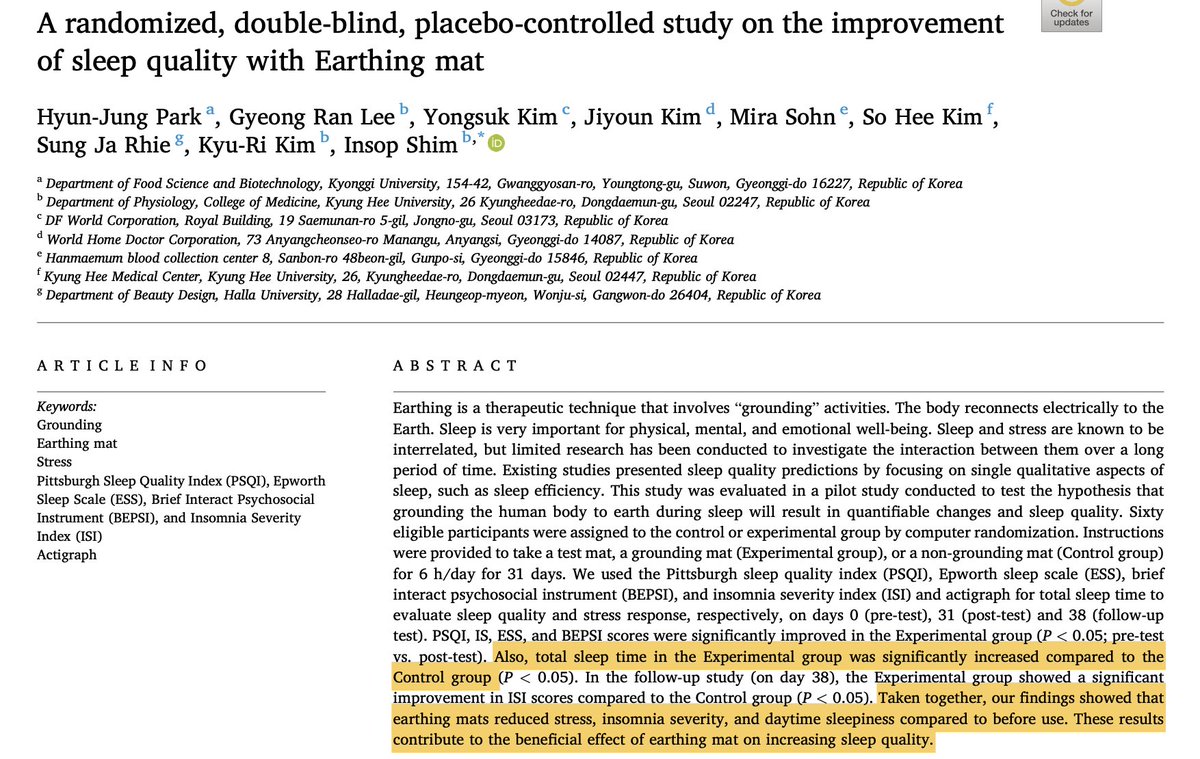
8/ A 2025 Korean double-blind grounding study found sleep improvements disappeared when grounding stopped.
H.J. Park and colleagues at Kyung Hee University in Seoul ran a study: 60 subjects. 31 days.
Half slept on grounding mats, half on visually identical sham mats.
Neither the subjects nor the researchers knew which mats were real.
Sleep was measured by ActiGraph accelerometers worn continuously — not questionnaires, not self-report.
Device-measured actual sleep time.
The grounded group showed significantly increased total sleep time compared to controls.
The follow-up finding is the one that matters most:
When grounding stopped for 7 days, insomnia scores began rising again.
Meaning the benefit isn't a one-time fix — it requires continued grounding.
H.J. Park and colleagues at Kyung Hee University in Seoul ran a study: 60 subjects. 31 days.
Half slept on grounding mats, half on visually identical sham mats.
Neither the subjects nor the researchers knew which mats were real.
Sleep was measured by ActiGraph accelerometers worn continuously — not questionnaires, not self-report.
Device-measured actual sleep time.
The grounded group showed significantly increased total sleep time compared to controls.
The follow-up finding is the one that matters most:
When grounding stopped for 7 days, insomnia scores began rising again.
Meaning the benefit isn't a one-time fix — it requires continued grounding.
9/ Grounding increases zeta potential and reduces blood viscosity, a major factor in heart attacks and strokes.
Dr. Stephen Sinatra — cardiologist of 50+ years and former chief of cardiology at Manchester Memorial Hospital in Connecticut — explained it simply:
"We want blood like red wine. Not like red ketchup.
Ketchup clots in the brain — that's a stroke.
Clots in the heart — that's a heart attack."
Every major cardiovascular condition connects to blood viscosity.
Here's the mechanism behind how grounding thins the blood:
Red blood cells carry a negative electrical surface charge.
When that charge weakens, the cells begin sticking together and stacking like rolls of coins.
Blood thickens.
When grounded, the body absorbs electrons from the earth. Red blood cells become more negatively charged and repel each other like negative magnets.
Blood thins.
Sinatra published a pilot study in 2013:
10 subjects were grounded for 2 hours using conductive electrode patches attached to the palms of both hands and soles of both feet — connected by wires to a ground rod outside.
Blood samples were taken before and after.
Researchers measured zeta potential — the electrical surface charge on red blood cell membranes — and observed red blood cell aggregation/clumping under a darkfield microscope.
The result?
Average zeta potential:
-5.28 mV before grounding
-14.3 mV after grounding
A 270% increase in electrical surface charge.
Normal healthy range for RBC zeta potential is roughly −15 mV to −20 mV.
Values closer to zero (like −5 mV) mean weaker repulsion → more clumping → thicker blood.
Grounding shifted the average from suboptimal to healthy territory.
All 10 subjects improved.
Red blood cells stopped stacking.
This directly improved flow to capillaries.
Visual improvements were dramatic under darkfield microscopy — blood appeared visibly thinner and more fluid.
Healthier subjects tended to show smaller gains; those with more issues showed larger improvements.
Because grounding shifts blood viscosity so significantly, Sinatra warned that anyone on blood-thinning medication should be medically supervised.
Dr. Stephen Sinatra — cardiologist of 50+ years and former chief of cardiology at Manchester Memorial Hospital in Connecticut — explained it simply:
"We want blood like red wine. Not like red ketchup.
Ketchup clots in the brain — that's a stroke.
Clots in the heart — that's a heart attack."
Every major cardiovascular condition connects to blood viscosity.
Here's the mechanism behind how grounding thins the blood:
Red blood cells carry a negative electrical surface charge.
When that charge weakens, the cells begin sticking together and stacking like rolls of coins.
Blood thickens.
When grounded, the body absorbs electrons from the earth. Red blood cells become more negatively charged and repel each other like negative magnets.
Blood thins.
Sinatra published a pilot study in 2013:
10 subjects were grounded for 2 hours using conductive electrode patches attached to the palms of both hands and soles of both feet — connected by wires to a ground rod outside.
Blood samples were taken before and after.
Researchers measured zeta potential — the electrical surface charge on red blood cell membranes — and observed red blood cell aggregation/clumping under a darkfield microscope.
The result?
Average zeta potential:
-5.28 mV before grounding
-14.3 mV after grounding
A 270% increase in electrical surface charge.
Normal healthy range for RBC zeta potential is roughly −15 mV to −20 mV.
Values closer to zero (like −5 mV) mean weaker repulsion → more clumping → thicker blood.
Grounding shifted the average from suboptimal to healthy territory.
All 10 subjects improved.
Red blood cells stopped stacking.
This directly improved flow to capillaries.
Visual improvements were dramatic under darkfield microscopy — blood appeared visibly thinner and more fluid.
Healthier subjects tended to show smaller gains; those with more issues showed larger improvements.
Because grounding shifts blood viscosity so significantly, Sinatra warned that anyone on blood-thinning medication should be medically supervised.
10/ "Inflammation cannot exist in a grounded body." — Clint Ober
The body still has normal immune responses, but grounding appears to prevent acute inflammation from progressing into unresolved chronic inflammation.
Here's the mechanism:
The immune system uses neutrophils to destroy pathogens.
They release Reactive Oxygen Species (ROS) — electrically charged molecules that strip electrons from pathogens to destroy them.
This is called an oxidative burst.
The problem starts after the pathogen is destroyed.
If the body is ungrounded and lacks a reservoir of free electrons, leftover ROS remain highly reactive.
Excess ROS that aren't neutralized oxidize healthy tissue instead.
That oxidation is inflammation.
Free electrons from the earth neutralize excess ROS — stopping the cascade before it damages tissue.
Ober explains it like this:
Hot burning pain = oxidative = stops with grounding.
Dull residual pain = tissue damage already done = remains until tissue repairs.
When ROS aren't neutralized, the immune system begins laying down connective tissue fibers around the site.
The barricade helps contain the damage — but also blocks antioxidants and repair cells from entering.
Repair becomes incomplete. The immune system keeps firing.
James Oschman — biophysicist, cell biologist, author of Energy Medicine and one of the primary researchers behind grounding's inflammation mechanism — explained it this way:
"Electrons are the ultimate antioxidants — they can be semiconducted into the inflammatory pouch where dissolved antioxidants cannot reach."
In 2011, Dr. Paweł Sokal and his father Dr. Karol Sokal, both Polish physicians independently showed that a single night of grounding significantly increased gamma globulin concentrations following vaccination — meaning the immune response was strengthened and accelerated.
Oschman once explained grounding's antioxidant effect this way:
To match the electron supply from grounding, you'd need to eat roughly 450–500 pounds of blueberries every day.
The body still has normal immune responses, but grounding appears to prevent acute inflammation from progressing into unresolved chronic inflammation.
Here's the mechanism:
The immune system uses neutrophils to destroy pathogens.
They release Reactive Oxygen Species (ROS) — electrically charged molecules that strip electrons from pathogens to destroy them.
This is called an oxidative burst.
The problem starts after the pathogen is destroyed.
If the body is ungrounded and lacks a reservoir of free electrons, leftover ROS remain highly reactive.
Excess ROS that aren't neutralized oxidize healthy tissue instead.
That oxidation is inflammation.
Free electrons from the earth neutralize excess ROS — stopping the cascade before it damages tissue.
Ober explains it like this:
Hot burning pain = oxidative = stops with grounding.
Dull residual pain = tissue damage already done = remains until tissue repairs.
When ROS aren't neutralized, the immune system begins laying down connective tissue fibers around the site.
The barricade helps contain the damage — but also blocks antioxidants and repair cells from entering.
Repair becomes incomplete. The immune system keeps firing.
James Oschman — biophysicist, cell biologist, author of Energy Medicine and one of the primary researchers behind grounding's inflammation mechanism — explained it this way:
"Electrons are the ultimate antioxidants — they can be semiconducted into the inflammatory pouch where dissolved antioxidants cannot reach."
In 2011, Dr. Paweł Sokal and his father Dr. Karol Sokal, both Polish physicians independently showed that a single night of grounding significantly increased gamma globulin concentrations following vaccination — meaning the immune response was strengthened and accelerated.
Oschman once explained grounding's antioxidant effect this way:
To match the electron supply from grounding, you'd need to eat roughly 450–500 pounds of blueberries every day.
11/ Grounding increased ATP production and reduced mitochondrial ROS in the first direct grounding-mitochondria experiment ever published.
In June 2025, Giulivi and Kotz at the University of California, Davis published the first direct measurement of grounding's effect on mitochondrial function.
They used fluorescence-based assays specifically designed to avoid the confounding effect of metal probes.
Their findings?
- Grounded mitochondria produced 5–11% more ATP
- Grounded mitochondria produced 22–33% less ROS
- Mitochondrial membrane potential decreased 5–6%
That last finding sounds like reduced function — but it's the opposite.
A modest reduction in membrane potential exponentially lowers ROS production while maintaining or increasing ATP output.
The mitochondria run cleaner and more efficiently.
The methodological implication was massive:
Most prior mitochondrial experiments used metal probes that unintentionally grounded the samples.
The "ungrounded baseline" in decades of mitochondrial research was actually the grounded state.
Modern humans are largely ungrounded.
Most mitochondrial experiments weren't.
In June 2025, Giulivi and Kotz at the University of California, Davis published the first direct measurement of grounding's effect on mitochondrial function.
They used fluorescence-based assays specifically designed to avoid the confounding effect of metal probes.
Their findings?
- Grounded mitochondria produced 5–11% more ATP
- Grounded mitochondria produced 22–33% less ROS
- Mitochondrial membrane potential decreased 5–6%
That last finding sounds like reduced function — but it's the opposite.
A modest reduction in membrane potential exponentially lowers ROS production while maintaining or increasing ATP output.
The mitochondria run cleaner and more efficiently.
The methodological implication was massive:
Most prior mitochondrial experiments used metal probes that unintentionally grounded the samples.
The "ungrounded baseline" in decades of mitochondrial research was actually the grounded state.
Modern humans are largely ungrounded.
Most mitochondrial experiments weren't.

12/ Ober observed multiple sclerosis (MS) symptoms shift within 40 minutes of grounding.
Rheumatologists referred MS, lupus, and fibromyalgia patients to Ober because conventional medicine had nothing for them.
One MS patient: arm had to be held in a fixed position or it would wander uncontrollably.
Needed the bathroom every 20 minutes. Pale. Visibly stressed.
Ober placed EKG patches on her arms, connected to ground.
Didn't tell her what to expect.
40 minutes later: she hadn't needed the bathroom.
Color had returned. Her demeanor shifted.
She went to the mirror and screamed:
"I look like myself again."
Ober explains that MS damage occurs when the immune system's neutrophils oxidize the tissue around the myelin sheath, exposing raw nerves and causing pain and loss of motor control.
When an MS patient is grounded, their body is flooded with free electrons.
Ober: Within 5 to 15 minutes, these electrons reduce reactive oxygen radicals, stopping neutrophils from continuing to attack the myelin sheath.
Ober observed that during this short time, a patient's circulation and respiration improved, and pain began to visibly subside.
His explanation:
Grounding stops the active inflammatory attack.
But the nerve damage already caused by years of oxidation still requires time to heal.
Based on this mechanism, Ober tells MS patients:
"As long as you're grounded, you no longer have MS. You're in recovery."
Rheumatologists referred MS, lupus, and fibromyalgia patients to Ober because conventional medicine had nothing for them.
One MS patient: arm had to be held in a fixed position or it would wander uncontrollably.
Needed the bathroom every 20 minutes. Pale. Visibly stressed.
Ober placed EKG patches on her arms, connected to ground.
Didn't tell her what to expect.
40 minutes later: she hadn't needed the bathroom.
Color had returned. Her demeanor shifted.
She went to the mirror and screamed:
"I look like myself again."
Ober explains that MS damage occurs when the immune system's neutrophils oxidize the tissue around the myelin sheath, exposing raw nerves and causing pain and loss of motor control.
When an MS patient is grounded, their body is flooded with free electrons.
Ober: Within 5 to 15 minutes, these electrons reduce reactive oxygen radicals, stopping neutrophils from continuing to attack the myelin sheath.
Ober observed that during this short time, a patient's circulation and respiration improved, and pain began to visibly subside.
His explanation:
Grounding stops the active inflammatory attack.
But the nerve damage already caused by years of oxidation still requires time to heal.
Based on this mechanism, Ober tells MS patients:
"As long as you're grounded, you no longer have MS. You're in recovery."
13/ Grounding accelerates wound healing — including wounds medicine had given up on.
In 2024, researchers studied 21 type 2 diabetic patients whose wounds hadn't healed despite years of standard medical treatment.
Some wounds were over a decade old.
Patients grounded for one hour per day for 30 days.
They sat or lay comfortably with bare feet placed directly on a custom copper plate connected via copper wire to a copper rod driven into the earth outdoors.
The published study showed statistically significant reduction in wound size across all subjects.
The reason this works comes down to two things.
First: blood viscosity.
Diabetic wounds often fail because thick blood can't reach the injury site fast enough to deliver oxygen and nutrients.
Grounding improves circulation directly.
Second: electrotaxis.
When skin is injured, it generates its own electrical field as a repair signal.
Repair cells migrate toward that signal.
Grounding amplifies it by supplying continuous electrons from the earth.
Research showed this tripled the speed of skin cell recovery — bringing damaged skin back to nearly the same healing speed as healthy skin.
In 2024, researchers studied 21 type 2 diabetic patients whose wounds hadn't healed despite years of standard medical treatment.
Some wounds were over a decade old.
Patients grounded for one hour per day for 30 days.
They sat or lay comfortably with bare feet placed directly on a custom copper plate connected via copper wire to a copper rod driven into the earth outdoors.
The published study showed statistically significant reduction in wound size across all subjects.
The reason this works comes down to two things.
First: blood viscosity.
Diabetic wounds often fail because thick blood can't reach the injury site fast enough to deliver oxygen and nutrients.
Grounding improves circulation directly.
Second: electrotaxis.
When skin is injured, it generates its own electrical field as a repair signal.
Repair cells migrate toward that signal.
Grounding amplifies it by supplying continuous electrons from the earth.
Research showed this tripled the speed of skin cell recovery — bringing damaged skin back to nearly the same healing speed as healthy skin.

14/ Grounding research in animals removes one of the biggest objections entirely: placebo.
Researchers at Kyung Hee University in Korea tested grounding in controlled rat experiments.
Same food.
Same environment.
Same genetics.
The variable was ground contact.
Study 1 — stress and anxiety (2022).
Rats exposed to restraint stress developed anxiety-like behaviors.
Grounded rats:
- spent more time exploring open spaces
- showed reduced stress signaling in the brain
- showed reduced corticotropin-releasing factor (CRF), a major stress-signaling pathway
Study 2 — sleep architecture (2024).
Rats grounded for 21 days showed:
- significantly less wake time
- increased REM sleep
- increased non-REM sleep
- increased total sleep time
Researchers also found:
- lower orexin levels — orexin (hypocretin) is a wakefulness neuropeptide that keeps the brain alert and suppresses sleep, especially REM sleep. Lower orexin = weaker wake drive = easier transition into sleep and longer sleep duration.
- higher SOD1 expression, suggesting lower oxidative stress
Study 3 — neuroinflammation and cognition (2025).
Researchers chemically induced hippocampal inflammation and memory impairment.
Grounded rats showed:
- improved spatial memory
- lower inflammatory markers (IL-1β and PGE₂)
- higher anti-inflammatory IL-4
Conclusion:
Grounding reduced neuroinflammation, improved sleep, and improved cognitive function.
You cannot explain that with placebo.
Researchers at Kyung Hee University in Korea tested grounding in controlled rat experiments.
Same food.
Same environment.
Same genetics.
The variable was ground contact.
Study 1 — stress and anxiety (2022).
Rats exposed to restraint stress developed anxiety-like behaviors.
Grounded rats:
- spent more time exploring open spaces
- showed reduced stress signaling in the brain
- showed reduced corticotropin-releasing factor (CRF), a major stress-signaling pathway
Study 2 — sleep architecture (2024).
Rats grounded for 21 days showed:
- significantly less wake time
- increased REM sleep
- increased non-REM sleep
- increased total sleep time
Researchers also found:
- lower orexin levels — orexin (hypocretin) is a wakefulness neuropeptide that keeps the brain alert and suppresses sleep, especially REM sleep. Lower orexin = weaker wake drive = easier transition into sleep and longer sleep duration.
- higher SOD1 expression, suggesting lower oxidative stress
Study 3 — neuroinflammation and cognition (2025).
Researchers chemically induced hippocampal inflammation and memory impairment.
Grounded rats showed:
- improved spatial memory
- lower inflammatory markers (IL-1β and PGE₂)
- higher anti-inflammatory IL-4
Conclusion:
Grounding reduced neuroinflammation, improved sleep, and improved cognitive function.
You cannot explain that with placebo.

15/ Hospitals already ground patients during open-heart surgery. They just don't do it for everyone else.
Any electrical interference with the heart during surgery can be fatal.
Every major hospital already has grounding infrastructure installed in operating rooms.
But outside the operating room, grounding is almost never used therapeutically.
In 2017, researchers at Penn State published a NICU grounding study in the journal Neonatology.
26 premature infants were grounded using small conductive patches attached to the feet at Kidney 1 acupuncture point — considered the body's primary electron entry point.
The infants remained inside EMF-dense incubator environments while grounded.
Results:
- vagal tone improved by 67%
- autonomic nervous system function significantly improved
- skin voltage dropped ~95% when grounded
Researchers described this as a Faraday cage effect operating inside the incubator environment.
After the lead nurse moved to another hospital, the grounding program ended.
The evidence existed.
The infrastructure existed.
The protocol disappeared.
Dr. Gaétan Chevalier argues the future standard should be simple:
Every hospital bed grounded.
The electrical infrastructure already exists.
Medicine simply hasn't updated the biological model yet.
Ober once asked a group of Southern California cardiologists — who had been ordering grounding products for nearly two decades to help control hypertension — why they didn't recommend grounding to patients.
One replied:
"When somebody walks through that door they're worth about $10,000 to us.
We have to run tests.
We have to do this.
If I don't get them on a script they're going to go somewhere else.
Look around.
We've got all these staff.
We've got this building.
Doctors married to doctors.
We've created a trap we're all in.
You can't tell people to go home and get well for free.
What are we going to do?
How are we going to pay for our education?"
The doctor cited the lack of American Medical Association (AMA) approval, the heavy educational component required to teach patients about grounding, and the financial reality of running a practice with high overhead and medical degrees to pay off.
Any electrical interference with the heart during surgery can be fatal.
Every major hospital already has grounding infrastructure installed in operating rooms.
But outside the operating room, grounding is almost never used therapeutically.
In 2017, researchers at Penn State published a NICU grounding study in the journal Neonatology.
26 premature infants were grounded using small conductive patches attached to the feet at Kidney 1 acupuncture point — considered the body's primary electron entry point.
The infants remained inside EMF-dense incubator environments while grounded.
Results:
- vagal tone improved by 67%
- autonomic nervous system function significantly improved
- skin voltage dropped ~95% when grounded
Researchers described this as a Faraday cage effect operating inside the incubator environment.
After the lead nurse moved to another hospital, the grounding program ended.
The evidence existed.
The infrastructure existed.
The protocol disappeared.
Dr. Gaétan Chevalier argues the future standard should be simple:
Every hospital bed grounded.
The electrical infrastructure already exists.
Medicine simply hasn't updated the biological model yet.
Ober once asked a group of Southern California cardiologists — who had been ordering grounding products for nearly two decades to help control hypertension — why they didn't recommend grounding to patients.
One replied:
"When somebody walks through that door they're worth about $10,000 to us.
We have to run tests.
We have to do this.
If I don't get them on a script they're going to go somewhere else.
Look around.
We've got all these staff.
We've got this building.
Doctors married to doctors.
We've created a trap we're all in.
You can't tell people to go home and get well for free.
What are we going to do?
How are we going to pay for our education?"
The doctor cited the lack of American Medical Association (AMA) approval, the heavy educational component required to teach patients about grounding, and the financial reality of running a practice with high overhead and medical degrees to pay off.
16/ Grounding is one of the most effective recovery tools ever tested for delayed onset muscle soreness (DOMS).
In 2010, Dick Brown, Gaétan Chevalier, and Michael Hill published a pilot study at the University of Oregon investigating grounding and muscle recovery.
8 healthy young men performed eccentric calf raises specifically designed to induce severe delayed-onset muscle soreness.
Subjects stayed in a controlled motel environment with identical food, sleep schedules, and minimal outside activity.
Double-blind, sham-controlled:
Grounded group:
conductive electrode patches attached to the calves and bottoms of both feet + conductive grounding sheets connected to a true earth ground outside.
Sham group:
identical setup, but the grounding connection was secretly broken.
Researchers measured:
- pain
- creatine kinase (CK) — a blood marker of muscle damage
- white blood cells
- cortisol
- MRI imaging
- magnetic resonance spectroscopy markers of muscle recovery
The grounded group showed:
- less pain (both subjective scale and higher pressure tolerance)
- lower white blood cell counts and altered immune response patterns (suggesting reduced inflammation)
- lower CK levels (less muscle damage leakage)
- better MRI/spectroscopy markers of recovery
The grounded group recovered faster overall.
Ungrounded subjects had more prolonged soreness and inflammatory signs.
James Oschman called it one of the most impressive grounding studies ever performed.
"Earthing was the best treatment ever found for delayed onset muscle soreness.
Massage helps.
Electrical stimulation helps.
But grounding really does the job."
Then in 2019, Dr. Erich Müller and colleagues at the University of Salzburg and the Austrian Olympic Training Center tested the same idea again — this time with a much larger and more rigorously controlled study.
They took 22 healthy male athletes.
Triple-blinded randomized controlled trial.
Triple-blind, meaning participants, researchers, and statisticians did not know who was grounded.
Researchers induced severe muscle damage using 20 minutes of downhill treadmill running at a −25% slope — a well-validated eccentric-loading model known to create substantial inflammation and DOMS.
Subjects then recovered for 10 days sleeping either:
- grounded
- sham-grounded
All subjects slept on visually identical conductive recovery sheets.
The grounded group showed:
- faster recovery
- less decline in strength
- better jump performance
- lower creatine kinase (CK) — meaning less muscle damage
- lower inflammatory markers associated with tissue damage
- better maintenance of performance capacity throughout recovery
The protocol was intentionally so severe that neither group fully recovered by day 10.
But the grounded athletes consistently recovered faster.
In 2010, Dick Brown, Gaétan Chevalier, and Michael Hill published a pilot study at the University of Oregon investigating grounding and muscle recovery.
8 healthy young men performed eccentric calf raises specifically designed to induce severe delayed-onset muscle soreness.
Subjects stayed in a controlled motel environment with identical food, sleep schedules, and minimal outside activity.
Double-blind, sham-controlled:
Grounded group:
conductive electrode patches attached to the calves and bottoms of both feet + conductive grounding sheets connected to a true earth ground outside.
Sham group:
identical setup, but the grounding connection was secretly broken.
Researchers measured:
- pain
- creatine kinase (CK) — a blood marker of muscle damage
- white blood cells
- cortisol
- MRI imaging
- magnetic resonance spectroscopy markers of muscle recovery
The grounded group showed:
- less pain (both subjective scale and higher pressure tolerance)
- lower white blood cell counts and altered immune response patterns (suggesting reduced inflammation)
- lower CK levels (less muscle damage leakage)
- better MRI/spectroscopy markers of recovery
The grounded group recovered faster overall.
Ungrounded subjects had more prolonged soreness and inflammatory signs.
James Oschman called it one of the most impressive grounding studies ever performed.
"Earthing was the best treatment ever found for delayed onset muscle soreness.
Massage helps.
Electrical stimulation helps.
But grounding really does the job."
Then in 2019, Dr. Erich Müller and colleagues at the University of Salzburg and the Austrian Olympic Training Center tested the same idea again — this time with a much larger and more rigorously controlled study.
They took 22 healthy male athletes.
Triple-blinded randomized controlled trial.
Triple-blind, meaning participants, researchers, and statisticians did not know who was grounded.
Researchers induced severe muscle damage using 20 minutes of downhill treadmill running at a −25% slope — a well-validated eccentric-loading model known to create substantial inflammation and DOMS.
Subjects then recovered for 10 days sleeping either:
- grounded
- sham-grounded
All subjects slept on visually identical conductive recovery sheets.
The grounded group showed:
- faster recovery
- less decline in strength
- better jump performance
- lower creatine kinase (CK) — meaning less muscle damage
- lower inflammatory markers associated with tissue damage
- better maintenance of performance capacity throughout recovery
The protocol was intentionally so severe that neither group fully recovered by day 10.
But the grounded athletes consistently recovered faster.
17/ Grounding may be one of the most underutilized performance tools in professional sports.
In 2007, the Discovery Channel Pro Cycling Team integrated grounding into their recovery protocols during the Tour de France.
Riders slept on grounding sheets or conductive sleeping bags/mats every night while at the race.
During one stage, a rider hit a car and severely injured his arm.
The team doctor said he was out of the race.
Chiropractor Jeff Spencer applied grounding patches around the injury and kept the rider grounded overnight during sleep.
By the next morning:
- minimal redness
- minimal swelling
- minimal pain
The rider continued racing the following day.
Spencer later said grounding became one of the team's most important recovery tools during the Tour.
The team used it for reducing inflammation, accelerating wound healing, lowering muscle soreness, and improving overall recovery between brutal stages.
Discovery Channel Pro Cycling Team won the 2007 Tour de France.
Researchers later began studying grounding during training itself.
In 2013, Paweł Sokal and colleagues studied grounding during exercise using a double-blind crossover design.
42 male subjects.
30 minutes cycling at 50% VO₂max.
Blood urea — a waste product created when the body breaks down protein — was significantly lower in grounded subjects at every measurement point:
- before exercise
- 15 minutes into exercise
- 30 minutes into exercise
- 40 minutes into recovery
The statistical significance was extreme — meaning the probability the effect happened randomly was extraordinarily low.
Lower blood urea = less protein being broken down.
More of what you eat goes toward building muscle instead of being burned for energy.
The paper directly compared this to space flight, where protein breakdown is a major physiological problem.
Grounding appeared to produce the opposite effect.
Biophysicist James Oschman recommends athletes ground for at least 15 minutes before competition.
His explanation:
The body's connective tissue acts as a reservoir for electrons.
Grounding "tops up" that reservoir before physical stress begins.
That provides two major advantages:
- more electrons available for mitochondrial ATP production
- immediate antioxidant defense when tissue damage occurs during competition
The moment injury occurs, stored electrons can move directly to the injury site and neutralize excess free radicals before they damage surrounding tissue.
By grounding for 15 minutes beforehand, the athlete ensures their mitochondria have the fuel required for peak performance and their immune system has the immediate electrical defenses needed to handle the physical trauma of the game.
In 2007, the Discovery Channel Pro Cycling Team integrated grounding into their recovery protocols during the Tour de France.
Riders slept on grounding sheets or conductive sleeping bags/mats every night while at the race.
During one stage, a rider hit a car and severely injured his arm.
The team doctor said he was out of the race.
Chiropractor Jeff Spencer applied grounding patches around the injury and kept the rider grounded overnight during sleep.
By the next morning:
- minimal redness
- minimal swelling
- minimal pain
The rider continued racing the following day.
Spencer later said grounding became one of the team's most important recovery tools during the Tour.
The team used it for reducing inflammation, accelerating wound healing, lowering muscle soreness, and improving overall recovery between brutal stages.
Discovery Channel Pro Cycling Team won the 2007 Tour de France.
Researchers later began studying grounding during training itself.
In 2013, Paweł Sokal and colleagues studied grounding during exercise using a double-blind crossover design.
42 male subjects.
30 minutes cycling at 50% VO₂max.
Blood urea — a waste product created when the body breaks down protein — was significantly lower in grounded subjects at every measurement point:
- before exercise
- 15 minutes into exercise
- 30 minutes into exercise
- 40 minutes into recovery
The statistical significance was extreme — meaning the probability the effect happened randomly was extraordinarily low.
Lower blood urea = less protein being broken down.
More of what you eat goes toward building muscle instead of being burned for energy.
The paper directly compared this to space flight, where protein breakdown is a major physiological problem.
Grounding appeared to produce the opposite effect.
Biophysicist James Oschman recommends athletes ground for at least 15 minutes before competition.
His explanation:
The body's connective tissue acts as a reservoir for electrons.
Grounding "tops up" that reservoir before physical stress begins.
That provides two major advantages:
- more electrons available for mitochondrial ATP production
- immediate antioxidant defense when tissue damage occurs during competition
The moment injury occurs, stored electrons can move directly to the injury site and neutralize excess free radicals before they damage surrounding tissue.
By grounding for 15 minutes beforehand, the athlete ensures their mitochondria have the fuel required for peak performance and their immune system has the immediate electrical defenses needed to handle the physical trauma of the game.
18/ A grounded body repels ELF. An ungrounded body absorbs it. For high-frequency EMF (WiFi, 5G) grounding does not provide meaningful shielding.
The most common misconception in grounding communities:
People use EMF meters near grounded mats, the reading goes up, and they conclude the mat is attracting EMF and dangerous.
The mechanism is the opposite.
Richard Feynman's electromagnetic physics explains why:
When the body's electrical potential equalizes with the earth's, the body becomes an extension of the earth's electrical system.
The earth's electrical potential cancels, reduces, and reflects electric fields from the body.
EMFs bounce off.
The meter reads higher because the field is being reflected — the same way a mirror reflects more light.
In a typical modern indoor environment surrounded by electrical wiring and powered devices, the body commonly carries several volts of induced AC voltage.
When grounded, body voltage drops dramatically to near-earth millivolt levels.
In 2016, Dick Brown, PhD, an exercise physiologist at the University of Oregon, tested this directly.
He recruited 50 participants between ages 12 and 79 and measured body voltage inside a home office surrounded by powered appliances:
- monitor
- desk lamp
- scanner
- cordless phone
Participants approached and touched the devices while researchers measured AC body voltage relative to true earth ground.
Then the same participants repeated the exact same movements while grounded.
Each participant served as their own control.
Average result:
AC body voltage dropped 58-fold when grounded.
Even within 3 feet of powered appliances, the AC current flowing through grounded subjects remained roughly 2,000 times below the minimum current humans can physically perceive.
Not one of the 50 participants felt anything.
Brown's conclusion:
Normal household electric fields (from 50/60 Hz household wiring and appliances) are too low to produce harmful currents in a grounded person.'
Independent confirmation came earlier in 2005 from MIT-trained engineer Roger Applewhite.
Applewhite measured himself grounded vs ungrounded inside a hotel room, a typical indoor environment full of 60 Hz AC electric fields from wiring, lamps, and appliances.
Standing directly underneath high-voltage power lines, his body voltage measured above 16 volts AC.
When grounded directly underneath, it dropped to nearly zero.
A grounded body drains and equalizes ELF electric fields so they no longer induce significant voltage on the body.
An ungrounded body accumulates that voltage.
Important distinction:
High-frequency EMF — WiFi, 5G, bluetooth, cell phone — grounding does not block or reflect these.
They move too fast for the body to reflect.
But grounding accelerates the repair mechanisms that address any damage caused.
The most common misconception in grounding communities:
People use EMF meters near grounded mats, the reading goes up, and they conclude the mat is attracting EMF and dangerous.
The mechanism is the opposite.
Richard Feynman's electromagnetic physics explains why:
When the body's electrical potential equalizes with the earth's, the body becomes an extension of the earth's electrical system.
The earth's electrical potential cancels, reduces, and reflects electric fields from the body.
EMFs bounce off.
The meter reads higher because the field is being reflected — the same way a mirror reflects more light.
In a typical modern indoor environment surrounded by electrical wiring and powered devices, the body commonly carries several volts of induced AC voltage.
When grounded, body voltage drops dramatically to near-earth millivolt levels.
In 2016, Dick Brown, PhD, an exercise physiologist at the University of Oregon, tested this directly.
He recruited 50 participants between ages 12 and 79 and measured body voltage inside a home office surrounded by powered appliances:
- monitor
- desk lamp
- scanner
- cordless phone
Participants approached and touched the devices while researchers measured AC body voltage relative to true earth ground.
Then the same participants repeated the exact same movements while grounded.
Each participant served as their own control.
Average result:
AC body voltage dropped 58-fold when grounded.
Even within 3 feet of powered appliances, the AC current flowing through grounded subjects remained roughly 2,000 times below the minimum current humans can physically perceive.
Not one of the 50 participants felt anything.
Brown's conclusion:
Normal household electric fields (from 50/60 Hz household wiring and appliances) are too low to produce harmful currents in a grounded person.'
Independent confirmation came earlier in 2005 from MIT-trained engineer Roger Applewhite.
Applewhite measured himself grounded vs ungrounded inside a hotel room, a typical indoor environment full of 60 Hz AC electric fields from wiring, lamps, and appliances.
Standing directly underneath high-voltage power lines, his body voltage measured above 16 volts AC.
When grounded directly underneath, it dropped to nearly zero.
A grounded body drains and equalizes ELF electric fields so they no longer induce significant voltage on the body.
An ungrounded body accumulates that voltage.
Important distinction:
High-frequency EMF — WiFi, 5G, bluetooth, cell phone — grounding does not block or reflect these.
They move too fast for the body to reflect.
But grounding accelerates the repair mechanisms that address any damage caused.
19/ How to actually ground properly:
Ocean > earth > grounding rod > outlet-grounded mat.
The absolute best grounding: the ocean (saltwater).
Saltwater is highly conductive and bathes the entire body, delivering electrons from all directions.
Plus: ocean air contains large amounts of negative ions absorbed directly through the lungs.
Next best: barefoot contact with grass (especially in the morning dew), sand (even better conductivity when wet), bare soil, stone, or unpainted concrete directly connected to earth.
Worst surfaces: asphalt, wood, rubber, plastic.
They insulate you completely.
Dr. Gaétan Chevalier, PhD — engineering physicist, Director of the Earthing Institute, and visiting scholar at UC San Diego School of Medicine — recommends two main tools for indoor grounding:
- grounding patches for fast localized relief (knee, elbow, back pain, etc.)
- grounding mats/sheets for long-duration overnight grounding
Chevalier personally sleeps on a grounding mat underneath a thin cotton sheet.
He also uses grounding pads under his feet while working on a laptop.
Normal nighttime perspiration creates conductivity within roughly 10–15 minutes.
Outdoor grounding is stronger.
Electrons move into the body faster through direct earth contact.
But overnight grounding works extremely well because duration compensates for lower transfer speed.
8 hours grounded while sleeping = massive cumulative exposure with zero additional time investment.
For most people: sleep grounding is the easiest long-term protocol, especially during winter.
Ideal setup: connect grounding devices directly to a dedicated grounding rod outside.
Standard outlet grounding also works well if the outlet is properly wired and tested.
Chevalier used outlet-grounding in his own home for over 15 years.
Electro-sensitive individuals may prefer dedicated rods because tiny residual voltages can remain on household ground lines.
The physiological response begins almost immediately.
1 to 3 seconds: The body's autonomic nervous system reacts almost instantly. Skin conductance drops, and the body shifts from a stressed, sympathetic state to a calmer, parasympathetic state.
5 to 10 minutes: If applying a conductive grounding patch directly over a localized area of acute inflammation or pain, the pain will often diminish or disappear within 5 to 10 minutes.
20 to 30 minutes (the minimum daily protocol): It takes about 30 minutes of continuous grounding for enough electrons to accumulate to cause significant, measurable physiological shifts. By this time, acute inflammation visibly decreases on thermal imaging, respiratory and cardiac rhythms change, and blood oxygenation improves.
Overnight (8 hours): Sleeping grounded resets the body's internal clocks. Cortisol secretion perfectly synchronizes with the day/night cycle, sleep becomes much deeper, and dreams become significantly more vivid.
2 to 3 months: If a person has been completely ungrounded for years, it takes approximately two to three months of regular grounding to fully "recharge" the body's internal electron battery to its highest optimal level.
Important:
Never use two separate grounding systems simultaneously during a thunderstorm (e.g. outlet ground + outdoor rod).
A lightning strike can create thousands of volts of difference between the two separate ground points, posing a massive shock risk.
Grounding is not a temporary intervention.
The human body evolved continuously connected to the earth — meaning the benefits only fully compound when grounding becomes consistent.
Ocean > earth > grounding rod > outlet-grounded mat.
The absolute best grounding: the ocean (saltwater).
Saltwater is highly conductive and bathes the entire body, delivering electrons from all directions.
Plus: ocean air contains large amounts of negative ions absorbed directly through the lungs.
Next best: barefoot contact with grass (especially in the morning dew), sand (even better conductivity when wet), bare soil, stone, or unpainted concrete directly connected to earth.
Worst surfaces: asphalt, wood, rubber, plastic.
They insulate you completely.
Dr. Gaétan Chevalier, PhD — engineering physicist, Director of the Earthing Institute, and visiting scholar at UC San Diego School of Medicine — recommends two main tools for indoor grounding:
- grounding patches for fast localized relief (knee, elbow, back pain, etc.)
- grounding mats/sheets for long-duration overnight grounding
Chevalier personally sleeps on a grounding mat underneath a thin cotton sheet.
He also uses grounding pads under his feet while working on a laptop.
Normal nighttime perspiration creates conductivity within roughly 10–15 minutes.
Outdoor grounding is stronger.
Electrons move into the body faster through direct earth contact.
But overnight grounding works extremely well because duration compensates for lower transfer speed.
8 hours grounded while sleeping = massive cumulative exposure with zero additional time investment.
For most people: sleep grounding is the easiest long-term protocol, especially during winter.
Ideal setup: connect grounding devices directly to a dedicated grounding rod outside.
Standard outlet grounding also works well if the outlet is properly wired and tested.
Chevalier used outlet-grounding in his own home for over 15 years.
Electro-sensitive individuals may prefer dedicated rods because tiny residual voltages can remain on household ground lines.
The physiological response begins almost immediately.
1 to 3 seconds: The body's autonomic nervous system reacts almost instantly. Skin conductance drops, and the body shifts from a stressed, sympathetic state to a calmer, parasympathetic state.
5 to 10 minutes: If applying a conductive grounding patch directly over a localized area of acute inflammation or pain, the pain will often diminish or disappear within 5 to 10 minutes.
20 to 30 minutes (the minimum daily protocol): It takes about 30 minutes of continuous grounding for enough electrons to accumulate to cause significant, measurable physiological shifts. By this time, acute inflammation visibly decreases on thermal imaging, respiratory and cardiac rhythms change, and blood oxygenation improves.
Overnight (8 hours): Sleeping grounded resets the body's internal clocks. Cortisol secretion perfectly synchronizes with the day/night cycle, sleep becomes much deeper, and dreams become significantly more vivid.
2 to 3 months: If a person has been completely ungrounded for years, it takes approximately two to three months of regular grounding to fully "recharge" the body's internal electron battery to its highest optimal level.
Important:
Never use two separate grounding systems simultaneously during a thunderstorm (e.g. outlet ground + outdoor rod).
A lightning strike can create thousands of volts of difference between the two separate ground points, posing a massive shock risk.
Grounding is not a temporary intervention.
The human body evolved continuously connected to the earth — meaning the benefits only fully compound when grounding becomes consistent.
• • •
Missing some Tweet in this thread? You can try to
force a refresh