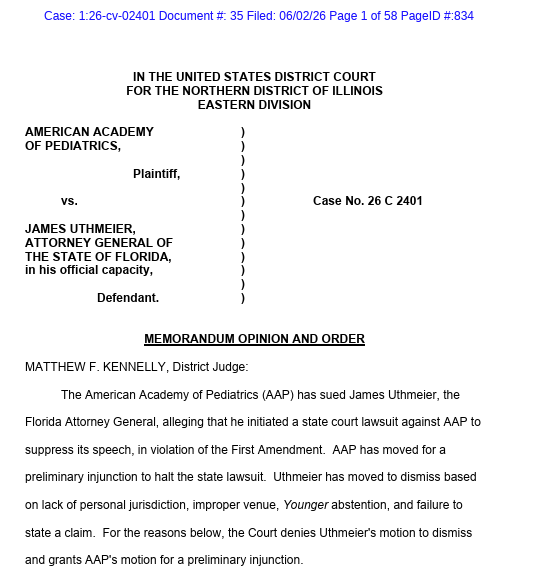
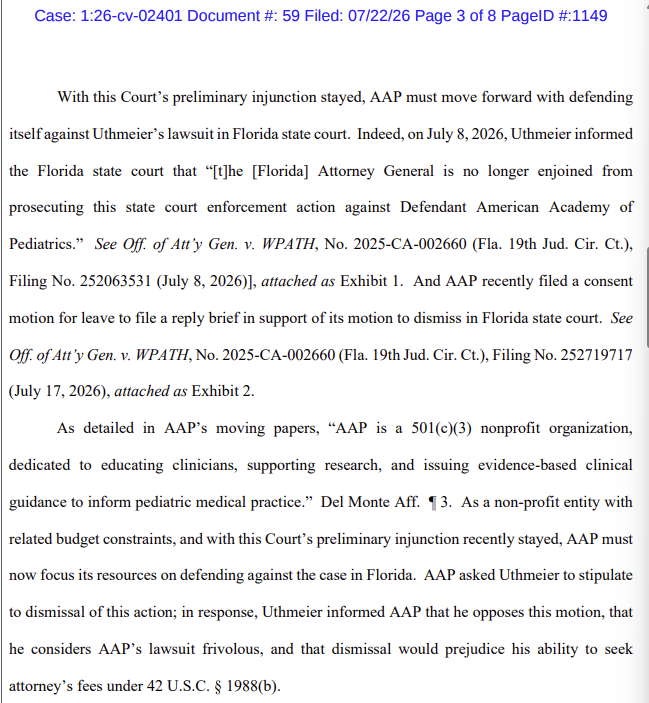
Ho boy. Florida AG @JamesUthmeierFL sued the American Academy of Pediatrics in Florida for deceptive practices--endorsing experimental sex change surgeries on children without basis. AAP then sued the AG in . . . Chicago federal court to stop his enforcement. The Court granted!
This out-of-state anti-suit injunction violates several vital principles of jurisprudence: personal jurisdiction, venue, Younger abstention, and anti-suit injunction principles. Yet the Court granted anyway. There are several independent bases for Seventh Circuit reversal.
How could the federal court have personal jurisdiction over Florida's AG, overseeing an investigation in Florida? Well, they *served* AAP. Serving a defendant cannot be enough to create specific personal jurisdiction. Nor can press releases about the action. I'm skeptical
Indeed, the Court goes at length about binding Seventh Circuit cases finding that service alone is not enough. But he interprets that to say that service+ is. I do not think that is the best reading of those cases.
Is scope of relief enough to create general jurisdiction? Here, the Court explains Florida wants to stop AAP "nationwide." So, he reasons, that justifies personal jurisdiction against Florida nationwide. That turns specific personal jurisdiction on its head. I am skeptical indeed
The Court also finds venue, although his opening paragraph explaining AG Uthmeier's argument seems like a hornbook/black letter explanation of correctly explaining the lack of venue.
Perhaps most troubling, though, is the Younger abstention issues. Courts *must* abstain over state criminal and quasi-criminal enforcement actions. Here, the Court finds the Florida enforcement to be a sham and thus bad faith. What happens when the Florida court denies the MTD?
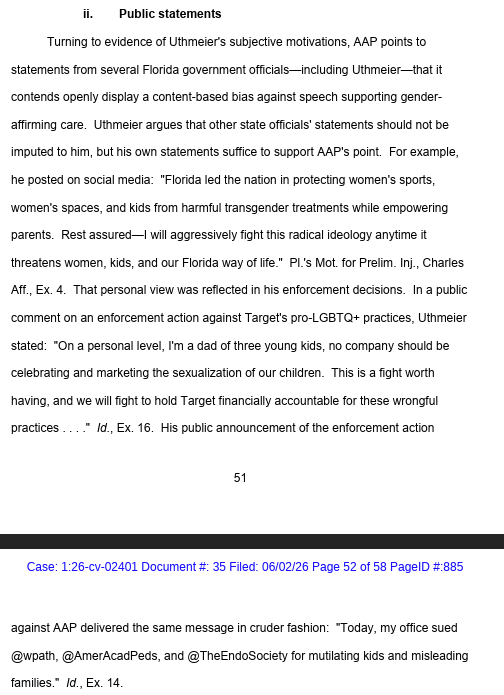
Here, Attorney General Uthmeier raised serious public concerns about AAP's cavalier attitude toward child safety. Good! Those standards are scientifically bunk. According to the Judge, such public remarks justify an out-of-state anti-suit injunction. I am *highly* skeptical.
This opinion should trouble anyone that values Federalism and longstanding doctrines that prevent perpetrators from running to a home state's courts when they violate laws out-of-state. I am confident Florida and its SG @david_dewhirst will file a persuasive appeal.
Talk about a headline. "Sex, Lies and Secrets: A Federal Judge's Trysts Go Public". The @nytimes digs into the Judge Ross affair in the Northern District of Georgia. Let's take a look.
The Times certainly knows how to write a lede! Apparently this tryst was ongoing for years? Three law clerks every year would know about the "jazz" and other noises coming from behind closed doors. Yikes.
Apparently we no longer have to say that we assume the quickly identified judge (see @MarcoPolo501c3 & @JoshMBlackman) is Judge Ross. The Times got their hands on the signed apology letter that she wrote. Honestly, the letter does not read as sincere to me
🔥Hot off the presses: @TheJusticeDept issued an opinion today explaining that disparate-impact liability under federal employment law is *unconstitutional*. This is an earthquake in federal civil rights law. If right, this is the foundation to overturn that pernicious regime.
The Supreme Court recently explained that we have a "colorblind Constitution." This opinion explains what is needed. First, business necessity is a *low bar* to defend against disparate impact. Second, causality is a *high bar* for plaintiffs. But the third requirement is👀
"Third, plaintiffs must establish with particular evidence that there is an available alternative practice that causes less disparate impact and would be equally effective for serving the employer’s valid business purpose." Louisiana v. Callais for employment law. Amazing!
Today, a court in Boston held President Trump's $100k fee for H-1B visas is illegal. But in December, a federal judge in D.C. declined to stop the same program. Both suits were brought by activists (one, a California-led coalition, the other, Chamber of Commerce). What gives?
These decisions help illustrate how, while we may be almost 18 months into President Trump's second term, so many of his policies have been stymied in the courts. Similar claims but different conclusions are just the most recent example of the novel scrutiny to executive action
Going through Judge Sorokin's (Obama, D. Mass) opinion, I'm looking for how he treats issues compared to Judge Howell (Obama, D.D.C.). First, consular nonreviewability. Howell sidesteps-with a denial he need not address. Sorokin finds that this visa denial via fee isn't a denial
"Because this Court has elevated unadulterated textualism over common sense
and longstanding principles of the criminal law, and [] we are now treading on dangerous constitutional waters." Judge Tjoflat, dissenting. Fascinating split with liberal Judges Abudu and Rosenbaum.
A pair of drug dealers ran an operation out of their home. Other dealers would sell drugs for them. One had a propensity to OD. She obtained drugs and died. Can the home-owner/chief drug dealer be prosecuted for dealing drugs and death resulting? Yes, per Judge Abudu.
Judge Abudu, joined by Judge Rosenbaum, concurs to explain why, under Eleventh Circuit precedent she reaches the result the sentence is constitutional. But she calls on the Eleventh Circuit to reconsider its precedent. Given her view of the law, she finds affirmance is required.
A Haitian man got a green card in 2002, and committed a Florida aggravated assault with a gun in 2021. After serving his time, he was deleted to Haiti. He challenges his deportation, claiming the assault was not a crime of violence. Judge Branch rejects his claim. Looks right!
A question for another day: The appeal was late. But can it be subject to equitable rolling? The Eleventh Circuit demurred, because the petition fails on the merits. Also fascinating within: a discussion on retroactivity, the Florida Supreme Court, and crimes of violence
Always interested in @UChicagoLaw programming. Sad that in a Supreme Court term that is so focused on executive power and @TheJusticeDept that the school couldn't find anyone that agrees with the administration to participate. Heck, I would have volunteered for diversity sake!
@UChicagoLaw @TheJusticeDept First up is Professor Strauss. He gave a very one-sided and misleading account of the transgender sports cases. Straight out of NPR. Then pooh-poohed the 8-1 Chiles v. Salazar decision. And ended with Geofence warrants. (Funny, Iowa led amici on 2/3 of those on the other side)
@UChicagoLaw @TheJusticeDept Next up is Professor Baude. He leads odd with the Second Amendment cases. Pretty fair coverage. Good meta point about how the Court should take more of these cases. Next up is executive removal. He also thinks Humphreys Executor is likely terminal. Good prediction!