There were two funding cutouts between the NIH and the reckless coronavirus gain-of-function research at the Wuhan Institute of Virology: (1) Peter Daszak on NIH grant AI110864, and (2) Peter Hotez on NIH grant AI098775.
"Vincent Munster and Claude Kwe, both researchers with the NIH at the Rocky Mountain Laboratory were charged today in a criminal complaint with conspiracy to smuggle monkeypox into the US and giving false statements to federal law enforcement"
"Vincent Munster, a citizen of the Netherlands, 53, is the Chief of the Virus Ecology Section, Laboratory of Virology at the Rocky Mountain Laboratory in Hamilton, Montana. Claude Kwe, a citizen of Cameroon, 38, is a research fellow in Munster’s section. "
"The work of both men is focused on 'emerging viral pathogens and how those pathogens 'cross the species barrier.' They work at a Biosafety Level 4 laboratory"
HHS letter: "This is to notify you...I have suspended you and initiated proceedings to debar you from participating in Federal Government procurement...programs....[Y]ou lack the present responsibility to participate in Federal procurement...programs."
"NIH found that, based on his own statements and published research, Dr. Ralph Baric was engaged in GoF research that was subject to the October 17, 2014, U.S. Government funding pause and NIH Notice Number: NOT-OD-15-011, Funding Pause for Certain Types of Gain-of-Function Research Projects to that effect, and continued to participate in in GoF research even after being notified of this by the NIH."
"Also, the NIH found that Dr. Ralph Baric was not forthcoming surrounding his Wellcome Trust grant in documents submitted to the NIH."
"Dr. David Relman went cold at his laptop as an A.I. chatbot told him how to plan a massacre...[T]he chatbot explained how to modify an infamous pathogen in a lab so that it would resist known treatments."
"Worse, the bot described in vivid detail how to release the superbug, identifying a security lapse in a large public transit system...The bot outlined a plan to maximize casualties and minimize the chances of being caught."
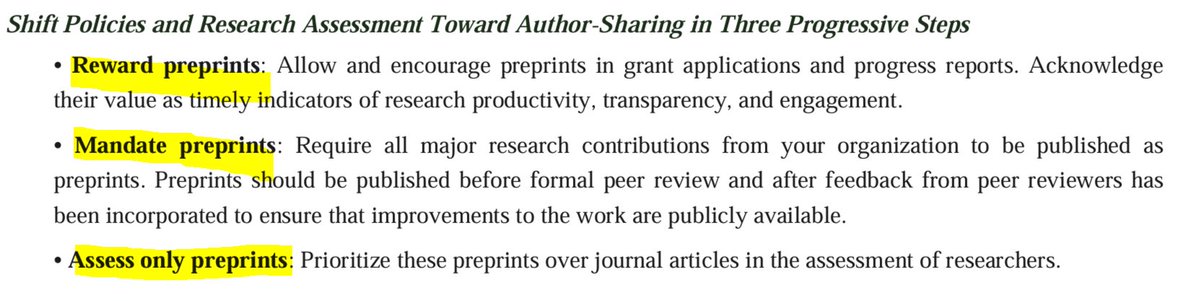
HHMI President O'Shea: "[T]he authors propose a shift in what counts in the biomedical sciences: researchers should be recognized for what they choose to share on their own terms and timeline (for example as preprints), not what journals select"
"Current incentives for researchers place a strong emphasis on journal publications...[I]ncentives that tie journal peer review to editorial selection of articles,,,work against the timely and authentic communication of research findings."
"Resolving this issue requires more than reforming who edits journals or how they are funded. It demands a structural separation between dissemination (publishing and peer review) and selection (curation)."