🔥Hot off the presses: @TheJusticeDept issued an opinion today explaining that disparate-impact liability under federal employment law is *unconstitutional*. This is an earthquake in federal civil rights law. If right, this is the foundation to overturn that pernicious regime.
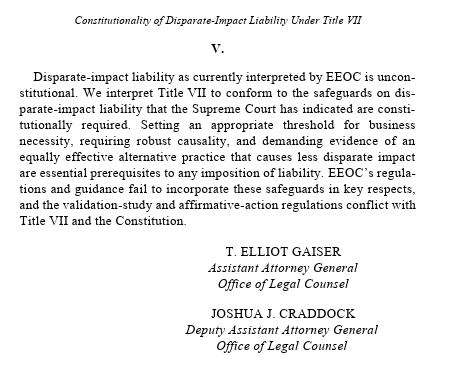
The Supreme Court recently explained that we have a "colorblind Constitution." This opinion explains what is needed. First, business necessity is a *low bar* to defend against disparate impact. Second, causality is a *high bar* for plaintiffs. But the third requirement is👀
"Third, plaintiffs must establish with particular evidence that there is an available alternative practice that causes less disparate impact and would be equally effective for serving the employer’s valid business purpose." Louisiana v. Callais for employment law. Amazing!
The whole opinion is necessary reading. But I always appreciate a nice summation conclusion. This single paragraph helps to contextualize everything that came before. Read while it's hot!
Kudos to @ElliotGaiser and @joshjcraddock
for putting together this logical, concise, and frankly devastating opinion for defenders of the old, illegal disparate impact regime. Great news for civil rights warrior @andrealucasEEOC too!
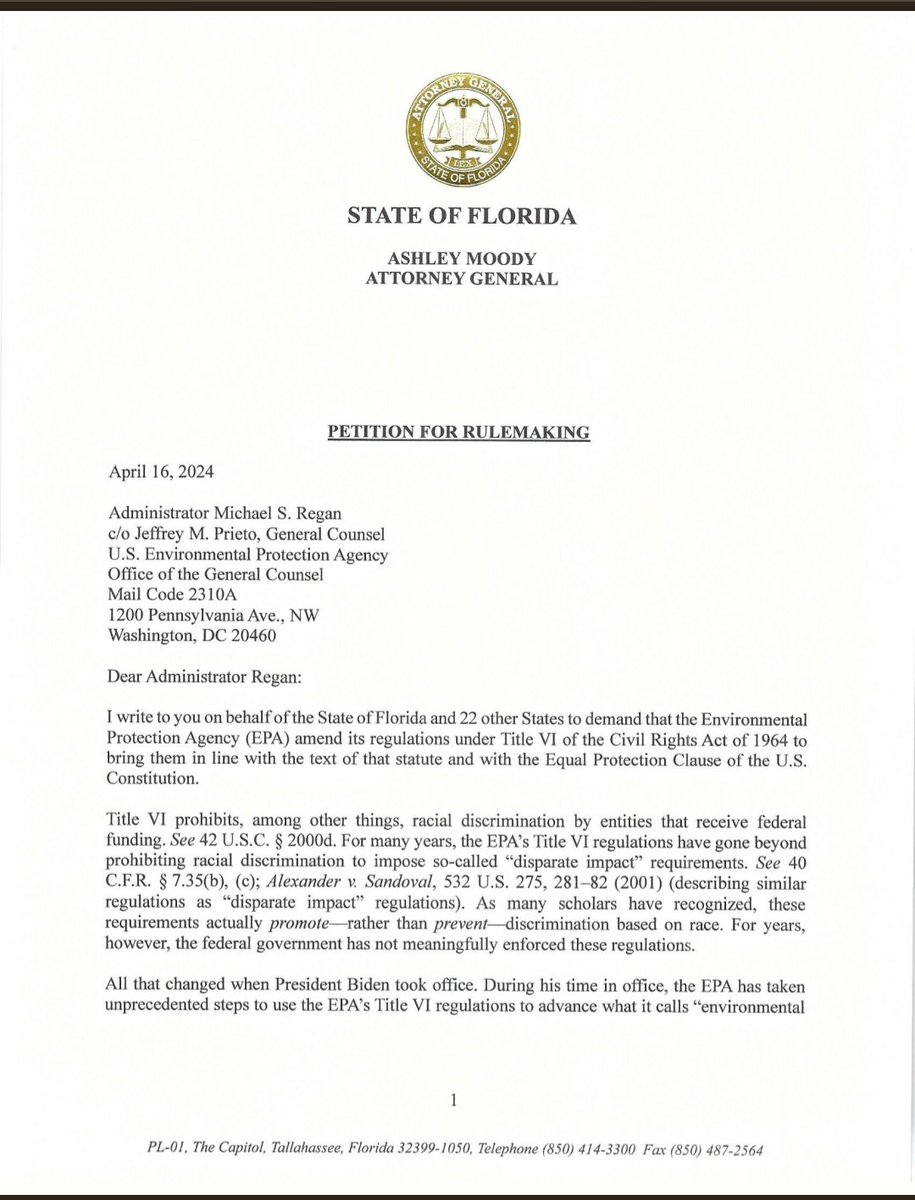
Then-Attorney General and now Senator @AshleyMoodyFL endorsed this in a petition to EPA in 2024. (Of course joining that coalition was @AGIowa.) Back then, AG Moody's chief was the notable @DHSGenCounsel 👀
@AshleyMoodyFL @AGIowa @DHSGenCounsel Senator Lee, the most based senator, weighs in:
Can President Trump fire the CIA's "diversity, equity, inclusion, and/or accessibility" staff? No, per Judge Berner (Biden). Congress allowed the CIA Director to fire any employee "at any time." A regulation creates an appeal process. The process beats the statute? I'm skeptical
"The district court’s and the majority’s holdings, I conclude, fail with double F’s." Judge Niemeyer has a pretty fiery (especially for him) dissent. He notes the regulation is irrelevant. The majority misreads the law. And there is no irreparable harm.
Also, just two days after learning that the President does, indeed, control the executive branch in Trump v. Slaughter, Judge Niemeyer critiques this district judge for appointing itself HR director for the CIA. Mandating "prior approval" before terminating *any* employee.
Supreme Court Opinions: Trump v. Barbara. Chief Justice Roberts writes, holding that the Constitution "guarantees citizenship to children born of parents unlawfully or temporarily present in the United States." The Constitutional holding is only 5-4, as Kavanaugh doesn't join.
Justice Jackson and Sotomayor concur to respond to Justice Thomas's dissent. "The Reconstruction Amendments were an anticaste, antisubordination reset for the Nation, not a mere spot treatment for the dark stain of slavery."
Justice Kavanaugh concurs in the Judgment. He would issue a narrower ruling. He would find that the Executive Order does *not* violate the Constitution, but is precluded by statute.
Supreme Court Opinions: NRSC v. FEC. Can Congress violate the First Amendment by limiting coordinated expenditures between candidates for office and their parties? No, per Justice Kavanaugh. Looks like @SeanJCooksey has officially won his Super Bowl. (Super Bowl FEC?)
First mootness. One question is whether Vice President Vance could bring this challenge. "The Court need not speculate about Vice President Vance’s future runs for office, however, because the Vice President still maintains an active 'Statement of Candidacy' on file."
Justice Kagan, joined by Justices Sotomayor and Jackson, dissent. They believe that these restrictions pass constitutional muster "with flying colors."
How influential is Justice Thomas? In Chief Justice Roberts's 26-page opinion temporarily stopping President Trump from firing Cook, he responds directly to Justice Thomas's 2-page dissent *25 times*. The whole opinion reads as an extended rebuttal. Very rare opinion approach
Kudos to Professor Sunstein, Professor Hamburger @NCLAlegal, and to @nytimes . Here, the Times published a debate between two professors that disagree on yesterday's Slaughter decision. And Professor Sunstein's critique (although not without flaws) is fair rather than histrionic
@NCLAlegal @nytimes Prof Hamburger: "The Supreme Court on Monday re-centered executive power in the president, restoring his authority to remove executive branch officials and ending the independence of government agencies."
@NCLAlegal @nytimes Sunstein's critique focuses on practicality and policy. But his framing gives away the game. Yes, the President controls the FCC and FTC. If not him, who? Ultimate accountability is to the political branches. As to whiplash, Congress can proscribe the agency's power if it wants
Slaughter v. Trump, Chief Justice Roberts vindicating Chief Justice Taft (a former President himself) and the unitary executive is fascinating. But alongside Taft, Justice Scalia looms large too. His dissents are vindicated in several places. The wolf leaves as a wolf.
Also fun, surrounding this Scalia cite is a classic Chief Justice Roberts formulation: "All that is left is reliance, upon which Slaughter (and the dissent) rely." Reliably good turner of phrase!
The Chief has some sympathy for plaintiff Slaughter. Less so for his dissenting colleagues. Might be an especially tough pill to swallow for Justice Kagan, the majordomo of hewing to precedent*
*Except when her vote may make a difference on a major decision she dislikes