Introducing the Fusion API, the smartest compound model in the market.
Fusion achieves Fable-level intelligence at half the price.
How it works 👇
Fusion achieves Fable-level intelligence at half the price.
How it works 👇

We benchmarked Fusion on 100 hard research tasks and found:
1. Panels of models consistently outperform individual models
2. Beyond-frontier performance can be achieved with frontier panels
3. Panels of budget models can surpass frontier models at a much lower cost
1. Panels of models consistently outperform individual models
2. Beyond-frontier performance can be achieved with frontier panels
3. Panels of budget models can surpass frontier models at a much lower cost
By testing different combinations of models, we found that roughly three quarters of the lift that Fusion provides comes from synthesis, and one quarter from diversity.

Notably, the budget panel was comparable with Claude Fable 5 in performance.
A panel of Gemini 3 Flash, Kimi K2.6, and DeepSeek V4 Pro, fused together, beat solo GPT-5.5 and solo Opus 4.8 outright.
And it landed within 1% of Fable 5 while costing roughly half the price.
A panel of Gemini 3 Flash, Kimi K2.6, and DeepSeek V4 Pro, fused together, beat solo GPT-5.5 and solo Opus 4.8 outright.
And it landed within 1% of Fable 5 while costing roughly half the price.
How does it work?
When you send a prompt to Fusion, we fan it out to a panel of models in parallel, each with web search and bash tools enabled.
A judge model reads every response and extracts the structure: consensus points, contradictions, partial coverage, unique insights, blind spots.
Chatroom: openrouter.ai/fusion
When you send a prompt to Fusion, we fan it out to a panel of models in parallel, each with web search and bash tools enabled.
A judge model reads every response and extracts the structure: consensus points, contradictions, partial coverage, unique insights, blind spots.
Chatroom: openrouter.ai/fusion
Then a synthesizer writes the final answer grounded in that analysis
Fusion runs server-side, so developers can call it exactly like a single model slug: "openrouter/fusion"
Or let the model decide when to reach for it by adding {"type": "openrouter:fusion"} to your tools array.
Fusion runs server-side, so developers can call it exactly like a single model slug: "openrouter/fusion"
Or let the model decide when to reach for it by adding {"type": "openrouter:fusion"} to your tools array.
We ran it on the DRACO deep research benchmark by Perplexity: 100 deep research tasks across 10 domains, from law and medicine to finance and product comparison.
Each task is graded against ~39 weighted criteria, and wrong answers carry negative weight. (You can't bluff your way to a high score by being verbose.)
arxiv.org/abs/2602.11685
Each task is graded against ~39 weighted criteria, and wrong answers carry negative weight. (You can't bluff your way to a high score by being verbose.)
arxiv.org/abs/2602.11685
One detail we want to call out: when we first gave the panel web search, models started surfacing the DRACO rubric online.
We excluded those domains across every model with a one-line config change to the OpenRouter web search tool config, then re-ran everything. All published numbers come from the clean setup.
We excluded those domains across every model with a one-line config change to the OpenRouter web search tool config, then re-ran everything. All published numbers come from the clean setup.
Want to customize the panel? Pass your own participant models and synthesizer:
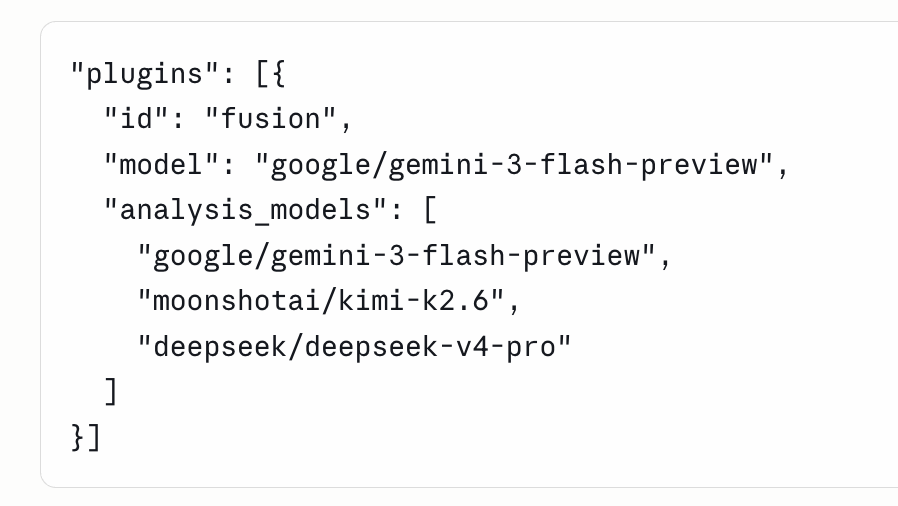
Fusion is neurodiversity, but for models. Try it now!
💬 Chatroom: openrouter.ai/fusion (pick a preset or build a custom panel)
⚙️ API: docs at openrouter.ai/docs/guides/fe…
ℹ️ More info on the blog post: openrouter.ai/blog/announcem…
💬 Chatroom: openrouter.ai/fusion (pick a preset or build a custom panel)
⚙️ API: docs at openrouter.ai/docs/guides/fe…
ℹ️ More info on the blog post: openrouter.ai/blog/announcem…
Note: we have only evaluated one deep research benchmark so far, which did not include long-horizon tasks.
Fable's long-horizon abilities were extremely impressive, and it calls for future work to benchmark both on long-horizon tasks.
Fable's long-horizon abilities were extremely impressive, and it calls for future work to benchmark both on long-horizon tasks.
• • •
Missing some Tweet in this thread? You can try to
force a refresh